

 |
市場調查報告書
商品編碼
2121186
2026-2035年豪華旅遊市場機會、成長要素、產業趨勢分析及預測Luxury Tourism Market Opportunity, Growth Drivers, Industry Trend Analysis, and Forecast 2026 - 2035 |
||||||

全球豪華旅遊市場預計到 2025 年將達到 283 億美元,年複合成長率為 8.1%,到 2035 年將達到 637 億美元。
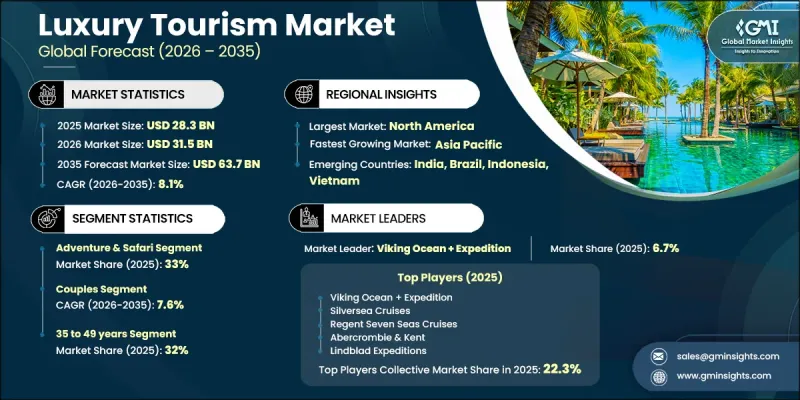
隨著可支配收入的成長,富裕旅客群體不斷擴大,以及對個人化旅遊體驗的需求重塑全球旅遊業,高階旅遊市場持續成長。高階旅客越來越重視高階住宿設施、專屬交通途徑、以健康養生為導向的度假以及提供私密、便捷和卓越體驗的客製化旅遊服務。這種對客製化行程日益成長的偏好促使飯店、旅行社和旅遊專業人士提供高度個人化的服務,以滿足每位旅客的個人偏好。數位轉型在高階旅遊市場的演變中也發揮著至關重要的作用,人工智慧、先進的預訂平台、安全的數位支付系統和線上旅行管理工具使高階旅行規劃更加便捷高效。同時,對高階飯店基礎設施、豪華住宿設施、高階旅遊服務和專屬休閒體驗的持續投資正在創造新的成長機會。政府旨在改善旅遊基礎設施、簡化旅行手續和提升目的地交通便利性的支持,進一步提升了整體旅行體驗,並增強了高階旅遊業的全球競爭力。
| 市場範圍 | |
|---|---|
| 開始年份 | 2025 |
| 預測期 | 2026-2035 |
| 上市時的市場規模 | 283億美元 |
| 預測金額 | 637億美元 |
| 複合年成長率 | 8.1% |
預計到2025年,探險與狩獵旅遊市場將佔據33%的市場佔有率,並在2026年至2035年間以9%的複合年成長率成長。隨著富裕旅客日益追求獨特的戶外體驗、高階導覽和特色目的地,該市場需求持續強勁成長。對客製化旅遊體驗和永續旅遊服務的日益關注,進一步鞏固了該細分市場對整體市場成長的貢獻,同時也促使營運商拓展其高階旅遊產品。
預計到2025年,情侶市場將佔據32%的佔有率,並在2026年至2035年間以7.6%的複合年成長率成長。情侶是市場上最大的客戶群,他們對個人化假期、浪漫旅行體驗和高階休閒服務的需求日益成長。豪華住宿設施、私人別墅、精緻餐飲、養生度假和客製化旅遊套餐持續吸引那些尋求舒適、私密且個人化服務的難忘假期體驗的旅客。
預計到2025年,美國高階旅遊市場將佔據88%的市場佔有率,市場規模將達到82億美元。市場成長的驅動力包括高消費能力、龐大的富裕人口以及完善的高階旅遊基礎設施。對客製化旅遊體驗、豪華飯店及度假村、高階交通服務和特色度假套餐日益成長的需求,進一步鞏固了美國在高階旅遊業的主導地位。
目錄
第1章:調查方法
第2章執行摘要
第3章 行業洞察
- 產業生態系分析
- 供應商情況
- 利潤率分析
- 成本結構
- 每個階段增加的價值
- 影響價值鏈的因素
- 中斷
- 影響產業的因素
- 促進因素
- 對個性化豪華旅遊的需求日益成長。
- 富裕人口增加
- 豪華旅遊基礎設施的擴建
- 旅遊服務的數位轉型
- 產業潛在風險與挑戰
- 豪華旅行高成本
- 經濟不確定性與地緣政治風險
- 市場機遇
- 拓展奢華探索與體驗式旅行
- 豪華旅遊的永續發展
- 新興豪華旅遊目的地的成長
- 促進因素
- 成長潛力分析
- 監理情勢
- 北美洲
- 美國國家旅遊策略
- 美國免簽證計畫相關規定
- 加拿大旅遊業成長策略
- 加拿大航空旅客保護條例
- 美國運輸安全局(TSA) 旅行安全規定
- 歐洲
- 申根區邊界程式碼
- 歐洲旅行資訊和許可系統(ETIAS)
- 歐盟關於旅遊套裝及相關旅遊安排的2015/2302號指令
- 一般資料保護規則(GDPR)
- 歐盟永續旅遊轉型藍圖
- 亞太地區
- 中華人民共和國旅遊法
- 《日本旅遊國地位提升基本計畫》
- 《澳洲旅遊業2030戰略》
- 新加坡旅遊業法
- 印度的「不可思議的印度」永續旅遊標準
- 根據澳洲生物安全法提出的旅行要求
- 拉丁美洲
- 巴西旅遊基本法
- 巴西國家旅遊計劃
- 墨西哥旅遊法
- 墨西哥旅遊品質認證標準
- 區域永續旅遊認證項目
- 中東和非洲
- 阿拉伯聯合大公國國家旅遊戰略 2031
- 杜拜經濟和旅遊局關於酒店業的規定
- 沙烏地阿拉伯旅遊法和國家旅遊策略
- 南非旅遊法
- 阿布達比文化與旅遊局飯店分類系統
- 北美洲
- 波特的分析
- PESTLE分析
- 技術與創新展望
- 最新科技趨勢
- 新興技術
- 2025年成本細分分析
- 專利分析
- 永續性和環境方面
- 永續計劃
- 減少廢棄物策略
- 生產中的能源效率
- 具有環保意識的舉措
- 考慮碳足跡
- 2022年至2035年國際觀光流量及赴日旅客人數分析
- 目的地之間主要航線的豪華遊客入境和出境人數。
- 調查主題:遊客數量
- 圖:平均消費者支出(美元)
- 出發地和目的地之間的主要路線以及簽證和入境壁壘的影響
- 按目的地區域分類的國際觀光入境人數趨勢
- 依客源市場分析遊客集中度與消費趨勢
- 新興高成長潛力旅遊目的地評估框架
- 偏遠地區和未開發的旅遊目的地
- 旅遊目的地生命週期分類
- 目的地之間主要航線的豪華遊客入境和出境人數。
- 2022年至2026年豪華旅遊的季節性與需求趨勢
- 按目的地和旅行類別分類的高峰期、平季和淡季需求週期
- 對收益管理的影響
- 事件導致需求激增
- 人工智慧和生成式人工智慧對市場的影響
- 利用人工智慧改造現有經營模式
- 按細分市場分類的生成式人工智慧用例和部署藍圖
- 風險、限制和監管考量
- 預測假設和情境分析
- 基本案例:驅動複合年成長率的關鍵宏觀經濟與產業變量
- 樂觀情境:宏觀經濟與產業的順風
- 悲觀情景:宏觀經濟放緩或產業逆風
第4章 競爭情勢
- 介紹
- 北美洲
- 歐洲
- 亞太地區
- LATAM
- 中東和非洲
- 主要市場公司的競爭分析
- 競爭定位矩陣
- 戰略展望矩陣
- 主要進展
- 併購
- 夥伴關係和聯盟
- 新產品發布
- 業務拓展計劃及資金籌措
第5章 市場估算與預測:依旅遊類別分類,2022-2035年
- 客製化私人假期
- 探險與狩獵
- 遊輪、遊艇和小船探險
- 節慶之旅
- 美食之旅與購物
- 豪華鐵路旅行
- 其他
第6章 市場估價與預測:依旅客類型分類,2022-2035年
- 個人旅行者
- 夫妻
- 家庭
- 朋友/團體
- 公司與獎勵組織
第7章 市場估計與預測:依年齡層別分類,2022-2035年
- 18-34歲
- 35-49歲
- 50-64歲
- 65歲或以上
第8章 市場估價與預測:依包裝類型分類,2022-2035年
- 尊享豪華套餐(5,001 美元 – 15,000 美元)
- 超豪華套餐(15,000 美元或以上)
第9章 市場估價與預測:依預訂管道分類,2022-2035年
- 旅行社和旅遊業者
- 線上旅行社(OTA)
- 直接向供應商預訂
- 禮賓及豪華旅行顧問
第10章 市場估價與預測:依旅行者分類,2022-2035年
- 國內的
- 國際的
第11章 市場估價與預測:按地區分類,2022-2035年
- 北美洲
- 美國
- 加拿大
- 歐洲
- 德國
- 英國
- 法國
- 義大利
- 西班牙
- 挪威
- 瑞典
- 芬蘭
- 丹麥
- 瑞士
- 希臘
- 葡萄牙
- 奧地利
- 亞太地區
- 中國
- 印度
- 日本
- 澳洲
- 韓國
- 新加坡
- 印尼
- 泰國
- 馬爾地夫
- 紐西蘭
- 越南
- 拉丁美洲
- 巴西
- 墨西哥
- 阿根廷
- 中東和非洲
- 南非
- 沙烏地阿拉伯
- UAE
第12章:公司簡介
- Luxury Hotels, Resorts & Wellness Retreats
- Aman Resorts
- Banyan Tree Hotels & Resorts
- Belmond(LVMH)
- Four Seasons Hotels & Resorts
- Mandarin Oriental Hotel
- One & Only Resorts
- Rosewood Hotels & Resorts
- Six Senses Hotels Resorts Spas
- Luxury Cruises, Yachting & Rail Journeys
- Explora Journeys
- Lindblad Expeditions
- Ponant
- Rocky Mountaineer
- Rovos Rail
- Silversea Cruises
- The Ritz-Carlton Yacht Collection
- Venice Simplon-Orient-Express(Belmond)
- Luxury Tour Operators, Safaris & Bespoke Experiences
- Abercrombie & Kent(A&K Travel)
- andBeyond
- Black Tomato
- Micato Safaris
- Pelorus
- Scott Dunn
- Tauck
- Wilderness Safaris
- Luxury Travel Platforms & Concierge Services
- Indagare
- Inspirato
- John Paul
- Pure Entertainment
- Quintessentially Travel
- Ten Lifestyle
- Virtuoso
The Global Luxury Tourism Market was valued at USD 28.3 billion in 2025 and is estimated to grow at a CAGR of 8.1% to reach USD 63.7 billion by 2035.
The market continues to expand as rising disposable incomes, a growing population of affluent travelers, and increasing demand for personalized travel experiences reshape the global tourism industry. Luxury travelers are placing greater emphasis on premium accommodations, exclusive transportation, wellness-focused vacations, and customized travel services that deliver privacy, convenience, and exceptional experiences. The increasing preference for tailor-made itineraries is encouraging hospitality providers, travel companies, and tourism specialists to offer highly personalized services designed to meet individual traveler expectations. Digital transformation is also playing a significant role in the evolution of the Luxury Tourism Market, with artificial intelligence, advanced booking platforms, secure digital payment systems, and online trip management tools making premium travel planning more convenient and efficient. At the same time, continued investments in high-end hospitality infrastructure, luxury accommodations, premium travel services, and exclusive leisure experiences are creating new growth opportunities. Supportive government initiatives aimed at improving tourism infrastructure, simplifying travel procedures, and strengthening destination accessibility are further enhancing the overall travel experience while increasing the global competitiveness of the luxury tourism industry.
| Market Scope | |
|---|---|
| Start Year | 2025 |
| Forecast Year | 2026-2035 |
| Start Value | $28.3 Billion |
| Forecast Value | $63.7 Billion |
| CAGR | 8.1% |
The adventure & safari segment accounted for a 33% share in 2025 and is expected to grow at a CAGR of 9% between 2026 and 2035. This segment continues to generate strong demand as affluent travelers increasingly seek exclusive outdoor experiences, premium guided journeys, and unique travel destinations. Growing interest in customized travel experiences and sustainable tourism offerings continues to strengthen the segment's contribution to overall market growth while encouraging providers to expand their premium travel portfolios.
The couples segment held a 32% share in 2025 and is projected to grow a CAGR of 7.6% from 2026 to 2035. Couples represent the largest customer group within the market, supported by rising demand for personalized vacations, romantic travel experiences, and premium leisure services. Luxury accommodations, private villas, fine dining experiences, wellness retreats, and customized travel packages continue to attract travelers seeking memorable and exclusive vacations with a strong focus on comfort, privacy, and personalized service.
United States Luxury Tourism Market accounted for an 88% share in 2025, generating USD 8.2 billion. Market growth is supported by high consumer spending power, a large affluent population, and a well-developed premium tourism infrastructure. Increasing demand for customized travel experiences, luxury hotels and resorts, premium transportation services, and exclusive vacation offerings continues to strengthen the country's leadership in the regional luxury tourism industry.
Major companies operating in the global luxury tourism market include Viking Ocean + Expedition, Silversea Cruises, Regent Seven Seas Cruises, Abercrombie & Kent, Lindblad Expeditions, Seabourn, PONANT, Belmond, and Tauck. Companies operating in the Luxury Tourism Market are strengthening their competitive positions through continuous investments in premium travel experiences, personalized services, and digital innovation. Many providers are expanding their portfolios by introducing customized travel packages, exclusive accommodations, wellness-focused experiences, and luxury transportation services that cater to evolving customer preferences. Strategic partnerships, acquisitions, and collaborations with hospitality providers, destination operators, and travel service companies continue to support broader market reach and stronger customer engagement. Businesses are also investing in advanced digital platforms, artificial intelligence, and customer relationship technologies to enhance booking experiences and deliver highly personalized travel recommendations.
Table of Contents
Chapter 1 Research Methodology
- 1.1 Research approach
- 1.2 Quality Commitments
- 1.2.1 GMI AI policy & data integrity commitment
- 1.2.1.1 Source consistency protocol
- 1.2.1 GMI AI policy & data integrity commitment
- 1.3 Research Trail & Confidence Scoring
- 1.3.1 Research Trail Components
- 1.3.2 Scoring Components
- 1.4 Data Collection
- 1.4.1 Partial list of primary sources
- 1.5 Data mining sources
- 1.5.1 Paid sources
- 1.5.1.1 Sources, by region
- 1.5.1 Paid sources
- 1.6 Base estimates and calculations
- 1.6.1 Base year calculation
- 1.7 Forecast model
- 1.7.1 Quantified market impact analysis
- 1.7.1.1 Mathematical impact of growth parameters on forecast
- 1.7.1 Quantified market impact analysis
- 1.8 Research transparency addendum
- 1.8.1 Source attribution framework
- 1.8.2 Quality assurance metrics
- 1.8.3 Our commitment to trust
Chapter 2 Executive Summary
- 2.1 Industry 360° synopsis, 2022 – 2035
- 2.2 Key market trends
- 2.2.1 Regional
- 2.2.2 Tourism
- 2.2.3 Traveler Profile
- 2.2.4 Age Group
- 2.2.5 Packages
- 2.2.6 Booking Channel
- 2.2.7 Traveler
- 2.3 TAM Analysis, 2026-2035
- 2.4 CXO perspectives: Strategic imperatives
Chapter 3 Industry Insights
- 3.1 Industry ecosystem analysis
- 3.1.1 Supplier landscape
- 3.1.2 Profit margin analysis
- 3.1.3 Cost structure
- 3.1.4 Value addition at each stage
- 3.1.5 Factor affecting the value chain
- 3.1.6 Disruptions
- 3.2 Industry impact forces
- 3.2.1 Growth drivers
- 3.2.1.1 Growing demand for personalized luxury travel
- 3.2.1.2 Rising high net worth population
- 3.2.1.3 Expansion of premium tourism infrastructure
- 3.2.1.4 Digital transformation in travel services
- 3.2.2 Industry pitfalls and challenges
- 3.2.2.1 High cost of luxury travel
- 3.2.2.2 Economic uncertainty and geopolitical risks
- 3.2.3 Market opportunities
- 3.2.3.1 Expansion of luxury expedition and experiential travel
- 3.2.3.2 Development of sustainable luxury tourism
- 3.2.3.3 Growth in emerging luxury destinations
- 3.2.1 Growth drivers
- 3.3 Growth potential analysis
- 3.4 Regulatory landscape
- 3.4.1 North America
- 3.4.1.1 US National Travel and Tourism Strategy
- 3.4.1.2 US Visa Waiver Program Regulations
- 3.4.1.3 Canada Tourism Growth Strategy
- 3.4.1.4 Canada Air Passenger Protection Regulations
- 3.4.1.5 US Transportation Security Administration Travel Security Regulations
- 3.4.2 Europe
- 3.4.2.1 Schengen Borders Code
- 3.4.2.2 European Travel Information and Authorisation System (ETIAS)
- 3.4.2.3 Package Travel and Linked Travel Arrangements Directive (EU) 2015/2302
- 3.4.2.4 General Data Protection Regulation (GDPR)
- 3.4.2.5 EU Sustainable Tourism Transition Pathway
- 3.4.3 Asia Pacific
- 3.4.3.1 China Tourism Law of the People's Republic of China
- 3.4.3.2 Japan Tourism Nation Promotion Basic Plan
- 3.4.3.3 Australia Tourism 2030 Strategy
- 3.4.3.4 Singapore Tourism Industry Act
- 3.4.3.5 India Incredible India Sustainable Tourism Criteria
- 3.4.3.6 Australia Biosecurity Act Travel Requirements
- 3.4.4 Latin America
- 3.4.4.1 Brazil General Tourism Law
- 3.4.4.2 Brazil National Tourism Plan
- 3.4.4.3 Mexico General Tourism Law
- 3.4.4.4 Mexico Tourism Quality Certification Standards
- 3.4.4.5 Regional Sustainable Tourism Certification Programs
- 3.4.5 Middle East & Africa
- 3.4.5.1 UAE National Tourism Strategy 2031
- 3.4.5.2 Dubai Department of Economy and Tourism Hospitality Regulations
- 3.4.5.3 Saudi Tourism Law and National Tourism Strategy
- 3.4.5.4 South Africa Tourism Act
- 3.4.5.5 Abu Dhabi Department of Culture and Tourism Hotel Classification System
- 3.4.1 North America
- 3.5 Porter’s analysis
- 3.6 PESTEL analysis
- 3.7 Technology and innovation landscape
- 3.7.1 Current technological trends
- 3.7.2 Emerging technologies
- 3.8 Cost breakdown analysis, 2025
- 3.9 Patent analysis (Driven by primary research)
- 3.10 Sustainability and environmental aspects
- 3.10.1 Sustainable practices
- 3.10.2 Waste reduction strategies
- 3.10.3 Energy efficiency in production
- 3.10.4 Eco-friendly Initiatives
- 3.10.5 Carbon footprint considerations
- 3.11 International tourism flow and visitor arrival analysis, 2022-2035 (Driven by Primary Research)
- 3.11.1 Inbound and outbound luxury tourist arrivals by major source destination corridors
- 3.11.1.1 Volume: Number of Visitors
- 3.11.1.2 Value: Average Consumer Spendings (USD)
- 3.11.2 Key source destination corridors and visa/access barrier impact
- 3.11.3 International visitor arrival trends by destination region
- 3.11.4 Source market visitor concentration and spending corridor analysis
- 3.11.1 Inbound and outbound luxury tourist arrivals by major source destination corridors
- 3.12 Emerging luxury destination hotspots and high potential market analysis, 2022-2026
- 3.12.1 High growth emerging destination scoring framework
- 3.12.2 Frontier and white space destinations
- 3.12.3 Destination lifecycle classification
- 3.13 Luxury tourism seasonality and demand patterns, 2022-2026
- 3.13.1 Peak, shoulder, and off-peak demand cycles by destination and travel category
- 3.13.2 Yield management implications
- 3.13.3 Event driven demand spikes
- 3.14 Impact of AI and Generative AI on the Market
- 3.14.1 AI Driven Disruption of Existing Business Models
- 3.14.2 GenAI Use Cases and Adoption Roadmap by Segment
- 3.14.3 Risks Limitations and Regulatory Considerations
- 3.15 Forecast assumptions & scenario analysis (Driven by Primary Research)
- 3.15.1 Base Case- Key Macro & Industry Variables Driving CAGR
- 3.15.2 Optimistic Scenarios- Favorable macro and industry tailwinds
- 3.15.3 Pessimistic Scenario - Macroeconomic slowdown or industry headwinds
Chapter 4 Competitive Landscape, 2025
- 4.1 Introduction
- 4.2 Company market share analysis, (Value & Volume) 2022-2025
- 4.2.1 North America
- 4.2.2 Europe
- 4.2.3 Asia Pacific
- 4.2.4 LATAM
- 4.2.5 MEA
- 4.3 Competitive analysis of major market players
- 4.4 Competitive positioning matrix
- 4.5 Strategic outlook matrix
- 4.6 Key developments
- 4.6.1 Mergers & acquisitions
- 4.6.2 Partnerships & collaborations
- 4.6.3 New Product Launches
- 4.6.4 Expansion Plans and funding
Chapter 5 Market Estimates & Forecast, By Tourism, 2022 - 2035 (USD Million, Number of Travelers)
- 5.1 Key trends
- 5.2 Customized & Private Vacations
- 5.3 Adventure & Safari
- 5.4 Cruises, Yachting & Small Ship Expeditions
- 5.5 Celebration Journeys
- 5.6 Culinary Travel & Shopping
- 5.7 Luxury Rail Journeys
- 5.8 Others
Chapter 6 Market Estimates & Forecast, By Traveler Profile, 2022 - 2035 (USD Million, Number of Travelers)
- 6.1 Key trends
- 6.2 Solo Travelers
- 6.3 Couples
- 6.4 Families
- 6.5 Friends & Groups
- 6.6 Corporate & Incentive Groups
Chapter 7 Market Estimates & Forecast, By Age Group, 2022 - 2035 (USD Million, Number of Travelers)
- 7.1 Key trends
- 7.2 18–34 Years
- 7.3 35–49 Years
- 7.4 50–64 Years
- 7.5 65 Years & Above
Chapter 8 Market Estimates & Forecast, By Packages, 2022 - 2035 (USD Million, Number of Travelers)
- 8.1 Key trends
- 8.2 Premium Luxury Packages (USD 5,001–15,000)
- 8.3 Ultra Luxury Packages (Above USD 15,000)
Chapter 9 Market Estimates & Forecast, By Booking Channel, 2022 - 2035 (USD Million, Number of Bookings)
- 9.1 Key trends
- 9.2 Travel Agents & Tour Operators
- 9.3 Online Travel Agencies (OTAs)
- 9.4 Direct Supplier Bookings
- 9.5 Concierge & Luxury Travel Advisors
Chapter 10 Market Estimates & Forecast, By Traveler, 2022 - 2035 (USD Million, Number of Travelers)
- 10.1 Key trends
- 10.2 Domestic
- 10.3 International
Chapter 11 Market Estimates & Forecast, By Region, 2022 - 2035 (USD Million, Number of Travelers)
- 11.1 Key trends
- 11.2 North America
- 11.2.1 US
- 11.2.2 Canada
- 11.3 Europe
- 11.3.1 Germany
- 11.3.2 UK
- 11.3.3 France
- 11.3.4 Italy
- 11.3.5 Spain
- 11.3.6 Norway
- 11.3.7 Sweden
- 11.3.8 Finland
- 11.3.9 Denmark
- 11.3.10 Switzerland
- 11.3.11 Greece
- 11.3.12 Portugal
- 11.3.13 Austria
- 11.4 Asia Pacific
- 11.4.1 China
- 11.4.2 India
- 11.4.3 Japan
- 11.4.4 Australia
- 11.4.5 South Korea
- 11.4.6 Singapore
- 11.4.7 Indonesia
- 11.4.8 Thailand
- 11.4.9 Maldives
- 11.4.10 New Zealand
- 11.4.11 Vietnam
- 11.5 Latin America
- 11.5.1 Brazil
- 11.5.2 Mexico
- 11.5.3 Argentina
- 11.6 Middle East and Africa
- 11.6.1 South Africa
- 11.6.2 Saudi Arabia
- 11.6.3 UAE
Chapter 12 Company Profiles
- 12.1 Luxury Hotels, Resorts & Wellness Retreats
- 12.1.1 Aman Resorts
- 12.1.2 Banyan Tree Hotels & Resorts
- 12.1.3 Belmond (LVMH)
- 12.1.4 Four Seasons Hotels & Resorts
- 12.1.5 Mandarin Oriental Hotel
- 12.1.6 One&Only Resorts
- 12.1.7 Rosewood Hotels & Resorts
- 12.1.8 Six Senses Hotels Resorts Spas
- 12.2 Luxury Cruises, Yachting & Rail Journeys
- 12.2.1 Explora Journeys
- 12.2.2 Lindblad Expeditions
- 12.2.3 Ponant
- 12.2.4 Rocky Mountaineer
- 12.2.5 Rovos Rail
- 12.2.6 Silversea Cruises
- 12.2.7 The Ritz-Carlton Yacht Collection
- 12.2.8 Venice Simplon-Orient-Express (Belmond)
- 12.3 Luxury Tour Operators, Safaris & Bespoke Experiences
- 12.3.1 Abercrombie & Kent (A&K Travel)
- 12.3.2 andBeyond
- 12.3.3 Black Tomato
- 12.3.4 Micato Safaris
- 12.3.5 Pelorus
- 12.3.6 Scott Dunn
- 12.3.7 Tauck
- 12.3.8 Wilderness Safaris
- 12.4 Luxury Travel Platforms & Concierge Services
- 12.4.1 Indagare
- 12.4.2 Inspirato
- 12.4.3 John Paul
- 12.4.4 Pure Entertainment
- 12.4.5 Quintessentially Travel
- 12.4.6 Ten Lifestyle
- 12.4.7 Virtuoso

 全球豪華旅遊市場規模、佔有率、成長、全球產業分析、區域趨勢及2026-2034年預測。
 豪華旅遊市場規模、佔有率和成長分析:按旅遊類型、旅行者類型、年齡層和地區分類-2026-2033年產業預測
 2026-2030年全球豪華旅遊市場
 豪華旅遊市場:按類別、年齡層、類型和地區分類2026-2034年全球豪華旅遊市場規模、佔有率、趨勢和成長分析報告全球豪華旅遊市場規模、佔有率、趨勢和成長分析報告(2026-2034)蜜月旅遊市場規模、佔有率、成長及全球產業分析:按類型、應用和地區分類的洞察,2026-2034 年預測豪華休閒旅遊市場規模、佔有率、成長及全球產業分析:按類型、應用和地區分類的洞察,2026-2034 年預測
 2026-2034年豪華旅遊市場規模、佔有率、趨勢及預測(依旅遊類型、年齡層、旅客類型及地區分類)
 豪華旅遊市場-全球產業規模、佔有率、趨勢、機會及預測(依旅遊類型、年齡層、旅客類型、地區及競爭格局分類,2021-2031年)