

 |
市場調查報告書
商品編碼
2121184
禮品卡市場機會、成長要素、產業趨勢分析及2026-2035年預測。Gift Card Market Opportunity, Growth Drivers, Industry Trend Analysis, and Forecast 2026 - 2035 |
||||||

全球禮品卡市場預計到 2025 年將達到 7.85 億美元,到 2035 年將以 15.4% 的複合年成長率成長,達到 31 億美元。
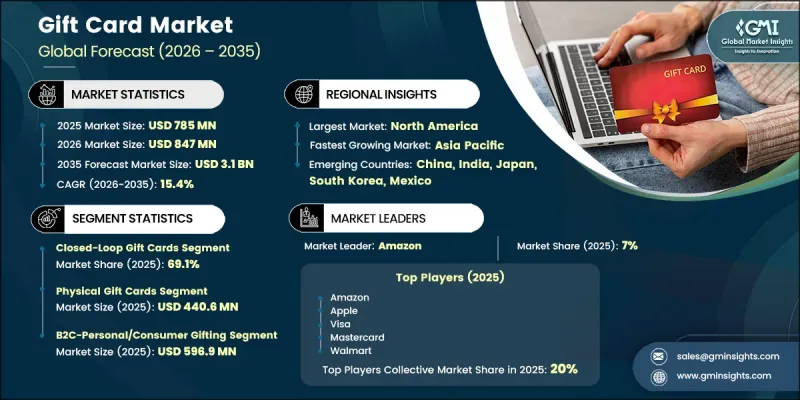
市場擴張的驅動力包括:持續向數位支付轉型、電子商務日益普及、禮品卡在員工獎勵和企業獎勵計劃中的應用日益廣泛,以及跨境電商的蓬勃發展。此外,旨在加強預付和預付式商品消費者保護的監管措施也促進了市場發展。同時,行動支付解決方案的普及、全通路零售模式的拓展,以及消費者和企業對即時數位禮品的偏好日益成長,都為市場創造了更多成長機會。隨著支付生態系統的數位化程度不斷提高,消費者尋求便利的預付式商品購買、分發和使用方式,禮品卡在現代零售和支付策略中扮演著越來越重要的角色。
| 市場範圍 | |
|---|---|
| 開始年份 | 2025 |
| 預測期 | 2026-2035 |
| 上市時的市場規模 | 7.85億美元 |
| 預測金額 | 31億美元 |
| 複合年成長率 | 15.4% |
禮品卡市場蓬勃發展,這主要得益於現金交易向數位化和非接觸式支付方式的轉變。許多政府和金融監管機構都在鼓勵使用安全的電子支付系統,而支付服務提供者也不斷擴展其數位預付服務。企業也開始將禮品卡作為促銷宣傳活動、員工獎勵和顧客忠誠度計畫的有效工具。隨著員工獎勵策略中。禮品卡的便利分發、柔軟性使用和數位化存取等優勢,使得企業能夠利用禮品卡來提升客戶參與和獎勵員工。
預計2025年,閉合迴路禮品卡市佔率將達到69.1%。其強勁的市場地位歸功於其在各個商家生態系統中的廣泛認可,以及其能夠有效提升顧客對特定品牌的忠誠度。這些禮品卡能夠幫助企業增強客戶維繫、鼓勵重複購買,並提高獲客效率。此外,它們與整合零售策略的兼容性,使得企業能夠將禮品卡項目與更廣泛的客戶參與和銷售活動相結合。隨著商家不斷尋求更具成本效益的顧客留存和提升購買頻率的方法,閉合迴路禮品卡預計將在整體市場中保持重要的地位。
預計到2035年,數位禮品卡或電子禮品卡市場將以19.2%的複合年成長率成長,成為禮品卡產業成長最快的領域之一。智慧型手機的普及、電子商務的擴張、行動錢包應用程式的日益廣泛使用以及消費者送禮偏好的改變,都在推動對數位禮品卡的需求。數位禮品卡具有發行和交付速度快、線上購買便利性以及可透過數位管道靈活兌換等優勢。這些特點使其成為尋求更快捷、更便利送禮方案的消費者和企業的理想選擇。此外,數位交付還能降低傳統實體卡專案的部分行銷和履約成本,進而激勵企業拓展其數位禮品卡業務。
預計到2025年,北美禮品卡市佔率將達到46.4%。數位支付技術的廣泛應用、相對較高的消費支出以及完善的電子商務基礎設施持續支撐著該地區的禮品卡需求。北美各地的消費者和企業普遍接受開放回路型和閉合迴路禮品卡,而數位錢包的日益普及也為電子禮品解決方案創造了更多機會。零售、娛樂、餐飲、旅館和電商通路的禮品卡消費也支撐著市場需求。該地區發達的數位支付生態系統和成熟的商家網路為禮品卡產品的持續成長提供了有利條件。
目錄
第1章:調查方法和範圍
第2章執行摘要
第3章 行業洞察
- 產業生態系分析
- 供應商情況
- 利潤率
- 成本結構
- 每個階段增加的價值
- 影響價值鏈的因素
- 中斷
- 影響產業的因素
- 促進因素
- 數位支付和無現金經濟的迅速普及
- 擴大企業薪酬、員工獎勵和客戶忠誠度計劃
- 電子商務與全通路零售的擴張
- 數位禮品卡的日益普及及其與行動錢包的整合。
- 政府推出支持預付商品的措施,並加強消費者保護。
- 產業潛在風險與挑戰
- 禮品卡片詐騙和網路安全風險的增加
- 遵守各國複雜的法規
- 市場機遇
- 透過行動錢包和超級應用程式拓展數位禮品卡業務
- 拓展跨國禮品與國際電子商務
- 促進因素
- 成長潛力分析
- 監理情勢
- 波特的分析
- PESTLE分析
- 技術與創新展望
- 最新科技趨勢
- 新興技術
- 價格趨勢
- 按地區
- 依產品
- 定價策略
- 新興經營模式
- 合規要求
- 專利和智慧財產權分析
第4章 競爭情勢
- 介紹
- 企業市佔率分析
- 按地區
- 市場集中度分析
- 主要公司的競爭標竿分析
- 財務績效比較
- 收入
- 利潤率
- R&D
- 產品系列比較
- 產品線寬度
- 科技
- 創新
- 區域擴張比較
- 全球擴張分析
- 服務網路覆蓋
- 按地區分類的市場滲透率
- 競爭定位矩陣
- 領導者
- 挑戰者
- 追蹤者
- 小眾玩家
- 戰略展望矩陣
- 財務績效比較
- 主要進展
- 併購
- 夥伴關係和聯盟
- 技術進步
- 擴張和投資策略
- 數位轉型計劃
- 新興企業競爭公司和新創企業的趨勢
第5章 市場估算與預測:卡片類型,2022-2035年
- 閉合迴路禮品卡
- 開放回路型禮品卡
第6章 市場估價與預測:依卡片格式分類,2022-2035年
- 實體禮品卡
- 數位/電子禮品卡
第7章 市場估計與預測:依最終用途/消費者類型分類,2022-2035年
- B2C - 個人/消費者的禮品
- 季節性和節日禮物
- 特殊場合贈送的禮物
- 其他
- B2B-企業獎勵與員工薪酬
- 員工獎勵和獎勵
- 顧客忠誠度和促銷禮品
- 贈送給企業客戶和合作夥伴的禮品
- 其他
第8章 市場估算與預測:依通路分類,2022-2035年
- 線上
- 品牌官方網站和行動應用程式
- 電子商務市場與數位聚合平台
- 企業禮品平台和B2B線上門戶
- 其他
- 離線
- 品牌自營店及店內銷售點
- 超級市場展示方案和便利商店網路
- 企業銷售及現場B2B分銷
- 其他
第9章 市場估計與預測:依地區分類,2022-2035年
- 北美洲
- 美國
- 加拿大
- 歐洲
- 德國
- 英國
- 法國
- 西班牙
- 義大利
- 俄羅斯
- 亞太地區
- 中國
- 印度
- 日本
- 澳洲
- 韓國
- 拉丁美洲
- 巴西
- 墨西哥
- 阿根廷
- 中東和非洲
- 南非
- 沙烏地阿拉伯
- UAE
第10章:公司簡介
- 全球主要公司
- Amazon
- Apple
- Visa
- Mastercard
- Walmart
- 該地區的主要公司
- 北美洲
- American Express
- Best Buy
- Starbucks
- Target
- 亞太地區
- JD.com
- 歐洲
- H&M Group
- Sephora(LVMH)
- Tesco
- 北美洲
- 小眾玩家/顛覆者
- Carrefour
The Global Gift Card Market was valued at USD 785 million in 2025 and is estimated to grow at a CAGR of 15.4% to reach USD 3.1 billion by 2035.
Market expansion is supported by the continued transition toward digital payments, broader e-commerce adoption, increasing use of gift cards for employee recognition and corporate incentive programs, and the growing reach of cross-border online commerce. Regulatory initiatives focused on strengthening consumer safeguards for prepaid and stored-value products are also contributing to market development. At the same time, the rising use of mobile payment solutions, the expansion of omnichannel retail models, and growing consumer and business preference for immediate digital gifting are creating additional growth opportunities. As payment ecosystems become increasingly digital and consumers seek convenient ways to purchase, distribute, and redeem stored-value products, gift cards are becoming an increasingly important component of modern retail and payment strategies.
| Market Scope | |
|---|---|
| Start Year | 2025 |
| Forecast Year | 2026-2035 |
| Start Value | $785 Million |
| Forecast Value | $3.1 Billion |
| CAGR | 15.4% |
The gift card market is benefiting from the ongoing movement away from cash-based transactions toward digital and contactless payment methods. Governments and financial authorities in several countries are encouraging the use of secure electronic payment systems, while payment providers continue to expand their digital prepaid offerings. Businesses are also adopting gift cards as effective tools for promotional campaigns, workforce recognition, and customer loyalty initiatives. Companies across retail, technology, and financial services are increasingly incorporating digital card-based rewards into their engagement strategies as employee incentive programs gain broader acceptance. The combination of convenient distribution, flexible usage, and digital accessibility is helping organizations use gift cards to support both customer engagement and workforce reward initiatives.
The closed-loop gift cards segment held a 69.1% share in 2025. Their strong position is associated with broad acceptance within individual merchant ecosystems and their ability to encourage customers to remain engaged with specific brands. These cards enable businesses to strengthen customer retention, encourage additional purchases, and improve the efficiency of customer acquisition efforts. Their compatibility with integrated retail strategies also allows businesses to connect gift card programs with broader customer engagement and sales initiatives. As merchants continue to seek cost-effective methods for retaining customers and increasing purchase frequency, closed-loop gift cards are expected to maintain a substantial presence within the overall market.
The digital or e-gift cards segment is projected to grow at a CAGR of 19.2% during 2035, making it one of the most rapidly developing areas of the gift card industry. Increasing smartphone adoption, expanding online commerce, greater use of mobile wallet applications, and changing consumer gifting preferences are supporting demand for digitally delivered cards. Digital gift cards offer rapid issuance and delivery, convenient online purchasing, and flexible redemption through digital channels. These characteristics make them attractive to consumers and businesses seeking faster and more convenient gifting solutions. Digital distribution can also lower certain marketing and fulfillment expenses associated with traditional physical card programs, further encouraging businesses to expand their digital gift card offerings.
North America Gift Card Market accounted for a 46.4% share in 2025. Strong adoption of digital payment technologies, relatively high consumer spending, and well-established e-commerce infrastructure continue to support regional demand. Consumers and businesses across North America demonstrate substantial acceptance of both open-loop and closed-loop gift card formats, while the expanding use of digital wallets is creating additional opportunities for electronic gifting solutions. Demand is also supported by gift card purchases across retail, entertainment, food service, hospitality, and online commerce channels. The region's developed digital payment ecosystem and established merchant networks provide favorable conditions for continued adoption of gift card products.
Prominent companies participating in the global gift card market include Visa, Amazon, Starbucks, Mastercard, Apple, Target, American Express, Walmart, Sephora (LVMH), Best Buy, Carrefour, H&M Group, Tesco, and JD.com. These companies are using a combination of product development, digital integration, strategic partnerships, customer engagement initiatives, and distribution expansion to strengthen their positions in the market. Companies in the gift card market are focusing on expanding digital capabilities, improving customer experiences, and increasing the accessibility of their card programs to strengthen their market foothold. Businesses are investing in mobile-friendly platforms and streamlined digital delivery to respond to rising demand for instant gifting. Partnerships with merchants, payment providers, technology companies, and distribution networks are helping market participants expand reach and improve redemption opportunities. Companies are also enhancing personalization and loyalty features to increase customer engagement and encourage repeat usage. Expanding into new geographic markets enables providers to capture growing demand for digital payments and online commerce.
Table of Contents
Chapter 1 Methodology and Scope
- 1.1 Market scope and definition
- 1.2 Research design
- 1.2.1 Research approach
- 1.2.2 Data collection methods
- 1.3 Data mining sources
- 1.3.1 Global
- 1.3.2 Regional/Country
- 1.4 Base estimates and calculations
- 1.4.1 Base year calculation
- 1.4.2 Key trends for market estimation
- 1.5 Primary research and validation
- 1.5.1 Primary sources
- 1.6 Forecast model
- 1.7 Research assumptions and limitations
Chapter 2 Executive Summary
- 2.1 Industry 360° synopsis, 2022 – 2035
- 2.2 Key market trends
- 2.2.1 Card type trends
- 2.2.2 Card format trends
- 2.2.3 End-use/ consumer type trends
- 2.2.4 Distribution channel trends
- 2.2.5 Regional trends
- 2.3 TAM Analysis, 2026-2035
- 2.4 CXO perspectives: Strategic imperatives
Chapter 3 Industry Insights
- 3.1 Industry ecosystem analysis
- 3.1.1 Supplier Landscape
- 3.1.2 Profit Margin
- 3.1.3 Cost structure
- 3.1.4 Value addition at each stage
- 3.1.5 Factor affecting the value chain
- 3.1.6 Disruptions
- 3.2 Industry impact forces
- 3.2.1 Growth drivers
- 3.2.1.1 Rapid adoption of digital payments and cashless economies
- 3.2.1.2 Growing corporate rewards, employee incentives, and customer loyalty programs
- 3.2.1.3 Expansion of e-commerce and omnichannel retailing
- 3.2.1.4 Increasing adoption of digital gift cards and mobile wallet integration
- 3.2.1.5 Supportive government initiatives and stronger consumer protection for prepaid products
- 3.2.2 Industry pitfalls and challenges
- 3.2.2.1 Rising gift card fraud and cybersecurity risks
- 3.2.2.2 Complex regulatory compliance across different countries
- 3.2.3 Market opportunities
- 3.2.3.1 Expansion of digital gift cards through mobile wallets and super apps
- 3.2.3.2 Growing cross-border gifting and international e-commerce
- 3.2.1 Growth drivers
- 3.3 Growth potential analysis
- 3.4 Regulatory landscape
- 3.4.1 North America
- 3.4.2 Europe
- 3.4.3 Asia Pacific
- 3.4.4 Latin America
- 3.4.5 Middle East & Africa
- 3.5 Porter’s analysis
- 3.6 PESTEL analysis
- 3.7 Technology and Innovation landscape
- 3.7.1 Current technological trends
- 3.7.2 Emerging technologies
- 3.8 Price trends
- 3.8.1 By region
- 3.8.2 By product
- 3.9 Pricing Strategies
- 3.10 Emerging Business Models
- 3.11 Compliance Requirements
- 3.12 Patent and IP analysis
Chapter 4 Competitive Landscape, 2025
- 4.1 Introduction
- 4.2 Company market share analysis
- 4.2.1 By region
- 4.2.1.1 North America
- 4.2.1.2 Europe
- 4.2.1.3 Asia Pacific
- 4.2.1.4 Latin America
- 4.2.1.5 Middle East & Africa
- 4.2.2 Market concentration analysis
- 4.2.1 By region
- 4.3 Competitive benchmarking of key players
- 4.3.1 Financial performance comparison
- 4.3.1.1 Revenue
- 4.3.1.2 Profit margin
- 4.3.1.3 R&D
- 4.3.2 Product portfolio comparison
- 4.3.2.1 Product range breadth
- 4.3.2.2 Technology
- 4.3.2.3 Innovation
- 4.3.3 Geographic presence comparison
- 4.3.3.1 Global footprint analysis
- 4.3.3.2 Service network coverage
- 4.3.3.3 Market penetration by region
- 4.3.4 Competitive positioning matrix
- 4.3.4.1 Leaders
- 4.3.4.2 Challengers
- 4.3.4.3 Followers
- 4.3.4.4 Niche players
- 4.3.5 Strategic outlook matrix
- 4.3.1 Financial performance comparison
- 4.4 Key developments
- 4.4.1 Mergers and acquisitions
- 4.4.2 Partnerships and collaborations
- 4.4.3 Technological advancements
- 4.4.4 Expansion and investment strategies
- 4.4.5 Digital transformation initiatives
- 4.5 Emerging/ startup competitors landscape
Chapter 5 Market Estimates and Forecast, By Card Type, 2022 – 2035 (USD Million)
- 5.1 Key trends
- 5.2 Closed-loop gift cards
- 5.3 Open-loop gift cards
Chapter 6 Market Estimates and Forecast, By Card Format, 2022 – 2035 (USD Million)
- 6.1 Key trends
- 6.2 Physical gift cards
- 6.3 Digital / e-gift cards
Chapter 7 Market Estimates and Forecast, By End-Use / Consumer Type, 2022 – 2035 (USD Million)
- 7.1 Key trends
- 7.2 B2C - personal / consumer gifting
- 7.2.1 Seasonal & holiday gifting
- 7.2.2 Occasion-based gifting
- 7.2.3 Others
- 7.3 B2B - corporate incentives & employee rewards
- 7.3.1 employee rewards & recognition
- 7.3.2 customer loyalty & promotional gifting
- 7.3.3 corporate client & partner gifting
- 7.3.4 others
Chapter 8 Market Estimates and Forecast, By Distribution Channel, 2022 – 2035 (USD Million)
- 8.1 Key trends
- 8.2 Online
- 8.2.1 Brand-owned websites & mobile applications
- 8.2.2 E-commerce marketplaces & digital aggregator platforms
- 8.2.3 Corporate gifting platforms & b2b online portals
- 8.2.4 Others
- 8.3 Offline
- 8.3.1 Brand outlets & in-store point-of-sale
- 8.3.2 Supermarket rack programs & convenience store networks
- 8.3.3 Corporate sales & field-based b2b distribution
- 8.3.4 Others
Chapter 9 Market Estimates and Forecast, By Region, 2022 – 2035 (USD Million)
- 9.1 Key trends
- 9.2 North America
- 9.2.1 U.S.
- 9.2.2 Canada
- 9.3 Europe
- 9.3.1 Germany
- 9.3.2 UK
- 9.3.3 France
- 9.3.4 Spain
- 9.3.5 Italy
- 9.3.6 Russia
- 9.4 Asia Pacific
- 9.4.1 China
- 9.4.2 India
- 9.4.3 Japan
- 9.4.4 Australia
- 9.4.5 South Korea
- 9.5 Latin America
- 9.5.1 Brazil
- 9.5.2 Mexico
- 9.5.3 Argentina
- 9.6 Middle East and Africa
- 9.6.1 South Africa
- 9.6.2 Saudi Arabia
- 9.6.3 UAE
Chapter 10 Company Profiles
- 10.1 Global Key Players
- 10.1.1 Amazon
- 10.1.2 Apple
- 10.1.3 Visa
- 10.1.4 Mastercard
- 10.1.5 Walmart
- 10.2 Regional key players
- 10.2.1 North America
- 10.2.1.1 American Express
- 10.2.1.2 Best Buy
- 10.2.1.3 Starbucks
- 10.2.1.4 Target
- 10.2.2 Asia Pacific
- 10.2.2.1 JD.com
- 10.2.3 Europe
- 10.2.3.1 H&M Group
- 10.2.3.2 Sephora (LVMH)
- 10.2.3.3 Tesco
- 10.2.1 North America
- 10.3 Niche Players/Disruptors
- 10.3.1 Carrefour

 禮品卡市場:2026-2032年全球市場預測(依卡片格式、發行模式、用途、應用程式、最終用戶、產業及通路分類)
 禮品卡市場:按類型、經銷商和地區分類數位禮品卡市場:按卡片類型、購買場合、交易類型、購買方式、應用程式和最終用戶分類-2026-2032年全球預測
 B2B禮品卡市場規模、佔有率和成長分析:按禮品卡類型、B2B應用、產業應用、銷售管道和地區分類-2026-2033年產業預測
 全球禮品卡市場規模、佔有率、趨勢和成長分析報告(2026-2034)
 禮品卡和獎勵卡市場-全球產業規模、佔有率、趨勢、機會和預測(按類型、用途、應用、地區和競爭格局分類),2021-2031年紙本禮品卡市場-全球產業規模、佔有率、趨勢、機會、預測:按卡片類型、最終用戶、地區和競爭對手分類,2021-2031年
 全球飯店禮品卡市場
 全球禮品卡市場:產業分析、規模、佔有率、成長、趨勢與預測(2025-2033)
 數位禮品卡市場報告:趨勢、預測和競爭分析(至 2031 年)