


 |
市場調查報告書
商品編碼
2121179
2026 年至 2035 年建築工人安全市場機會、成長促進因素、產業趨勢分析與預測。Construction Worker Safety Market Opportunity, Growth Drivers, Industry Trend Analysis, and Forecast 2026 - 2035 |
||||||

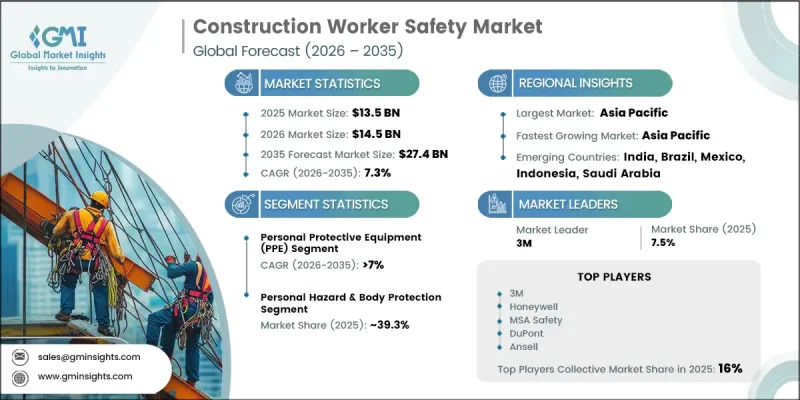
據估計,到 2025 年,全球建築工人安全市場價值將達到 135 億美元,年複合成長率為 7.3%,到 2035 年將達到 274 億美元。
建設公司正日益利用數位技術來加強職場安全防護、提高危險可見度並加快安全回應速度。人工智慧驅動的風險識別、工人協作技術和集中式安全平台正在改變承包商管理職場風險的方式。緊湊型感測器技術和雲端軟體的進步使安全團隊能夠透過整合系統收集和分析來自多個資訊來源的數據。這些功能使公司能夠監測工人狀況、識別潛在危險、確保符合安全標準並更有效率地應對事故。市場也從傳統的防護設備轉向將實體防護與數位監測和分析相結合的「互聯安全生態系統」。製造商正在開發可在各種安全環境下運行的整合硬體和軟體解決方案,從而減少對獨立系統的依賴。同時,人們對穿戴式機器人技術的興趣日益濃厚,以減輕身體負擔,這正在擴大建築安全解決方案的範圍。這些新技術的出現促使監管機構和相關人員建立更清晰的使用框架,從而支持建築工人安全市場的進一步發展。
| 市場範圍 | |
|---|---|
| 開始年份 | 2025 |
| 預測期 | 2026-2035 |
| 起始金額 | 135億美元 |
| 預測金額 | 274億美元 |
| 複合年成長率 | 7.3% |
隨著人工智慧、連網型設備和集中式安全管理平台的日益融合,建築工人安全市場持續受益。企業現在可以將來自各種安全技術的資訊整合到一個統一的數位環境中,從而使安全團隊能夠更有效率地評估職場狀況和與工人相關的風險。感測器設計和雲端基礎設施的改進也增強了持續收集安全資訊的能力,無需依賴多個互不相連的系統。這種轉變正促使建設公司採用更廣泛的「互聯工人」解決方案,而不是僅僅依賴單一防護產品。製造商正擴大提供整合的安全生態系統,將配備感測器的設備、數位儀錶板和事故管理功能相結合。互通性是關鍵考慮因素,因為承包商需要能夠在不同設備和技術環境下運作的解決方案。同時,外骨骼技術在減輕肌肉骨骼壓力方面的應用日益廣泛,這表明穿戴式機器人有望在大規模建設項目中為工人提供幫助。此外,針對新型安全技術的法規結構的發展也為市場擴張創造了更系統化的環境。
個人防護設備(PPE) 市佔率佔 55.6%,預計到 2035 年將以 7% 的複合年成長率成長。建設公司始終將 PPE 視為職場必不可少的實體防護層。防護裝備可直接抵禦常見的職業風險,並且仍然是建築安全計畫的基本要求。雇主依靠正確選擇和穿戴的裝備來保護工人免受建築工作中遇到的物理危害和暴露風險。由於 PPE 可在暴露現場直接保護工人,因此即使數位監控和聯網工人技術日益普及,公司仍優先考慮 PPE。監控平台、培訓計劃和其他基於技術的安全解決方案通常是物理防護的補充,而不是替代方案。
預計到2025年,個人危害預防和身體防護產品市場佔有率將達到39.3%,並在2026年至2035年間保持6.7%的複合年成長率。個人防護和身體防護產品是建築業個人防護裝備的核心,因為它們能夠滿足各種職場的防護需求。承包商無需大規模的數位基礎設施即可部署這些產品,這使得不同規模專案的公司都能輕鬆使用。這些產品在職場安全方面發揮著重要作用,採購流程也更加簡化,並且應用範圍廣泛,這些因素持續推動該細分市場的成長。建築安全計畫始終將個人防護設備放在首位,因為工人在現場日常工作中必須採取必要的實體安全措施。此外,領先的安全設備製造商也始終關注這一領域,並不斷開發產品、認證和防護技術,以滿足不斷變化的職場需求。
到2025年,美國建築工人安全市場將佔據84.3%的市場。美國是北美建築安全解決方案的領先市場,這得益於其成熟的建設產業、完善的職場安全規範以及對監管合規的高度重視。建設公司持續投資於防護設備和安全技術,以滿足職場的要求並提升工人安全保障。國內主要安全設備製造商的存在也促進了產品的供應、技術發展和產業應用。這些製造商已建構了符合美國建築營運特定需求的產品系列和認證能力。
目錄
第1章:調查方法
第2章執行摘要
第3章 行業洞察
- 產業生態系分析
- 供應商情況
- 利潤率分析
- 成本結構
- 每個階段增加的價值
- 影響價值鏈的因素
- 中斷
- 影響產業的因素
- 成長促進因素
- 美國職業安全與健康管理局 (OSHA) 和全球職業安全法規均嚴格要求遵守個人防護裝備 (PPE) 和防墜落措施。
- 建築工地死亡和受傷率的上升促使人們增加對安全措施的投資。
- 各國政府和私營部門的全球基礎設施投資正在激增。
- 在各種工作場所推廣智慧安全技術(物聯網、人工智慧、穿戴式裝置)的應用。
- 市場限制因素
- 引進先進安全設備和技術需要較高的前期成本。
- 供應鏈中斷與原料價格波動(醯胺纖維、鋼鐵、聚合物)
- 市場機遇
- 將人工智慧、物聯網和穿戴式感測器整合到下一代個人防護裝備和監測系統中
- 高成本安全設備租賃模式的推廣將降低中小企業採用此類設備的門檻。
- 成長促進因素
- 成長潛力分析
- 技術與創新展望
- 最新科技趨勢
- 新興技術
- 價格分析
- 對過去價格趨勢的分析
- 依球員類型分類的定價策略(高級球員、超值球員、成本加成球員)
- 監管指南
- 北美洲
- OSHA建設產業標準(29 CFR 1926),包括子部分M“防墜落”
- 美國職業安全與健康管理局危險資訊溝通標準(29 CFR 1910.1200)
- CSA Z1000 / 加拿大各省職業安全與健康法(例如,安大略省職業安全與健康法 (OHSA)、卑詩省工作安全局 (WorkSafeBC))
- 墨西哥 NOM-017-STPS(個人防護設備)
- 歐洲(歐盟)
- 關於個人防護設備的法規 (EU) 2016/425
- 指示 89/656/EEC -職場個人防護設備(PPE) 的使用
- 框架指令 89/391/EEC(職業安全與健康架構指令)
- CEN/CENELEC 個人防護裝備認證協調標準
- 亞太地區(APAC)
- 印度2020年職業安全、健康與工作條件法
- 中國職業安全國家標準(GB:國標)
- 澳洲職業健康與安全法及職業健康與安全示範條例
- 日本產業安全衛生法(ISHA)
- 拉丁美洲
- 巴西監管標準(NR-18 建築安全,NR-6個人防護設備)
- 墨西哥 NOM-031-STPS(工地安全標準)
- 哥倫比亞職業安全與健康管理系統(SG-SST)
- 智利第16.744號法律和第594號總統令
- 中東和非洲(MEA)
- 沙烏地阿拉伯 OSHAD/HCIS 指南
- 阿拉伯聯合大公國 OSHAD-SF(阿布達比)與杜拜市建築安全實施規範
- 南非職業安全與健康法(OHSA)和2014年建築法規
- 海灣合作理事會標準化組織(GSO)技術規章
- 北美洲
- 波特的分析
- PESTLE分析
- 專利趨勢
- 生產能力和生產情況
- 設備產能:按地區和主要生產商分類
- 運轉率和擴張計劃
- 人工智慧和生成式人工智慧對市場的影響
- 利用人工智慧改造現有經營模式
- 按細分市場分類的生成式人工智慧用例和部署藍圖
- 風險、限制和監管考量
- 永續性和環境方面
- 永續計劃
- 減少廢棄物策略
- 生產中的能源效率
- 具有環保意識的舉措
- 考慮碳足跡
- 預測假設和情境分析
- 基本案例:驅動複合年成長率的關鍵宏觀經濟與產業變量
- 樂觀情境:宏觀經濟與產業的順風
- 悲觀情景:宏觀經濟放緩或產業逆風
第4章 競爭情勢
- 介紹
- 主要市場公司的競爭分析
- 競爭定位矩陣
- 主要進展
- 併購
- 夥伴關係和聯盟
- 新產品發布
- 業務拓展計劃及資金籌措
- 按公司規模進行基準測試
- 排名分類標準與遴選標準
- 按收入、地區和創新能力分類的層級定位矩陣。
第5章 市場估價與預測:依產品分類,2022-2035年
- 個人防護設備(PPE)
- 頭部防護裝備(安全帽)
- 眼部和臉部防護用品(護目鏡和麵罩)
- 呼吸防護設備(口罩及其他呼吸防護裝置)
- 手部防護(安全手套)
- 足部和腿部防護裝備(安全鞋和護脛)
- 聽力保護裝置(耳罩和耳塞)
- 高能見度防護衣(背心和連身工作服衣)
- 防跌倒系統
- 個人防墜落系統
- 護欄與安全屏障
- 安全網
- 鷹架安全系統
- 環境監測和檢測系統
- 氣體和化學物質檢測系統
- 噪音和振動監測裝置
- 粉塵和空氣品質監測系統
- 溫度、天氣和結構監測
- 現場安全管理系統
- EHS 安全管理軟體
- 現場監控和影像監控
- 穿戴式感測器和物聯網整合平台
- 安全通道和緊急設備
第6章 市場估計與預測:依應用領域分類,2022-2035年
- 防止墜落和高空作業的安全措施
- 個人防護工具與身體防護
- 環境和現場危害監測
- 安全訓練、合規和管理
第7章 市場估價與預測:依建築類型分類,2022-2035年
- 住宅
- 商業建築
- 工業建築
- 基礎設施和土木工程
第8章 市場估算與預測:依最終用途分類,2022-2035年
- 總承包商
- 專業建築承包商
- 政府/地方政府
- 獨立承包商/安全顧問
第9章 市場估價與預測:依銷售管道分類,2022-2035年
- 直銷
- 總承包商
- 專業承包商
- 政府/地方政府
- 獨立承包商/安全顧問
- 間接銷售
- 總承包商
- 專業建築承包商
- 政府/地方政府
- 獨立承包商/安全顧問
第10章 市場估價與預測:依地區分類,2022-2035年
- 北美洲
- 美國
- 加拿大
- 歐洲
- 德國
- 英國
- 法國
- 義大利
- 西班牙
- 俄羅斯
- 丹麥
- 荷蘭
- 瑞典
- 亞太地區
- 中國
- 印度
- 日本
- ANZ
- 韓國
- 印尼
- 泰國
- 越南
- 拉丁美洲
- 巴西
- 墨西哥
- 阿根廷
- 中東和非洲
- 南非
- 沙烏地阿拉伯
- UAE
第11章:公司簡介
- 世界公司
- Honeywell International Inc.
- 3M Company
- DuPont de Nemours Inc.
- Kimberly-Clark Professional
- MSA Safety Incorporated
- Dragerwerk AG & Co. KGaA
- Ansell Limited
- Crowcon Detection Instruments
- Petzl
- Portwest
- 當地公司
- Lakeland Industries Inc.
- Uvex Safety Group
- Bullard Company
- Blackline Safety Corp.
- Pyramex Safety
- Ergodyne(Tenacious Holdings)
- Radians Inc.
- MCR Safety
- Alpha Pro Tech Ltd.
- Cresto Safety AB
The Global Construction Worker Safety Market was valued at USD 13.5 billion in 2025 and is estimated to grow at a CAGR of 7.3% to reach USD 27.4 billion by 2035.
Construction companies increasingly use digital technologies to strengthen workplace protection, improve hazard visibility, and support faster safety responses. AI-enabled risk identification, connected-worker technologies, and centralized safety platforms are changing how contractors manage workplace risks. Advances in compact sensor technology and cloud-based software allow safety teams to collect and review information from multiple sources through integrated systems. These capabilities help companies monitor worker conditions, identify potential hazards, verify safety compliance, and respond to incidents more efficiently. The market is also moving beyond conventional protective equipment toward connected safety ecosystems that combine physical protection with digital monitoring and analytics. Manufacturers are developing integrated hardware and software solutions that can operate across diverse safety environments, reducing dependence on isolated systems. At the same time, growing interest in wearable robotic technologies for reducing physical strain is expanding the scope of construction safety solutions. The emergence of new technologies is also encouraging regulators and industry stakeholders to establish clearer frameworks for their use, supporting further development of the construction worker safety market.
| Market Scope | |
|---|---|
| Start Year | 2025 |
| Forecast Year | 2026-2035 |
| Start Value | $13.5 Billion |
| Forecast Value | $27.4 Billion |
| CAGR | 7.3% |
The construction worker safety market continues to benefit from the increasing integration of artificial intelligence, connected devices, and centralized safety management platforms. Companies can now bring information from different safety technologies into unified digital environments, allowing safety teams to evaluate workplace conditions and worker-related risks more efficiently. Improvements in sensor design and cloud infrastructure have also expanded the ability to collect safety information continuously without relying on multiple disconnected systems. This shift is encouraging construction companies to adopt broader connected-worker solutions instead of depending solely on individual protective products. Manufacturers are increasingly combining sensor-enabled equipment, digital dashboards, and incident-management functions into integrated safety ecosystems. Interoperability has become an important consideration as contractors seek solutions that can work across different equipment and technology environments. Meanwhile, greater adoption of exoskeleton technology for reducing musculoskeletal stress is demonstrating the potential for wearable robotics to support workers in large-scale construction operations. The development of regulatory frameworks for emerging safety technologies is also helping create a more structured environment for market expansion.
The personal protective equipment segment held a 55.6% share, and is projected to grow at a CAGR of 7% through 2035. Construction companies continue to treat PPE as the essential physical layer of workplace protection. Protective equipment provides direct coverage against common occupational risks and remains a fundamental requirement within construction safety programs. Employers rely on properly selected and fitted equipment to protect workers from physical hazards and exposure risks encountered during construction activities. Because PPE directly protects workers at the point of exposure, companies continue to prioritize it even as digital monitoring and connected-worker technologies gain traction. Monitoring platforms, training programs, and other technology-based safety solutions generally complement physical protection rather than replace it.
The personal hazard and body protection segment accounted for a 39.3% share in 2025 and is expected to register a CAGR of 6.7% between 2026 and 2035. Personal and body protection products form a central component of construction PPE because they address a broad range of workplace protection requirements. Contractors can deploy these products without requiring extensive digital infrastructure, making them accessible to businesses operating across projects of different sizes. Their established role in workplace safety, straightforward procurement requirements, and widespread adoption continue to support segment growth. Construction safety programs consistently prioritize personal protection because workers require physical safeguards as part of routine site operations. The category also remains an important focus for major safety equipment manufacturers, which continue to develop products, certifications, and protection technologies around changing workplace requirements.
United States Construction Worker Safety Market accounted for an 84.3% share in 2025. The country represents the primary market for construction safety solutions in North America because of its mature construction industry, established workplace safety practices, and strong emphasis on regulatory compliance. Construction companies continue to invest in protective equipment and safety technologies to meet workplace requirements and improve worker protection. The presence of major safety equipment manufacturers within the country also supports product availability, technology development, and industry adoption. Domestic manufacturers have developed product portfolios and certification capabilities that closely address the requirements of U.S. construction operations.
Major companies operating in the global construction worker safety market include MSA Safety, 3M, Honeywell, Ansell, Blackline Safety, DuPont, Dragerwerk AG & Co. KGaA, Lakeland Industries, and Crowcon Detection Instruments. Companies in the construction worker safety market are strengthening their positions through product innovation, technology integration, portfolio expansion, strategic partnerships, and improvements in distribution and service capabilities. Manufacturers are developing protective products that combine enhanced comfort, durability, functionality, and compliance to address evolving jobsite requirements. Businesses are also investing in connected safety technologies, sensor integration, digital monitoring, and cloud-based platforms to expand beyond conventional PPE offerings. Expanding product portfolios allows companies to serve different construction environments and address a broader range of worker protection requirements. Strategic collaborations can help manufacturers accelerate technology development, strengthen distribution networks, and reach new customer groups. Companies are also increasing investments in research and development to improve wearable safety technologies and connected-worker solutions.
Table of Contents
Chapter 1 Methodology
- 1.1 Research approach
- 1.2 Quality Commitments
- 1.2.1 GMI AI policy & data integrity commitment
- 1.2.1.1 Source consistency protocol
- 1.2.1 GMI AI policy & data integrity commitment
- 1.3 Research Trail & Confidence Scoring
- 1.3.1 Research Trail Components
- 1.3.2 Scoring Components
- 1.4 Data Collection
- 1.4.1 Partial list of primary sources
- 1.5 Data mining sources
- 1.5.1 Paid sources
- 1.5.1.1 Sources, by region
- 1.5.1 Paid sources
- 1.6 Base estimates and calculations
- 1.6.1 Base year calculation
- 1.7 Forecast Model
- 1.7.1 Quantified market impact analysis
- 1.7.1.1 Mathematical impact of growth parameters on forecast
- 1.7.1 Quantified market impact analysis
- 1.8 Research transparency addendum
- 1.8.1 Source attribution framework
- 1.8.2 Quality assurance metrics
- 1.8.3 Our commitment to trust
Chapter 2 Executive Summary
- 2.1 Industry 360° synopsis, 2022 – 2035
- 2.2 Key market trends
- 2.2.1 Regional
- 2.2.2 Product
- 2.2.3 Application
- 2.2.4 Construction Type
- 2.2.5 End Use
- 2.2.6 Sales Channel
- 2.3 TAM Analysis, 2026-2035
- 2.4 CXO perspectives: Strategic imperatives
Chapter 3 Industry Insights
- 3.1 Industry ecosystem analysis
- 3.1.1 Supplier landscape
- 3.1.2 Profit margin analysis
- 3.1.3 Cost structure
- 3.1.4 Value addition at each stage
- 3.1.5 Factor affecting the value chain
- 3.1.6 Disruptions
- 3.2 Industry impact forces
- 3.2.1 Growth drivers
- 3.2.1.1 Stringent OSHA & Global Occupational Safety Regulations Mandating PPE & Fall Protection Compliance
- 3.2.1.2 Rising Construction Fatality & Injury Rates Driving Proactive Safety Investment
- 3.2.1.3 Surge in Global Infrastructure Spending by Government & Private Sector
- 3.2.1.4 Growing Adoption of Smart Safety Technologies (IoT, AI, Wearables) Across Job Sites
- 3.2.2 Market Restraints
- 3.2.2.1 High Initial Cost of Advanced Safety Equipment & Technology Implementation
- 3.2.2.2 Supply Chain Disruptions & Raw Material Price Volatility (Aramid Fiber, Steel, Polymers)
- 3.2.3 Market Opportunities
- 3.2.3.1 Integration of AI, IoT & Wearable Sensors in Next-Generation PPE & Monitoring Systems
- 3.2.3.2 Expanding Rental & Leasing Models for High-Cost Safety Equipment Lowering SME Adoption Barriers
- 3.2.1 Growth drivers
- 3.3 Growth potential analysis
- 3.4 Technology and Innovation landscape
- 3.4.1 Current technological trends
- 3.4.2 Emerging technologies
- 3.5 Pricing analysis (driven by primary research)
- 3.5.1 Historical price trend analysis
- 3.5.2 Pricing strategy by player type (premium / value / cost-plus)
- 3.6 Regulatory guidelines
- 3.6.1 North America
- 3.6.1.1 OSHA Construction Industry Standards (29 CFR 1926), including Subpart M Fall Protection
- 3.6.1.2 OSHA Hazard Communication Standard (29 CFR 1910.1200)
- 3.6.1.3 CSA Z1000 / Canadian Provincial OHS Acts (e.g., Ontario OHSA, WorkSafeBC)
- 3.6.1.4 Mexico NOM-017-STPS (Personal Protective Equipment)
- 3.6.2 Europe (EU)
- 3.6.2.1 Regulation (EU) 2016/425 on Personal Protective Equipment
- 3.6.2.2 Directive 89/656/EEC — Use of PPE at the Workplace
- 3.6.2.3 Framework Directive 89/391/EEC (OSH Framework Directive)
- 3.6.2.4 CEN/CENELEC Harmonized Standards for PPE Certification
- 3.6.3 Asia Pacific (APAC)
- 3.6.3.1 India Occupational Safety, Health and Working Conditions (OSH) Code, 2020
- 3.6.3.2 China GB (Guobiao) National Standards for Occupational Safety
- 3.6.3.3 Australia Work Health and Safety (WHS) Act & Model WHS Regulations
- 3.6.3.4 Japan Industrial Safety and Health Act (ISHA)
- 3.6.4 Latin America (LA)
- 3.6.4.1 Brazil Normas Regulamentadoras (NR-18 Construction Safety, NR-6 PPE)
- 3.6.4.2 Mexico NOM-031-STPS (Construction Safety Conditions)
- 3.6.4.3 Colombia Sistema de Gestion de Seguridad y Salud en el Trabajo (SG-SST)
- 3.6.4.4 Chile Ley 16.744 and DS 594
- 3.6.5 Middle East & Africa (MEA)
- 3.6.5.1 Saudi Arabia OSHAD / HCIS Guidelines
- 3.6.5.2 UAE OSHAD-SF (Abu Dhabi) & Dubai Municipality Code of Construction Safety Practice
- 3.6.5.3 South Africa Occupational Health and Safety Act (OHSA) & Construction Regulations 2014
- 3.6.5.4 GCC Standardization Organization (GSO) Technical Regulations
- 3.6.1 North America
- 3.7 Porter’s analysis
- 3.8 PESTEL analysis
- 3.9 Patent landscape (driven by primary research)
- 3.10 Capacity & production landscape (driven by primary research)
- 3.10.1 Installed capacity by region & key producer
- 3.10.2 Capacity utilization rates & expansion pipelines
- 3.11 Impact of AI & Generative AI on the market (driven by primary research)
- 3.11.1 AI-driven disruption of existing business models
- 3.11.2 GenAI use cases & adoption roadmap by segment
- 3.11.3 Risks, limitations & regulatory considerations
- 3.12 Sustainability and environmental aspects
- 3.12.1 Sustainable practices
- 3.12.2 Waste reduction strategies
- 3.12.3 Energy efficiency in production
- 3.12.4 Eco-friendly initiatives
- 3.12.5 Carbon footprint considerations
- 3.13 Forecast assumptions & scenario analysis (driven by primary research)
- 3.13.1 Base case - key macro & industry variables driving CAGR
- 3.13.2 Optimistic scenarios - favourable macro and industry tailwinds
- 3.13.3 Pessimistic scenario - macroeconomic slowdown or industry headwinds
Chapter 4 Competitive Landscape, 2025
- 4.1 Introduction
- 4.2 Company market share analysis, 2022-2025
- 4.2.1 North America
- 4.2.2 Europe
- 4.2.3 Asia Pacific
- 4.2.4 Latin America
- 4.2.5 MEA
- 4.3 Competitive analysis of major market players
- 4.4 Competitive positioning matrix
- 4.5 Key developments
- 4.5.1 Mergers & acquisitions
- 4.5.2 Partnerships & collaborations
- 4.5.3 New product launches
- 4.5.4 Expansion plans and funding
- 4.6 Company tier benchmarking
- 4.6.1 Tier classification criteria & qualifying thresholds
- 4.6.2 Tier positioning matrix by revenue, geography & innovation
Chapter 5 Market Estimates & Forecast, By Product, 2022 - 2035 ($Bn)
- 5.1 Key trends
- 5.2 Personal protective equipment (PPE)
- 5.2.1 Head protection (hard hats & helmets)
- 5.2.2 Eye & face protection (goggles & face shields)
- 5.2.3 Respiratory protection (masks & respirators)
- 5.2.4 Hand protection (safety gloves)
- 5.2.5 Foot & leg protection (safety boots & shin guards)
- 5.2.6 Hearing protection (earmuffs & earplugs)
- 5.2.7 High-visibility & protective apparel (vests & coveralls)
- 5.3 Fall protection systems
- 5.3.1 Personal fall arrest systems
- 5.3.2 Guardrails & safety barriers
- 5.3.3 Safety nets
- 5.3.4 Scaffolding safety systems
- 5.4 Environmental monitoring & detection systems
- 5.4.1 Gas & chemical detection systems
- 5.4.2 Noise & vibration monitoring devices
- 5.4.3 Dust & air quality monitoring systems
- 5.4.4 Temperature, weather & structural monitoring
- 5.5 On-site safety management systems
- 5.5.1 EHS safety management software
- 5.5.2 Site surveillance & video monitoring
- 5.5.3 Wearable sensor & IoT integration platforms
- 5.6 Safe access & emergency equipment
Chapter 6 Market Estimates & Forecast, By Application, 2022 - 2035 ($Bn)
- 6.1 Key trends
- 6.2 Fall prevention & height safety
- 6.3 Personal hazard & body protection
- 6.4 Environmental & site hazard monitoring
- 6.5 Safety training, compliance & management
Chapter 7 Market Estimates & Forecast, By Construction Type, 2022 - 2035 ($Bn)
- 7.1 Key trends
- 7.2 Residential construction
- 7.3 Commercial construction
- 7.4 Industrial construction
- 7.5 Infrastructure & civil construction
Chapter 8 Market Estimates & Forecast, By End Use, 2022 – 2035 ($Bn)
- 8.1 Key trends
- 8.2 General contractors
- 8.3 Specialty trade contractors
- 8.4 Government & municipal bodies
- 8.5 Independent contractors & safety consultants
Chapter 9 Market Estimates & Forecast, By Sales Channel, 2022 – 2035 ($Bn)
- 9.1 Key trends
- 9.2 Direct sales
- 9.2.1 General contractors
- 9.2.2 Specialty trade contractors
- 9.2.3 Government & municipal bodies
- 9.2.4 Independent contractors & safety consultants
- 9.3 Indirect sales
- 9.3.1 General contractors
- 9.3.2 Specialty trade contractors
- 9.3.3 Government & municipal bodies
- 9.3.4 Independent contractors & safety consultants
Chapter 10 Market Estimates & Forecast, By Region, 2022 - 2035 ($Bn, Units)
- 10.1 Key trends
- 10.2 North America
- 10.2.1 US
- 10.2.2 Canada
- 10.3 Europe
- 10.3.1 Germany
- 10.3.2 UK
- 10.3.3 France
- 10.3.4 Italy
- 10.3.5 Spain
- 10.3.6 Russia
- 10.3.7 Denmark
- 10.3.8 Netherlands
- 10.3.9 Sweden
- 10.4 Asia Pacific
- 10.4.1 China
- 10.4.2 India
- 10.4.3 Japan
- 10.4.4 ANZ
- 10.4.5 South Korea
- 10.4.6 Indonesia
- 10.4.7 Thailand
- 10.4.8 Vietnam
- 10.5 Latin America
- 10.5.1 Brazil
- 10.5.2 Mexico
- 10.5.3 Argentina
- 10.6 MEA
- 10.6.1 South Africa
- 10.6.2 Saudi Arabia
- 10.6.3 UAE
Chapter 11 Company Profiles
- 11.1 Global Players
- 11.1.1 Honeywell International Inc.
- 11.1.2 3M Company
- 11.1.3 DuPont de Nemours Inc.
- 11.1.4 Kimberly-Clark Professional
- 11.1.5 MSA Safety Incorporated
- 11.1.6 Dragerwerk AG & Co. KGaA
- 11.1.7 Ansell Limited
- 11.1.8 Crowcon Detection Instruments
- 11.1.9 Petzl
- 11.1.10 Portwest
- 11.2 Regional Players
- 11.2.1 Lakeland Industries Inc.
- 11.2.2 Uvex Safety Group
- 11.2.3 Bullard Company
- 11.2.4 Blackline Safety Corp.
- 11.2.5 Pyramex Safety
- 11.2.6 Ergodyne (Tenacious Holdings)
- 11.2.7 Radians Inc.
- 11.2.8 MCR Safety
- 11.2.9 Alpha Pro Tech Ltd.
- 11.2.10 Cresto Safety AB

 安全帽市場-2026-2032年全球市場預測
 兒童安全頭盔的市場機會、成長動力、產業趨勢和預測(2026-2035 年)。
 建築工人安全市場:規模、佔有率和成長分析(按類別、技術整合、應用、服務類型、分銷管道和地區分類)-2026-2033年產業預測
 2026年全球建築工人安全市場報告建築工人安全市場:依產品類型、服務類型、最終用戶和通路分類-2026-2032年全球市場預測
 安全頭盔市場規模、佔有率和趨勢分析報告:按材料、產品、最終用途、地區和細分市場預測,2026-2033年
 全球建築安全帽市場,2026-2030年
 建築安全帽市場規模、佔有率及成長分析(按產品類型、材質、應用、產業及地區分類)-2026-2033年產業預測
 安全頭盔市場規模、佔有率及成長分析(按材料、產品、最終用戶和地區分類)-產業預測(2026-2033)
 建築工人安全市場-全球產業規模、佔有率、趨勢、機會和預測(按類型、技術、最終用途、地區和競爭細分,2020-2030 年)