


 |
市場調查報告書
商品編碼
2121175
2026 年至 2035 年手持式混凝土切割機的市場機會、成長促進因素、產業趨勢分析與預測。Handheld Concrete Saws Market Opportunity, Growth Drivers, Industry Trend Analysis, and Forecast 2026 - 2035 |
||||||

預計到 2025 年,全球手持式混凝土切割機市場價值將達到 3.258 億美元,年複合成長率為 5.2%,到 2035 年將達到 5.422 億美元。
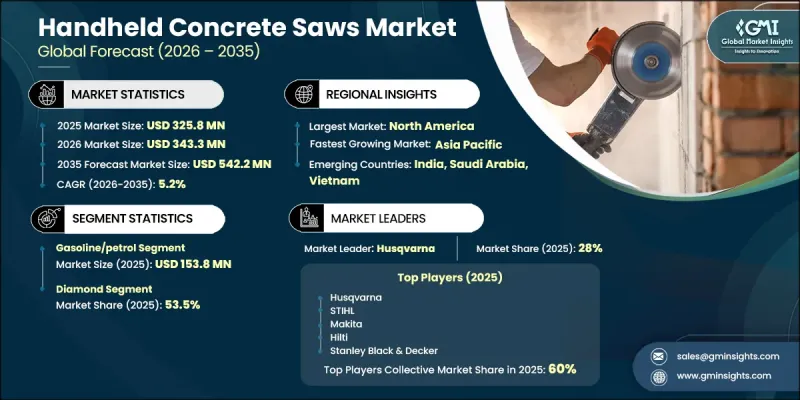
由於建築和基礎設施開發活動持續推動對高效、精準、可靠的混凝土切割設備的需求,市場持續擴張。承包商和建設公司越來越需要能夠提供穩定切割性能並滿足不斷變化的職場安全標準和操作要求的工具。手持式混凝土切割機用途廣泛,適用於整體建設活動,使製造商能夠接觸到多元化的基本客群,並減少對單一建築領域的依賴。設備設計、切割效率、便攜性、粉塵控制、振動控制和工人安全等方面的整體改進也推動了產品的普及。市場受益於對能夠應對持續基礎設施開發、維修工程和高難度切割任務的專業級設備的需求。製造商正在透過開發能夠提高生產效率並滿足日益嚴格的安全標準的解決方案來滿足這些需求。隨著建設公司繼續優先考慮設備的效率、可靠性和合規性,預計到2035年,對手持式混凝土切割機的需求將保持穩定成長。
| 市場範圍 | |
|---|---|
| 開始年份 | 2025 |
| 預測期 | 2026-2035 |
| 起始金額 | 3.258億美元 |
| 預測金額 | 5.422億美元 |
| 複合年成長率 | 5.2% |
預計2025年,汽油動力手持式混凝土切割機市場規模將達1.538億美元。在電池充電設施和可靠電力基礎設施仍然有限的市場,這類切割機的需求仍然強勁。它們無需固定電源即可獨立運作,因此適用於電力供應不穩定的地區。燃料配送網路的完善也支撐著汽油動力設備在許多市場的持續使用。移動性、無需固定電源的運作以及對高要求切割條件的適應性,共同確保了汽油動力切割機在手持式混凝土切割機行業中的重要地位。
預計到2025年,鑽石切割刀具的市佔率將達到53.5%。鑽石切割刀具的持續強勁表現反映了市場對高精度、高耐用性和性能穩定的切割解決方案的持續高需求。專業用戶越來越青睞鑽石切割技術,因為它們不僅能夠滿足嚴苛的混凝土切割要求,還能提高工作效率和切割精度。此外,其優異的性能還能幫助承包商更有效地滿足品質和監管要求。 Husqvarna 仍然是鑽石切割刀具市場的重要參與企業,其豐富的產品系列鞏固了公司作為專業用戶製造商的地位。
美國手持式混凝土切割機市佔率高達85.6%,預計2025年市場規模將達9,420萬美元。北美手持式混凝土切割機產業發展成熟,這得益於其完善的專業建築系統和對專用施工機械的強勁需求。該地區的建築工人非常重視設備的擁有率、生產效率、耐用性和運作可靠性。基於美國職業安全與健康管理局(OSHA)標準的職場安全要求也會影響設備的選擇,專業用戶正在推動採用內建除塵和減震功能的切割機。
目錄
第1章:調查方法
第2章執行摘要
第3章 行業洞察
- 產業生態系與價值鏈分析
- 原料及零件供應商(鑽石刀片、硬質合金、馬達零件)
- 製造商和原始設備製造商
- 銷售代理商、經銷商、租賃商店
- 最終用戶
- 對整個價值鏈的利潤率進行分析
- 影響產業的因素
- 市場促進因素
- 全球基礎設施投資正在激增。
- 優質電池/無線技術循環
- 新興市場建築業蓬勃發展
- 市場挑戰與陷阱
- 高昂的資本成本和特殊的進入障礙。
- 外匯不利因素對以美元計價的市值構成壓力
- 市場機遇
- 物聯網連接和智慧工具整合
- 中東2030年願景與印度國家基礎設施計畫(NIP)中的大型企劃儲備
- 市場促進因素
- 成長潛力分析
- 產業生態系分析
- 監理框架
- 職業安全與健康法規(OSHA,歐盟機械指令)
- 二氧化矽粉塵暴露標準和合規性(NIOSH、HSE UK)
- 區域噪音和振動排放標準
- 各國進口、認證和產品合規要求
- 價格分析
- 過去價格趨勢分析(2022-2024)
- 依球員類型分類的定價策略(高級球員、超值球員、成本加成球員)
- 技術與創新展望
- 當前技術趨勢
- 新興電池和無線平台技術的發展趨勢
- 刀片材料創新(鑽石刀片黏合,硬質合金等級)
- 除塵和水冷技術的進步
- 人體工學設計與減振技術的發展趨勢
- 波特的分析
- PESTLE分析
- 供應鏈分析
- 主要原料(鑽石刀頭、鋼材、硬質合金、馬達零件)
- 供應鏈中斷風險評估
- 近岸外包和供應商多元化趨勢
- 貿易數據分析
- 進出口量及進口額趨勢
- 主要貿易路線及關稅的影響(中美之間、歐盟與亞洲之間以及區域內部)
- 人工智慧和生成式人工智慧對市場的影響
- 利用人工智慧改造現有經營模式(智慧工具的連接、與物聯網的整合)
- 針對特定細分市場的生成式人工智慧應用案例和實施藍圖(預測性維護、葉片壽命最佳化)
- 電動工具中的人工智慧風險、限制和監管考量
- 生產能力和生產情況
- 按地區和主要製造商分類的安裝和生產能力
- 運轉率和擴張計劃
第4章 競爭情勢
- 介紹
- 企業市佔率分析
- 北美洲
- 歐洲
- 亞太地區
- 拉丁美洲
- 中東和非洲
- 企業矩陣分析
- 主要市場公司的競爭分析
- 競爭定位矩陣
- 主要進展
- 併購
- 夥伴關係和聯盟
- 新產品發布
- 業務拓展計劃
第5章 市場估算與預測:依電源類型分類,2022-2035年
- 電的
- 有線電動型
- 無線/電池供電
- 汽油/汽油
- 油壓
- 氣壓
第6章 市場估計與預測:依葉片類型分類,2022-2035年
- 鑽石刀片
- 磨料/氧化鋁刀片
- 硬質合金刀片
- 分段式無合金鋼刀片
第7章 市場估計與預測:依最終用途分類,2022-2035年
- 住宅
- 商業的
- 產業
- 基礎設施和土木工程
第8章 市場估算與預測:依通路分類,2022-2035年
- 線上
- 離線
第9章 市場估計與預測:依地區分類,2022-2035年
- 北美洲
- 美國
- 加拿大
- 歐洲
- 德國
- 英國
- 法國
- 義大利
- 西班牙
- 荷蘭
- 亞太地區
- 中國
- 印度
- 日本
- 澳洲
- 韓國
- 拉丁美洲
- 巴西
- 墨西哥
- 中東和非洲
- 南非
- 沙烏地阿拉伯
- UAE
第10章:公司簡介
- 世界公司
- Husqvarna AB
- Hilti AG
- Robert Bosch GmbH
- Makita Corporation
- Andreas Stihl AG & Co. KG
- Milwaukee Tool
- Stanley Black & Decker/DeWalt
- 當地公司
- Koki Holdings Co., Ltd.
- Wacker Neuson SE
- MK Diamond Products, Inc.
- ECHO Inc.
- Saint-Gobain Abrasives
- Flex-Elektrowerkzeuge GmbH
- Evolution Power Tools Ltd.
- 小眾玩家
- ICS/Oregon Tool, Inc.
- Diamond Products Co.
- Tyrolit Group
- Golz GmbH
- CS Unitec, Inc.
- iQ Power Tools
- Multiquip Inc.
The Global Handheld Concrete Saws Market was valued at USD 325.8 million in 2025 and is estimated to grow at a CAGR of 5.2% to reach USD 542.2 million by 2035.
The market continues to expand as construction and infrastructure activities create sustained demand for efficient, accurate, and dependable concrete cutting equipment. Contractors and construction companies increasingly require tools that can deliver consistent cutting performance while meeting evolving workplace safety and operational requirements. The broad applicability of handheld concrete saws across construction activities gives manufacturers access to a diverse customer base and helps reduce reliance on individual construction segments. Improvements in equipment design, cutting efficiency, portability, dust management, vibration control, and overall operator safety are also supporting product adoption. The market benefits from continued infrastructure development, renovation activity, and demand for professional-grade equipment that can handle demanding cutting operations. Manufacturers are responding to these requirements by developing solutions that improve productivity while addressing increasingly stringent safety expectations. As construction companies continue to prioritize equipment efficiency, reliability, and compliance, demand for handheld concrete saws is expected to maintain steady growth through 2035.
| Market Scope | |
|---|---|
| Start Year | 2025 |
| Forecast Year | 2026-2035 |
| Start Value | $325.8 Million |
| Forecast Value | $542.2 Million |
| CAGR | 5.2% |
The gasoline/petrol-powered handheld concrete saws segment accounted for USD 153.8 million in 2025. These saws continue to maintain strong demand in markets where access to battery-charging facilities or dependable electrical infrastructure remains limited. Their ability to operate independently from fixed electrical sources makes them suitable for locations where continuous access to power cannot be assured. Fuel distribution networks also support the continued use of gasoline-powered equipment across numerous markets. The combination of mobility, operating independence, and suitability for demanding cutting requirements continues to preserve the importance of gasoline/petrol-powered saws within the handheld concrete saws industry.
The diamond segments held a 53.5% share in 2025. The strong position of diamond segment cutting tools reflects the continued preference for cutting solutions that deliver high precision, durability, and consistent performance. Professional users increasingly favor diamond-based cutting technologies because they can support demanding concrete cutting requirements while helping improve operational efficiency and cutting accuracy. Their performance characteristics also allow contractors to address quality and regulatory requirements more effectively. Husqvarna remains an important participant in the diamond segment cutting tools market, with its product portfolio supporting the company's position among manufacturers serving professional users.
U.S. Handheld Concrete Saws Market accounted for an 85.6% share, generating USD 94.2 million in 2025. North America maintains a mature position in the handheld concrete saws industry, supported by an established professional contractor base and strong demand for specialized construction equipment. Contractors across the region place considerable emphasis on equipment ownership, productivity, durability, and operational reliability. Workplace safety requirements under OSHA standards are also influencing equipment selection, encouraging professional users to adopt saws equipped with integrated features designed to improve dust control and reduce vibration.
Key players operating in the global handheld concrete saws industry include Husqvarna AB, Hilti AG, Robert Bosch GmbH, Makita Corporation, Andreas Stihl AG & Co. KG, Milwaukee Tool, Stanley Black & Decker / DeWalt, Koki Holdings Co., Ltd., Wacker Neuson SE, MK Diamond Products, Inc., ECHO Inc., Saint-Gobain Abrasives, Flex-Elektrowerkzeuge GmbH, Evolution Power Tools Ltd., ICS / Oregon Tool, Inc., Diamond Products Co., Tyrolit Group, Golz GmbH, CS Unitec, Inc., iQ Power Tools, and Multiquip Inc. Companies in the handheld concrete saws market are strengthening their positions by expanding product portfolios, improving cutting performance, and developing equipment that addresses changing contractor requirements. Manufacturers are investing in research and development to enhance power efficiency, durability, ergonomics, dust management, vibration reduction, and operator safety. Companies are also broadening their distribution networks to improve product availability across established and emerging construction markets. Strategic partnerships, product launches, technology upgrades, and regional expansion remain important approaches for increasing market reach. Leading participants are focusing on professional-grade solutions that can improve productivity while meeting increasingly demanding workplace requirements. Manufacturers are also strengthening after-sales support, service capabilities, and customer relationships to encourage brand loyalty.
Table of Contents
Chapter 1 Methodology
- 1.1 Research approach
- 1.2 Quality Commitments
- 1.2.1 GMI AI policy & data integrity commitment
- 1.2.1.1 Source consistency protocol
- 1.2.1 GMI AI policy & data integrity commitment
- 1.3 Research Trail & Confidence Scoring
- 1.3.1 Research Trail Components
- 1.3.2 Scoring Components
- 1.4 Data Collection
- 1.4.1 Partial list of primary sources
- 1.5 Data mining sources
- 1.5.1 Paid sources
- 1.5.1.1 Sources, by region
- 1.5.1 Paid sources
- 1.6 Base estimates and calculations
- 1.6.1 Base year calculation for any one approach
- 1.7 Forecast model
- 1.7.1 Quantified market impact analysis
- 1.7.1.1 Mathematical impact of growth parameters on forecast
- 1.7.1 Quantified market impact analysis
- 1.8 Research transparency addendum
- 1.8.1 Source attribution framework
- 1.8.2 Quality assurance metrics
- 1.8.3 Our commitment to trust
Chapter 2 Executive Summary
- 2.1 Industry snapshot
- 2.2 Business trends
- 2.2.1 Power Source trends
- 2.2.2 Blade Type trends
- 2.2.3 End use trends
- 2.2.4 Distribution channel trends
- 2.2.5 Regional trends
Chapter 3 Industry Insights
- 3.1 Industry ecosystem and value chain analysis
- 3.1.1 Raw material & component suppliers (diamond segments, carbide, motor components)
- 3.1.2 Manufacturers & OEMs
- 3.1.3 Distributors, dealers & rental outlets
- 3.1.4 End users
- 3.1.5 Profit margin analysis across the value chain
- 3.2 Industry impact forces
- 3.2.1 Market Driver
- 3.2.1.1 Global Infrastructure Investment Surge
- 3.2.1.2 Battery/Cordless Technology Premium Cycle
- 3.2.1.3 Emerging Market Construction Boom
- 3.2.2 Market challenges/pitfalls
- 3.2.2.1 High Capital Cost and Professional Barrier to Entry
- 3.2.2.2 Foreign Exchange Headwinds on USD-Denominated Market Value
- 3.2.3 Market opportunities
- 3.2.3.1 IoT Connectivity and Smart Tool Integration
- 3.2.3.2 Middle East Vision 2030 and India NIP Mega-Project Pipeline
- 3.2.1 Market Driver
- 3.3 Growth potential analysis
- 3.4 Industry ecosystem analysis
- 3.5 Regulatory framework
- 3.5.1 Occupational health & safety regulations (OSHA, EU machinery directive)
- 3.5.2 Silica dust exposure standards & compliance (NIOSH, HSE UK)
- 3.5.3 Noise & vibration emission standards by region
- 3.5.4 Country-specific import, certification & product compliance requirements
- 3.6 Pricing analysis (driven by primary research)
- 3.6.1 Historical price trend analysis (2022–2024) (driven by primary research)
- 3.6.2 Pricing strategy by player type (premium/value/cost-plus) (driven by primary research)
- 3.7 Technology and innovation landscape
- 3.7.1 Current technology trends
- 3.7.2 Emerging battery & cordless platform technology trends
- 3.7.3 Blade material innovation (diamond segment bonding, carbide grades)
- 3.7.4 Dust suppression & water cooling technology advances
- 3.7.5 Ergonomic design & vibration-reduction technology trends
- 3.8 Porter’s Analysis
- 3.9 PESTEL Analysis
- 3.10 Supply Chain Analysis
- 3.10.1 Key raw materials (diamond segments, steel, carbide, motor components)
- 3.10.2 Supply chain disruption risk assessment
- 3.10.3 Nearshoring & supplier diversification trends
- 3.11 Trade data analysis (driven by paid database)
- 3.11.1 Import/export volume & value trends (HS code: 8464.10)
- 3.11.2 Key trade corridors & tariff impact (US-China, EU-Asia, intra-regional)
- 3.12 Impact of AI and generative AI on the market
- 3.12.1 AI-driven disruption of existing business models (smart tool connectivity, IoT integration)
- 3.12.2 GenAI use cases & adoption roadmap by segment (predictive maintenance, blade life optimization)
- 3.12.3 Risks, limitations & regulatory considerations for AI in power tools
- 3.13 Capacity & production landscape (driven by primary research)
- 3.13.1 Installed production capacity by region & key manufacturer (driven by primary research)
- 3.13.2 Capacity utilization rates & expansion pipelines (driven by primary research)
Chapter 4 Competitive Landscape, 2025
- 4.1 Introduction
- 4.2 Company market share analysis
- 4.2.1 North America
- 4.2.2 Europe
- 4.2.3 APAC
- 4.2.4 LATAM
- 4.2.5 MEA
- 4.3 Company matrix analysis
- 4.4 Competitive analysis of major market players
- 4.5 Competitive positioning matrix
- 4.6 Key developments
- 4.6.1 Mergers & acquisitions
- 4.6.2 Partnerships & collaborations
- 4.6.3 New product launches
- 4.6.4 Expansion plans
Chapter 5 Market Estimates and Forecast, By Power Source, 2022 – 2035 ($ Million) (Thousand Units)
- 5.1 Key trends
- 5.2 Electric
- 5.2.1 Corded Electric
- 5.2.2 Cordless / Battery-Powered
- 5.3 Gasoline / Petrol
- 5.4 Hydraulic
- 5.5 Pneumatic
Chapter 6 Market Estimates and Forecast, By Blade Type, 2022 – 2035 ($ Million) (Thousand Units)
- 6.1 Key trends
- 6.2 Diamond Blades
- 6.3 Abrasive / Aluminum Oxide Blades
- 6.4 Carbide-Tipped Blades
- 6.5 Segmented Plain Steel Blades
Chapter 7 Market Estimates and Forecast, By End Use, 2022 – 2035 ($ Million) (Thousand Units)
- 7.1 Key trends
- 7.2 Residential
- 7.3 Commercial
- 7.4 Industrial
- 7.5 Infrastructure & Civil Construction
Chapter 8 Market Estimates and Forecast, By Distribution Channel, 2022 – 2035 ($ Million) (Thousand Units)
- 8.1 Key trends
- 8.2 Online
- 8.3 Offline
Chapter 9 Market Estimates and Forecast, By Region, 2022 – 2035 ($ Million) (Thousand Units)
- 9.1 Key trends
- 9.2 North America
- 9.2.1 US
- 9.2.2 Canada
- 9.3 Europe
- 9.3.1 Germany
- 9.3.2 UK
- 9.3.3 France
- 9.3.4 Italy
- 9.3.5 Spain
- 9.3.6 Netherlands
- 9.4 Asia Pacific
- 9.4.1 China
- 9.4.2 India
- 9.4.3 Japan
- 9.4.4 Australia
- 9.4.5 South Korea
- 9.5 Latin America
- 9.5.1 Brazil
- 9.5.2 Mexico
- 9.6 Middle East and Africa
- 9.6.1 South Africa
- 9.6.2 Saudi Arabia
- 9.6.3 UAE
Chapter 10 Company Profiles
- 10.1 Global Players
- 10.1.1 Husqvarna AB
- 10.1.2 Hilti AG
- 10.1.3 Robert Bosch GmbH
- 10.1.4 Makita Corporation
- 10.1.5 Andreas Stihl AG & Co. KG
- 10.1.6 Milwaukee Tool
- 10.1.7 Stanley Black & Decker / DeWalt
- 10.2 Regional Players
- 10.2.1 Koki Holdings Co., Ltd.
- 10.2.2 Wacker Neuson SE
- 10.2.3 MK Diamond Products, Inc.
- 10.2.4 ECHO Inc.
- 10.2.5 Saint-Gobain Abrasives
- 10.2.6 Flex-Elektrowerkzeuge GmbH
- 10.2.7 Evolution Power Tools Ltd.
- 10.3 Niche Players
- 10.3.1 ICS / Oregon Tool, Inc.
- 10.3.2 Diamond Products Co.
- 10.3.3 Tyrolit Group
- 10.3.4 Golz GmbH
- 10.3.5 CS Unitec, Inc.
- 10.3.6 iQ Power Tools
- 10.3.7 Multiquip Inc.

 醫療設備塗佈設備市場:依材料、應用、塗佈、設備類型、國家及地區分類-全球產業分析、市場規模、市場佔有率及2026年至2033年預測
 旋轉式壓接模具市場規模、佔有率和成長分析:按產品類型、應用、最終用戶、模具尺寸、安裝方式和地區分類-2026-2033年產業預測
 混凝土切割機市場分析及預測(至2035年):類型、產品類型、技術、組件、應用、製程、最終用戶、安裝配置、設備、解決方案
 無撬桿輪胎拆裝機市場規模、佔有率及成長分析:按機器類型、車輛類型、安裝方式、最終用戶、應用及地區分類-2026-2033年產業預測
 金屬切削工具機市場-2026-2032年全球市場預測
 2026 年至 2035 年手動切割設備的市場機會、成長要素、產業趨勢分析與預測。
 氣動擋風玻璃切割機市場預測—按類型、最終用戶和地區分類的全球分析—2034年
 2026年全球混凝土切割鋸片市場報告
 2026-2030年全球金屬切削工具機市場電動步行跑步機市場報告:趨勢、預測與競爭分析(至2035年)