


 |
市場調查報告書
商品編碼
2121132
SaMD(軟體即醫療器材)市場機會、成長促進因素、產業趨勢分析及2026-2035年預測Software as a Medical Device (SaMD) Market Opportunity, Growth Drivers, Industry Trend Analysis, and Forecast 2026 - 2035 |
||||||

全球醫療器材軟體 (SaMD) 市場預計到 2025 年將達到 58 億美元,並預計以 13.9% 的複合年成長率成長,到 2035 年達到 211 億美元。
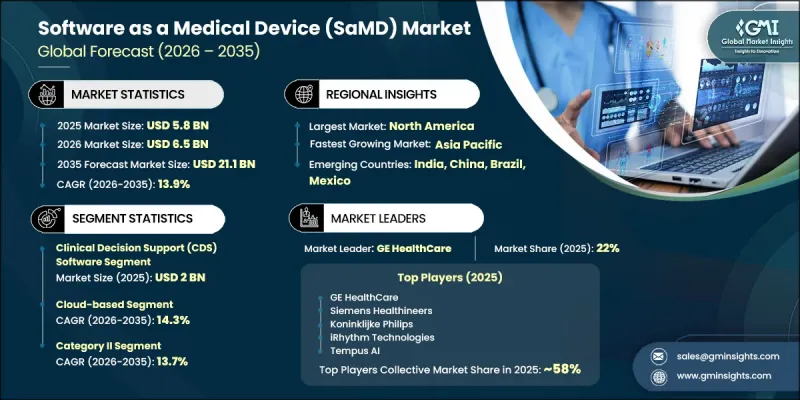
隨著數位醫療日益融入臨床工作流程,醫療服務提供者和技術開發商正不斷加速採用軟體為基礎的醫療解決方案。保險報銷範圍的擴大,對遠端患者監護的支持力度不斷加大;數位療法監管政策的利多;以及數位健康技術的日益普及,都為市場創造了新的機會。人工智慧驅動的診斷軟體也備受關注,因為開發商不斷提升其臨床效能、分析能力和決策支援功能。人工智慧 (AI) 和機器學習的進步正在拓展軟體即醫療器材 (SaMD) 平台的功能,而新興醫療市場的廣泛應用也為進一步的商業化鋪平了道路。此外,開發人員也更專注於開發用於心理健康管理、個人化醫療、預測醫學和數據驅動型臨床工作流程的軟體。
| 市場範圍 | |
|---|---|
| 開始年份 | 2025 |
| 預測期 | 2026-2035 |
| 起始金額 | 58億美元 |
| 預測金額 | 211億美元 |
| 複合年成長率 | 13.9% |
預計到2025年,臨床決策支援(CDS)軟體市場規模將達20億美元。醫療機構正擴大採用CDS平台來增強診斷流程、改善治療方案製定並支持更明智的臨床決策。這些軟體解決方案能夠處理患者資訊、臨床指南、檢驗結果和歷史醫療數據,從而為醫療專業人員提供循證建議。對高效臨床工作流程、更完善的診斷支援和數據驅動的治療決策日益成長的需求,持續推動醫療服務提供者將CDS軟體整合到其數位化基礎設施中。
預計到2025年,醫院和診所將佔據48.1%的市場。醫院和診所仍然是主要的需求來源,因為醫療機構需要在患者照護的多個階段使用軟體解決方案進行臨床監測、診斷和決策支援。隨著醫療營運日益數位化,醫療服務提供者正在推動採用能夠提高工作流程效率、改善資料存取和加強臨床協作的軟體平台。對個人化治療、預測醫學能力和整合數位健康基礎設施日益成長的需求也在推動醫院和診所採用軟體即醫療器材(SaMD)。隨著醫療機構技術環境的現代化,對擴充性且具有臨床實用性的軟體解決方案的需求預計將進一步成長。
預計到2025年,北美醫療器材軟體(SaMD)市場將佔據40%的市場。該地區受益於先進的醫療基礎設施、高普及率的數位技術以及對個人化、數據驅動型患者照護日益成長的需求。北美各地的醫療服務提供者正在擴大軟體醫療解決方案的使用,以改善臨床工作流程、病患監測、診斷和治療管理。慢性病盛行率的上升也推動了對持續監測和技術驅動型護理的需求。此外,SaMD平台與電子健康記錄(EHR)之間更緊密的整合正在改善患者資訊的獲取,並促進更協調的醫療服務。對醫療技術、人工智慧驅動的醫療軟體和數位基礎設施的持續投資預計將進一步推動該地區的市場成長。
目錄
第1章:調查方法和範圍
第2章執行摘要
第3章 行業洞察
- 產業生態系分析
- 影響產業的因素
- 成長促進因素
- 擴大數位健康技術的應用
- 擴大遠端患者監護的保險覆蓋範圍代碼
- 人工智慧驅動的診斷型SaMD,與傳統方法相比,展現出更高的臨床敏感度。
- 對數位療法和軟體解決方案的監管支持
- 產業潛在風險與挑戰
- 網路安全和資料隱私問題
- 臨床檢驗和證據生成方面的挑戰
- 市場機遇
- 透過將 SaMD 與穿戴式裝置和 IoMT 裝置整合,持續收集真實世界數據 (RE)。
- 數位療法(DTx)的廣泛應用
- 成長促進因素
- 成長潛力分析
- 監理情勢
- 技術進步
- 最新科技趨勢
- 新興技術
- 價格趨勢分析
- 未來市場趨勢
- 波特的分析
- PESTLE分析
- 差距分析
- 人工智慧和生成式人工智慧對市場的影響
第4章 競爭情勢
- 介紹
- 企業矩陣分析
- 企業市佔率分析
- 世界
- 北美洲
- 歐洲
- 亞太地區
- 競爭定位矩陣
- 主要市場公司的競爭分析
- 主要進展
- 併購
- 夥伴關係和聯盟
- 新產品發布
- 業務拓展計劃
第5章 市場估價與預測:依軟體類型分類,2022-2035年
- 診斷和影像軟體
- 臨床決策支援(CDS)軟體
- 遠端患者監護(RPM)軟體
- 數位療法 (DTx)
- 手術規劃和導航軟體
- 其他類型的軟體
第6章 市場估算與預測:依部署模式分類,2022-2035年
- 基於雲端的
- 現場
第7章 市場估算與預測:IMDRF風險類別,2022-2035年
- 第一類
- 第二類
- 第三類
- 第四類
第8章 市場估算與預測:依最終用途分類,2022-2035年
- 醫院和診所
- 診斷中心/放射科
- 居家醫療
- 研究和學術機構
- 其他最終用戶
第9章 市場估計與預測:依地區分類,2022-2035年
- 北美洲
- 美國
- 加拿大
- 歐洲
- 德國
- 英國
- 法國
- 西班牙
- 義大利
- 荷蘭
- 亞太地區
- 中國
- 印度
- 日本
- 澳洲
- 韓國
- 拉丁美洲
- 巴西
- 墨西哥
- 阿根廷
- 中東和非洲
- 沙烏地阿拉伯
- 南非
- UAE
第10章:公司簡介
- Aidoc Medical
- Brainlab AG
- Butterfly Network
- Canon Medical Systems
- Fujifilm Holdings
- GE HealthCare
- Huma Therapeutics
- iRhythm Technologies
- Koninklijke Philips
- Medtronic
- PathAI
- Qlarity Imaging
- Roche Diagnostics
- Siemens Healthineers
- Tempus AI
- Viz.ai
The Global Software as a Medical Device (SaMD) Market was valued at USD 5.8 billion in 2025 and is estimated to grow at a CAGR of 13.9% to reach USD 21.1 billion by 2035.
Healthcare providers and technology developers continue to accelerate the adoption of software-based medical solutions as digital healthcare becomes more integrated into clinical workflows. Expanding reimbursement support for remote patient monitoring, favorable regulatory developments for digital therapeutics, and growing use of digital health technologies are creating new opportunities across the market. AI-powered diagnostic software is also gaining attention as developers improve clinical performance, analytical capabilities, and decision-making support. Advances in artificial intelligence and machine learning are expanding the functionality of SaMD platforms, while growing penetration across emerging healthcare markets is opening additional avenues for commercialization. Developers are also increasing their focus on software designed for mental health management, personalized care, predictive healthcare, and data-driven clinical workflows.
| Market Scope | |
|---|---|
| Start Year | 2025 |
| Forecast Year | 2026-2035 |
| Start Value | $5.8 Billion |
| Forecast Value | $21.1 Billion |
| CAGR | 13.9% |
The clinical decision support (CDS) software segment captured USD 2 billion in 2025. Healthcare organizations are increasingly adopting CDS platforms to strengthen diagnostic processes, improve treatment planning, and support more informed clinical decisions. These software solutions process patient information, clinical guidelines, laboratory findings, and historical medical data to generate evidence-based recommendations for healthcare professionals. Increasing demand for efficient clinical workflows, improved diagnostic support, and data-driven treatment decisions continues to encourage healthcare providers to incorporate CDS software into their digital infrastructure.
The hospitals and clinics segment held a 48.1% share in 2025. Hospitals and clinics continue to represent a major source of demand because healthcare facilities require software solutions for clinical monitoring, diagnosis, and decision support across multiple stages of patient care. Increasing digitization of healthcare operations is encouraging providers to adopt software platforms that improve workflow efficiency, data accessibility, and clinical coordination. Growing demand for personalized treatment, predictive healthcare capabilities, and integrated digital health infrastructure is also supporting SaMD adoption across hospitals and clinics. As healthcare organizations continue to modernize their technology environments, the need for scalable and clinically relevant software solutions is expected to increase.
North America Software as a Medical Device (SaMD) Market recorded a 40% share in 2025. The region benefits from advanced healthcare infrastructure, high adoption of digital technologies, and increasing demand for personalized, data-driven approaches to patient care. Healthcare providers across North America are expanding the use of software-based medical solutions to improve clinical workflows, patient monitoring, diagnostics, and treatment management. The growing prevalence of chronic diseases is also increasing demand for continuous monitoring and technology-enabled care. In addition, stronger integration between SaMD platforms and electronic health records (EHRs) is improving access to patient information and supporting more connected healthcare delivery. Continued investments in healthcare technology, AI-enabled medical software, and digital infrastructure are expected to further support regional market expansion.
Prominent companies operating in the global software as a medical device (SaMD) market include Aidoc Medical, Brainlab AG, Butterfly Network, Canon Medical Systems, Fujifilm Holdings, GE HealthCare, Huma Therapeutics, iRhythm Technologies, Koninklijke Philips, Medtronic, PathAI, Qlarity Imaging, Roche Diagnostics, Siemens Healthineers, Tempus AI, and Viz.ai. Companies operating in the global software as a medical device (SaMD) market are strengthening their market positions through product development, artificial intelligence integration, strategic collaborations, and expansion into new healthcare applications. Leading companies are investing in research and development to improve software accuracy, usability, interoperability, and clinical performance. Businesses are also developing AI-powered diagnostic and decision-support capabilities to address the growing demand for efficient digital healthcare solutions. Strategic partnerships with healthcare providers, technology companies, and research organizations help companies expand their customer networks and accelerate the adoption of SaMD platforms. Companies are further strengthening their presence by integrating software with electronic health records, expanding regulatory capabilities, and developing solutions for remote monitoring, personalized care, and digital therapeutics. Geographic expansion, portfolio diversification, continuous platform upgrades, and stronger cybersecurity capabilities also help market participants improve competitiveness and establish a broader foothold in the global software as a medical device (SaMD) market.
Table of Contents
Chapter 1 Methodology and Scope
- 1.1 Market scope and definition
- 1.2 Research design
- 1.2.1 Research approach
- 1.2.2 Data collection methods
- 1.3 Data mining sources
- 1.3.1 Global
- 1.3.2 Regional/Country
- 1.4 Base estimates and calculations
- 1.4.1 Base year calculation
- 1.4.2 Key trends for market estimation
- 1.5 Primary research and validation
- 1.5.1 Primary sources
- 1.6 Forecast model
- 1.7 Research assumptions and limitations
Chapter 2 Executive Summary
- 2.1 Industry 360° synopsis
- 2.2 Key market trends
- 2.2.1 Regional trends
- 2.2.2 Software type trends
- 2.2.3 Deployment mode trends
- 2.2.4 IMDRF risk category trends
- 2.2.5 End use trends
- 2.3 CXO perspectives: Strategic imperatives
Chapter 3 Industry Insights
- 3.1 Industry ecosystem analysis
- 3.2 Industry impact forces
- 3.2.1 Growth drivers
- 3.2.1.1 Rising adoption of digital health technologies
- 3.2.1.2 Expansion of remote patient monitoring reimbursement codes
- 3.2.1.3 AI-powered diagnostic SaMD demonstrating superior clinical sensitivity in comparison with traditional methods
- 3.2.1.4 Regulatory support for digital therapeutics and software-based solutions
- 3.2.2 Industry pitfalls and challenges
- 3.2.2.1 Cybersecurity and data privacy concerns
- 3.2.2.2 Challenges in clinical validation and evidence generation
- 3.2.3 Market opportunities
- 3.2.3.1 Integration of SaMD with wearables and IoMT devices for continuous real-world evidence
- 3.2.3.2 Growing adoption of digital therapeutics (DTx)
- 3.2.1 Growth drivers
- 3.3 Growth potential analysis
- 3.4 Regulatory landscape
- 3.4.1 North America
- 3.4.2 Europe
- 3.4.3 Asia Pacific
- 3.4.4 Latin America
- 3.4.5 Middle East and Africa
- 3.5 Technological advancements
- 3.5.1 Current technological trends
- 3.5.2 Emerging technologies
- 3.6 Pricing trend analysis (Driven by primary research)
- 3.7 Future market trends (Driven by primary research)
- 3.8 Porter's analysis
- 3.9 PESTEL analysis
- 3.10 Gap analysis
- 3.11 Impact of AI and Generative AI on the market (Driven by primary research)
Chapter 4 Competitive Landscape, 2025
- 4.1 Introduction
- 4.2 Company matrix analysis
- 4.3 Company market share analysis (Driven by primary research)
- 4.3.1 Global
- 4.3.2 North America
- 4.3.3 Europe
- 4.3.4 Asia Pacific
- 4.4 Competitive positioning matrix
- 4.5 Competitive analysis of major market players
- 4.6 Key developments
- 4.6.1 Mergers & acquisitions
- 4.6.2 Partnerships & collaborations
- 4.6.3 New product launches
- 4.6.4 Expansion plans
Chapter 5 Market Estimates and Forecast, By Software Type, 2022 - 2035 ($ Mn)
- 5.1 Key trends
- 5.2 Diagnostic and imaging software
- 5.3 Clinical decision support (CDS) software
- 5.4 Remote patient monitoring (RPM) software
- 5.5 Digital therapeutics (DTx)
- 5.6 Surgical planning and navigation software
- 5.7 Other software types
Chapter 6 Market Estimates and Forecast, By Deployment Mode, 2022 - 2035 ($ Mn)
- 6.1 Key trends
- 6.2 Cloud-based
- 6.3 On-premise
Chapter 7 Market Estimates and Forecast, By IMDRF Risk Category, 2022 - 2035 ($ Mn)
- 7.1 Key trends
- 7.2 Category I
- 7.3 Category II
- 7.4 Category III
- 7.5 Category IV
Chapter 8 Market Estimates and Forecast, By End Use, 2022 - 2035 ($ Mn)
- 8.1 Key trends
- 8.2 Hospitals and clinics
- 8.3 Diagnostic centers and radiology
- 8.4 Home care settings
- 8.5 Research and academic institutions
- 8.6 Other end users
Chapter 9 Market Estimates and Forecast, By Region, 2022 - 2035 ($ Mn)
- 9.1 Key trends
- 9.2 North America
- 9.2.1 U.S.
- 9.2.2 Canada
- 9.3 Europe
- 9.3.1 Germany
- 9.3.2 UK
- 9.3.3 France
- 9.3.4 Spain
- 9.3.5 Italy
- 9.3.6 Netherlands
- 9.4 Asia Pacific
- 9.4.1 China
- 9.4.2 India
- 9.4.3 Japan
- 9.4.4 Australia
- 9.4.5 South Korea
- 9.5 Latin America
- 9.5.1 Brazil
- 9.5.2 Mexico
- 9.5.3 Argentina
- 9.6 Middle East and Africa
- 9.6.1 Saudi Arabia
- 9.6.2 South Africa
- 9.6.3 UAE
Chapter 10 Company Profiles
- 10.1 Aidoc Medical
- 10.2 Brainlab AG
- 10.3 Butterfly Network
- 10.4 Canon Medical Systems
- 10.5 Fujifilm Holdings
- 10.6 GE HealthCare
- 10.7 Huma Therapeutics
- 10.8 iRhythm Technologies
- 10.9 Koninklijke Philips
- 10.10 Medtronic
- 10.11 PathAI
- 10.12 Qlarity Imaging
- 10.13 Roche Diagnostics
- 10.14 Siemens Healthineers
- 10.15 Tempus AI
- 10.16 Viz.ai


