


 |
市場調查報告書
商品編碼
2121120
生物製程設備市場機會、成長要素、產業趨勢分析及2026-2035年預測。Bioprocessing Equipment Market Opportunity, Growth Drivers, Industry Trend Analysis, and Forecast 2026 - 2035 |
||||||

全球生物製程設備市場預計到 2025 年將達到 481 億美元,年複合成長率為 12.3%,到 2035 年將達到 1,522 億美元。
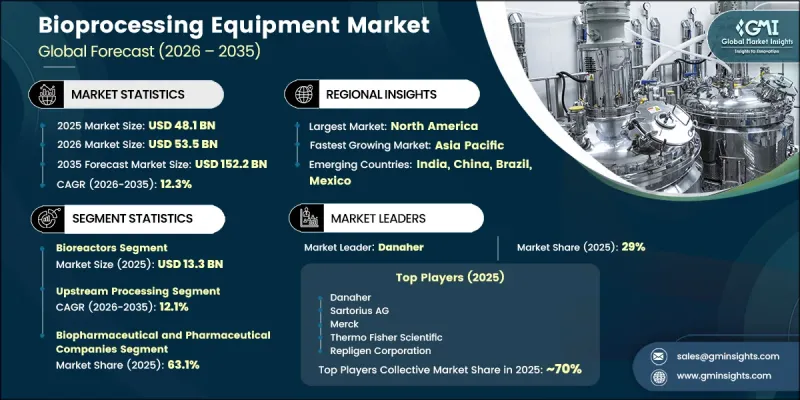
隨著生物製藥企業加大對先進生產技術的投資,以提高效率、擴充性和產品質量,市場持續擴張。一次性生物製程系統的日益普及、對生物製藥和生物相似藥需求的成長以及細胞和基因療法的快速商業化,都催生了對先進生物製程設備的強勁需求。此外,契約製造組織 (CMO) 和受託研究機構(CRO) 的擴張加速了設備採購,並促進了生產基礎設施的持續升級。各公司正持續投資於自動化生產平台、製程最佳化技術和高性能設備,以提高生產柔軟性,同時確保符合法規要求。生物製程工程的持續進步、研發活動的活性化以及對下一代療法生產投資的不斷成長,進一步增強了產業的前景。丹納赫、賽多利斯、默克、賽默飛世爾科技和瑞普利根等領先企業透過持續的產品創新、研發投入、全球業務拓展以及與醫療保健和生命科學機構的策略合作,不斷提升自身競爭力。
| 市場範圍 | |
|---|---|
| 開始年份 | 2025 |
| 預測期 | 2026-2035 |
| 上市時的市場規模 | 481億美元 |
| 預計金額 | 1522億美元 |
| 複合年成長率 | 12.3% |
預計到2025年,生物反應器市場規模將達到133億美元。生物反應器仍然是現代生物製程中最關鍵的組成部分之一,它為培養微生物、哺乳動物細胞以及其他製藥生產所需的生物材料提供高度可控的環境。生物製藥、生物相似藥、疫苗和先進治療產品的產量不斷成長,推動了對高性能生物反應器系統的持續需求。生物反應器設計、自動化能力、製程監控技術和生產效率的不斷改進,進一步促進了該領域的成長,並使製造商能夠在維持產品品質穩定的同時擴大產能。
預計到2025年,生物製藥和製藥公司將佔據63.1%的市場。這些公司持續增加對先進製造技術的投資,以提高生物製藥、疫苗、生物相似藥和新興治療產品的產量。對生產效率、製程標準化、法規遵循和生產規模化能力的日益重視,正推動製藥生產設施採用先進的生物製程設備。此外,研發活動的持續拓展、創新療法商業化的進展以及對現代化生產基礎設施投資的增加,預計將在整個預測期內維持該終端用戶領域的強勁需求。
預計到2025年,北美生物製程設備市佔率將達到38%。該地區持續保持強勁成長勢頭,這得益於其成熟的生物製藥生產生態系統、先進的醫療保健基礎設施以及不斷成長的生物技術研發投入。有利的政府政策、生物製藥和先進療法產量的增加以及慢性病盛行率的上升,正在加速全部區域期內,不斷擴大的生產能力、研發設施以及對下一代生物製程技術的持續投資,將進一步鞏固北美在生物製程設備市場的主導地位。
目錄
第1章:調查方法和範圍
第2章執行摘要
第3章 行業洞察
- 產業生態系分析
- 影響產業的因素
- 促進因素
- 生物製藥和生物相似藥的需求不斷成長
- 一次性生物處理系統的日益普及降低了資本投資成本和污染風險。
- 細胞和基因治療生產快速擴張
- 外包給合約生產商 (CMO) 和合約研究機構 (CRO) 的做法正在加速設備採購週期。
- 產業潛在風險與挑戰
- 生物加工設施需要大量資金投入。
- 嚴格的監理合規要求
- 市場機遇
- 連續生物製程技術的應用日益廣泛
- 對個人化醫療產品的需求日益成長
- 促進因素
- 成長潛力分析
- 監理情勢
- 技術進步
- 最新科技趨勢
- 新興技術
- 價格趨勢分析
- 未來市場趨勢
- 波特的分析
- PESTLE分析
- 差距分析
- 人工智慧和生成式人工智慧對市場的影響
第4章 競爭情勢
- 介紹
- 企業矩陣分析
- 企業市佔率分析
- 世界
- 北美洲
- 歐洲
- 亞太地區
- 競爭定位矩陣
- 主要市場公司的競爭分析
- 主要進展
- 併購
- 夥伴關係和聯盟
- 新產品發布
- 業務拓展計劃
第5章 市場估算與預測:依產品類型分類,2022-2035年
- 生物反應器
- 過濾系統
- 層析法系統
- 混合系統
- 離心機
- 細胞培養系統
- 控制和監控系統
- 其他產品類型
第6章 市場估價與預測:依製程分類,2022-2035年
- 上游工程
- 下游工藝
第7章 市場估計與預測:依應用領域分類,2022-2035年
- 單株抗體(mAbs)
- 疫苗和免疫療法
- 細胞和基因治療
- 重組蛋白質和酶
- 生物相似藥
- 其他用途
第8章 市場估算與預測:依最終用途分類,2022-2035年
- 生物製藥和製藥公司
- 首席行銷長和首席營收官
- 學術研究機構
第9章 市場估計與預測:依地區分類,2022-2035年
- 北美洲
- 美國
- 加拿大
- 歐洲
- 德國
- 英國
- 法國
- 西班牙
- 義大利
- 荷蘭
- 亞太地區
- 中國
- 印度
- 日本
- 澳洲
- 韓國
- 拉丁美洲
- 巴西
- 墨西哥
- 阿根廷
- 中東和非洲
- 沙烏地阿拉伯
- 南非
- UAE
第10章:公司簡介
- ABEC Inc.
- Cellexus Ltd.
- Danaher
- Distek Inc.
- Eppendorf AG
- Getinge AB
- Lonza Group
- Merck
- PBS Biotech Inc.
- Pierre Guerin Technologies(SPX Flow)
- Repligen Corporation
- Sartorius AG
- Single Use Support GmbH
- Solaris Biotech(Donaldson)
- Thermo Fisher Scientific
The Global Bioprocessing Equipment Market was valued at USD 48.1 billion in 2025 and is estimated to grow at a CAGR of 12.3% to reach USD 152.2 billion by 2035.
The market continues to expand as biopharmaceutical manufacturers increase investments in advanced production technologies to improve efficiency, scalability, and product quality. Growing adoption of single-use bioprocessing systems, increasing demand for biologics and biosimilars, and the rapid commercialization of cell and gene therapies are creating strong demand for sophisticated bioprocessing equipment. In addition, the expansion of contract manufacturing organizations (CMOs) and contract research organizations (CROs) is accelerating equipment procurement and encouraging continuous upgrades of manufacturing infrastructure. Companies are increasingly investing in automated production platforms, process optimization technologies, and high-performance equipment to improve manufacturing flexibility while maintaining regulatory compliance. Continuous advancements in bioprocess engineering, increasing research activities, and growing investments in next-generation therapeutic manufacturing are further strengthening the industry's outlook. Leading participants, including Danaher, Sartorius AG, Merck, Thermo Fisher Scientific, and Repligen Corporation, continue to reinforce their competitive position through sustained product innovation, research and development investments, global business expansion, and strategic collaborations with healthcare organizations and life science institutions.
| Market Scope | |
|---|---|
| Start Year | 2025 |
| Forecast Year | 2026-2035 |
| Start Value | $48.1 Billion |
| Forecast Value | $152.2 Billion |
| CAGR | 12.3% |
The bioreactors segment captured USD 13.3 billion in 2025. Bioreactors continue to represent one of the most essential components of modern bioprocessing because they provide highly controlled environments for cultivating microorganisms, mammalian cells, and other biological materials required for pharmaceutical manufacturing. Growing production of biologics, biosimilars, vaccines, and advanced therapeutic products is driving sustained demand for high-performance bioreactor systems. Continuous improvements in bioreactor design, automation capabilities, process monitoring technologies, and manufacturing efficiency are further supporting segment growth while enabling manufacturers to increase production capacity and maintain consistent product quality.
The biopharmaceutical and pharmaceutical companies segment accounted for 63.1% share in 2025. These organizations continue to invest heavily in advanced manufacturing technologies to strengthen the production of biologics, vaccines, biosimilars, and emerging therapeutic products. Increasing emphasis on manufacturing efficiency, process standardization, regulatory compliance, and production scalability is encouraging widespread adoption of advanced bioprocessing equipment across pharmaceutical manufacturing facilities. Furthermore, continuous expansion of research and development activities, increasing commercialization of innovative therapies, and growing investments in modern manufacturing infrastructure are expected to sustain strong demand from this end-user segment throughout the forecast period.
North America Bioprocessing Equipment Market held a 38% share in 2025. The region continues to demonstrate strong growth, supported by its well-established biopharmaceutical manufacturing ecosystem, advanced healthcare infrastructure, and increasing investments in biotechnology research and development. Favorable government initiatives, expanding production of biologics and advanced therapeutics, and the growing prevalence of chronic diseases are accelerating the adoption of modern bioprocessing equipment across the region. In addition, continuous technological advancements in bioprocessing systems, increasing demand for automated and single-use manufacturing solutions, and the presence of leading pharmaceutical and biotechnology companies are creating significant growth opportunities. Ongoing investments in manufacturing capacity expansion, research facilities, and next-generation bioprocessing technologies are expected to further strengthen North America's leadership in the Bioprocessing Equipment Market throughout the forecast period.
Major companies operating in the global bioprocessing equipment market include ABEC Inc., Cellexus Ltd., Danaher, Distek Inc., Eppendorf AG, Getinge AB, Lonza Group, Merck, PBS Biotech Inc., Pierre Guerin Technologies (SPX Flow), Repligen Corporation, Sartorius AG, Single Use Support GmbH, Solaris Biotech (Donaldson), and Thermo Fisher Scientific. Companies operating in the global bioprocessing equipment market are strengthening their competitive position by investing extensively in product innovation, advanced manufacturing technologies, and research and development initiatives. Leading manufacturers are expanding their portfolios with highly automated, scalable, and single-use bioprocessing solutions that improve production efficiency while reducing operational complexity. Strategic partnerships with pharmaceutical companies, biotechnology firms, CMOs, and research institutions are helping organizations strengthen customer relationships and expand their global market presence. Businesses are also investing in digital process monitoring, automation technologies, and smart manufacturing platforms to enhance operational performance and improve process consistency. In addition, companies are expanding production capacity, strengthening global distribution networks, improving technical support services, and developing customized bioprocessing solutions to reinforce their market foothold, enhance competitiveness, and capitalize on the growing demand across the global bioprocessing equipment market.
Table of Contents
Chapter 1 Methodology and Scope
- 1.1 Market scope and definition
- 1.2 Research design
- 1.2.1 Research approach
- 1.2.2 Data collection methods
- 1.3 Data mining sources
- 1.3.1 Global
- 1.3.2 Regional/Country
- 1.4 Base estimates and calculations
- 1.4.1 Base year calculation
- 1.4.2 Key trends for market estimation
- 1.5 Primary research and validation
- 1.5.1 Primary sources
- 1.6 Forecast model
- 1.7 Research assumptions and limitations
Chapter 2 Executive Summary
- 2.1 Industry 360° synopsis
- 2.2 Key market trends
- 2.2.1 Regional trends
- 2.2.2 Product type trends
- 2.2.3 Process trends
- 2.2.4 Application trends
- 2.2.5 End use trends
- 2.3 CXO perspectives: Strategic imperatives
Chapter 3 Industry Insights
- 3.1 Industry ecosystem analysis
- 3.2 Industry impact forces
- 3.2.1 Growth drivers
- 3.2.1.1 Rising demand for biologics and biosimilars
- 3.2.1.2 Growing adoption of single-use bioprocessing systems is reducing capital and contamination risk
- 3.2.1.3 Rapid expansion of cell and gene therapy manufacturing
- 3.2.1.4 Increasing outsourcing to CMOs and CROs accelerating equipment procurement cycles
- 3.2.2 Industry pitfalls and challenges
- 3.2.2.1 High capital investment requirements for bioprocessing facilities
- 3.2.2.2 Stringent regulatory compliance requirements
- 3.2.3 Market opportunities
- 3.2.3.1 Increasing adoption of continuous bioprocessing technologies
- 3.2.3.2 Growing demand for personalized medicine production
- 3.2.1 Growth drivers
- 3.3 Growth potential analysis
- 3.4 Regulatory landscape
- 3.4.1 North America
- 3.4.2 Europe
- 3.4.3 Asia Pacific
- 3.4.4 Latin America
- 3.4.5 Middle East and Africa
- 3.5 Technological advancements
- 3.5.1 Current technological trends
- 3.5.2 Emerging technologies
- 3.6 Pricing trend analysis (Driven by primary research)
- 3.7 Future market trends (Driven by primary research)
- 3.8 Porter's analysis
- 3.9 PESTEL analysis
- 3.10 Gap analysis
- 3.11 Impact of AI and Generative AI on the market (Driven by primary research)
Chapter 4 Competitive Landscape, 2025
- 4.1 Introduction
- 4.2 Company matrix analysis
- 4.3 Company market share analysis (Driven by primary research)
- 4.3.1 Global
- 4.3.2 North America
- 4.3.3 Europe
- 4.3.4 Asia Pacific
- 4.4 Competitive positioning matrix
- 4.5 Competitive analysis of major market players
- 4.6 Key developments
- 4.6.1 Mergers & acquisitions
- 4.6.2 Partnerships & collaborations
- 4.6.3 New product launches
- 4.6.4 Expansion plans
Chapter 5 Market Estimates and Forecast, By Product Type, 2022 - 2035 ($ Mn)
- 5.1 Key trends
- 5.2 Bioreactors
- 5.3 Filtration systems
- 5.4 Chromatography systems
- 5.5 Mixing systems
- 5.6 Centrifuges
- 5.7 Cell culture systems
- 5.8 Control and monitoring systems
- 5.9 Other product types
Chapter 6 Market Estimates and Forecast, By Process, 2022 - 2035 ($ Mn)
- 6.1 Key trends
- 6.2 Upstream processing
- 6.3 Downstream processing
Chapter 7 Market Estimates and Forecast, By Application, 2022 - 2035 ($ Mn)
- 7.1 Key trends
- 7.2 Monoclonal antibodies (mAbs)
- 7.3 Vaccines and immunotherapy
- 7.4 Cell and gene therapy
- 7.5 Recombinant proteins and enzymes
- 7.6 Biosimilars
- 7.7 Other applications
Chapter 8 Market Estimates and Forecast, By End Use, 2022 - 2035 ($ Mn)
- 8.1 Key trends
- 8.2 Biopharmaceutical and pharmaceutical companies
- 8.3 CMOs and CROs
- 8.4 Academic and research institutes
Chapter 9 Market Estimates and Forecast, By Region, 2022 - 2035 ($ Mn)
- 9.1 Key trends
- 9.2 North America
- 9.2.1 U.S.
- 9.2.2 Canada
- 9.3 Europe
- 9.3.1 Germany
- 9.3.2 UK
- 9.3.3 France
- 9.3.4 Spain
- 9.3.5 Italy
- 9.3.6 Netherlands
- 9.4 Asia Pacific
- 9.4.1 China
- 9.4.2 India
- 9.4.3 Japan
- 9.4.4 Australia
- 9.4.5 South Korea
- 9.5 Latin America
- 9.5.1 Brazil
- 9.5.2 Mexico
- 9.5.3 Argentina
- 9.6 Middle East and Africa
- 9.6.1 Saudi Arabia
- 9.6.2 South Africa
- 9.6.3 UAE
Chapter 10 Company Profiles
- 10.1 ABEC Inc.
- 10.2 Cellexus Ltd.
- 10.3 Danaher
- 10.4 Distek Inc.
- 10.5 Eppendorf AG
- 10.6 Getinge AB
- 10.7 Lonza Group
- 10.8 Merck
- 10.9 PBS Biotech Inc.
- 10.10 Pierre Guerin Technologies (SPX Flow)
- 10.11 Repligen Corporation
- 10.12 Sartorius AG
- 10.13 Single Use Support GmbH
- 10.14 Solaris Biotech (Donaldson)
- 10.15 Thermo Fisher Scientific

 生物製程技術市場-2026-2032年全球市場預測
 全球生物製程市場規模、佔有率、趨勢和成長分析報告(2026-2034年)
 一次性下游生物製程市場(第二版):按產品類型、企業規模、最終用戶和地區分類的趨勢和預測(至 2035 年)
 生物製程自動化市場規模、佔有率和趨勢分析報告:按產品/服務、製程階段、最終用途、地區和細分市場分類(2026-2033 年)閉迴路生物製程市場規模、佔有率和趨勢分析報告:按產品、應用、最終用途、地區和細分市場預測(2026-2033 年)全球生物加工技術市場規模、佔有率、趨勢和成長分析報告(2026-2034年)全球生物過程分析儀器市場規模、佔有率、趨勢和成長分析報告(2026-2034)
 全球連續生物製程市場:依產品、應用、最終用途及地區劃分的分析-市場規模、產業趨勢、機會分析及2026年至2035年預測
 生物加工技術市場規模、佔有率和成長分析(按產品類型、製程、技術、應用、最終用戶和地區分類)-2026-2033年產業預測生物製程自動化軟體市場規模、佔有率和趨勢分析報告:按類型、應用、最終用途、地區和細分市場預測(2025-2033 年)