


 |
市場調查報告書
商品編碼
2121116
數控車削中心市場機會、成長促進因素、產業趨勢分析及2026-2035年預測CNC Turning Centers Market Opportunity, Growth Drivers, Industry Trend Analysis, and Forecast 2026 - 2035 |
||||||

2025年全球CNC車削中心市場價值為145億美元,預計2035年將以4.9%的複合年成長率成長至236億美元。
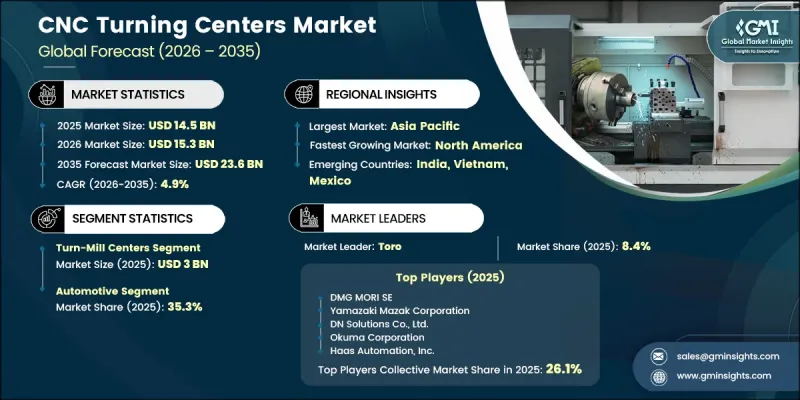
在嚴苛的生產環境中,製造商越來越依賴數控車削來實現高精度、高重複性和高效率的加工。這些電腦控制系統利用旋轉工件和精密切削刀具來生產圓柱形、圓錐形和複雜形狀的零件,同時保持嚴格的製造公差。如今,先進的工具機配置將多種加工功能、自動換刀裝置、附加軸、輔助主軸操作、冷卻技術和偵測功能整合到一個統一的生產平台中。隨著製造商追求更高的生產效率、更少的人工勞動、更高的加工一致性和更短的生產週期,市場需求持續成長。雖然汽車製造業仍然是主要的需求來源,但航太、醫療設備、能源和更廣泛的工業生產也在推動市場擴張。互聯製造技術的日益普及,透過改善監控、維護計畫和生產管理,進一步改變了企業營運數控設備的方式。同時,對國內製造業產能的投資以及主要經濟體工業生產的全面復甦,也為數控車削中心供應商創造了更多商機。
| 市場範圍 | |
|---|---|
| 開始年份 | 2025 |
| 預測期 | 2026-2035 |
| 起始金額 | 145億美元 |
| 預測金額 | 236億美元 |
| 複合年成長率 | 4.9% |
精密加工零件市場持續受惠於各工業領域對精密加工零件的穩定需求。數控系統的進步,包括更強大的連接性、邊緣運算和物聯網監控,正幫助製造商提高設備運轉率,並在意外停機前識別維護需求。主要製造業經濟體的工業活動活性化,也推動了資本投資。隨著汽車製造商向電動動力傳動系統轉型,汽車生產正在經歷重大變革,這催生了新的加工需求,並增加了對能夠生產高精度零件的設備的需求。同時,飛機生產的擴張和醫療設備製造業的產量成長,也維持了對先進多軸加工中心和整合式車銑複合機床的需求。這些系統使製造商能夠在滿足日益嚴格的尺寸和形狀要求的同時,最大限度地減少工件重複加工和所有生產過程。
預計2025年,車銑複合加工中心市場規模將達30億美元。製造商持續青睞這類系統,因為它們將車削和銑削功能整合於單一加工環境中。這種配置在生產需要多種製作流程和複雜形狀的零件時提供了更大的柔軟性。無需在工具機間反覆轉移工件即可完成多種製作流程,從而減輕了設定負擔,最大限度地減少了對準誤差,並縮短了整體生產週期。這些優勢使得車銑複合加工中心尤其適用於那些需要在滿足多樣化生產需求的同時保持嚴格精度標準的製造商。此外,製作流程的整合能力能夠提高專業化生產作業和大規模製造環境中的工作流程效率。
預計到2025年,汽車產業將佔據35.3%的市場。現代汽車生產需要大量高精度加工零件,這使得汽車製造商成為CNC車削中心的主要需求來源。向電動車的轉型進一步擴大了需要高精度加工的零件範圍,促使製造商升級其生產設施。主要汽車製造國的生產基地不斷維護和升級其CNC工具機。
到2025年,美國CNC車削中心市場將佔全球市場的92.9%。憑藉龐大的製造業基礎和高水準的工業資本投資,美國已成為該地區數控車削設備的主要需求中心。此外,美國製造商正日益注重將產能轉移到更靠近國內市場的地方,並加強本地供應鏈。聯邦政府的政策支持正在刺激對製造業基礎設施和產能的更多投資。 《晶片與科學法案》、《通貨膨脹控制法案》和《基礎設施投資與就業法案》等關鍵措施正在為工業投資創造有利環境。
目錄
第1章:調查方法
第2章執行摘要
第3章 行業洞察
- 產業生態系與價值鏈分析
- 產業生態系與價值鏈分析
- 原料及零件供應商(主軸、滾珠螺桿、數控控制器)
- 工具機製造商
- 系統整合商和自動化合作夥伴
- 銷售代理商、經銷商和服務網路
- 終端用戶產業
- 影響產業的因素
- 市場促進因素
- 市場挑戰與陷阱
- 市場機遇
- 成長潛力分析
- 技術與創新展望
- CNC控制器技術的發展歷程(FANUC、西門子、三菱)
- 現場巡迴及Y軸發展
- 溫度補償與振動阻尼技術
- 數位孿生在車削中心的整合
- 基於物聯網的狀態監測和預測性維護
- 監理框架
- CE標誌與歐盟機械指令(2006/42/EC)
- 美國職業安全與健康管理局 (OSHA) 機械安全標準
- ISO 230系列:工具機測試標準
- 環境法規:能源效率和冷卻劑處置
- 各國具體的進出口法規和兩用物項法規
- 供應鏈分析
- 主要零件(滾珠螺桿、線性滑軌、主軸馬達)的採購趨勢
- 供應鏈中斷風險評估
- 工具機供應鏈近岸外包與在地化趨勢
- 價格分析
- 2019-2024年歷史價格趨勢分析
- 依球員類型分類的定價策略(高級球員、超值球員、成本加成球員)
- 按機器類型和軸配置分類的價格基準
- 原物料成本對機器定價的影響
- 波特的分析
- PESTLE分析
- 貿易數據分析
- 依HS編碼(HS 8458、8457)分類的進出口量和進口額趨勢
- 主要貿易路線及關稅影響(美中貿易、歐盟-亞洲貿易、亞洲內部貿易)
- 人工智慧和生成式人工智慧對市場的影響
- 利用人工智慧改造現有的數控編程和刀具路徑生成流程
- 針對特定細分市場的生成式人工智慧(互動式電腦輔助教學、人工智慧驅動的流程最佳化)用例和實施藍圖
- 人工智慧整合工具機的風險、限制和監管考量
- 生產能力和生產情況
- 按地區和主要生產商分類的已安裝製造能力
- 2024-2034年運轉率和擴張計劃
第4章 競爭情勢
- 介紹
- 企業市佔率分析
- 北美洲
- 歐洲
- 亞太地區
- 拉丁美洲
- 中東和非洲
- 企業矩陣分析
- 主要市場公司的競爭分析
- 競爭定位矩陣
- 主要進展
- 併購
- 夥伴關係和聯盟
- 新產品發布
- 業務拓展計劃
第5章 市場估價與預測:依機器類型分類,2022-2035年
- 標準臥式車削中心
- 立式車床(VTL)
- 瑞士型/滑動式主軸箱車削中心
- 多軸車削中心
- 車銑複合床/多功能工具機
第6章 市場估算與預測:依軸線分類,2022-2035年
- 2軸
- 3軸
- 四軸
- 5個或更多軸
第7章 市場估算與預測:依自動化程度分類,2022-2035年
- 傳統CNC工具機(手動上料)
- 半自動
- 全自動/機器人整合
第8章 市場估算與預測:依最終用途分類,2022-2035年
- 汽車和商用車輛
- 航太/國防
- 醫療設備和牙科器械
- 電子和半導體製造設備
- 石油、天然氣和能源
- 一般製造商和合約製造商
- 其他
第9章 市場估價與預測:依通路分類,2022-2035年
- 直銷
- 間接銷售
第10章 市場估價與預測:依地區分類,2022-2035年
- 北美洲
- 美國
- 加拿大
- 歐洲
- 德國
- 英國
- 法國
- 義大利
- 西班牙
- 亞太地區
- 中國
- 印度
- 日本
- 澳洲
- 韓國
- 拉丁美洲
- 巴西
- 墨西哥
- 中東和非洲
- 南非
- 沙烏地阿拉伯
- UAE
第11章:公司簡介
- 世界公司
- DMG MORI SE
- Yamazaki Mazak Corporation
- Okuma Corporation
- Haas Automation, Inc.
- DN Solutions Co., Ltd.
- JTEKT Corporation
- EMAG GmbH & Co. KG
- 當地公司
- Hyundai WIA Corporation
- Nakamura-Tome Precision Industry Co., Ltd.
- INDEX-Werke GmbH & Co. KG
- Lakshmi Machine Works Ltd.(LMW)
- Shenyang Machine Tool Co., Ltd.(SMTCL)
- Hwacheon Machine Tool Co., Ltd.
- EMCO Group GmbH
- Victor Taichung Machinery Works Co., Ltd.
- Murata Machinery Ltd.(Muratec)
- 小眾/專業公司
- Citizen Machinery Co., Ltd.
- Tsugami Corporation
- Tornos SA
- Star Micronics Co., Ltd.
- Nexturn Co., Ltd.
The Global CNC Turning Centers Market was valued at USD 14.5 billion in 2025 and is estimated to grow at a CAGR of 4.9% to reach USD 23.6 billion by 2035.
Manufacturers increasingly rely on CNC turning centers to achieve accurate, repeatable, and efficient machining across demanding production environments. These computer-controlled systems use rotating workpieces and precision cutting tools to manufacture cylindrical, conical, and intricate components while maintaining tight production tolerances. Advanced machine configurations now combine multiple machining functions, automated tool systems, additional axes, secondary spindle operations, cooling technologies, and inspection capabilities within integrated production platforms. Demand continues to rise as manufacturers pursue higher productivity, reduced manual intervention, improved machining consistency, and shorter production cycles. Automotive manufacturing remains a major source of demand, while aerospace, medical equipment, energy, and broader industrial production also support market expansion. The growing adoption of connected manufacturing technologies is further changing how companies operate CNC equipment by enabling improved monitoring, maintenance planning, and production control. At the same time, investment in domestic manufacturing capacity and the broader recovery of industrial production in key economies are creating additional opportunities for CNC turning center suppliers.
| Market Scope | |
|---|---|
| Start Year | 2025 |
| Forecast Year | 2026-2035 |
| Start Value | $14.5 Billion |
| Forecast Value | $23.6 Billion |
| CAGR | 4.9% |
The market continues to benefit from steady demand for precision-manufactured components across a wide range of industries. Advances in CNC control systems, including greater connectivity, edge-based processing, and IoT-enabled monitoring, are helping manufacturers improve equipment utilization and identify maintenance requirements before unexpected downtime occurs. The strengthening of industrial activity across major manufacturing economies is also supporting investment in equipment. Automotive production is undergoing significant changes as manufacturers transition to electrified powertrains, creating new machining requirements and increasing the need for equipment capable of producing components with high accuracy. Meanwhile, expanding aircraft production and rising output in the medical manufacturing sector are sustaining demand for advanced multi-axis and integrated turning and milling equipment. These systems allow manufacturers to achieve tighter dimensional and geometric requirements while limiting the need for repeated workpiece handling and additional production stages.
The turn-mill centers segment generated USD 3 billion in 2025. Manufacturers continue to favor these systems because they combine turning and milling functions within a single machining environment. This configuration provides greater production flexibility for components that require several machining processes and complex geometries. Completing multiple operations without repeatedly transferring the workpiece between machines can reduce setup requirements, minimize alignment-related inaccuracies, and shorten overall production schedules. These advantages make turn-mill centers particularly suitable for manufacturers that handle diverse production requirements while maintaining stringent precision standards. Their ability to consolidate machining processes also supports more efficient workflows for both specialized production operations and larger manufacturing environments.
The automotive industry accounted for a 35.3% share in 2025. Automotive manufacturers continue to represent a substantial source of CNC turning center demand because modern vehicle production requires large volumes of accurately machined components. The transition toward electric vehicles is further expanding the range of parts that require high-precision machining and is encouraging manufacturers to update their production equipment. Automotive production centers across major manufacturing countries continue to maintain and upgrade their CNC machine inventories to achieve required quality standards, improve machining consistency, and meet targeted production cycle times. Ongoing investments in vehicle manufacturing capacity, combined with changing component designs and evolving production requirements, are expected to maintain strong demand for CNC turning centers from the automotive sector.
United States CNC Turning Centers Market accounted for 92.9% in 2025. The country represents the primary demand center for CNC turning equipment in the region, supported by its broad manufacturing base and high level of industrial capital investment. Manufacturers in the United States are also increasing their focus on bringing production capacity closer to domestic markets and strengthening local supply chains. Federal policy support has encouraged additional investment in manufacturing infrastructure and production capabilities. Major initiatives, including the CHIPS and Science Act, the Inflation Reduction Act, and the Infrastructure Investment and Jobs Act, are contributing to a favorable environment for industrial investment.
Major companies operating in the global CNC turning centers market include Nexturn Co., Ltd., Citizen Machinery Co., Ltd., DMG MORI SE, EMCO Group GmbH, Yamazaki Mazak Corporation, Victor Taichung Machinery Works Co., Ltd., Okuma Corporation, Star Micronics Co., Ltd., Haas Automation, Inc., Tornos SA, DN Solutions Co., Ltd., Tsugami Corporation, JTEKT Corporation, Murata Machinery Ltd. (Muratec), EMAG GmbH & Co. KG, Hyundai WIA Corporation, Nakamura-Tome Precision Industry Co., Ltd., INDEX-Werke GmbH & Co. KG, Lakshmi Machine Works Ltd. (LMW), Shenyang Machine Tool Co., Ltd. (SMTCL), and Hwacheon Machine Tool Co., Ltd. Companies in the CNC turning centers market are strengthening their market positions by investing in advanced machine designs, automation, digital connectivity, and integrated manufacturing solutions. Manufacturers are expanding product portfolios to address different production volumes, machining requirements, and precision levels across end-use industries. Strategic collaborations and long-term customer relationships help companies improve market access and secure recurring equipment demand. Businesses are also incorporating smart manufacturing capabilities that support remote monitoring, production analytics, predictive maintenance, and more efficient machine utilization. Product innovation remains another important strategy, with manufacturers improving machining speed, accuracy, flexibility, energy efficiency, and automated operation. Companies are also increasing their presence in emerging manufacturing regions through distribution networks, local partnerships, service infrastructure, and production investments.
Table of Contents
Chapter 1 Methodology
- 1.1 Research approach
- 1.2 Quality Commitments
- 1.2.1 GMI AI policy & data integrity commitment
- 1.2.1.1 Source consistency protocol
- 1.2.1 GMI AI policy & data integrity commitment
- 1.3 Research Trail & Confidence Scoring
- 1.3.1 Research Trail Components
- 1.3.2 Scoring Components
- 1.4 Data Collection
- 1.4.1 Partial list of primary sources
- 1.5 Data mining sources
- 1.5.1 Paid sources
- 1.5.1.1 Sources, by region
- 1.5.1 Paid sources
- 1.6 Base estimates and calculations
- 1.6.1 Base year calculation for any one approach
- 1.7 Forecast model
- 1.7.1 Quantified market impact analysis
- 1.7.1.1 Mathematical impact of growth parameters on forecast
- 1.7.1 Quantified market impact analysis
- 1.8 Research transparency addendum
- 1.8.1 Source attribution framework
- 1.8.2 Quality assurance metrics
- 1.8.3 Our commitment to trust
Chapter 2 Executive Summary
- 2.1 Industry snapshot
- 2.2 Business trends
- 2.3 By Machine Type
- 2.4 By Axis Configuration
- 2.5 By Automation Level
- 2.6 By End Use
- 2.7 By Distribution Channel
- 2.8 Regional trends
Chapter 3 Industry Insights
- 3.1 Industry ecosystem and value chain analysis
- 3.1.1 Industry ecosystem & value chain analysis
- 3.1.2 Raw material & component suppliers (spindles, ball screws, CNC controllers)
- 3.1.3 Machine tool manufacturers
- 3.1.4 System integrators & automation partners
- 3.1.5 Distributors, dealers & service networks
- 3.1.6 End-user industries
- 3.2 Industry impact forces
- 3.2.1 Market Driver
- 3.2.2 Market challenges/pitfalls
- 3.2.3 Market opportunities
- 3.3 Growth potential analysis
- 3.4 Technology & innovation landscape
- 3.4.1 CNC controller technology evolution (FANUC, Siemens, Mitsubishi)
- 3.4.2 Live tooling & Y-axis advancements
- 3.4.3 Thermal compensation & vibration damping technologies
- 3.4.4 Digital twin integration in turning centers
- 3.4.5 IoT-enabled condition monitoring & predictive maintenance
- 3.5 Regulatory framework
- 3.5.1 CE marking & EU Machinery Directive (2006/42/EC)
- 3.5.2 OSHA machine safety standards (USA)
- 3.5.3 ISO 230 series: Machine tool test codes
- 3.5.4 Environmental regulations: Energy efficiency & coolant disposal
- 3.5.5 Country-specific import/export controls & dual-use regulations
- 3.6 Supply chain analysis
- 3.6.1 Key component sourcing landscape (ball screws, linear guides, spindle motors)
- 3.6.2 Supply chain disruption risk assessment
- 3.6.3 Nearshoring & regionalization trends in machine tool supply chains
- 3.7 Pricing analysis (driven by primary research)
- 3.7.1 Historical price trend analysis (2019-2024) (driven by primary research)
- 3.7.2 Pricing strategy by player type (premium/value/cost-plus) (driven by primary research)
- 3.7.3 Price benchmarking by machine type & axis configuration
- 3.7.4 Impact of raw material costs on machine pricing
- 3.8 Porter’s Analysis
- 3.9 PESTEL Analysis
- 3.10 Trade data analysis (driven by primary research) (HS Code: 8427)
- 3.10.1 Import/export volume & value trends by HS code (HS 8458, 8457) (driven by primary research)
- 3.10.2 Key trade corridors & tariff impact (US-China, EU-Asia, Intra-Asia) (driven by primary research)
- 3.11 Impact of AI and generative AI on the market
- 3.11.1 AI-driven disruption of existing CNC programming & toolpath generation
- 3.11.2 GenAI use cases & adoption roadmap by segment (conversational CAM, AI-assisted process optimization)
- 3.11.3 Risks, limitations & regulatory considerations in AI-integrated machine tools
- 3.12 Capacity & production landscape (driven by primary research)
- 3.12.1 Installed manufacturing capacity by region & key producer (driven by primary research)
- 3.12.2 Capacity utilization rates & expansion pipelines (2024-2034) (driven by primary research)
Chapter 4 Competitive Landscape, 2025
- 4.1 Introduction
- 4.2 Company market share analysis
- 4.2.1 North America
- 4.2.2 Europe
- 4.2.3 APAC
- 4.2.4 LATAM
- 4.2.5 MEA
- 4.3 Company matrix analysis
- 4.4 Competitive analysis of major market players
- 4.5 Competitive positioning matrix
- 4.6 Key developments
- 4.6.1 Mergers & acquisitions
- 4.6.2 Partnerships & collaborations
- 4.6.3 New product launches
- 4.6.4 Expansion plans
Chapter 5 Market Estimates and Forecast, By Machine Type, 2022 – 2035 ($ Billion) (Thousand Units)
- 5.1 Key trends
- 5.2 Standard Horizontal Turning Centers
- 5.3 Vertical Turning Centers (VTL)
- 5.4 Swiss-Type / Sliding Headstock Turning Centers
- 5.5 Multi-Spindle Turning Centers
- 5.6 Turn-Mill / Multi-Tasking Centers
Chapter 6 Market Estimates and Forecast, By Axis Configuration, 2022 – 2035 ($ Billion) (Thousand Units)
- 6.1 Key trends
- 6.2 2-Axis
- 6.3 3-Axis
- 6.4 4-Axis
- 6.5 5-Axis & Above
Chapter 7 Market Estimates and Forecast, By Automation Level, 2022 – 2035 ($ Billion) (Thousand Units)
- 7.1 Key trends
- 7.2 Conventional CNC (Manual Loading)
- 7.3 Semi-Automatic
- 7.4 Fully Automatic / Robot-Integrated
Chapter 8 Market Estimates and Forecast, By End Use, 2022 – 2035 ($ Billion) (Thousand Units)
- 8.1 Key trends
- 8.2 Automotive & Commercial Vehicles
- 8.3 Aerospace & Defense
- 8.4 Medical Devices & Dental
- 8.5 Electronics & Semiconductor Equipment
- 8.6 Oil & Gas & Energy
- 8.7 General Manufacturing & Job Shops
- 8.8 Others
Chapter 9 Market Estimates and Forecast, By Distribution Channel, 2022 – 2035 ($ Billion) (Thousand Units)
- 9.1 Key trends
- 9.2 Direct sales
- 9.3 Indirect sales
Chapter 10 Market Estimates and Forecast, By Region, 2022 – 2035 ($ Billion) (Thousand Units)
- 10.1 Key trends
- 10.2 North America
- 10.2.1 US
- 10.2.2 Canada
- 10.3 Europe
- 10.3.1 Germany
- 10.3.2 UK
- 10.3.3 France
- 10.3.4 Italy
- 10.3.5 Spain
- 10.4 Asia Pacific
- 10.4.1 China
- 10.4.2 India
- 10.4.3 Japan
- 10.4.4 Australia
- 10.4.5 South Korea
- 10.5 Latin America
- 10.5.1 Brazil
- 10.5.2 Mexico
- 10.6 Middle East and Africa
- 10.6.1 South Africa
- 10.6.2 Saudi Arabia
- 10.6.3 UAE
Chapter 11 Company Profiles
- 11.1 Global Players
- 11.1.1 DMG MORI SE
- 11.1.2 Yamazaki Mazak Corporation
- 11.1.3 Okuma Corporation
- 11.1.4 Haas Automation, Inc.
- 11.1.5 DN Solutions Co., Ltd.
- 11.1.6 JTEKT Corporation
- 11.1.7 EMAG GmbH & Co. KG
- 11.2 Regional Players
- 11.2.1 Hyundai WIA Corporation
- 11.2.2 Nakamura-Tome Precision Industry Co., Ltd.
- 11.2.3 INDEX-Werke GmbH & Co. KG
- 11.2.4 Lakshmi Machine Works Ltd. (LMW)
- 11.2.5 Shenyang Machine Tool Co., Ltd. (SMTCL)
- 11.2.6 Hwacheon Machine Tool Co., Ltd.
- 11.2.7 EMCO Group GmbH
- 11.2.8 Victor Taichung Machinery Works Co., Ltd.
- 11.2.9 Murata Machinery Ltd. (Muratec)
- 11.3 Niche & Specialist Players
- 11.3.1 Citizen Machinery Co., Ltd.
- 11.3.2 Tsugami Corporation
- 11.3.3 Tornos SA
- 11.3.4 Star Micronics Co., Ltd.
- 11.3.5 Nexturn Co., Ltd.

 汽車地板市場規模、佔有率和成長分析:按材料、車輛類型、製造流程、最終用戶、應用和地區分類-2026-2033年產業預測
 汽車地板面板組件市場規模、佔有率和成長分析:按組件、材料、車輛類型、驅動系統、銷售管道和地區分類-2026-2033年產業預測
 汽車後端模組市場規模、佔有率和成長分析:按組件、車輛類型、材料、銷售管道、最終用戶和地區分類-2026年至2033年產業預測
 汽車翼形支架市場規模、佔有率和成長分析:按產品類型、材料、車輛類型、銷售管道、最終用戶和地區分類-2026-2033年產業預測
 轉向柱軸承市場規模、佔有率和成長分析:按軸承類型、材質、車輛類型、銷售管道和地區分類-2026-2033年產業預測
 高速加工中心市場規模、佔有率和成長分析:按產品類型、軸配置、主軸轉速、應用、最終用戶產業和地區分類 - 產業預測,2026-2033年
 高階自行車零件市場規模、佔有率和成長分析:按零件類型、自行車類型、材料、最終用戶、分銷管道和地區分類-2026-2033年產業預測
 2026年全球岩心塞市場報告
 自行車零件售後市場規模、佔有率和成長分析:按產品類型、自行車類型、材料、銷售管道、最終用戶和地區分類 - 產業預測,2026-2033 年2026年全球燃油管路斷開工具市場報告