

 |
市場調查報告書
商品編碼
2109293
2026 年至 2035 年無血清培養基的市場機會、成長要素、產業趨勢與預測。Serum-free Media Market Opportunity, Growth Drivers, Industry Trend Analysis, and Forecast 2026 - 2035 |
||||||

全球無血清培養基市場預計到 2025 年將價值 21 億美元,並將以 11.2% 的複合年成長率成長,到 2035 年達到 59 億美元。
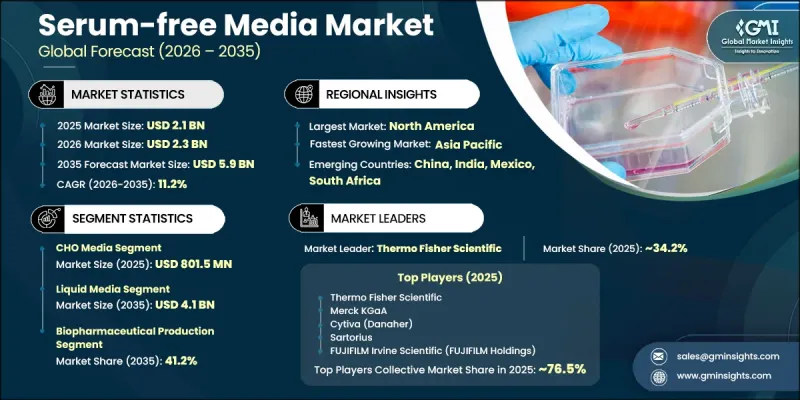
市場擴張的驅動力主要來自對生物製藥生產、再生醫學和疫苗研究日益成長的需求,以及細胞和基因療法應用範圍的不斷擴大。自體免疫疾病、癌症和罕見遺傳疾病等慢性病的盛行率不斷上升,持續推動對先進生物製藥和細胞療法的強勁需求,進而促進了無血清培養基的應用。無血清培養基是一種特殊的細胞培養製劑,不使用動物性血清,而是含有嚴格定義的營養物質、荷爾蒙、生長因子和添加劑,以在受控的實驗室條件下支持細胞增殖。由於其性能穩定、產品安全性高且高度符合監管要求,這些製劑被廣泛應用於生物製藥生產、組織工程、幹細胞研究、疫苗生產以及細胞和基因治療的開發。影響無血清培養基市場的另一個重要趨勢是,傳統含血清培養基正加速向無血清培養基和化學成分明確的替代培養基轉變。這項轉變的驅動力在於提高生產的一致性、可重複性、可擴展性,降低污染風險,並加強監管合規性。因此,製造商正擴大採用無血清培養基來規範生物製藥和先進治療產品的生產流程,並提高生產效率。
| 市場範圍 | |
|---|---|
| 開始年份 | 2025 |
| 預測期 | 2026-2035 |
| 初始市場規模 | 21億美元 |
| 預測金額 | 59億美元 |
| 複合年成長率 | 11.2% |
預計到2025年,CHO培養基市場的銷售額將達到8.015億美元。 細胞株在單株抗體、重組蛋白、疫苗和各種生物製藥生產中的廣泛應用,為其強大的市場地位提供了支持。由於CHO細胞具有高蛋白產量、可靠的可擴展性以及在大規模生產環境中穩定的生產性能,因此在商業性生物製藥生產中仍然備受青睞。此外,越來越多的生物製藥和生物相似藥進入臨床開發和商業化生產階段,也推動了對先進的無血清CHO培養基的持續成長需求。
到2025年,生物製藥生產領域將佔據41.2%的市場佔有率,成為最大的應用類別。該領域的成長主要得益於全球生物製藥產業的持續擴張以及生物製藥(包括單株抗體、重組蛋白、疫苗以及細胞和基因療法)商業化的推進。慢性病相關的醫療保健需求不斷成長,以及精準醫療需求的日益擴大,正推動製藥公司增加生物製藥的生產,從而持續推高對高品質無血清培養基的需求,以確保可靠的生產性能和符合監管要求。
到2025年,北美無血清培養基市佔率將達到38.9%。該地區受益於高度發展的生物技術生態系統、成熟的製藥生產能力、對生命科學領域的積極投資以及先進的研究基礎設施。對生物醫學研究的持續資金支持,以及生物技術和製藥領域的持續投資,將進一步鞏固區域市場成長,並繼續支持無血清培養基產業的創新和商業發展。
目錄
第1章:調查方法和範圍
第2章執行摘要
第3章 行業洞察
- 產業生態系分析
- 影響產業的因素
- 促進因素
- 生物製藥和生物相似藥的需求不斷成長
- 細胞療法和基因療法的應用日益廣泛
- 慢性病盛行率上升
- 化學成分明確的培養基配方進展
- 產業潛在風險與挑戰
- 特殊無血清製劑高成本
- 各種細胞株的複雜最佳化要求
- 與法規和品質合規相關的挑戰
- 市場機遇
- 合約研發生產機構(CDMO)的成長
- 媒體最佳化和自動化方面的技術進步
- 促進因素
- 成長潛力分析
- 監理情勢
- 技術與創新展望
- 最新技術
- 新興技術
- 2025年價格分析
- 對過去價格趨勢的分析
- 按產品類型分類的定價策略
- 波特的分析
- PESTLE分析
- 未來市場趨勢
- 人工智慧和生成式人工智慧對市場的影響
第4章 競爭情勢
- 介紹
- 企業市佔率分析
- 北美洲
- 歐洲
- 亞太地區
- 企業矩陣分析
- 主要市場公司的競爭分析
- 競爭定位矩陣
- 主要進展
- 併購
- 夥伴關係和聯盟
- 新產品發布
- 業務拓展計劃
第5章 市場估算與預測:依產品類型分類,2022-2035年
- CHO細胞培養基
- HEK 293 細胞培養基
- BHK細胞培養基
- VERO細胞培養基
- 昆蟲細胞培養基
- 免疫細胞培養基
- 其他無血清培養基
第6章 市場估計與預測:依形式分類,2022-2035年
- 液體介質
- 半固體和固體培養基
第7章 市場估計與預測:依應用領域分類,2022-2035年
- 生物製藥生產
- 疫苗生產
- 藥物發現與開發
- 幹細胞研究與治療
- 組織工程與再生醫學
- 其他用途
第8章 市場估算與預測:依最終用途分類,2022-2035年
- 製藥和生物技術公司
- 合約研究組織(CRO)
- 學術和研究機構
- 其他最終用戶
第9章 市場估計與預測:依地區分類,2022-2035年
- 北美洲
- 美國
- 加拿大
- 歐洲
- 德國
- 英國
- 法國
- 西班牙
- 義大利
- 荷蘭
- 亞太地區
- 日本
- 中國
- 印度
- 澳洲
- 韓國
- 拉丁美洲
- 巴西
- 墨西哥
- 阿根廷
- 中東和非洲
- 南非
- 沙烏地阿拉伯
- UAE
第10章:公司簡介
- ACROBiosystems
- Biowest
- Corning
- Cytiva
- Cellplus Bio
- Elabscience
- Eminence Scientific
- FUJIFILM Irvine Scientific
- JSBio
- Lonza
- Merck KGaA
- Miltenyi Biotec
- MP Biomedicals
- PromoCell
- PAN-Biotech
- Sartorius
- Sino Biological
- Thermo Fisher Scientific
The Global Serum-Free Media Market was valued at USD 2.1 billion in 2025 and is estimated to grow at a CAGR of 11.2% to reach USD 5.9 billion by 2035.
Market expansion is fueled by the rising demand for biopharmaceutical manufacturing, regenerative medicine, vaccine research, and expanding cell and gene therapy applications. The increasing prevalence of chronic diseases, including autoimmune disorders, cancer, and rare genetic conditions, continues to create strong demand for advanced biologics and cell-based treatments, supporting the adoption of serum-free media. Serum-free media are specialized cell culture formulations developed without animal serum and instead contain carefully defined nutrients, hormones, growth factors, and supplements that support cell growth under controlled laboratory conditions. These formulations are extensively utilized in biologics production, tissue engineering, stem cell research, vaccine manufacturing, and cell and gene therapy development because they offer consistent performance, improved product safety, and greater compatibility with regulatory requirements. Another important trend influencing the serum-free media market is the accelerating transition from conventional serum-containing formulations to serum-free and chemically defined alternatives. This shift is being driven by the need for greater manufacturing consistency, enhanced reproducibility, improved scalability, reduced contamination risks, and stronger regulatory compliance. As a result, manufacturers are increasingly adopting serum-free media to standardize production processes and improve manufacturing efficiency for biologics and advanced therapeutic products.
| Market Scope | |
|---|---|
| Start Year | 2025 |
| Forecast Year | 2026-2035 |
| Start Value | $2.1 Billion |
| Forecast Value | $5.9 Billion |
| CAGR | 11.2% |
The CHO media segment generated USD 801.5 million in 2025. Its strong market position is supported by the extensive use of CHO cell lines in producing monoclonal antibodies, recombinant proteins, vaccines, and a broad range of biologic products. CHO cells continue to be widely preferred for commercial biopharmaceutical manufacturing because they provide high protein productivity, reliable scalability, and consistent manufacturing performance in large-scale production environments. Furthermore, the growing pipeline of biologics and biosimilars entering clinical development and commercial production continues to strengthen demand for advanced serum-free CHO media formulations.
The biopharmaceutical production segment accounted for 41.2% share in 2025, representing the largest application category. Growth within this segment is supported by the continued expansion of the global biopharmaceutical industry and the increasing commercialization of biologics, including monoclonal antibodies, recombinant proteins, vaccines, and cell and gene therapies. Rising healthcare needs associated with chronic diseases and the growing demand for precision medicines are encouraging pharmaceutical companies to expand biologics production, creating sustained demand for high-quality serum-free media that deliver reliable manufacturing performance and regulatory compliance.
North America Serum-Free Media Market captured 38.9% share in 2025. The region benefits from a highly advanced biotechnology ecosystem, well-established pharmaceutical manufacturing capabilities, strong life sciences investments, and sophisticated research infrastructure. Continued financial support for biomedical research, combined with ongoing investments across the biotechnology and pharmaceutical sectors, continues to strengthen regional market growth while supporting innovation and commercial development within the serum-free media industry.
Prominent companies operating in the global serum-free media market include Thermo Fisher Scientific, Sartorius, Cytiva, Corning, Lonza, Merck KGaA, FUJIFILM Irvine Scientific, ACROBiosystems, Sino Biological, Miltenyi Biotec, Biowest, PromoCell, PAN-Biotech, MP Biomedicals, Cellplus Bio, JSBio, Elabscience, and Eminence Scientific. Companies operating in the serum-free media market are strengthening their market position by expanding product portfolios with chemically defined and application-specific media formulations tailored for biopharmaceutical production and advanced therapies. They are investing heavily in research and development to improve media performance, scalability, and manufacturing consistency while meeting evolving regulatory standards. Strategic collaborations with biotechnology firms, contract development and manufacturing organizations, and research institutions are helping accelerate product innovation and commercial adoption. Manufacturers are also increasing production capacity, strengthening global distribution networks, and enhancing technical support services to serve growing customer demand.
Table of Contents
Chapter 1 Methodology and Scope
- 1.1 Market scope and definition
- 1.2 Research approach
- 1.3 Quality commitments
- 1.3.1 GMI AI policy and data integrity commitment
- 1.3.1.1 Source consistency protocol
- 1.3.1 GMI AI policy and data integrity commitment
- 1.4 Research trail and confidence scoring
- 1.4.1 Research trail components
- 1.4.2 Scoring components
- 1.5 Data collection
- 1.5.1 Partial list of primary sources
- 1.6 Data mining sources
- 1.6.1 Paid sources
- 1.6.1.1 Sources, by region
- 1.6.1 Paid sources
- 1.7 Base estimates and calculations
- 1.7.1 Revenue share analysis
- 1.7.2 Base year calculation
- 1.8 Forecast model
- 1.8.1 Quantified market impact analysis
- 1.8.1.1 Mathematical impact of growth parameters on forecast
- 1.8.1 Quantified market impact analysis
- 1.9 Research transparency addendum
- 1.9.1 Source attribution framework
- 1.9.2 Quality assurance metrics
- 1.9.3 Our commitment to trust
Chapter 2 Executive Summary
- 2.1 Industry 360° synopsis
- 2.2 Key market trends
- 2.2.1 Regional trends
- 2.2.2 Product type trends
- 2.2.3 Form trends
- 2.2.4 Application trends
- 2.2.5 End use trends
- 2.3 CXO perspectives: Strategic imperatives
Chapter 3 Industry Insights
- 3.1 Industry ecosystem analysis
- 3.2 Industry impact forces
- 3.2.1 Growth drivers
- 3.2.1.1 Rising demand for biologics and biosimilars
- 3.2.1.2 Increasing adoption of cell and gene therapies
- 3.2.1.3 Rising incidence of chronic diseases
- 3.2.1.4 Advancements in chemically defined media formulations
- 3.2.2 Industry pitfalls & challenges
- 3.2.2.1 High cost of specialized serum-free formulations
- 3.2.2.2 Complex optimization requirements for different cell lines
- 3.2.2.3 Regulatory and quality compliance challenges
- 3.2.3 Market opportunities
- 3.2.3.1 Growth in contract development and manufacturing organizations (CDMOs)
- 3.2.3.2 Technological advancements in media optimization and automation
- 3.2.1 Growth drivers
- 3.3 Growth potential analysis
- 3.4 Regulatory landscape (Driven by Primary Research)
- 3.4.1 North America
- 3.4.2 Europe
- 3.4.3 Asia Pacific
- 3.4.4 Latin America
- 3.4.5 Middle East & Africa
- 3.5 Technology and innovation landscape (Driven by Primary Research)
- 3.5.1 Current technologies
- 3.5.2 Emerging technologies
- 3.6 Pricing analysis, 2025 (Driven by Primary Research)
- 3.6.1 Historical price trend analysis
- 3.6.2 Pricing strategy, by product type
- 3.7 Porter’s analysis
- 3.8 PESTEL analysis
- 3.9 Future market trends
- 3.10 Impact of AI and Gen AI on the market
Chapter 4 Competitive Landscape, 2025
- 4.1 Introduction
- 4.2 Company market share analysis
- 4.2.1 North America
- 4.2.2 Europe
- 4.2.3 Asia Pacific
- 4.3 Company matrix analysis
- 4.4 Competitive analysis of major market players
- 4.5 Competitive positioning matrix
- 4.6 Key developments
- 4.6.1 Merger and acquisition
- 4.6.2 Partnership and collaboration
- 4.6.3 New product launches
- 4.6.4 Expansion plans
Chapter 5 Market Estimates and Forecast, By Product Type, 2022 - 2035 ($ Mn)
- 5.1 Key trends
- 5.2 CHO media
- 5.3 HEK 293 media
- 5.4 BHK media
- 5.5 VERO cell media
- 5.6 Insect cell media
- 5.7 Immune cell media
- 5.8 Other serum-free media
Chapter 6 Market Estimates and Forecast, By Form, 2022 - 2035 ($ Mn)
- 6.1 Key trends
- 6.2 Liquid media
- 6.3 Semi-solid and solid media
Chapter 7 Market Estimates and Forecast, By Application, 2022 - 2035 ($ Mn)
- 7.1 Key trends
- 7.2 Biopharmaceutical production
- 7.3 Vaccine production
- 7.4 Drug discovery & development
- 7.5 Stem cell research & therapy
- 7.6 Tissue engineering & regenerative medicine
- 7.7 Other applications
Chapter 8 Market Estimates and Forecast, By End Use, 2022 - 2035 ($ Mn)
- 8.1 Key trends
- 8.2 Pharmaceutical & biotechnology companies
- 8.3 Clinical research organizations (CROs)
- 8.4 Academic & research institutions
- 8.5 Other end users
Chapter 9 Market Estimates and Forecast, By Region, 2022 - 2035 ($ Mn)
- 9.1 Key trends
- 9.2 North America
- 9.2.1 U.S.
- 9.2.2 Canada
- 9.3 Europe
- 9.3.1 Germany
- 9.3.2 UK
- 9.3.3 France
- 9.3.4 Spain
- 9.3.5 Italy
- 9.3.6 Netherlands
- 9.4 Asia Pacific
- 9.4.1 Japan
- 9.4.2 China
- 9.4.3 India
- 9.4.4 Australia
- 9.4.5 South Korea
- 9.5 Latin America
- 9.5.1 Brazil
- 9.5.2 Mexico
- 9.5.3 Argentina
- 9.6 Middle East and Africa
- 9.6.1 South Africa
- 9.6.2 Saudi Arabia
- 9.6.3 UAE
Chapter 10 Company Profiles
- 10.1 ACROBiosystems
- 10.2 Biowest
- 10.3 Corning
- 10.4 Cytiva
- 10.5 Cellplus Bio
- 10.6 Elabscience
- 10.7 Eminence Scientific
- 10.8 FUJIFILM Irvine Scientific
- 10.9 JSBio
- 10.10 Lonza
- 10.11 Merck KGaA
- 10.12 Miltenyi Biotec
- 10.13 MP Biomedicals
- 10.14 PromoCell
- 10.15 PAN-Biotech
- 10.16 Sartorius
- 10.17 Sino Biological
- 10.18 Thermo Fisher Scientific

 無血清培養基市場規模、佔有率和成長分析:按產品類型、培養基類型、應用、細胞類型、最終用戶、配方類型和地區分類-2026-2033年產業預測
 無血清培養基市場:按產品類型、無血清培養基類型、細胞類型、配方、應用和最終用戶分類-2026-2030年全球市場預測內皮細胞培養基市場按產品類型、形式、應用和最終用戶分類-全球預測,2026-2032年
 全球血清遊離輕鏈(sFLC)檢測市場:市場規模、佔有率、成長率、行業分析、依類型、應用和地區劃分的分析以及未來預測(2026-2034)
 全球無血清培養基最佳化市場:預測至 2032 年—按成分、細胞類型、培養基規格、尺寸、應用、最終用戶和地區進行分析
 無血清培養基:全球市場佔有率和排名、總收入和需求預測(2025-2031年)
 全球無血清培養基市場:市場規模、佔有率和趨勢分析(按解決方案、產品、最終用途、類型、地區和細分市場,2025-2030 年)