


 |
市場調查報告書
商品編碼
2109284
脂質奈米顆粒市場:商業機會、成長要素、產業趨勢分析及2026-2035年預測Lipid Nanoparticles Market Opportunity, Growth Drivers, Industry Trend Analysis, and Forecast 2026 - 2035 |
||||||

2025年全球脂質奈米顆粒市場價值為12億美元,預計2035年將以13.3%的複合年成長率成長至41億美元。
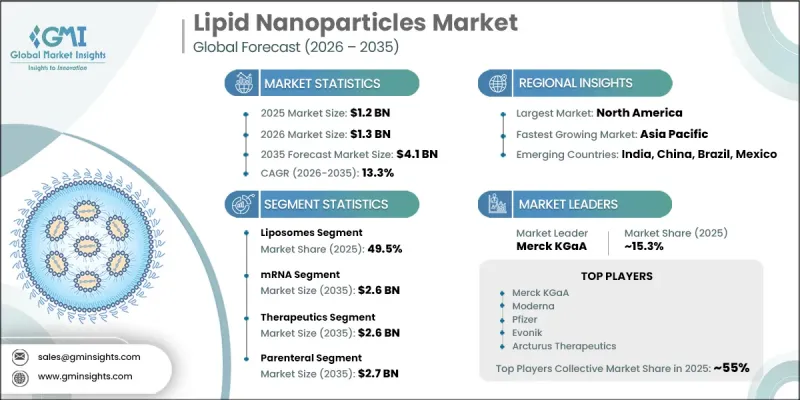
脂質奈米顆粒產業的整體成長主要受感染疾病和癌症發病率上升以及對先進藥物遞送技術日益成長的需求所驅動,這些技術旨在提高藥物製劑的穩定性、生物利用度和治療效果。脂質奈米顆粒是一種奈米級遞送系統,用於封裝核酸療法、疫苗和小分子藥物等治療性化合物,並將其直接遞送至體內目標細胞。這些脂質載體的尺寸通常在10至1000奈米之間,在提高現代藥物遞送的效率和精確度方面發揮著至關重要的作用。對奈米醫學研究、RNA療法和下一代藥物技術的投資增加也促進了該市場的成長。製藥公司、研究機構和政府機構的資金投入增加,正在加速脂質奈米顆粒平台的創新,並加強先進治療方案的開發。預計在預測期內,精準醫療、標靶藥物傳遞和新型治療製劑的持續進步將為全球脂質奈米顆粒市場創造巨大的成長機會。
| 市場範圍 | |
|---|---|
| 開始年份 | 2025 |
| 預測期 | 2026-2035 |
| 初始市場規模 | 12億美元 |
| 預測金額 | 41億美元 |
| 複合年成長率 | 13.3% |
隨著先進藥物遞送系統研發活動的蓬勃發展,全球脂質奈米顆粒產業持續擴張。人們越來越關注提高治療效率、減少全身副作用和增強療效,脂質奈米顆粒技術正被廣泛應用於藥物研發的整體。製劑技術的不斷創新正在提升遞送能力、拓展應用前景,並推動先進治療產品的商業化進程。對精準醫療和下一代藥物技術的持續投入,也進一步促進了市場的長期成長。
預計到2025年,脂質體市佔率將達到49.5%。其領先地位得益於脂質體在提高藥物包封效率、最佳化藥物動力學性能以及增強治療化合物的穩定性和生物利用度方面的優勢。脂質體的結構特性使其能夠有效地遞送多種類型的治療藥物,並支持長期臨床應用。透過先進的表面修飾技術,脂質體製劑技術的不斷進步,進一步提高了藥物遞送效率,降低了全身毒性,並延長了循環時間,從而鞏固了脂質體在整體市場中的主導地位。
預計到2025年,製藥和生技板塊的銷售額將達到7.474億美元。此板塊的成長主要得益於脂質奈米顆粒平台在臨床開發、商業化生產和先進藥物遞送應用的廣泛應用。持續加大研發投入,旨在提高核酸療法和標靶治療方案的遞送效率,從而推動了其更廣泛的市場應用。此外,與合約研發生產機構(CDMO)的合作不斷加強,提高了生產規模化能力、合規性、生產品質和商業化能力,進一步鞏固了該板塊的市場主導地位。
預計到2025年,北美脂質奈米顆粒市場將佔據41.6%的市場佔有率,並在整個預測期內保持顯著成長。該地區市場的擴張主要受癌症和其他慢性疾病日益普遍的推動,這持續推高了對先進標靶藥物遞送技術的需求。強大的研發能力、大量的醫藥投資、不斷擴大的臨床開發活動以及先進治療平台的持續創新,進一步鞏固了該地區在全球脂質奈米顆粒行業的主導地位。
目錄
第1章:調查方法
第2章執行摘要
第3章 行業洞察
- 產業生態系分析
- 影響產業的因素
- 促進因素
- 感染疾病和癌症發生率上升
- 對穩定性和生物利用度更高的製劑的需求日益成長
- 擴大研究經費和活動
- 基於mRNA的治療藥物的應用正在不斷擴大。
- 產業潛在風險與挑戰
- 嚴格的監管要求
- 原料高成本
- 機會
- 個人化醫療和精準醫療正變得越來越普及。
- 促進因素
- 成長潛力分析
- 監理情勢
- 價格趨勢分析
- 技術與創新展望
- 最新科技趨勢
- 新興技術
- 未來市場趨勢
- 人工智慧和生成式人工智慧對市場的影響
- 波特的分析
- PESTLE分析
第4章 競爭情勢
- 介紹
- 企業矩陣分析
- 企業市佔率分析
- 世界
- 北美洲
- 歐洲
- 亞太地區
- LAMEA
- 主要市場公司的競爭分析
- 競爭定位矩陣
- 主要進展
- 併購
- 夥伴關係和聯盟
- 新產品發布
- 業務拓展計劃
第5章 市場估算與預測:依產品類型分類,2022-2035年
- 脂質體
- 固體脂質奈米顆粒
- 奈米結構脂質載體
- 其他產品類型
第6章 市場估計與預測:依分子分類,2022-2035年
- siRNA
- mRNA
- 其他分子
第7章 市場估計與預測:依應用領域分類,2022-2035年
- 治療
- 癌症
- 真菌病
- 止痛藥
- 疫苗
- 免疫抑制劑
- 其他用途
- 調查
第8章 市場估計與預測:依給藥途徑分類,2022-2035年
- 口服
- 腸外
- 外用
- 其他給藥途徑
第9章 市場估計與預測:依最終用途分類,2022-2035年
- 製藥和生物技術公司
- 研究機構
- 其他最終用戶
第10章 市場估價與預測:依地區分類,2022-2035年
- 北美洲
- 美國
- 加拿大
- 歐洲
- 德國
- 英國
- 法國
- 西班牙
- 義大利
- 荷蘭
- 亞太地區
- 中國
- 日本
- 印度
- 澳洲
- 韓國
- 拉丁美洲
- 巴西
- 墨西哥
- 阿根廷
- 中東和非洲
- 南非
- 沙烏地阿拉伯
- UAE
第11章:公司簡介
- ABP Biosciences
- Acrotech Biopharm
- Alnylam Pharmaceuticals
- Arcturus Therapeutics
- Ascendia Pharmaceuticals
- Bayer Pharmaceuticals
- Boehringer Ingelheim
- Cayman Chemical
- Creative Biostructure
- Diant Pharma
- Evonik
- Merck KGaA
- Moderna
- Pfizer
- Sigma-Tau Pharmaceuticals
- Teva Pharmaceuticals
- Thermo Fisher Scientific
The Global Lipid Nanoparticles Market was valued at USD 1.2 billion in 2025 and is estimated to grow at a CAGR of 13.3% to reach USD 4.1 billion by 2035.
Growth across the lipid nanoparticles industry is fueled by the increasing prevalence of infectious diseases and cancer, along with rising demand for advanced drug delivery technologies that improve the stability, bioavailability, and therapeutic effectiveness of pharmaceutical formulations. Lipid nanoparticles are nanoscale delivery systems engineered to encapsulate and transport therapeutic compounds, including nucleic acid-based therapies, vaccines, and small-molecule drugs, directly to targeted cells within the body. Typically ranging from 10 to 1,000 nanometers in size, these lipid-based carriers play a critical role in enhancing the efficiency and precision of modern drug delivery. The market is also benefiting from expanding investments in nanomedicine research, RNA-based therapeutics, and next-generation pharmaceutical technologies. Growing financial support from pharmaceutical companies, research institutions, and government organizations is accelerating innovation in lipid nanoparticle platforms while strengthening the development of advanced therapeutic solutions. Continued progress in precision medicine, targeted drug delivery, and novel therapeutic formulations is expected to create significant growth opportunities for the global lipid nanoparticles market throughout the forecast period.
| Market Scope | |
|---|---|
| Start Year | 2025 |
| Forecast Year | 2026-2035 |
| Start Value | $1.2 Billion |
| Forecast Value | $4.1 Billion |
| CAGR | 13.3% |
The global lipid nanoparticles industry continues to expand as research and development activities surrounding advanced drug delivery systems gain momentum. Increasing focus on improving treatment efficiency, reducing systemic side effects, and enhancing therapeutic performance is encouraging broader adoption of lipid nanoparticle technologies across pharmaceutical development. Ongoing innovation in formulation techniques is improving delivery performance, expanding application potential, and supporting the commercialization of advanced therapeutic products. Rising investment in precision medicine and next-generation pharmaceutical technologies is further reinforcing long-term market growth.
The liposomes segment accounted for a 49.5% share in 2025. Its dominant position is supported by its ability to improve drug encapsulation, optimize pharmacokinetic performance, and enhance the stability and bioavailability of therapeutic compounds. The structural characteristics of liposomes enable efficient delivery of multiple types of therapeutic agents while supporting long-term clinical applications. Continuous advancements in liposomal formulation technologies have improved drug-loading efficiency, minimized systemic toxicity, and enhanced circulation time through advanced surface modification techniques, strengthening the segment's leadership across the market.
The pharmaceutical and biotechnology companies segment generated USD 747.4 million in 2025. Growth within this segment is driven by extensive utilization of lipid nanoparticle platforms for clinical development, commercial-scale manufacturing, and advanced drug delivery applications. Continued investment in research and development aimed at improving delivery efficiency for nucleic acid-based therapeutics and targeted treatment solutions is supporting broader market adoption. In addition, increasing collaboration with contract development and manufacturing organizations is improving production scalability, regulatory compliance, manufacturing quality, and commercialization capabilities, further reinforcing the segment's dominant market position.
North America Lipid Nanoparticles Market accounted for a 41.6% share in 2025 and is expected to experience notable growth throughout the forecast period. Regional expansion is being supported by the growing prevalence of cancer and other chronic diseases, which continues to increase demand for advanced targeted drug delivery technologies. Strong research capabilities, substantial pharmaceutical investment, expanding clinical development activities, and continued innovation in advanced therapeutic platforms are further strengthening the region's leadership within the global lipid nanoparticles industry.
Major companies operating in the global lipid nanoparticles market include ABP Biosciences, Acrotech Biopharm, Alnylam Pharmaceuticals, Arcturus Therapeutics, Ascendia Pharmaceuticals, Bayer Pharmaceuticals, Boehringer Ingelheim, Cayman Chemicals, Creative Biostructure, Diant Pharma, Evonik, Merck KGaA, Moderna, Pfizer, Sigma-Tau Pharmaceuticals, Teva Pharmaceuticals, and Thermo Fisher Scientific. Companies participating in the lipid nanoparticles industry are strengthening their market position by investing heavily in research and development, advanced formulation technologies, and scalable manufacturing capabilities. Many organizations are expanding production capacity while improving lipid nanoparticle performance, stability, and delivery efficiency to address the growing demand for precision therapeutics. Strategic collaborations with pharmaceutical companies, research organizations, and contract manufacturing partners are accelerating product development and commercialization. Businesses are also focusing on regulatory compliance, quality assurance, and process optimization to support large-scale manufacturing and global market expansion.
Table of Contents
Chapter 1 Research Methodology
- 1.1 Research approach
- 1.2 Quality commitments
- 1.2.1 GMI AI policy & data integrity commitment
- 1.2.1.1 Source consistency protocol
- 1.2.1 GMI AI policy & data integrity commitment
- 1.3 Research trail & confidence scoring
- 1.3.1 Research trail components
- 1.3.2 Scoring components
- 1.4 Data collection
- 1.4.1 Partial list of primary sources
- 1.5 Data mining sources
- 1.5.1 Paid sources
- 1.5.1.1 Sources, by region
- 1.5.1 Paid sources
- 1.6 Base estimates and calculations
- 1.6.1 Base year calculation
- 1.7 Forecast model
- 1.7.1 Quantified market impact analysis
- 1.7.1.1 Mathematical impact of growth parameters on forecast
- 1.7.1 Quantified market impact analysis
- 1.8 Research transparency addendum
- 1.8.1 Source attribution framework
- 1.8.2 Quality assurance metrics
- 1.8.3 Our commitment to trust
Chapter 2 Executive Summary
- 2.1 Industry 360° synopsis
- 2.2 Key market trends
- 2.2.1 Regional trends
- 2.2.2 Product type trends
- 2.2.3 Molecule trends
- 2.2.4 Application trends
- 2.2.5 Route of administration trends
- 2.2.6 End use trends
- 2.3 CXO perspectives: Strategic imperatives
Chapter 3 Industry Insights
- 3.1 Industry ecosystem analysis
- 3.2 Industry impact forces
- 3.2.1 Growth drivers
- 3.2.1.1 Rising prevalence of infectious diseases and cancer
- 3.2.1.2 Growing demand for improved stability and bioavailability drug formulations
- 3.2.1.3 Expanding research funding and activities
- 3.2.1.4 Growing expansion in mRNA therapeutics
- 3.2.2 Industry pitfalls and challenges
- 3.2.2.1 Stringent regulatory requirements
- 3.2.2.2 High cost of raw materials
- 3.2.3 Opportunities
- 3.2.3.1 Rising adoption of personalized and precision medicine
- 3.2.1 Growth drivers
- 3.3 Growth potential analysis
- 3.4 Regulatory landscape
- 3.5 Pricing trend analysis (Driven by Primary Research)
- 3.6 Technology and innovation landscape (Driven by Primary Research)
- 3.6.1 Current technological trends
- 3.6.2 Emerging technologies
- 3.7 Future market trends (Driven by Primary Research)
- 3.8 Impact of AI & Generative AI on the Market (Driven by Primary Research)
- 3.9 Porter's analysis
- 3.10 PESTEL analysis
Chapter 4 Competitive Landscape, 2025
- 4.1 Introduction
- 4.2 Company matrix analysis
- 4.3 Company market share analysis (Driven by Primary Research)
- 4.3.1 Global
- 4.3.2 North America
- 4.3.3 Europe
- 4.3.4 Asia Pacific
- 4.3.5 LAMEA
- 4.4 Competitive analysis of major market players
- 4.5 Competitive positioning matrix
- 4.6 Key developments
- 4.6.1 Mergers & acquisitions
- 4.6.2 Partnerships & collaborations
- 4.6.3 New product launches
- 4.6.4 Expansion plans
Chapter 5 Market Estimates and Forecast, By Product Type, 2022 - 2035 ($ Mn)
- 5.1 Key trends
- 5.2 Liposomes
- 5.3 Solid lipid nanoparticles
- 5.4 Nanostructured lipid carriers
- 5.5 Other product types
Chapter 6 Market Estimates and Forecast, By Molecule, 2022 - 2035 ($ Mn)
- 6.1 Key trends
- 6.2 siRNA
- 6.3 mRNA
- 6.4 Other molecules
Chapter 7 Market Estimates and Forecast, By Application, 2022 - 2035 ($ Mn)
- 7.1 Key trends
- 7.2 Therapeutics
- 7.2.1 Cancer
- 7.2.2 Fungal disease
- 7.2.3 Analgesics
- 7.2.4 Vaccines
- 7.2.5 Immunosuppressants
- 7.2.6 Other applications
- 7.3 Research
Chapter 8 Market Estimates and Forecast, By Route of Administration, 2022 - 2035 ($ Mn)
- 8.1 Key trends
- 8.2 Oral
- 8.3 Parenteral
- 8.4 Topical
- 8.5 Other routes of administration
Chapter 9 Market Estimates and Forecast, By End Use, 2022 - 2035 ($ Mn)
- 9.1 Key trends
- 9.2 Pharmaceutical and biotechnology companies
- 9.3 Research institutes
- 9.4 Other end users
Chapter 10 Market Estimates and Forecast, By Region, 2022 - 2035 ($ Mn)
- 10.1 Key trends
- 10.2 North America
- 10.2.1 U.S.
- 10.2.2 Canada
- 10.3 Europe
- 10.3.1 Germany
- 10.3.2 UK
- 10.3.3 France
- 10.3.4 Spain
- 10.3.5 Italy
- 10.3.6 Netherlands
- 10.4 Asia Pacific
- 10.4.1 China
- 10.4.2 Japan
- 10.4.3 India
- 10.4.4 Australia
- 10.4.5 South Korea
- 10.5 Latin America
- 10.5.1 Brazil
- 10.5.2 Mexico
- 10.5.3 Argentina
- 10.6 MEA
- 10.6.1 South Africa
- 10.6.2 Saudi Arabia
- 10.6.3 UAE
Chapter 11 Company Profiles
- 11.1 ABP Biosciences
- 11.2 Acrotech Biopharm
- 11.3 Alnylam Pharmaceuticals
- 11.4 Arcturus Therapeutics
- 11.5 Ascendia Pharmaceuticals
- 11.6 Bayer Pharmaceuticals
- 11.7 Boehringer Ingelheim
- 11.8 Cayman Chemical
- 11.9 Creative Biostructure
- 11.10 Diant Pharma
- 11.11 Evonik
- 11.12 Merck KGaA
- 11.13 Moderna
- 11.14 Pfizer
- 11.15 Sigma-Tau Pharmaceuticals
- 11.16 Teva Pharmaceuticals
- 11.17 Thermo Fisher Scientific

 2026-2034年全球蛋黃磷脂醯膽鹼市場規模、佔有率、趨勢和成長分析報告
 雞蛋來源磷脂醯膽鹼市場:商業機會、成長要素、產業趨勢分析及 2026-2035 年預測。
 脂質奈米顆粒市場:按原料、類型、製造方法、配方、粒徑、功能、應用和終端用戶產業分類-2026-2032年全球市場預測蛋黃來源磷脂醯膽鹼市場:依應用、形態、磷脂醯膽鹼含量及萃取方法分類-2026-2032年全球市場預測
 脂質奈米顆粒市場分析與預測(至2035年):按類型、產品類型、技術、應用、材料類型、製程、最終用戶、功能、溶液分類脂質奈米顆粒製造市場分析與預測(至2035年):類型、產品、服務、技術、組件、應用、材料類型、製程、最終用戶
 全球蛋黃磷脂醯膽鹼市場:市場規模、佔有率和趨勢分析(按形態、應用和地區分類),細分市場預測(2026-2033 年)按劑型、包裝、劑量強度、應用、最終用戶和通路分類的蛋白結合型紫杉醇市場-2026-2032年全球預測氫化磷脂醯膽鹼市場:依來源、形態、應用和最終用途產業分類,全球預測(2026-2032年)脂質奈米顆粒開發服務市場(按服務類型、給藥途徑、材料、應用和最終用戶分類)—2026-2032年全球預測