


 |
市場調查報告書
商品編碼
2109279
打包機市場機會、成長要素、產業趨勢分析及 2026-2035 年預測。Baler Market Opportunity, Growth Drivers, Industry Trend Analysis, and Forecast 2026 - 2035 |
||||||

預計到 2025 年,全球打包機市場價值將達到 49 億美元,並將以 5.2% 的複合年成長率成長,到 2035 年達到 84 億美元。
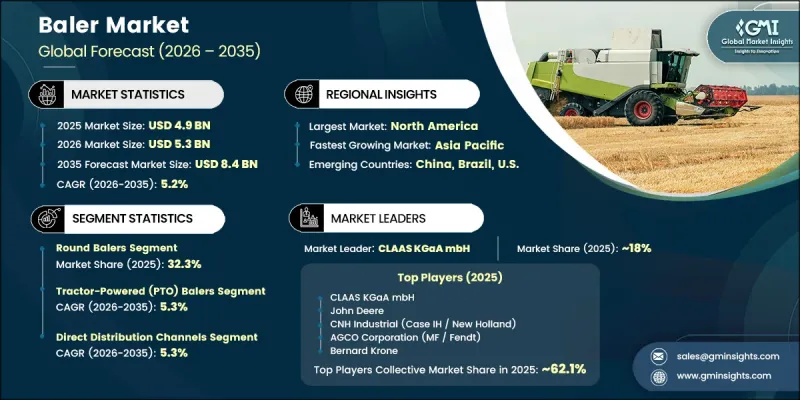
市場成長主要受已開發國家和新興國家農業機械化、工業廢棄物管理和生質能加工需求不斷成長的驅動。該行業的需求主要來自兩個方面:一是需要高效包裝飼料和作物殘渣的農業企業,二是尋求高效物料壓縮解決方案的回收和廢棄物管理機構。人口結構變化和持續的都市區化加劇了農村地區的勞動力短缺,促使農民用機械設備取代勞力密集的打包作業。農場平均規模的擴大,尤其是在農業已開發地區,進一步提升了投資打包設備的經濟效益。人事費用的上升以及提高營運效率的需求,促使許多農場(無論規模大小)採用先進的打包機,以提高效率、減少對人工的依賴並最佳化作物處理流程。這一趨勢正穩步擴大目標市場,從大型商業農場擴展到尋求透過設備現代化提高生產力的中型農業企業。
| 市場範圍 | |
|---|---|
| 開始年份 | 2025 |
| 預測期 | 2026-2035 |
| 初始市場規模 | 49億美元 |
| 預測金額 | 84億美元 |
| 複合年成長率 | 5.2% |
預計到2025年,圓捆打包機機市佔率將達到32.3%,並在2035年之前以5.2%的複合年成長率成長。圓捆打包機因其能夠處理多種作物、具有競爭力的入門成本以及與各種曳引機功率輸出的兼容性,仍然是加工乾草、秸稈和青貯飼料的首選。可變容積圓捆打包機因其操作柔軟性且能夠打出各種尺寸的捆包而繼續廣泛應用。同時,固定容積圓捆打捆機仍受到注重成本且需要日常農業應用中可靠性能的使用者的青睞。
預計到2025年,曳引機驅動動力輸出軸(PTO)打包機市佔率將達到54.3%。其強勁的市場地位得益於曳引機作為農業機械主要動力來源的廣泛應用。這些打包機相容於標準的540轉/分和1000轉/分PTO系統,能夠輕鬆整合到現有曳引機車隊中,使其成為成熟農業市場和新興農業市場機械化耕作的實用高效解決方案。
北美打包機市佔率佔比達32.9%,預計2026年至2035年將以5%的複合年成長率成長。該地區受益於大規模商業化農業運營、完善的農業機械融資計劃以及穩定的農業機械更新周期。農場營運的持續整合以及對高效飼料和作物殘茬管理解決方案日益成長的需求,正推動全部區域對先進打捆設備的持續投資。
打包機市場的競爭格局包括約翰迪爾、AGCO集團(旗下擁有Massey Ferguson、Hesston和Fendt等品牌)、CLAAS KGaA mbH、Vermeer公司、CNH Industrial(旗下擁有Case IH和New Holland等品牌)、庫恩集團、保田株式會社 (International (IBC)、Orkel AS、HSM GmbH + Co. KG、Pottinger Landtechnik GmbH以及多家區域性製造商。打包機市場的各公司正致力於產品創新、技術進步和業務拓展,以提升自身競爭力。領先企業正投資於自動化、精密農業整合和智慧監控技術,以提高機器生產率和營運效率。各公司正拓展銷售網路、強化售後服務體系,並推出節能高效率的打包機,以滿足不斷變化的客戶需求。與經銷商、農機供應商和工業廢棄物管理公司建立策略合作夥伴關係,也有助於擴大市場覆蓋範圍。此外,各公司都在增加對研發、產能和數位服務平台的投資,同時提供客製化的設備解決方案,以支持提高客戶滿意度、增強品牌忠誠度,並在全球農業和工業市場實現長期成長。
目錄
第1章:調查方法和範圍
第2章執行摘要
第3章 行業洞察
- 產業生態系分析
- 原料和零件供應商
- OEM
- 經銷商、銷售代理、租賃網路
- 最終用戶和售後服務提供服務業者
- 節點特定價值鏈利潤分析
- 利潤率
- 每個階段增加的價值
- 影響價值鏈的因素
- 影響產業的因素
- 促進因素
- 農業機械化的進步和人事費用的上升正在推動打包機的普及。
- 更嚴格的廢棄物管理法規正在加速對回收再生用打包機的需求。
- 對包裝生質能源和可再生原料日益成長的需求正在創造新的應用需求。
- 潛在風險和挑戰
- 由於初始投資成本高,小規模和微型農戶的採用受到限制。
- 收入會因季節性需求變化和對作物生長週期的依賴而波動。
- 機會
- 物聯網智慧打包機的預測性維護與遠端監控:高階市場
- 包裝設備的電氣化符合農業脫碳的需求。
- 促進因素
- 成長潛力分析
- 技術與創新展望
- 固定式和可變式打捆技術的比較
- 自動化高精度軸承系統
- 現代打包機的物聯網整合和遠端資訊處理
- 新興技術:電動和自動化包裝機
- 監理框架
- 美國環保署第四階段最終排放氣體標準(北美)
- 歐盟第五階段引擎排放氣體法規(歐洲)
- 區域廢棄物管理和回收義務
- 農業機械化激勵計畫和補貼
- 價格分析
- 按產品類型分析歷史價格趨勢
- 依球員類型分類的定價策略(高級球員、超值球員、成本加成球員)
- 供應鏈分析
- 主要原料
- 供應商集中度高以及對單一供應來源的依賴所帶來的風險
- 半導體短缺對打包機公司生產計畫的影響
- 近岸外包與供應鏈彈性策略
- 貿易數據分析
- 按產品類別分類的進出口量和進口額趨勢
- 主要貿易路線及關稅的影響
- 人工智慧和生成式人工智慧對市場的影響
- 利用人工智慧改造現有經營模式
- 按細分市場分類的生成式人工智慧用例和部署藍圖
- 風險、限制和監管考量
- 生產能力和生產情況
- 按地區和主要OEM製造商分類的產能
- 主要打包機製造商的設備運轉率和擴張計劃
第4章 競爭情勢
- 介紹
- 企業市佔率分析
- 按地區
- 企業矩陣分析
- 主要市場公司的競爭分析
- 競爭定位矩陣
- 主要進展
- 併購
- 夥伴關係和聯盟
- 新產品發布
- 業務拓展計劃
第5章 市場估價與預測:依打包機類型分類,2022-2035年
- 圓捆打包機
- 固定式圓打包機
- 可變腔室圓打包機
- 小型圓打包機
- 方捆打包機
- 小型方捆打包機
- 大型方捆打包機
- 水平打包機
- 單缸臥式打捆打包機
- 雙缸臥式打包機
- 連續式/密封門式臥式打包機
- 直立式打包機
- 低密度直立式打包機
- 高密度直立式打包機
- 專用打包機
- 棉花打包機
- 青貯打包機
- 大麻和生質能打包機
- 其他
第6章 市場估算與預測:依電源類型分類,2022-2035年
- 曳引機驅動(動力輸出軸驅動)打包機
- 適用於100馬力以下曳引機的打包機
- 適用於100馬力以上曳引機的打包機
- 自走式打捆打包機
- 電動/液壓打包機
- 全電動打包機
- 液壓固定式打包機
- 其他
第7章 市場估計與預測:依應用領域分類,2022-2035年
- 農業
- 乾草和飼料打包
- 秸稈和作物殘茬打捆
- 棉花
- 青貯飼料和生質能量成分的打包
- 回收和廢棄物管理
- 紙板和OCC(廢舊紙板箱)
- 塑膠打包
- 金屬廢料打包
- 混合固態廢棄物打包
- 零售和分銷
- 超級市場和大型零售商店
- 倉庫和履約中心
- 工業製造
- 紡織服裝廢棄物打包
- 橡膠和發泡材打包
- 造紙和紙漿產業的破產
- 其他
第8章 市場估算與預測:依通路分類,2022-2035年
- 直接的
- 間接
第9章 市場估計與預測:依地區分類,2022-2035年
- 北美洲
- 美國
- 加拿大
- 歐洲
- 德國
- 英國
- 法國
- 義大利
- 西班牙
- 亞太地區
- 中國
- 日本
- 印度
- 澳洲
- 韓國
- 拉丁美洲
- 巴西
- 墨西哥
- 阿根廷
- 中東和非洲
- 南非
- 沙烏地阿拉伯
- UAE
第10章:公司簡介
- 世界公司
- John Deere
- CLAAS
- CNH(Case IH/NH)
- AGCO(MF/Fendt)
- Bernard Krone
- Vermeer
- Kuhn Group
- Kubota
- McHale Engineering
- Zoomlion
- Foton Lovol
- Bollegraaf
- 當地公司
- Harris American
- HSM GmbH
- Orkel AS
- Bramidan A/S
- Minos Agri
- 新興企業
- Abbriata Srl
- IHI Star Machinery
- Goweil Maschinenbau
- Brantner/SITREX
The Global Baler Market was valued at USD 4.9 billion in 2025 and is estimated to grow at a CAGR of 5.2% to reach USD 8.4 billion by 2035.
Market growth is driven by rising demand from agricultural mechanization, industrial waste management, and biomass handling applications across both developed and emerging economies. The industry is supported by two primary demand streams: agricultural operations requiring efficient baling of forage and crop residue, and recycling and waste management facilities seeking effective material compaction solutions. Increasing labor shortages in rural areas, driven by demographic changes and ongoing urban migration, are encouraging farmers to replace labor-intensive baling practices with mechanized equipment. The expansion of average farm sizes, particularly across developed agricultural regions, continues to strengthen the economic advantages of investing in baling equipment. Rising labor costs, combined with the need to improve operational productivity, are prompting farms of various sizes to adopt advanced balers that enhance efficiency, reduce dependence on manual labor, and optimize crop handling. This trend is steadily expanding the addressable market beyond large commercial farms to include mid-sized agricultural operations focused on improving productivity through equipment modernization.
| Market Scope | |
|---|---|
| Start Year | 2025 |
| Forecast Year | 2026-2035 |
| Start Value | $4.9 Billion |
| Forecast Value | $8.4 Billion |
| CAGR | 5.2% |
The round baler segment accounted for 32.3% share in 2025 and is anticipated to grow at a CAGR of 5.2% through 2035. Round balers remain the preferred choice for handling hay, straw, and silage because they offer versatility across multiple crop types, competitive acquisition costs, and compatibility with a wide range of tractor power capacities. Variable-chamber round balers continue to gain wider adoption due to their operational flexibility and ability to produce bales of different sizes, while fixed-chamber models remain popular among cost-conscious users seeking dependable performance for routine agricultural applications.
The tractor-powered power take-off (PTO) balers segment held 54.3% share in 2025. Their strong market position is supported by the widespread use of tractors as the primary power source for agricultural equipment. Compatibility with standardized 540 rpm and 1,000 rpm PTO systems allows these balers to integrate easily with existing tractor fleets, making them a practical and efficient solution for mechanized farming operations across both established and developing agricultural markets.
North America Baler Market held 32.9% share, and is expected to grow at a CAGR of 5% between 2026 and 2035. The region benefits from large-scale commercial farming operations, well-developed agricultural equipment financing programs, and a consistent replacement cycle for farm machinery. Continued consolidation of farming operations and increasing demand for efficient forage and crop residue management solutions are supporting steady investment in advanced baling equipment throughout the region.
The competitive landscape of the baler market includes companies such as John Deere, AGCO Corporation (Massey Ferguson / Hesston / Fendt), CLAAS KGaA mbH, Vermeer Corporation, CNH Industrial (Case IH / New Holland), Kuhn Group, Kubota Corporation, Bernard Krone (Krone Group), Lely Industries, Harris Equipment, International Baler Corporation (IBC), Orkel AS, HSM GmbH + Co. KG, Pottinger Landtechnik GmbH, and several regional manufacturers. Companies operating in the baler market are focusing on product innovation, technological advancements, and geographic expansion to strengthen their competitive positions. Leading manufacturers are investing in automation, precision farming integration, and smart monitoring technologies to improve machine productivity and operational efficiency. Businesses are expanding their distribution networks, enhancing after-sales service capabilities, and introducing fuel-efficient, high-performance balers to meet changing customer requirements. Strategic partnerships with dealers, agricultural equipment suppliers, and industrial waste management companies are helping expand market reach. Companies are also increasing investments in research and development, manufacturing capacity, and digital service platforms while offering customized equipment solutions to improve customer satisfaction, strengthen brand loyalty, and support long-term growth across global agricultural and industrial markets.
Table of Contents
Chapter 1 Methodology and Scope
- 1.1 Market scope and definition
- 1.2 Research design
- 1.2.1 Research approach
- 1.2.2 Data collection methods
- 1.3 Data mining sources
- 1.3.1 Global
- 1.3.2 Regional/Country
- 1.4 Base estimates and calculations
- 1.4.1 Base year calculation
- 1.4.2 Key trends for market estimation
- 1.5 Primary research and validation
- 1.5.1 Primary sources
- 1.6 Forecast model
- 1.7 Research assumptions and limitations
Chapter 2 Executive Summary
- 2.1 Industry 360° synopsis
- 2.2 Key market trends
- 2.2.1 Regional
- 2.2.2 Baler type
- 2.2.3 Power source
- 2.2.4 Application
- 2.2.5 Distribution channel
Chapter 3 Industry Insights
- 3.1 Industry ecosystem analysis
- 3.1.1 Raw material & component suppliers
- 3.1.2 OEM manufacturers
- 3.1.3 Dealers, distributors & rental networks
- 3.1.4 End-users & after-sales service providers
- 3.1.5 Value chain margin analysis by node
- 3.1.6 Profit margin
- 3.1.7 Value addition at each stage
- 3.1.8 Factor affecting the value chain
- 3.2 Industry impact forces
- 3.2.1 Growth drivers
- 3.2.1.1 Rising agricultural mechanization & labor cost inflation driving baler adoption
- 3.2.1.2 Tightening waste management regulations accelerating recycling baler demand
- 3.2.1.3 Growth in bioenergy & renewable feedstock baling creating new application demand
- 3.2.2 Pitfalls & Challenges
- 3.2.2.1 High initial capital expenditure limiting adoption among small & marginal farmers
- 3.2.2.2 Seasonal demand fluctuations & crop cycle dependence creating revenue volatility
- 3.2.3 Opportunities
- 3.2.4 IoT-enabled smart balers predictive maintenance & remote monitoring premium segment
- 3.2.5 Electrification of baling equipment aligned with farm decarbonization mandates
- 3.2.1 Growth drivers
- 3.3 Growth potential analysis
- 3.4 Technology and innovation landscape
- 3.4.1 Fixed-chamber vs. Variable-chamber baling technology
- 3.4.2 Automation & precision baling systems
- 3.4.3 Iot integration & telematics in modern balers
- 3.4.4 Emerging technologies electric & autonomous balers
- 3.5 Regulatory framework
- 3.5.1 EPA Tier 4 final emissions standards (North America)
- 3.5.2 EU Stage V engine emissions regulations (Europe)
- 3.5.3 Waste management & recycling mandates by region
- 3.5.4 Farm mechanization incentive programs & subsidies
- 3.6 Pricing analysis (driven by primary research)
- 3.6.1 Historical price trend analysis by product category
- 3.6.2 Pricing strategy by player type (premium / value / cost-plus)
- 3.7 Supply chain analysis
- 3.7.1 Key raw materials
- 3.7.2 Supplier concentration & single-source dependency risks
- 3.7.3 Semiconductor shortage impact on baler production timelines
- 3.7.4 Nearshoring & supply chain resilience strategies
- 3.8 Trade data analysis (driven by paid database) (HS code- 8479899565)
- 3.8.1 Import/export volume & value trends by product category
- 3.8.2 Key trade corridors & tariff impact
- 3.9 Impact of AI & generative AI on the market
- 3.9.1 AI-driven disruption of existing business models
- 3.9.2 GenAI use cases & adoption roadmap by segment
- 3.9.3 Risks, limitations & regulatory considerations
- 3.10 Capacity & production landscape (driven by primary research)
- 3.10.1 Installed manufacturing capacity by region & key OEM producer (driven by primary research)
- 3.10.2 Capacity utilization rates & expansion pipelines among top baler manufacturers (driven by primary research)
Chapter 4 Competitive Landscape, 2025
- 4.1 Introduction
- 4.2 Company market share analysis
- 4.2.1 By region
- 4.2.1.1 North America
- 4.2.1.2 Europe
- 4.2.1.3 Asia Pacific
- 4.2.1.4 Latin America
- 4.2.1.5 Middle East and Africa
- 4.2.1 By region
- 4.3 Company matrix analysis
- 4.4 Competitive analysis of major market players
- 4.5 Competitive positioning matrix
- 4.6 Key developments
- 4.6.1 Mergers & acquisitions
- 4.6.2 Partnerships & collaborations
- 4.6.3 New product launches
- 4.6.4 Expansion plans
Chapter 5 Market Estimates and Forecast, By Baler Type, 2022 - 2035 (USD Billion) (Thousand Units)
- 5.1 Key trends
- 5.2 Round balers
- 5.2.1 Fixed-chamber round balers
- 5.2.2 Variable-chamber round balers
- 5.2.3 Mini round balers
- 5.3 Square balers
- 5.3.1 Small square balers
- 5.3.2 Large square balers
- 5.4 Horizontal balers
- 5.4.1 Single-ram horizontal balers
- 5.4.2 Two-ram horizontal balers
- 5.4.3 Continuous/closed-door horizontal balers
- 5.5 Vertical balers
- 5.5.1 Low-density vertical balers
- 5.5.2 High-density vertical balers
- 5.6 Specialty balers
- 5.6.1 Cotton balers
- 5.6.2 Silage balers
- 5.6.3 Hemp & biomass balers
- 5.7 Others
Chapter 6 Market Estimates and Forecast, By Power Source, 2022 - 2035 (USD Billion) (Thousand Units)
- 6.1 Key trends
- 6.2 Tractor-powered (PTO-driven) balers
- 6.2.1 Below 100 HP tractor-compatible balers
- 6.2.2 Above 100 HP tractor-compatible balers
- 6.3 Self-propelled balers
- 6.4 Electric/hydraulic balers
- 6.4.1 Fully electric balers
- 6.4.2 Hydraulic-powered stationary balers
- 6.5 Others
Chapter 7 Market Estimates and Forecast, By Application, 2022 - 2035 (USD Billion) (Thousand Units)
- 7.1 Key trends
- 7.2 Agriculture
- 7.2.1 Hay & forage baling
- 7.2.2 Straw & crop residue baling
- 7.2.3 Cotton baling
- 7.2.4 Silage & bioenergy feedstock baling
- 7.3 Recycling & waste management
- 7.3.1 Cardboard & OCC (old corrugated containers)
- 7.3.2 Plastics baling
- 7.3.3 Metal scrap baling
- 7.3.4 Mixed solid waste baling
- 7.4 Retail & distribution
- 7.4.1 Supermarkets & big-box retail
- 7.4.2 Warehousing & fulfillment centers
- 7.5 Industrial manufacturing
- 7.5.1 Textile & apparel waste baling
- 7.5.2 Rubber & foam baling
- 7.5.3 Paper & pulp industry baling
- 7.6 Others
Chapter 8 Market Estimates and Forecast, By Distribution Channel, 2022 - 2035 (USD Billion) (Thousand Units)
- 8.1 Key trends
- 8.2 Direct
- 8.3 Indirect
Chapter 9 Market Estimates and Forecast, By Region, 2022 - 2035 (USD Billion) (Thousand Units)
- 9.1 Key trends
- 9.2 North America
- 9.2.1 U.S.
- 9.2.2 Canada
- 9.3 Europe
- 9.3.1 Germany
- 9.3.2 UK
- 9.3.3 France
- 9.3.4 Italy
- 9.3.5 Spain
- 9.4 Asia Pacific
- 9.4.1 China
- 9.4.2 Japan
- 9.4.3 India
- 9.4.4 Australia
- 9.4.5 South Korea
- 9.5 Latin America
- 9.5.1 Brazil
- 9.5.2 Mexico
- 9.5.3 Argentina
- 9.6 Middle East and Africa
- 9.6.1 South Africa
- 9.6.2 Saudi Arabia
- 9.6.3 UAE
Chapter 10 Company Profiles
- 10.1 Global players
- 10.1.1 John Deere
- 10.1.2 CLAAS
- 10.1.3 CNH (Case IH / NH)
- 10.1.4 AGCO (MF / Fendt)
- 10.1.5 Bernard Krone
- 10.1.6 Vermeer
- 10.1.7 Kuhn Group
- 10.1.8 Kubota
- 10.1.9 McHale Engineering
- 10.1.10 Zoomlion
- 10.1.11 Foton Lovol
- 10.1.12 Bollegraaf
- 10.2 Regional players
- 10.2.1 Harris American
- 10.2.2 HSM GmbH
- 10.2.3 Orkel AS
- 10.2.4 Bramidan A/S
- 10.2.5 Minos Agri
- 10.3 Emerging players
- 10.3.1 Abbriata Srl
- 10.3.2 IHI Star Machinery
- 10.3.3 Goweil Maschinenbau
- 10.3.4 Brantner / SITREX

 剪切式打包機回收機市場:全球市場預測(2026-2032年)
 全球圓捆打包機市場捆包抓斗市場:全球市場依產品類型、應用、最終用途產業及通路分類的預測,2026-2032年拖掛式打包機市場:按捆型、作物類型、馬力需求、動力類型、最終用途和分銷管道分類,全球預測,2026-2032年拖掛式拾取打包機市場:按組成、作物類型、動力需求、容量、驅動系統、最終用戶和銷售管道,全球預測,2026-2032年拖掛式破碎打包機市場:按類型、作物類型、操作方式、最終用戶和分銷管道分類,全球預測,2026-2032年牽引式圓捆打包機市場:按倉式、捆包尺寸、原料、動力來源、應用、終端用戶產業和銷售管道分類-2026-2032年全球預測
 日本打包機市場報告:按產品、分銷管道、應用、最終用戶和地區分類(2026-2034 年)全球打包機市場
 打包機市場規模、佔有率、趨勢分析報告:產品、地區、細分市場預測,2025-2030 年