

 |
市場調查報告書
商品編碼
2109276
電腦微晶片市場機會、成長要素、產業趨勢分析及2026-2035年預測。Computer Microchips Market Opportunity, Growth Drivers, Industry Trend Analysis, and Forecast 2026 - 2035 |
||||||

全球電腦微晶片市場預計到 2025 年將達到 307 億美元,並以 10.7% 的複合年成長率成長,到 2035 年將達到 847 億美元。
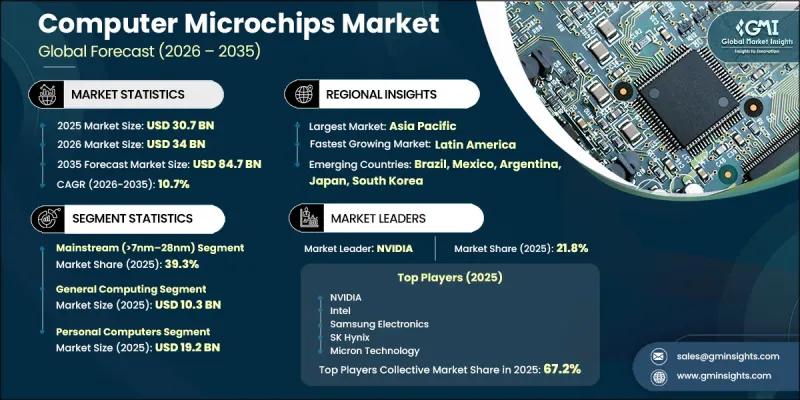
由於各行各業對先進運算技術的持續高需求,市場正在快速擴張。人工智慧 (AI) 基礎設施投資的增加、超大規模資料中心容量的擴張、支援半導體製造的政策以及下一代汽車中半導體負載的不斷成長,都創造了巨大的成長機會。此外,半導體製造技術的不斷進步正在提升晶片的性能、能源效率和處理能力,進一步推動市場擴張。企業正在加大對先進運算平台的投資,以滿足日益成長的高效能處理需求,而各國政府則繼續透過策略性舉措促進國內半導體生產,以增強製造能力和供應鏈韌性。同時,雲端運算、資料密集型應用和數位轉型 (DX) 的普及也推動了對先進微晶片的持續需求。這些因素共同增強了電腦微晶片產業的長期前景,使其在預測期內成為全球技術生態系統的關鍵組成部分。
| 市場範圍 | |
|---|---|
| 開始年份 | 2025 |
| 預測期 | 2026-2035 |
| 初始市場規模 | 307億美元 |
| 預測金額 | 847億美元 |
| 複合年成長率 | 10.7% |
隨著各組織加速投資人工智慧、雲端運算和高效能運算基礎設施,電腦微晶片市場持續成長。隨著運算工作負載的不斷增加,半導體製造商正在擴大產能,以滿足企業技術供應商和先進運算平台日益成長的需求。對國內半導體製造、研發能力、人才培育和供應鏈韌性的持續投資,進一步推動了產業成長。旨在擴大產能和推動半導體創新的公共和私人舉措,正在支持市場的長期發展,並促進全球各行業採用先進計算技術。
預計到2025年,主流(7nm-28nm)晶圓製程將佔據39.3%的市佔率。工業自動化、汽車電子、消費性電子設備、企業系統和邊緣運算應用等領域對這些半導體技術的需求持續成長。對現有晶圓製造設施的持續投資以及半導體在各類電子產品中日益廣泛的應用,都支撐著這一領域的持續成長。對可靠且經濟高效的半導體解決方案日益成長的需求,預計將在整個預測期內保持強勁的市場成長勢頭。
預計到2025年,個人電腦市場規模將達到192億美元。全球市場需求依然強勁,這主要得益於桌上型電腦、筆記型電腦和商用運算系統中先進微處理器的持續普及。持續的設備更換、生產力軟體的日益普及、數位化學習環境的擴展以及混合辦公模式的不斷轉變,都支撐著個人電腦設備的持續需求。這些趨勢不斷鞏固了半導體技術在個人電腦領域的重要性,並有望在未來幾年推動市場進一步成長。
預計到2025年,北美電腦微晶片市場佔有率將達到27.7%,這主要得益於人工智慧、高效能運算、雲端基礎設施和先進伺服器技術領域投資的增加。政府為促進半導體製造和提升國內產能所採取的舉措,進一步加速了市場擴張。此外,數位轉型(DX)專案投資的增加、企業雲端採用率的提高,以及對先進處理器、圖形處理技術和人工智慧加速器日益成長的需求,都將繼續支撐該地區的強勁成長。
目錄
第1章:調查方法和範圍
第2章執行摘要
第3章 行業洞察
- 產業生態系分析
- 供應商情況
- 利潤率
- 成本結構
- 每個階段增加的價值
- 影響價值鏈的因素
- 中斷
- 影響產業的因素
- 促進因素
- 對人工智慧和高效能運算 (HPC) 晶片的需求不斷成長
- 政府鼓勵半導體製造業發展的政策(晶片法和國家半導體政策)
- 雲端資料中心和超大規模基礎設施的快速擴張
- 受電動車和高級駕駛輔助系統 (ADAS) 的推動,汽車半導體的需求正在擴大。
- 擴大先進製造製程節點和晶片/先進封裝技術的應用。
- 產業潛在風險與挑戰
- 大量資本投資和製造成本
- 地緣政治緊張局勢和半導體供應鏈中斷
- 市場機遇
- 人工智慧專用晶片和邊緣人工智慧運算的擴展
- 先進封裝、晶片組和異構整合
- 促進因素
- 成長潛力分析
- 監理情勢
- 波特的分析
- PESTLE分析
- 技術與創新展望
- 最新科技趨勢
- 新興技術
- 價格趨勢
- 按地區
- 依產品
- 定價策略
- 新興經營模式
- 合規要求
- 專利和智慧財產權分析
第4章 競爭情勢
- 介紹
- 企業市佔率分析
- 按地區
- 市場集中度分析
- 主要公司的競爭標竿分析
- 財務績效比較
- 收入
- 利潤率
- R&D
- 產品系列比較
- 產品線寬度
- 科技
- 創新
- 區域擴張比較
- 全球擴張分析
- 服務網路覆蓋
- 按地區分類的市場滲透率
- 競爭定位矩陣
- 領導者
- 挑戰者
- 追蹤者
- 小眾玩家
- 戰略展望矩陣
- 財務績效比較
- 主要進展
- 併購
- 夥伴關係和聯盟
- 技術進步
- 擴張和投資策略
- 數位轉型計劃
- 新興企業競爭公司和新創企業的發展趨勢
第5章 市場估算與預測:依晶片類型分類,2022-2035年
- 中央處理器(CPU)
- 圖形處理器(GPU)
- 記憶
- FPGA(現場可程式化閘陣列)
- ASIC(專用積體電路)
- SoC 和晶片組
- 其他
第6章 市場估算與預測:依指令集架構 (ISA) 分類,2022-2035 年
- x86/x86-64
- ARM(Advanced RISC Machine)
- RISC-V
- 其他
第7章 市場估計與預測:依技術節點分類,2022-2035年
- 尖端(7奈米或更小)
- 主流製程(7奈米至28奈米)
- 成熟/傳統製程(28nm以上)
第8章 市場估計與預測:依應用領域分類,2022-2035年
- 通用計算
- 遊戲和內容創作
- 人工智慧和機器學習
- 邊緣運算和嵌入式運算
- 資料中心和雲端基礎設施
- 高效能運算和科學研究
第9章 市場估計與預測:依最終用途平台分類,2022-2035年
- 個人電腦
- 伺服器和資料中心
- 嵌入式運算系統
- 其他
第10章 市場估價與預測:依地區分類,2022-2035年
- 北美洲
- 美國
- 加拿大
- 歐洲
- 德國
- 英國
- 法國
- 西班牙
- 義大利
- 俄羅斯
- 亞太地區
- 中國
- 印度
- 日本
- 澳洲
- 韓國
- 台灣
- 拉丁美洲
- 巴西
- 墨西哥
- 阿根廷
- 中東和非洲
- 南非
- 沙烏地阿拉伯
- UAE
第11章:公司簡介
- 全球主要公司
- NVIDIA
- Intel
- Samsung Electronics
- SK Hynix
- Micron Technology
- 該地區的主要公司
- 北美洲
- AMD
- Broadcom Inc.
- Qualcomm
- Texas Instruments
- Marvell Technology
- 亞太地區
- MediaTek
- Kioxia Holdings
- 歐洲
- STMicroelectronics
- Infineon Technologies
- 北美洲
- 小眾玩家/顛覆者
- Altera Corporation
- SiFive
- Tenstorrent
- Cerebras Systems
- Groq
- Lattice Semiconductor
The Global Computer Microchips Market was valued at USD 30.7 billion in 2025 and is estimated to grow at a CAGR of 10.7% to reach USD 84.7 billion by 2035.
The market is expanding rapidly as demand for advanced computing technologies continues to increase across multiple industries. Rising investments in artificial intelligence infrastructure, expanding hyperscale data center capacity, supportive semiconductor manufacturing policies, and growing semiconductor content in next-generation vehicles are creating significant growth opportunities. Continuous advancements in semiconductor manufacturing technologies are also improving chip performance, power efficiency, and processing capabilities, further supporting market expansion. Businesses are increasing investments in advanced computing platforms to meet the growing need for high-performance processing, while governments continue to encourage domestic semiconductor production through strategic initiatives that strengthen manufacturing capacity and supply chain resilience. At the same time, increasing adoption of cloud computing, data-intensive applications, and digital transformation initiatives is driving sustained demand for advanced microchips. These combined factors are reinforcing the long-term outlook for the computer microchips industry, positioning it as a critical component of the global technology ecosystem over the forecast period.
| Market Scope | |
|---|---|
| Start Year | 2025 |
| Forecast Year | 2026-2035 |
| Start Value | $30.7 Billion |
| Forecast Value | $84.7 Billion |
| CAGR | 10.7% |
The computer microchips market continues to gain momentum as organizations accelerate investments in artificial intelligence, cloud computing, and high-performance computing infrastructure. Growing computational workloads are encouraging semiconductor manufacturers to expand production capacity in response to increasing demand from enterprise technology providers and advanced computing platforms. Continued investment in domestic semiconductor manufacturing, research capabilities, workforce development, and supply chain resilience is further strengthening industry growth. Public and private sector initiatives aimed at expanding fabrication capacity and advancing semiconductor innovation are supporting long-term market development while improving the availability of advanced computing technologies across global industries.
The mainstream (>7nm-28nm) segment accounted for 39.3% share in 2025. Demand for these semiconductor technologies continues to grow across industrial automation, automotive electronics, consumer devices, enterprise systems, and edge computing applications. Ongoing investments in established wafer manufacturing facilities and increasing semiconductor adoption across a broad range of electronic products are supporting continued expansion of this segment. Growing demand for reliable, cost-effective semiconductor solutions is expected to maintain strong market momentum throughout the forecast period.
The personal computers segment reached USD 19.2 billion in 2025. Demand remains strong as advanced microprocessors continue to power desktops, laptops, notebooks, and commercial computing systems worldwide. Ongoing device replacement cycles, rising adoption of productivity software, expanding digital learning environments, and the continued shift toward hybrid work models are supporting sustained demand for personal computing devices. These trends continue to reinforce the importance of semiconductor technologies within the personal computer segment and are expected to drive further market growth over the coming years.
North America Computer Microchips Market accounted for a 27.7% share in 2025, supported by increasing investments in artificial intelligence, high-performance computing, cloud infrastructure, and advanced server technologies. Government initiatives that encourage semiconductor manufacturing and strengthen domestic production capabilities are further accelerating market expansion. Rising investment in digital transformation projects, expanding enterprise cloud adoption, and increasing demand for advanced processors, graphics processing technologies, and artificial intelligence accelerators continue to support strong regional growth.
Prominent companies operating in the global computer microchips market include Altera Corporation, AMD, Broadcom Inc., Cerebras Systems, Groq, Infineon Technologies, Intel Corporation, Kioxia Holdings, Lattice Semiconductor, Marvell Technology, MediaTek, Micron Technology, NVIDIA Corporation, Qualcomm, Samsung Electronics, SiFive, SK Hynix, STMicroelectronics, Tenstorrent, and Texas Instruments. Companies operating in the computer microchips market are strengthening their competitive position through continuous investment in advanced semiconductor technologies, manufacturing capacity expansion, and product innovation. Industry participants are increasing research and development efforts to improve chip performance, energy efficiency, and processing capabilities while supporting next-generation computing applications. Strategic collaborations with cloud service providers, enterprise technology companies, and automotive manufacturers are helping expand market opportunities and accelerate product commercialization. Many companies are also investing in advanced fabrication facilities, supply chain resilience, and packaging technologies to improve production efficiency and address growing global demand.
Table of Contents
Chapter 1 Methodology and Scope
- 1.1 Market scope and definition
- 1.2 Research design
- 1.2.1 Research approach
- 1.2.2 Data collection methods
- 1.3 Data mining sources
- 1.3.1 Global
- 1.3.2 Regional/Country
- 1.4 Base estimates and calculations
- 1.4.1 Base year calculation
- 1.4.2 Key trends for market estimation
- 1.5 Primary research and validation
- 1.5.1 Primary sources
- 1.6 Forecast model
- 1.7 Research assumptions and limitations
Chapter 2 Executive Summary
- 2.1 Industry 360° synopsis, 2022 – 2035
- 2.2 Key market trends
- 2.2.1 Chip type trends
- 2.2.2 Instruction set architecture (ISA) trends
- 2.2.3 Technology node trends
- 2.2.4 Application trends
- 2.2.5 End-use platform trends
- 2.2.6 Regional trends
- 2.3 TAM Analysis, 2026-2035
- 2.4 CXO perspectives: Strategic imperatives
Chapter 3 Industry Insights
- 3.1 Industry ecosystem analysis
- 3.1.1 Supplier Landscape
- 3.1.2 Profit Margin
- 3.1.3 Cost structure
- 3.1.4 Value addition at each stage
- 3.1.5 Factor affecting the value chain
- 3.1.6 Disruptions
- 3.2 Industry impact forces
- 3.2.1 Growth drivers
- 3.2.1.1 Rising AI and High-Performance Computing (HPC) chip demand
- 3.2.1.2 Government semiconductor manufacturing incentive programs (CHIPS Acts and national semiconductor policies)
- 3.2.1.3 Rapid expansion of cloud data centers and hyperscale infrastructure
- 3.2.1.4 Growing automotive semiconductor demand driven by EVs and ADAS
- 3.2.1.5 Increasing adoption of advanced manufacturing nodes and chiplet/advanced packaging technologies
- 3.2.2 Industry pitfalls and challenges
- 3.2.2.1 High capital investment and fabrication costs
- 3.2.2.2 Geopolitical tensions and semiconductor supply chain disruptions
- 3.2.3 Market opportunities
- 3.2.3.1 Expansion of AI-specific chips and edge AI computing
- 3.2.3.2 Advanced packaging, chiplets, and heterogeneous integration
- 3.2.1 Growth drivers
- 3.3 Growth potential analysis
- 3.4 Regulatory landscape
- 3.4.1 North America
- 3.4.2 Europe
- 3.4.3 Asia Pacific
- 3.4.4 Latin America
- 3.4.5 Middle East & Africa
- 3.5 Porter’s analysis
- 3.6 PESTEL analysis
- 3.7 Technology and Innovation landscape
- 3.7.1 Current technological trends
- 3.7.2 Emerging technologies
- 3.8 Price trends
- 3.8.1 By region
- 3.8.2 By product
- 3.9 Pricing Strategies
- 3.10 Emerging Business Models
- 3.11 Compliance Requirements
- 3.12 Patent and IP analysis
Chapter 4 Competitive Landscape, 2025
- 4.1 Introduction
- 4.2 Company market share analysis
- 4.2.1 By region
- 4.2.1.1 North America
- 4.2.1.2 Europe
- 4.2.1.3 Asia Pacific
- 4.2.1.4 Latin America
- 4.2.1.5 Middle East & Africa
- 4.2.2 Market concentration analysis
- 4.2.1 By region
- 4.3 Competitive benchmarking of key players
- 4.3.1 Financial performance comparison
- 4.3.1.1 Revenue
- 4.3.1.2 Profit margin
- 4.3.1.3 R&D
- 4.3.2 Product portfolio comparison
- 4.3.2.1 Product range breadth
- 4.3.2.2 Technology
- 4.3.2.3 Innovation
- 4.3.3 Geographic presence comparison
- 4.3.3.1 Global footprint analysis
- 4.3.3.2 Service network coverage
- 4.3.3.3 Market penetration by region
- 4.3.4 Competitive positioning matrix
- 4.3.4.1 Leaders
- 4.3.4.2 Challengers
- 4.3.4.3 Followers
- 4.3.4.4 Niche players
- 4.3.5 Strategic outlook matrix
- 4.3.1 Financial performance comparison
- 4.4 Key developments
- 4.4.1 Mergers and acquisitions
- 4.4.2 Partnerships and collaborations
- 4.4.3 Technological advancements
- 4.4.4 Expansion and investment strategies
- 4.4.5 Digital transformation initiatives
- 4.5 Emerging/ startup competitors landscape
Chapter 5 Market Estimates and Forecast, By Chip Type, 2022 – 2035 (USD Million)
- 5.1 Key trends
- 5.2 Central processing units (CPUs)
- 5.3 Graphics processing units (GPUs)
- 5.4 Memory ICs
- 5.5 FPGAs (Field-Programmable Gate Arrays)
- 5.6 ASICs (Application-Specific Integrated Circuits)
- 5.7 SoCs & Chipsets
- 5.8 Others
Chapter 6 Market Estimates and Forecast, By Instruction Set Architecture (ISA), 2022 – 2035 (USD Million)
- 6.1 Key trends
- 6.2 x86 / x86-64
- 6.3 ARM (Advanced RISC Machine)
- 6.4 RISC-V
- 6.5 Others
Chapter 7 Market Estimates and Forecast, By Technology Node, 2022 – 2035 (USD Million)
- 7.1 Key trends
- 7.2 Advanced (≤7nm)
- 7.3 Mainstream (>7nm–28nm)
- 7.4 Mature & legacy (>28nm)
Chapter 8 Market Estimates and Forecast, By Application, 2022 – 2035 (USD Million)
- 8.1 Key trends
- 8.2 General Computing
- 8.3 Gaming & Content Creation
- 8.4 AI & Machine Learning
- 8.5 Edge & Embedded Computing
- 8.6 Data Center & Cloud Infrastructure
- 8.7 HPC & Scientific Research
Chapter 9 Market Estimates and Forecast, By End-Use Platform, 2022 – 2035 (USD Million)
- 9.1 Key trends
- 9.2 Personal computers
- 9.3 Servers & data centers
- 9.4 Embedded computing systems
- 9.5 Others
Chapter 10 Market Estimates and Forecast, By Region, 2022 – 2035 (USD Million)
- 10.1 Key trends
- 10.2 North America
- 10.2.1 U.S.
- 10.2.2 Canada
- 10.3 Europe
- 10.3.1 Germany
- 10.3.2 UK
- 10.3.3 France
- 10.3.4 Spain
- 10.3.5 Italy
- 10.3.6 Russia
- 10.4 Asia Pacific
- 10.4.1 China
- 10.4.2 India
- 10.4.3 Japan
- 10.4.4 Australia
- 10.4.5 South Korea
- 10.4.6 Taiwan
- 10.5 Latin America
- 10.5.1 Brazil
- 10.5.2 Mexico
- 10.5.3 Argentina
- 10.6 Middle East and Africa
- 10.6.1 South Africa
- 10.6.2 Saudi Arabia
- 10.6.3 UAE
Chapter 11 Company Profiles
- 11.1 Global Key Players
- 11.1.1 NVIDIA
- 11.1.2 Intel
- 11.1.3 Samsung Electronics
- 11.1.4 SK Hynix
- 11.1.5 Micron Technology
- 11.2 Regional key players
- 11.2.1 North America
- 11.2.1.1 AMD
- 11.2.1.2 Broadcom Inc.
- 11.2.1.3 Qualcomm
- 11.2.1.4 Texas Instruments
- 11.2.1.5 Marvell Technology
- 11.2.2 Asia Pacific
- 11.2.2.1 MediaTek
- 11.2.2.2 Kioxia Holdings
- 11.2.3 Europe
- 11.2.3.1 STMicroelectronics
- 11.2.3.2 Infineon Technologies
- 11.2.1 North America
- 11.3 Niche Players/Disruptors
- 11.3.1 Altera Corporation
- 11.3.2 SiFive
- 11.3.3 Tenstorrent
- 11.3.4 Cerebras Systems
- 11.3.5 Groq
- 11.3.6 Lattice Semiconductor


