


 |
市場調查報告書
商品編碼
2109274
2026-2035年自動駕駛堆高機市場機會、成長要素、產業趨勢分析及預測Autonomous Forklift Market Opportunity, Growth Drivers, Industry Trend Analysis, and Forecast 2026 - 2035 |
||||||

全球自動駕駛堆高機市場預計到 2025 年將價值 46 億美元,並將以 15.1% 的複合年成長率成長,到 2035 年達到 194 億美元。
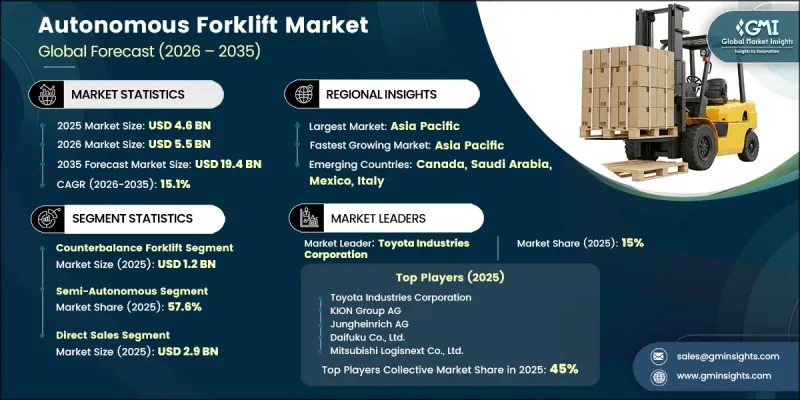
整個自動駕駛堆高機產業的成長主要得益於倉儲自動化投資的增加,以及製造業、物流和配送業長期人手不足的日益嚴峻。各公司正加速採用物料輸送解決方案,以提高生產力、最佳化營運效率並支援大批量倉儲作業。自動駕駛堆高機能夠以最少的人工干預實現穩定可靠的貨物搬運,正逐漸成為現代化自動化設施的重要組成部分。由於這些系統有助於提高處理能力、降低營運成本、提升工作流程的準確性並增強倉庫的整體績效,各公司越來越將採用自動駕駛堆高機視為一項長期策略投資。人工智慧、自主導航、感測器技術和電動汽車平臺的不斷進步,進一步拓展了自動駕駛堆高機的應用範圍,使其能夠應用於更廣泛的工業領域。此外,持續的技術創新以及對智慧物流基礎設施和自動化物料搬運系統投資的增加,共同為全球自動駕駛堆高機市場帶來了強勁的長期成長前景。
| 市場範圍 | |
|---|---|
| 開始年份 | 2025 |
| 預測期 | 2026-2035 |
| 初始市場規模 | 46億美元 |
| 預測金額 | 194億美元 |
| 複合年成長率 | 15.1% |
預計到2025年,平衡重式堆高機市場規模將達12億美元。其主導地位主要得益於其設計的多功能性。這種設計使其能夠在各種工業環境中高效搬運物料,而無需對現有設備進行重大改造。平衡重式堆高機因其部署靈活、搬運能力可靠以及適用於各種倉儲和製造應用而廣受歡迎。預計其能夠適應各種不同的操作需求並支援高效的物料搬運,將在整個預測期內持續推動強勁的需求。
到2025年,半自動市場佔有率將達到57.6%,成為以自動化程度分類的最大細分市場。該細分市場持續佔據主導,是因為它有效地平衡了自動化和操作員監督。這使得企業能夠在自動化重複性物料搬運任務的同時,對更複雜的操作進行人工監督。半自動系統能夠幫助企業提高生產力、減少營運低效率環節,並實現從傳統堆高機操作的平穩過渡,而無需進行大規模的基礎設施升級。其便利的實施和低操作複雜性正持續推動半自動系統在工業設施中的廣泛應用。
美國目前佔據74.3%的市場佔有率,預計2025年市場規模將達到9億美元。市場成長的主要驅動力是倉儲自動化領域的大量投資、物流基礎設施的不斷擴展以及智慧物料搬運技術的日益普及。企業持續部署自動駕駛堆高機,以提高營運效率、緩解人手不足並提升倉庫生產力。預計在預測期內,對自動化物流設施和先進工業技術的持續投資將進一步鞏固美國在該領域的主導地位。
目錄
第1章:調查方法和範圍
第2章執行摘要
第3章 行業洞察
- 產業生態系分析
- 供應商情況
- 利潤率
- 每個階段增加的價值
- 影響價值鏈的因素
- 影響產業的因素
- 促進因素
- 倉庫自動化技術的進步
- 對企業效率的需求
- 人工智慧和感測器技術的進步
- 產業潛在風險與挑戰
- 巨額資本投資
- 技術限制
- 機會
- 智慧倉庫的開發
- Robotics-as-a-Service(RaaS)
- 促進因素
- 成長潛力分析
- 監理框架
- 美國職業安全與健康管理局 (OSHA) 動力工業車標準 (29 CFR 1910.178)
- ISO 3691-4:2023 - 無人工業車輛安全要求
- 歐盟機械指令和自動駕駛卡車的CE標誌要求
- ANSI/ITSDF B56.5 - AGV 安全標準(北美)
- 區域安全標準和合規環境的變化
- 價格分析
- 2022-2025年歷史價格趨勢分析
- 依球員類型分類的定價策略(高級球員、超值球員、成本加成球員)
- 貿易數據分析
- 主要國家的進出口量及進口額趨勢
- 主要貿易路線及關稅對自動堆高機商業化的影響
- 人工智慧和生成式人工智慧對市場的影響
- 利用人工智慧改造現有經營模式
- 按細分市場分類的生成式人工智慧用例和部署藍圖
- 人工智慧在寵物護理領域的風險、限制與監管考量
- 生產能力和生產情況
- 按地區和主要生產商分類的製造能力
- 運轉率和擴張計劃
第4章 競爭情勢
- 介紹
- 企業市佔率分析
- 按地區
- 企業矩陣分析
- 主要市場公司的競爭分析
- 競爭定位矩陣
- 主要進展
- 併購
- 夥伴關係和聯盟
- 新產品發布
- 業務拓展計劃
第5章 市場估價與預測:依堆高機類型分類,2022-2035年
- 平衡重式堆高機
- 前移式堆高機
- 托盤搬運車/托盤車
- 堆垛機式堆高機
- 揀貨員
- 窄巷/超窄巷(VNA)堆高機
- 牽引曳引機/匕首
- 其他(行動平台,配備AGC的類型)
第6章 市場估價與預測:依導航技術分類,2022-2035年
- LiDAR/自然地形導航
- 反射式雷射導航
- 視覺(相機/3D視覺)
- SLAM(同步定位與建圖)
- 磁的
- 感應式/有線式
- QR碼/光學導航
- 其他(混合/多模態導航系統)
第7章 市場估價與預測:依裝載能力分類,2022-2035年
- 少於1.5噸
- 1.5至3噸
- 3-5噸
- 5噸或以上
第8章 市場估算與預測:依自動駕駛等級分類,2022-2035年
- 半自動
- 完全自主
第9章 市場估計與預測:依應用領域分類,2022-2035年
- 倉庫自動化
- 物料運輸及裝卸
- 訂單揀選和履約
- 生產供應和向組裝供應
- 裝卸
- 冷氣和溫度控制工作
- 自動化出貨和出庫物流
- 其他
第10章 市場估價與預測:依最終用途產業分類,2022-2035年
- 倉儲、第三方物流
- 製造業
- 電子商務與零售
- 食品/飲料
- 車
- 藥品和醫療保健
- 紙漿和紙漿
- 化學品
- 半導體和電子學
- 航太/國防
- 其他(建築、塑膠、消費品)
第11章 市場估價與預測:依通路分類,2022-2035年
- 直銷
- 間接銷售
第12章 市場估計與預測:依地區分類,2022-2035年
- 北美洲
- 美國
- 加拿大
- 歐洲
- 德國
- 英國
- 法國
- 義大利
- 西班牙
- 亞太地區
- 中國
- 日本
- 印度
- 澳洲
- 韓國
- 拉丁美洲
- 巴西
- 墨西哥
- 阿根廷
- 中東和非洲
- 南非
- 沙烏地阿拉伯
- UAE
第13章:公司簡介
- 世界公司
- Toyota Industries Corporation
- KION Group AG
- Jungheinrich AG
- Crown Equipment Corporation
- Hyster-Yale Materials Handling, Inc.
- Mitsubishi Logisnext Co., Ltd.
- Daifuku Co., Ltd.
- 當地公司
- VisionNav Robotics
- SEER Robotics
- Multiway Robotics
- Anhui Heli Co., Ltd.
- AGVE Group
- Hangcha Group Co., Ltd.
- Agilox Services GmbH
- 新興企業
- Gideon Brothers
- Vecna Robotics
- OTTO by Rockwell Automation
- Mobile Industrial Robots(MiR)
- Geek+(Geekplus Technology)
- IPLUSMOBOT
- E80 Group
The Global Autonomous Forklift Market was valued at USD 4.6 billion in 2025 and is estimated to grow at a CAGR of 15.1% to reach USD 19.4 billion by 2035.
Growth across the autonomous forklift industry is fueled by rising investments in warehouse automation and the increasing need to overcome persistent labor shortages across manufacturing, logistics, and distribution operations. Businesses are accelerating the adoption of intelligent material handling solutions to improve productivity, optimize operational efficiency, and support high-volume warehouse activities. Autonomous forklifts have become an essential component of modern automated facilities by enabling consistent and reliable movement of goods while minimizing manual intervention. Organizations are increasingly viewing autonomous forklift deployment as a long-term strategic investment because these systems help improve throughput, reduce operating costs, enhance workflow accuracy, and increase overall warehouse performance. Continuous advancements in artificial intelligence, autonomous navigation, sensor technologies, and electric-powered vehicle platforms are further expanding the capabilities of autonomous forklifts across a broader range of industrial applications. Ongoing technological innovation, combined with growing investment in smart logistics infrastructure and automated material handling systems, continues to strengthen the long-term growth outlook for the global autonomous forklift market.
| Market Scope | |
|---|---|
| Start Year | 2025 |
| Forecast Year | 2026-2035 |
| Start Value | $4.6 Billion |
| Forecast Value | $19.4 Billion |
| CAGR | 15.1% |
The counterbalance forklift segment generated USD 1.2 billion in 2025. Its leadership is supported by the versatility of counterbalance forklift designs, which can efficiently perform material handling operations across diverse industrial environments without requiring significant modifications to existing facilities. These forklifts are widely preferred because they offer flexible deployment, dependable load handling, and compatibility with a broad range of warehouse and manufacturing applications. Their ability to support efficient material movement while adapting to varying operational requirements continues to sustain strong demand throughout the forecast period.
The semi-autonomous segment accounted for a 57.6% share in 2025, representing the largest share by autonomy level. This segment continues to dominate because it provides an effective balance between automation and operator supervision, allowing businesses to automate repetitive material handling activities while maintaining human oversight for complex operational tasks. Semi-autonomous systems enable organizations to improve productivity, reduce operational inefficiencies, and simplify the transition from conventional forklift operations without requiring extensive infrastructure upgrades. Their practical implementation and lower operational complexity continue to encourage widespread adoption across industrial facilities.
U.S. Autonomous Forklift Market captured a 74.3% share, generating USD 0.9 billion in 2025. Market growth is supported by substantial investment in warehouse automation, expanding logistics infrastructure, and increasing adoption of intelligent material handling technologies. Businesses continue to deploy autonomous forklifts to improve operational efficiency, address workforce shortages, and enhance warehouse productivity. Continued investment in automated distribution facilities and advanced industrial technologies is expected to reinforce the country's leadership throughout the forecast period.
Major companies operating in the global autonomous forklift market include Toyota Industries Corporation, KION Group AG, Jungheinrich AG, Crown Equipment Corporation, Hyster-Yale Materials Handling, Inc., Mitsubishi Logisnext Co., Ltd., Daifuku Co., Ltd., VisionNav Robotics, SEER Robotics, Multiway Robotics, Anhui Heli Co., Ltd., AGVE Group, Hangcha Group Co., Ltd., Agilox Services GmbH, Gideon Brothers, Vecna Robotics, OTTO by Rockwell Automation, Mobile Industrial Robots (MiR), Geek+ (Geekplus Technology), IPLUSMOBOT, and E80 Group. Companies participating in the autonomous forklift market are strengthening their competitive position through continuous investment in artificial intelligence, autonomous navigation technologies, and advanced warehouse automation solutions. Manufacturers are expanding their product portfolios by developing intelligent forklifts with enhanced sensing capabilities, improved navigation accuracy, higher operational efficiency, and greater system reliability. Many organizations are increasing research and development investments, expanding manufacturing capacity, and strengthening regional distribution and service networks to improve customer support and market reach. Strategic partnerships, technology collaborations, and long-term commercial agreements remain key approaches for accelerating innovation and expanding business opportunities.
Table of Contents
Chapter 1 Methodology and Scope
- 1.1 Market scope & definitions
- 1.2 Research design
- 1.2.1 Research approach
- 1.2.2 Data collection methods
- 1.3 Base estimates and calculations
- 1.3.1 Base year calculation
- 1.3.2 Market estimates & forecasts parameters
- 1.4 Forecast Model
- 1.4.1 Key trends for market estimates
- 1.4.2 Quantified market impact analysis
- 1.4.2.1 Mathematical impact of growth parameters on forecast
- 1.4.3 Scenario analysis framework
- 1.5 Primary research and validation
- 1.5.1 Some of the primary sources (but not limited to)
- 1.6 Data mining sources
- 1.6.1 Paid Sources
- 1.7 Primary research
- 1.7.1 Primary sources
- 1.8 Research Trail & confidence scoring
- 1.8.1 Research trail components
- 1.8.2 Scoring components
- 1.9 Research transparency addendum
- 1.9.1 Source attribution framework
- 1.9.2 Quality assurance metrics
- 1.9.3 Our commitment to trust
Chapter 2 Executive Summary
- 2.1 Industry 360° synopsis
- 2.2 Key market trends
- 2.2.1 Regional
- 2.2.2 Forklift type
- 2.2.3 Navigation technology
- 2.2.4 Load capacity
- 2.2.5 Autonomy level
- 2.2.6 Application
- 2.2.7 End use industry
- 2.2.8 Distribution channel
Chapter 3 Industry Insights
- 3.1 Industry ecosystem analysis
- 3.1.1 Supplier landscape
- 3.1.2 Profit margin
- 3.1.3 Value addition at each stage
- 3.1.4 Factor affecting the value chain
- 3.2 Industry impact forces
- 3.2.1 Growth drivers
- 3.2.1.1 Increasing warehouse automation
- 3.2.1.2 Demand for operational efficiency
- 3.2.1.3 Advancements in artificial intelligence and sensors
- 3.2.2 Industry pitfalls & challenges
- 3.2.2.1 High capital investment
- 3.2.2.2 Technical limitations
- 3.2.3 Opportunities
- 3.2.3.1 Smart warehouse development
- 3.2.3.2 Robotics-as-a-Service (RaaS)
- 3.2.1 Growth drivers
- 3.3 Growth potential analysis
- 3.4 Regulatory framework
- 3.4.1 OSHA powered industrial trucks standard (29 CFR 1910.178)
- 3.4.2 ISO 3691-4:2023 - safety requirements for unmanned industrial trucks
- 3.4.3 EU machinery directive & CE marking requirements for automated trucks
- 3.4.4 ANSI/ITSDF B56.5 - safety standard for AGVs (North America)
- 3.4.5 Evolving regional safety standards & compliance landscape
- 3.5 Pricing analysis (driven by primary research)
- 3.5.1 Historical price trend analysis (2022-2025)
- 3.5.2 Pricing strategy by player type (premium / value / cost-plus)
- 3.6 Trade data analysis (driven by paid database)
- 3.6.1 Import/export volume & value trends by key country
- 3.6.2 Key trade corridors & tariff impact on autonomous forklift commerce
- 3.7 Impact of AI & generative AI on the market
- 3.7.1 AI-driven disruption of existing business models
- 3.7.2 GenAI use cases & adoption roadmap by segment
- 3.7.3 Risks, limitations & regulatory considerations for AI in pet care
- 3.8 Capacity & production landscape (driven by primary research)
- 3.8.1 Installed manufacturing capacity by region & key producer
- 3.8.2 Capacity utilization rates & expansion pipelines
Chapter 4 Competitive Landscape, 2025
- 4.1 Introduction
- 4.2 Company market share analysis
- 4.2.1 By region
- 4.2.1.1 North America
- 4.2.1.2 Europe
- 4.2.1.3 Asia Pacific
- 4.2.1.4 Latin America
- 4.2.1.5 Middle East and Africa
- 4.2.1 By region
- 4.3 Company matrix analysis
- 4.4 Competitive analysis of major market players
- 4.5 Competitive positioning matrix
- 4.6 Key developments
- 4.6.1 Mergers & acquisitions
- 4.6.2 Partnerships & collaborations
- 4.6.3 New product launches
- 4.6.4 Expansion plans
Chapter 5 Market Estimates and Forecast, By Forklift Type, 2022 – 2035 (USD Billion) (Units)
- 5.1 Key trends
- 5.2 Counterbalance forklift
- 5.3 Reach truck
- 5.4 Pallet mover / pallet truck
- 5.5 Stacker forklift
- 5.6 Order picker
- 5.7 Narrow-aisle / very narrow aisle (VNA) forklift
- 5.8 Tow tractor / tugger
- 5.9 Others (mobile platforms, AGC-based units)
Chapter 6 Market Estimates and Forecast, By Navigation Technology, 2022 – 2035 (USD Billion) (Units)
- 6.1 Key trends
- 6.2 LiDAR / natural feature navigation
- 6.3 Reflector-based laser navigation
- 6.4 Vision (camera / 3D vision)
- 6.5 Slam (simultaneous localization & mapping)
- 6.6 Magnetic
- 6.7 Inductive / wire
- 6.8 QR code / optical navigation
- 6.9 Others (hybrid / multi-modal navigation systems)
Chapter 7 Market Estimates and Forecast, By Load Capacity, 2022 – 2035 (USD Billion) (Units)
- 7.1 Key trends
- 7.2 Below 1.5 tons
- 7.3 1.5 to 3 tons
- 7.4 3 to 5 tons
- 7.5 Above 5 tons
Chapter 8 Market Estimates and Forecast, By Autonomy Level, 2022 – 2035 (USD Billion) (Units)
- 8.1 Key trends
- 8.2 Semi-autonomous
- 8.3 Fully autonomous
Chapter 9 Market Estimates and Forecast, By Application, 2022 – 2035 (USD Billion) (Units)
- 9.1 Key trends
- 9.2 Warehouse automation
- 9.3 Material handling & transportation
- 9.4 Order picking & fulfillment
- 9.5 Production supply & assembly line feeding
- 9.6 Loading & unloading
- 9.7 Cold storage & temperature-controlled operations
- 9.8 Automated shipping & outbound logistics
- 9.9 Others
Chapter 10 Market Estimates and Forecast, By End Use Industry, 2022 – 2035 (USD Billion) (Units)
- 10.1 Key trends
- 10.2 Warehousing & third-party logistics
- 10.3 Manufacturing
- 10.4 E-commerce & retail
- 10.5 Food & beverage
- 10.6 Automotive
- 10.7 Pharmaceutical & healthcare
- 10.8 Paper & pulp
- 10.9 Chemical
- 10.10 Semiconductor & electronics
- 10.11 Aerospace & defense
- 10.12 Others (construction, plastics, consumer goods)
Chapter 11 Market Estimates and Forecast, By Distribution Channel, 2022 – 2035 (USD Billion) (Units)
- 11.1 Key trends
- 11.2 Direct sales
- 11.3 Indirect sales
Chapter 12 Market Estimates and Forecast, By Region, 2022 – 2035 (USD Billion) (Units)
- 12.1 Key trends
- 12.2 North America
- 12.2.1 U.S.
- 12.2.2 Canada
- 12.3 Europe
- 12.3.1 Germany
- 12.3.2 UK
- 12.3.3 France
- 12.3.4 Italy
- 12.3.5 Spain
- 12.4 Asia Pacific
- 12.4.1 China
- 12.4.2 Japan
- 12.4.3 India
- 12.4.4 Australia
- 12.4.5 South Korea
- 12.5 Latin America
- 12.5.1 Brazil
- 12.5.2 Mexico
- 12.5.3 Argentina
- 12.6 Middle East and Africa
- 12.6.1 South Africa
- 12.6.2 Saudi Arabia
- 12.6.3 UAE
Chapter 13 Company Profiles
- 13.1 Global players
- 13.1.1 Toyota Industries Corporation
- 13.1.2 KION Group AG
- 13.1.3 Jungheinrich AG
- 13.1.4 Crown Equipment Corporation
- 13.1.5 Hyster-Yale Materials Handling, Inc.
- 13.1.6 Mitsubishi Logisnext Co., Ltd.
- 13.1.7 Daifuku Co., Ltd.
- 13.2 Regional players
- 13.2.1 VisionNav Robotics
- 13.2.2 SEER Robotics
- 13.2.3 Multiway Robotics
- 13.2.4 Anhui Heli Co., Ltd.
- 13.2.5 AGVE Group
- 13.2.6 Hangcha Group Co., Ltd.
- 13.2.7 Agilox Services GmbH
- 13.3 Emerging players
- 13.3.1 Gideon Brothers
- 13.3.2 Vecna Robotics
- 13.3.3 OTTO by Rockwell Automation
- 13.3.4 Mobile Industrial Robots (MiR)
- 13.3.5 Geek+ (Geekplus Technology)
- 13.3.6 IPLUSMOBOT
- 13.3.7 E80 Group

 全球自動駕駛堆高機市場-2026-2032年市場預測
 2026年全球自主升降模組市場報告
 全球自動駕駛堆高機市場(至2033年):負載容量(3噸以下、3-5噸、5噸以上)、導航方式(雷射、視覺、光碟、磁性、SLAM、電感)、銷售管道、應用、終端用戶產業、堆高機類型、動力系統、零件和地區分類
 自主堆高機市場:市場規模、佔有率和趨勢分析(按堆高機類型、托盤類型、移動方式、導航技術、負載容量、自主程度、應用、最終用戶和地區分類),基於細分市場的預測(2026-2033 年)2026年全球自動駕駛堆高機市場報告自主堆高機市場:按終端用戶產業、動力來源、自動化程度、負載能力、導航技術和電池類型分類-全球預測,2026-2032年
 自動化堆高機市場規模、佔有率、成長及全球產業分析:依類型、導航技術、應用、產業垂直領域和地區劃分的洞察與預測(2026-2034)
 自主堆高機市場-全球產業規模、佔有率、趨勢、機會與預測:導航技術、推進類型、應用、地區和競爭格局(2021-2031年)
 自主堆高機市場規模、佔有率和成長分析(按導航技術、應用、載重能力、燃料來源、類型、堆高機類型、銷售管道和地區分類)-2026-2033年產業預測
 全球自動堆高機市場