

 |
市場調查報告書
商品編碼
2109270
2026 年至 2035 年住宅空間加熱器市場的商業機會、成長要素、產業趨勢和預測。Residential Space Heater Market Opportunity, Growth Drivers, Industry Trend Analysis, and Forecast 2026 - 2035 |
||||||

全球住宅空間加熱器市場預計到 2025 年將價值 62 億美元,並將以 6.8% 的複合年成長率成長,到 2035 年將達到 120 億美元。
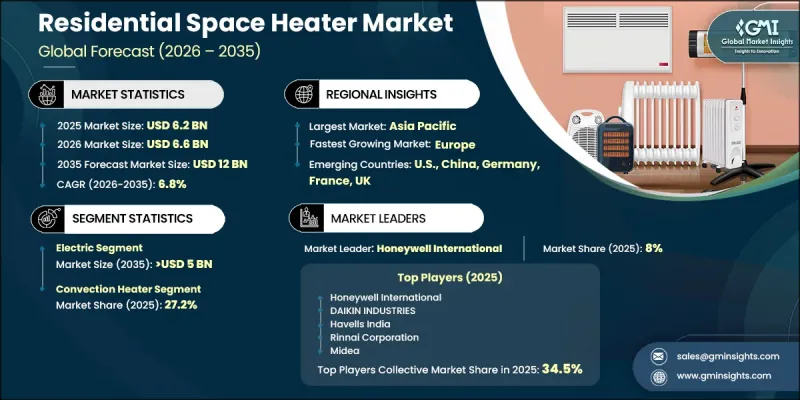
由於消費者對高效且便利的室內暖氣解決方案的需求不斷成長,該市場正經歷穩定成長。都市化、住宅建設活動的擴張以及人們對節能家電日益增強的意識,都促進了這些產品的廣泛應用。此外,家庭生活水準的提高和人們對室內舒適度的日益關注,也進一步推動了市場發展。消費者越來越傾向於選擇兼具柔軟性、低運作成本和卓越能源效率的暖氣解決方案。智慧連接、增強的安全功能和自動控制等技術進步,正使住宅空間加熱器更加高效便捷。預計在預測期內,人們對智慧家庭的興趣日益濃厚,加上環保意識的增強以及對經濟實惠的供暖替代方案的需求,將為住宅空間加熱器行業創造更多機遇。
| 市場範圍 | |
|---|---|
| 開始年份 | 2025 |
| 預測期 | 2026-2035 |
| 初始市場規模 | 62億美元 |
| 預測金額 | 120億美元 |
| 複合年成長率 | 6.8% |
住宅空間加熱器是一種緊湊型加熱設備,旨在為住宅內的特定區域提供溫暖。這些產品廣泛用作現有暖氣系統的輔助加熱方式,或用於維持特定生活空間的舒適溫度。現代空間加熱器不斷發展,融合了先進的安全技術,例如自動斷電、過熱保護和穩定性控制,從而提升了用戶安全。消費者對環境永續性和節能的日益關注推動了對先進加熱產品的需求。人口成長和智慧技術在住宅中的應用進一步促進了市場成長。遠端控制、可調節加熱時間表、可程式設計溫度控制以及與智慧家庭生態系統的兼容性等功能正在推動產品的普及。此外,人們對智慧家庭和環保解決方案的日益關注也進一步增強了市場前景。
預計2035年,住宅電暖器市場規模將達50億美元。人們對節能加熱解決方案、永續性目標以及電暖器系統經濟可行性的日益關注,正在創造有利的市場環境。電暖器憑藉可程式設計溫控器、遙控器功能和增強的安全設計等特性,正變得越來越受歡迎。持續向可再生能源轉型以及家庭購買力的提升,預計將進一步推動產業成長。消費者越來越傾向選擇兼具便利性、高效率性和低環境影響的電暖器產品。
預計到2025年,對流式電暖器市佔率將達到27.2%。對流式電暖器在公寓、獨棟住宅和住宅小區中越來越受歡迎,因為它們能夠在保持室內溫度均勻的同時,運作噪音極低。城市發展、輔助暖氣設備的普及以及人們對提升住宅舒適度日益成長的需求,都在推動對流式供暖系統的需求。而能夠保持室內溫度均勻此特性,也持續吸引眾多住宅選擇使用對流式電暖器。
2025年,美國住宅暖氣市場規模預計將達到10.351億美元。市場成長的驅動力主要來自消費者對小型、便攜、便利供暖設備日益成長的需求,以及家庭結構的不斷變化。持續的技術創新正在推動更高效、更環保的暖氣解決方案的問世,包括電暖器和紅外線加熱設備。這些進步吸引了注重節能和永續性的消費者,為美國暖氣產業的發展創造了巨大的機會。
目錄
第1章:調查方法和範圍
第2章執行摘要
第3章 行業洞察
- 產業生態系分析
- 原物料供應及採購分析
- 生產能力評估
- 供應鏈韌性與風險因素
- 配電網路分析
- 影響產業的因素
- 促進因素
- 產業潛在風險與挑戰
- 監理情勢
- 成長潛力分析
- 波特的分析
- PESTLE分析
- 成本結構分析:住宅暖氣器
- 新機會與趨勢
- 數位化和物聯網整合
- 投資分析及未來展望
- 價格趨勢分析
- 按地區
- 依產品
- 人工智慧和生成式人工智慧對市場的影響
- 利用人工智慧最佳化生產
- 預測性維護和故障檢測
第4章 競爭情勢
- 介紹
- 企業市佔率分析:按地區分類
- 北美洲
- 歐洲
- 亞太地區
- 中東和非洲
- 拉丁美洲
- 主要市場公司的競爭分析
- 競爭定位矩陣
- 主要進展
- 併購
- 夥伴關係和聯盟
- 新產品發布
- 業務拓展計劃及資金籌措
- 按公司規模進行基準測試
- 排名分類標準與遴選標準
- 按銷售額、地區和創新能力分類的層級定位矩陣。
第5章 市場規模及預測:依產品分類,2022-2035年
- 對流加熱器
- 陶瓷加熱器
- 輻射式和紅外線加熱器
- 風扇加熱器
- 油加熱器
- 其他
第6章 市場規模及預測:依技術分類,2022-2035年
- 可攜式的
- 表面黏著技術型
第7章 市場規模及預測:依能源來源分類,2022-2035年
- 電的
- 氣體
第8章 市場規模及預測:依地區分類,2022-2035年
- 北美洲
- 美國
- 加拿大
- 墨西哥
- 歐洲
- 德國
- 義大利
- 法國
- 荷蘭
- 西班牙
- 挪威
- 英國
- 瑞典
- 亞太地區
- 中國
- 日本
- 印度
- 澳洲
- 韓國
- 泰國
- 新加坡
- 馬來西亞
- 菲律賓
- 越南
- 印尼
- 中東和非洲
- 沙烏地阿拉伯
- UAE
- 伊朗
- 伊拉克
- 土耳其
- 南非
- 拉丁美洲
- 巴西
- 智利
- 阿根廷
第9章:公司簡介
- ComDomus
- Crane-USA
- DAIKIN INDUSTRIES
- Dr. Infrared Heater
- Duraflame, Inc.
- Dyson
- Energy Wise Solutions
- Havells India
- Honeywell
- Lasko Products
- Midea
- Mill
- OPOLAR
- Optimus Enterprise, Inc.
- Rinnai Corporation
- Sunbeam Products, Inc.
- SUNHEAT International
- Twin Star Home
- Vornado Air
- Wayfair
The Global Residential Space Heater Market was valued at USD 6.2 billion in 2025 and is estimated to grow at a CAGR of 6.8% to reach USD 12 billion by 2035.
The market is witnessing steady growth due to increasing consumer demand for efficient and convenient indoor heating solutions. Rising urbanization, expanding residential construction activities, and growing awareness regarding energy-saving home appliances are contributing to higher product adoption. Improving household living standards and increasing focus on indoor comfort are further supporting market development. Consumers are increasingly seeking heating solutions that provide flexibility, lower operating costs, and improved energy performance. Technological advancements, including smart connectivity, enhanced safety features, and automated controls, are transforming residential space heaters into more efficient and user-friendly appliances. The growing preference for home automation, combined with rising environmental awareness and the need for cost-effective heating alternatives, is expected to create additional opportunities for the residential space heater industry during the forecast period.
| Market Scope | |
|---|---|
| Start Year | 2025 |
| Forecast Year | 2026-2035 |
| Start Value | $6.2 Billion |
| Forecast Value | $12 Billion |
| CAGR | 6.8% |
Residential space heaters are compact heating devices designed to deliver warmth to selected areas within homes. These products are commonly used as supplementary heating solutions alongside existing heating systems or for maintaining comfortable temperatures in specific residential spaces. Modern space heaters have evolved with advanced safety technologies, including automatic shut-off functions, protection against overheating, and stability controls to improve user safety. Increasing consumer focus on environmental sustainability and energy conservation is encouraging demand for advanced heating products. Market growth is further supported by population expansion and the integration of smart technologies into residential appliances. Features such as remote operation, adjustable heating schedules, programmable temperature controls, and compatibility with connected home ecosystems are increasing product adoption. Additionally, rising interest in automated homes and environmentally responsible solutions is strengthening the market outlook.
The electric residential space heater market is expected to reach USD 5 billion by 2035. Increasing attention toward energy-efficient heating solutions, sustainability goals, and the affordability of electricity-based heating systems is creating favorable market conditions. Electric space heaters are gaining popularity due to features such as programmable thermostats, remote-control functionality, and improved safety designs. The growing transition toward renewable energy sources, along with increasing household purchasing power, is expected to further support industry expansion. Consumers are increasingly selecting electric heating products that combine convenience, efficiency, and reduced environmental impact.
The convection heater segment accounted for a 27.2% share in 2025. Convection heaters are becoming increasingly preferred across apartments, independent homes, and residential communities because they provide consistent indoor heating while operating with minimal noise. Growing urban development, increased use of supplemental heating devices, and rising emphasis on improving residential comfort levels are driving demand for convection heating systems. Their ability to maintain balanced room temperatures continues to support their adoption among residential users.
U.S. Residential Space Heater Market was valued at USD 1,035.1 million in 2025. Increasing demand for compact, portable, and convenient heating devices, combined with changing household structures, is supporting market growth. Continuous technological advancements are leading to the introduction of more efficient and environmentally conscious heating solutions, including electric and infrared-based models. These developments are attracting consumers who prioritize energy efficiency and sustainability, creating significant opportunities for industry expansion in the United States.
Major players operating in the global residential space heater industry are Dyson, Honeywell, Midea, Lasko Products, Vornado Air, DAIKIN INDUSTRIES, Rinnai Corporation, Duraflame, Inc., Sunbeam Products, Inc., Havells India, Twin Star Home, Dr. Infrared Heater, Mill, OPOLAR, Optimus Enterprise, Inc., SUNHEAT International, Energy Wise Solutions, Crane - USA, ComDomus, and Wayfair. Companies operating in the residential space heater market are adopting strategies focused on product innovation, smart technology integration, energy efficiency improvements, and expansion of distribution networks to strengthen their market position. Manufacturers are developing advanced heating solutions with improved safety features, connected controls, and enhanced performance to meet changing consumer preferences. Businesses are also investing in research and development to introduce environmentally friendly products with lower energy consumption. Strategic partnerships, broader retail presence, and stronger online distribution channels are helping companies reach a wider customer base. Market participants are emphasizing customized solutions, improved designs, and competitive pricing to increase adoption.
Table of Contents
Chapter 1 Methodology & Scope
- 1.1 Research approach
- 1.2 Quality commitments
- 1.2.1 GMI AI policy & data integrity commitment
- 1.2.1.1 Source consistency protocol
- 1.2.1 GMI AI policy & data integrity commitment
- 1.3 Research trail & confidence scoring
- 1.3.1 Research trail components
- 1.3.2 Scoring components
- 1.4 Data collection
- 1.4.1 Partial list of primary sources
- 1.5 Data mining sources
- 1.5.1 Paid sources
- 1.5.1.1 Sources, by region
- 1.5.1 Paid sources
- 1.6 Base estimates and calculations
- 1.6.1 Base year calculation for any one approach
- 1.7 Market estimates & forecasts parameters
- 1.8 Forecast model
- 1.8.1 Quantified market impact analysis
- 1.8.1.1 Mathematical impact of growth parameters on forecast
- 1.8.1 Quantified market impact analysis
- 1.9 Research transparency addendum
- 1.9.1 Source attribution framework
- 1.9.2 Quality assurance metrics
- 1.9.3 Our commitment to trust
- 1.10 Market definitions
Chapter 2 Executive Summary
- 2.1 Industry synopsis, 2022 - 2035
- 2.1.1 Business trends
- 2.1.2 Product trends
- 2.1.3 Technology trends
- 2.1.4 Energy source trends
- 2.1.5 Regional trends
Chapter 3 Industry Insights
- 3.1 Industry ecosystem analysis
- 3.1.1 Raw material availability & sourcing analysis
- 3.1.2 Manufacturing capacity assessment
- 3.1.3 Supply chain resilience & risk factors
- 3.1.4 Distribution network analysis
- 3.2 Industry impact forces
- 3.2.1 Growth drivers
- 3.2.2 Industry pitfalls & challenges
- 3.3 Regulatory landscape
- 3.4 Growth potential analysis
- 3.5 Porter's analysis
- 3.5.1 Bargaining power of suppliers
- 3.5.2 Bargaining power of buyers
- 3.5.3 Threat of new entrants
- 3.5.4 Threat of substitutes
- 3.6 PESTEL analysis
- 3.6.1 Political factors
- 3.6.2 Economic factors
- 3.6.3 Social factors
- 3.6.4 Technological factors
- 3.6.5 Legal factors
- 3.6.6 Environmental factors
- 3.7 Cost structure analysis of residential space heater
- 3.8 Emerging opportunities & trends
- 3.9 Digitalization & IoT integration
- 3.10 Investment analysis & future prospects
- 3.11 Price trend analysis (USD/Unit) (Driven by Primary Research)
- 3.11.1 By region (Driven by Primary Research)
- 3.11.2 By product (Driven by Primary Research)
- 3.12 Impact of AI & Generative AI on the market (Driven by Primary Research)
- 3.12.1 AI-Driven production optimization (Driven by Primary Research)
- 3.12.2 Predictive maintenance & fault detection (Driven by Primary Research)
Chapter 4 Competitive Landscape, 2026
- 4.1 Introduction
- 4.2 Company market share analysis, by region, 2025
- 4.2.1 North America
- 4.2.2 Europe
- 4.2.3 Asia Pacific
- 4.2.4 Middle East & Africa
- 4.2.5 Latin America
- 4.3 Competitive analysis of major market players
- 4.4 Competitive positioning matrix
- 4.5 Key developments
- 4.5.1 Mergers & acquisitions
- 4.5.2 Partnerships & collaborations
- 4.5.3 New product launches
- 4.5.4 Expansion plans & funding
- 4.6 Company tier benchmarking
- 4.6.1 Tier classification criteria & qualifying thresholds
- 4.6.2 Tier positioning matrix by revenue, geography & innovation
Chapter 5 Market Size and Forecast, By Product, 2022 - 2035 (USD Million & '000 Units)
- 5.1 Key trends
- 5.2 Convection heater
- 5.3 Ceramic heater
- 5.4 Radiant & infrared heater
- 5.5 Fan heater
- 5.6 Oil filled heater
- 5.7 Others
Chapter 6 Market Size and Forecast, By Technology, 2022 - 2035 (USD Million & '000 Units)
- 6.1 Key trends
- 6.2 Portable
- 6.3 Surface-mounted
Chapter 7 Market Size and Forecast, By Energy Source, 2022 - 2035 (USD Million & '000 Units)
- 7.1 Key trends
- 7.2 Electric
- 7.3 Gas
Chapter 8 Market Size and Forecast, By Region, 2022 - 2035 (USD Million & '000 Units)
- 8.1 Key trends
- 8.2 North America
- 8.2.1 U.S.
- 8.2.2 Canada
- 8.2.3 Mexico
- 8.3 Europe
- 8.3.1 Germany
- 8.3.2 Italy
- 8.3.3 France
- 8.3.4 Netherlands
- 8.3.5 Spain
- 8.3.6 Norway
- 8.3.7 UK
- 8.3.8 Sweden
- 8.4 Asia Pacific
- 8.4.1 China
- 8.4.2 Japan
- 8.4.3 India
- 8.4.4 Australia
- 8.4.5 South Korea
- 8.4.6 Thailand
- 8.4.7 Singapore
- 8.4.8 Malaysia
- 8.4.9 Philippines
- 8.4.10 Vietnam
- 8.4.11 Indonesia
- 8.5 Middle East & Africa
- 8.5.1 Saudi Arabia
- 8.5.2 UAE
- 8.5.3 Iran
- 8.5.4 Iraq
- 8.5.5 Turkey
- 8.5.6 South Africa
- 8.6 Latin America
- 8.6.1 Brazil
- 8.6.2 Chile
- 8.6.3 Argentina
Chapter 9 Company Profiles
- 9.1 ComDomus
- 9.2 Crane - USA
- 9.3 DAIKIN INDUSTRIES
- 9.4 Dr. Infrared Heater
- 9.5 Duraflame, Inc.
- 9.6 Dyson
- 9.7 Energy Wise Solutions
- 9.8 Havells India
- 9.9 Honeywell
- 9.10 Lasko Products
- 9.11 Midea
- 9.12 Mill
- 9.13 OPOLAR
- 9.14 Optimus Enterprise, Inc.
- 9.15 Rinnai Corporation
- 9.16 Sunbeam Products, Inc.
- 9.17 SUNHEAT International
- 9.18 Twin Star Home
- 9.19 Vornado Air
- 9.20 Wayfair

 陶瓷絕緣加熱器市場:全球市場預測,2026-2032年
 北美空間加熱器市場,2026 年
 屋頂一體化暖氣系統市場規模、佔有率和成長分析:按系統類型、應用、安裝類型、最終用途和地區分類-2026-2033年產業預測
 智慧型電暖器市場報告:趨勢、預測與競爭分析(至2035年)
 2026-2030年全球智慧型暖氣市場智慧房間加熱器市場:2026-2032年全球市場預測(依產品類型、輸出功率、連接方式、應用和銷售管道)
 工業加熱器市場機會、成長要素、產業趨勢分析及2026-2035年預測
 2026-2034年全球工業加熱器導熱油市場規模、佔有率、趨勢及成長分析報告全球單元式加熱器市場規模、佔有率、趨勢和成長分析報告(2026-2034年)暖氣設備市場規模、佔有率、成長及全球產業分析:按類型、應用和地區分類,並預測至2026-2034年