


 |
市場調查報告書
商品編碼
2109263
濕式洗滌器市場:商業機會、成長要素、產業趨勢分析及2026-2035年預測Wet Scrubbers Market Opportunity, Growth Drivers, Industry Trend Analysis, and Forecast 2026 - 2035 |
||||||

預計到 2025 年,全球濕式洗滌器市場價值將達到 138 億美元,年複合成長率為 5.5%,到 2035 年將達到 237 億美元。
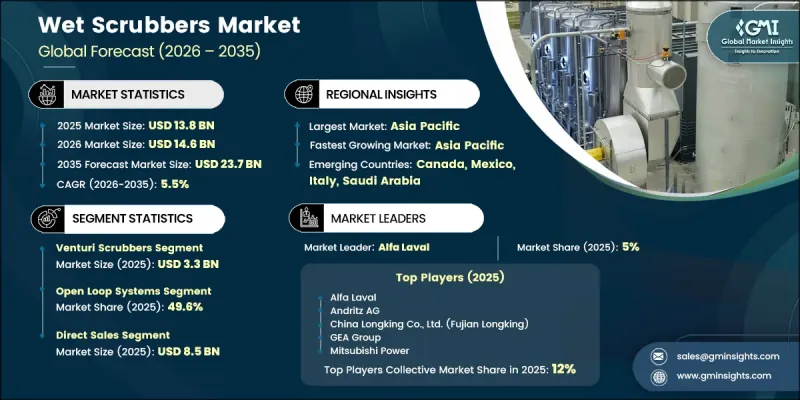
濕式洗滌器市場正蓬勃發展,其成長動力主要來自日益嚴格的工業排放法規以及已開發經濟體和新興經濟體工業產能的持續擴張。濕式洗滌器系統廣泛用於去除工業廢氣中的有害氣體和懸浮顆粒物,是現代空氣污染控制策略的重要組成部分。多種濕式洗滌器技術旨在滿足不同的工業氣體處理需求,同時幫助企業遵守不斷變化的環境法規。各行業正擴大用整合系統取代傳統的單一用途排放控制設備,這些系統能夠同時處理多種污染物,並保持更高的運作效率和合規性。現有工業設施的持續現代化改造以及新建工廠從一開始就需要先進的排放控制解決方案,也推動了對濕式洗滌器的需求。隨著對清潔生產技術投資的不斷增加,以及對環境永續性和運作效率的日益重視,全球濕式洗滌器市場的長期成長前景持續增強。
| 市場範圍 | |
|---|---|
| 開始年份 | 2025 |
| 預測期 | 2026-2035 |
| 初始市場規模 | 138億美元 |
| 預測金額 | 237億美元 |
| 複合年成長率 | 5.5% |
到2025年,開放回路系統市佔率將達到49.6%。該細分市場持續保持主導地位,主要得益於其在工業應用中的廣泛應用,而高效的氣體淨化和經濟高效的運作仍然是這些應用的關鍵需求。開放回路系統因其能夠有效控制排放氣體並持續支援大規模工業運作而備受青睞。其良好的口碑和運作可靠性持續推動眾多終端用戶產業的需求。
美國濕式洗滌器市場佔86.8%的佔有率,預計到2025年市場規模將達到26億美元。該地區的需求主要源於為滿足不斷變化的環境法規而進行的舊設備更換和升級,而非新建工業設施。美國憑藉其完善的工業基礎設施和日益嚴格的空氣品質法規,繼續引領區域市場,這些因素持續推動對先進排放氣體控制技術的投資。
目錄
第1章:調查方法和範圍
第2章執行摘要
第3章 行業洞察
- 產業生態系分析
- 供應商情況
- 利潤率
- 每個階段增加的價值
- 影響價值鏈的因素
- 影響產業的因素
- 促進因素
- 嚴格的空氣排放法規
- 重工業部門的成長
- 人們對職業安全與健康的興趣日益濃厚
- 產業潛在風險與挑戰
- 巨額資本投資
- 高營運成本
- 機會
- 維修和現代化項目
- 半導體和電子製造
- 促進因素
- 成長潛力分析
- 監理框架
- 美國環保署 (EPA)《清潔空氣法》—MACT 和 NESHAP 標準
- 歐盟工業排放指令 (IED) 和 BREF 標準
- 國際海事組織《防止船舶造成污染公約》附則六(船舶硫排放規定-全球硫排放限值為0.5%)
- 亞太地區排放標準(中國的GB標準、印度的CPCB標準、韓國)
- 新興市場(中東和非洲、拉丁美洲)的監管狀況
- 價格分析
- 2022-2025年歷史價格趨勢分析
- 依球員類型分類的定價策略(高級球員、超值球員、成本加成球員)
- 貿易數據分析
- 進出口量及進口額趨勢
- 主要貿易路線及關稅的影響
- 人工智慧和生成式人工智慧對市場的影響
- 利用人工智慧改造現有洗滌器業務模式(監控即服務、遠距離診斷)
- 按細分市場分類的生成式人工智慧用例和部署藍圖
- 人工智慧在寵物護理領域的風險、限制與監管考量
- 生產能力和生產情況
- 按地區和主要生產商分類的製造能力
- 運轉率和擴張計劃
第4章 競爭情勢
- 介紹
- 企業市佔率分析
- 按地區
- 企業矩陣分析
- 主要市場公司的競爭分析
- 競爭定位矩陣
- 主要進展
- 併購
- 夥伴關係和聯盟
- 新產品發布
- 業務拓展計劃
第5章 市場估算與預測:依產品類型分類,2022-2035年
- 已裝滿洗滌器
- 文丘里洗滌器
- 噴淋塔洗滌器
- 旋風洗滌器
- 衝擊式板式洗滌器
- 其他(教育型洗滌器、生物洗滌器、濕式靜電集塵器)
第6章 市場估計與預測:依污染物類型分類,2022-2035年
- 顆粒物(PM)的監管
- 抑制酸性氣體
- 揮發性有機化合物(VOCs)的監管
- 氣味控制
- 有毒氣體和重金屬的監管
- 其他(多污染物應對系統、二氧化碳預處理)
第7章 市場估計與預測:依投資類型分類,2022-2035年
- 開放回路系統
- 封閉回路型系統
- 乾濕混合系統
- 其他(半封閉式、混合式相容式)
第8章 市場估算與預測:依最終用途產業分類,2022-2035年
- 化學品
- 石油和天然氣
- 煉油和石油化工
- 採礦和冶金
- 製藥
- 其他(船舶、水泥、發電等)
第9章 市場估價與預測:依通路分類,2022-2035年
- 直銷
- 間接銷售
第10章 市場估價與預測:依地區分類,2022-2035年
- 北美洲
- 美國
- 加拿大
- 歐洲
- 德國
- 英國
- 法國
- 義大利
- 西班牙
- 亞太地區
- 中國
- 日本
- 印度
- 澳洲
- 韓國
- 拉丁美洲
- 巴西
- 墨西哥
- 阿根廷
- 中東和非洲
- 南非
- 沙烏地阿拉伯
- UAE
第11章:公司簡介
- 世界公司
- CECO Environmental Corp
- Andritz AG
- Babcock & Wilcox(B&W)
- Durr AG(Megtec/Universal)
- GEA Group
- Alfa Laval
- Mitsubishi Power
- 當地公司
- Bionomic Industries
- Ducon Technologies
- Monroe Environmental
- Tri-Mer Corporation
- Korting Hannover GmbH
- Thermax Limited
- China Longking Co., Ltd.(Fujian Longking)
- 新興企業
- Beltran Technologies
- Wartsila(Exhaust Treatment)
- Biorem Technologies(BIOREM Inc.)
- Envitech Inc.
- Croll-Reynolds Company
- Sly LLC(Sly Inc.)
- CR Clean Air Group
The Global Wet Scrubbers Market was valued at USD 13.8 billion in 2025 and is estimated to grow at a CAGR of 5.5% to reach USD 23.7 billion by 2035.
Growth in the wet scrubbers market is supported by increasingly stringent industrial emission regulations and continuous expansion of industrial production capacity across developed and emerging economies. Wet scrubber systems are widely utilized to remove harmful gases and airborne particulate matter from industrial exhaust streams, making them an essential component of modern air pollution control strategies. Various wet scrubbing technologies are designed to address diverse industrial gas treatment requirements while helping facilities comply with evolving environmental regulations. Industries are increasingly replacing conventional single-purpose emission control equipment with integrated systems capable of treating multiple pollutants simultaneously while maintaining higher operational efficiency and regulatory compliance. Demand for wet scrubbers is also being driven by ongoing modernization of existing industrial facilities and the construction of new manufacturing plants requiring advanced emission control solutions from the beginning of operations. Rising investments in cleaner production technologies, combined with greater emphasis on environmental sustainability and operational efficiency, continue to strengthen long-term growth opportunities across the global wet scrubbers market.
| Market Scope | |
|---|---|
| Start Year | 2025 |
| Forecast Year | 2026-2035 |
| Start Value | $13.8 Billion |
| Forecast Value | $23.7 Billion |
| CAGR | 5.5% |
The open loop systems segment held a 49.6% share in 2025. This segment continues to lead due to its widespread installation across industrial applications where efficient gas cleaning and cost-effective operation remain key priorities. Open loop systems are recognized for their ability to deliver effective emission control while supporting continuous large-scale industrial operations. Their established installation base and operational reliability continue to reinforce demand across multiple end-use industries.
U.S. Wet Scrubbers Market accounted for an 86.8% share, generating USD 2.6 billion in 2025. Regional demand is primarily supported by equipment replacement and upgrades required to meet evolving environmental regulations rather than by new industrial construction. The United States continues to lead the regional market due to its extensive industrial infrastructure and ongoing implementation of increasingly stringent air quality regulations, which continue to encourage investments in advanced emission control technologies.
Major companies operating in the global wet scrubbers market include CECO Environmental Corp, Andritz AG, Babcock & Wilcox (B&W), Durr AG (Megtec/Universal), GEA Group, Alfa Laval, Mitsubishi Power, Bionomic Industries, Ducon Technologies, Monroe Environmental, Tri-Mer Corporation, Korting Hannover GmbH, Thermax Limited, China Longking Co., Ltd. (Fujian Longking), Beltran Technologies, Wartsila (Exhaust Treatment), Biorem Technologies (BIOREM Inc.), Envitech Inc., Croll-Reynolds Company, Sly LLC (Sly Inc.), and CR Clean Air Group. Companies operating in the wet scrubbers market are strengthening their competitive position by investing in research and development to improve emission control efficiency, operational reliability, and system performance. Many manufacturers are expanding product portfolios with advanced multi-stage pollution control solutions that address evolving industrial and environmental requirements. Strategic collaborations with engineering firms, industrial operators, and technology providers are supporting broader market penetration and accelerating project execution. Businesses are also increasing manufacturing capabilities, enhancing customization options, and integrating digital monitoring technologies to improve equipment performance and maintenance efficiency.
Table of Contents
Chapter 1 Methodology and Scope
- 1.1 Market scope & definitions
- 1.2 Research design
- 1.2.1 Research approach
- 1.2.2 Data collection methods
- 1.3 Base estimates and calculations
- 1.3.1 Base year calculation
- 1.3.2 Market estimates & forecasts parameters
- 1.4 Forecast Model
- 1.4.1 Key trends for market estimates
- 1.4.2 Quantified market impact analysis
- 1.4.2.1 Mathematical impact of growth parameters on forecast
- 1.4.3 Scenario analysis framework
- 1.5 Primary research and validation
- 1.5.1 Some of the primary sources (but not limited to)
- 1.6 Data mining sources
- 1.6.1 Paid Sources
- 1.7 Primary research and validation
- 1.7.1 Primary sources
- 1.8 Research Trail & confidence scoring
- 1.8.1 Research trail components
- 1.8.2 Scoring components
- 1.9 Research transparency addendum
- 1.9.1 Source attribution framework
- 1.9.2 Quality assurance metrics
- 1.9.3 Our commitment to trust
Chapter 2 Executive Summary
- 2.1 Industry 360° synopsis
- 2.2 Key market trends
- 2.2.1 Regional
- 2.2.2 Product type
- 2.2.3 Pollutant type
- 2.2.4 Operation type
- 2.2.5 End use industry
- 2.2.6 Distribution channel
Chapter 3 Industry Insights
- 3.1 Industry ecosystem analysis
- 3.1.1 Supplier landscape
- 3.1.2 Profit margin
- 3.1.3 Value addition at each stage
- 3.1.4 Factor affecting the value chain
- 3.2 Industry impact forces
- 3.2.1 Growth drivers
- 3.2.1.1 Stringent air emission regulations
- 3.2.1.2 Growth of heavy industrial sectors
- 3.2.1.3 Rising focus on occupational health & safety
- 3.2.2 Industry pitfalls & challenges
- 3.2.2.1 High capital investment
- 3.2.2.2 High operating costs
- 3.2.3 Opportunities
- 3.2.3.1 Retrofit and modernization projects
- 3.2.3.2 Semiconductor and electronics manufacturing
- 3.2.1 Growth drivers
- 3.3 Growth potential analysis
- 3.4 Regulatory framework
- 3.4.1 U.S. EPA clean air act - MACT & NESHAP standards
- 3.4.2 EU Industrial Emissions Directive (IED) & BREF standards
- 3.4.3 IMO MARPOL Annex VI (Marine Sulfur Cap - 0.5% global sulfur limit)
- 3.4.4 Asia Pacific emission standards (China GB Standards, India CPCB, South Korea)
- 3.4.5 Emerging Markets Regulatory Landscape (MEA, Latin America)
- 3.5 Pricing analysis (driven by primary research)
- 3.5.1 Historical price trend analysis (2022-2025)
- 3.5.2 Pricing strategy by player type (premium / value / cost-plus)
- 3.6 Trade data analysis (driven by paid database)
- 3.6.1 Import/export volume & value trends (HS Code 842139 industrial air scrubbers)
- 3.6.2 Key trade corridors & tariff impact
- 3.7 Impact of AI & generative AI on the market
- 3.7.1 AI-driven disruption of existing scrubber business models (monitoring-as-a-service, remote diagnostics)
- 3.7.2 GenAI use cases & adoption roadmap by segment
- 3.7.3 Risks, limitations & regulatory considerations for AI in pet care
- 3.8 Capacity & production landscape (driven by primary research)
- 3.8.1 Installed manufacturing capacity by region & key producer
- 3.8.2 Capacity utilization rates & expansion pipelines
Chapter 4 Competitive Landscape, 2025
- 4.1 Introduction
- 4.2 Company market share analysis
- 4.2.1 By region
- 4.2.1.1 North America
- 4.2.1.2 Europe
- 4.2.1.3 Asia Pacific
- 4.2.1.4 Latin America
- 4.2.1.5 Middle East and Africa
- 4.2.1 By region
- 4.3 Company matrix analysis
- 4.4 Competitive analysis of major market players
- 4.5 Competitive positioning matrix
- 4.6 Key developments
- 4.6.1 Mergers & acquisitions
- 4.6.2 Partnerships & collaborations
- 4.6.3 New product launches
- 4.6.4 Expansion plans
Chapter 5 Market Estimates and Forecast, By Product Type, 2022 – 2035 (USD Billion) (Units)
- 5.1 Key trends
- 5.2 Packed bed scrubbers
- 5.3 Venturi scrubbers
- 5.4 Spray tower scrubbers
- 5.5 Cyclonic scrubbers
- 5.6 Impingement plate scrubbers
- 5.7 Others (eductor scrubbers, biological/bio scrubbers, wet electrostatic precipitators)
Chapter 6 Market Estimates and Forecast, By Pollutant Type, 2022 – 2035 (USD Billion) (Units)
- 6.1 Key trends
- 6.2 Particulate matter (PM) control
- 6.3 Acid gas control
- 6.4 Volatile organic compounds (VOC) control
- 6.5 Odor control
- 6.6 Toxic fumes & heavy metals control
- 6.7 Others (multi-pollutant control systems, CO₂ pre-treatment)
Chapter 7 Market Estimates and Forecast, By Operation Type, 2022 – 2035 (USD Billion) (Units)
- 7.1 Key trends
- 7.2 Open loop systems
- 7.3 Closed loop systems
- 7.4 Dry & wet hybrid systems
- 7.5 Others (semi-closed, hybrid-ready configurations)
Chapter 8 Market Estimates and Forecast, By End Use Industry, 2022 – 2035 (USD Billion) (Units)
- 8.1 Key trends
- 8.2 Chemical
- 8.3 Oil & gas
- 8.4 Refinery & petrochemicals
- 8.5 Mining & metallurgy
- 8.6 Pharmaceuticals
- 8.7 Others (marine, cement, power generation, Etc.)
Chapter 9 Market Estimates and Forecast, By Distribution Channel, 2022 – 2035 (USD Billion) (Units)
- 9.1 Key trends
- 9.2 Direct sales
- 9.3 Indirect sales
Chapter 10 Market Estimates and Forecast, By Region, 2022 – 2035 (USD Billion) (Units)
- 10.1 Key trends
- 10.2 North America
- 10.2.1 U.S.
- 10.2.2 Canada
- 10.3 Europe
- 10.3.1 Germany
- 10.3.2 UK
- 10.3.3 France
- 10.3.4 Italy
- 10.3.5 Spain
- 10.4 Asia Pacific
- 10.4.1 China
- 10.4.2 Japan
- 10.4.3 India
- 10.4.4 Australia
- 10.4.5 South Korea
- 10.5 Latin America
- 10.5.1 Brazil
- 10.5.2 Mexico
- 10.5.3 Argentina
- 10.6 Middle East and Africa
- 10.6.1 South Africa
- 10.6.2 Saudi Arabia
- 10.6.3 UAE
Chapter 11 Company Profiles
- 11.1 Global players
- 11.1.1 CECO Environmental Corp
- 11.1.2 Andritz AG
- 11.1.3 Babcock & Wilcox (B&W)
- 11.1.4 Durr AG (Megtec/Universal)
- 11.1.5 GEA Group
- 11.1.6 Alfa Laval
- 11.1.7 Mitsubishi Power
- 11.2 Regional players
- 11.2.1 Bionomic Industries
- 11.2.2 Ducon Technologies
- 11.2.3 Monroe Environmental
- 11.2.4 Tri-Mer Corporation
- 11.2.5 Korting Hannover GmbH
- 11.2.6 Thermax Limited
- 11.2.7 China Longking Co., Ltd. (Fujian Longking)
- 11.3 Emerging players
- 11.3.1 Beltran Technologies
- 11.3.2 Wartsila (Exhaust Treatment)
- 11.3.3 Biorem Technologies (BIOREM Inc.)
- 11.3.4 Envitech Inc.
- 11.3.5 Croll-Reynolds Company
- 11.3.6 Sly LLC (Sly Inc.)
- 11.3.7 CR Clean Air Group

 全球濕式洗滌器市場規模、佔有率、趨勢和成長分析報告(2026-2034年)
 洗滌器系統市場-2026-2032年全球市場預測
 2026年全球流體化媒裂(FCC)濕式氣體洗滌器市場報告
 濕式洗滌器市場規模、佔有率和成長分析:按產品類型、運作類型、應用、污染物類型、最終用戶和地區分類-2026-2033年產業預測
 洗滌器和空氣清淨機市場 - 全球產業規模、佔有率、趨勢、機會和預測:按類型、最終用戶、安裝類型、地區和競爭格局分類,2021-2031年2026年全球混合式廢氣淨化系統市場報告
 洗滌器系統市場分析及預測(至2035年):類型、產品類型、服務、技術、組件、應用、製程、最終用戶、功能、安裝配置
 洗滌器系統市場:按類型、行業和地區分類旋風分離洗滌器市場:依技術、通路、應用及終端用戶產業分類-2026-2032年全球預測氣體洗滌器系統市場:依產品類型、技術、安裝方式、產業和應用分類-2026-2032年全球預測