

 |
市場調查報告書
商品編碼
2109244
資料中心資產管理市場機會、成長促進因素、產業趨勢分析及2026-2035年預測Data Center Asset Management Market Opportunity, Growth Drivers, Industry Trend Analysis, and Forecast 2026 - 2035 |
||||||

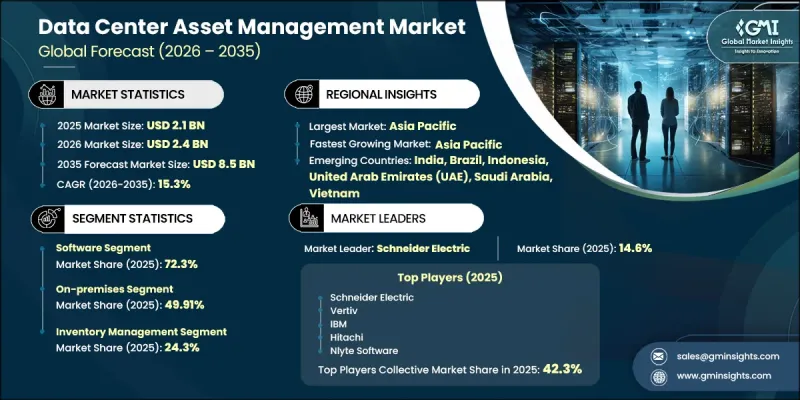
全球資料中心資產管理市場預計到 2025 年將達到 21 億美元,並以 15.3% 的複合年成長率成長,到 2035 年將達到 85 億美元。
隨著企業日益重視高效的基礎設施利用、提升營運績效以及全面掌握關鍵資料中心資產,該市場正經歷強勁成長。對數位轉型、雲端運算、人工智慧和邊緣資料中心基礎設施的投資不斷增加,加速了對智慧資產管理平台的需求,這些平台能夠提升營運管理和資源最佳化。隨著資料中心環境規模不斷擴大、複雜性日益增加,企業正在採用先進的解決方案,以實現即時資產監控、自動化生命週期管理和精準的基礎設施追蹤。現代資產管理平台透過集中式管理功能,幫助負責人提高設備利用率、減少停機時間、簡化維護流程並最佳化容量規劃。自動化、預測分析和人工智慧在資料中心營運中的日益整合,進一步推動了市場需求。隨著企業越來越關注營運效率、成本最佳化、基礎設施彈性以及業務永續營運,預計全球資料中心資產管理市場將在預測期內持續成長。
| 市場範圍 | |
|---|---|
| 開始年份 | 2025 |
| 預測期 | 2026-2035 |
| 初始市場規模 | 21億美元 |
| 預測金額 | 85億美元 |
| 複合年成長率 | 15.3% |
資料中心資產管理解決方案使企業能夠透過集中式管理平台監控、管理和追蹤實體及虛擬基礎設施資產。這些解決方案提供對伺服器、儲存系統、網路設備、配電基礎設施、冷卻系統、軟體資產和其他關鍵資源的全面可視性。透過即時了解資產位置、利用率、運作狀態、維護計畫和生命週期性能,負責人可以最佳化資源分配、最大限度地提高基礎設施可用性並降低營運成本。隨著企業資料中心營運的現代化,自動化、人工智慧和預測分析技術的應用正在增強資產管理平台的功能,並推動市場持續成長。
預計到2025年,軟體市佔率將達到72.3%,並在2026年至2035年間以14.7%的複合年成長率成長。軟體解決方案仍然是現代化資產管理平台的基礎,使企業能夠監控、分析和最佳化IT基礎設施及設施基礎設施的整個生命週期。先進的軟體平台融合了人工智慧、機器學習、預測分析和自動化功能,以提高資產利用率、最佳化容量規劃、最大限度地減少停機時間並提升整體營運效率。
預計到2025年,本地部署市場佔有率將達到49.91%,在那些需要對基礎設施管理、資料安全和合規性進行更嚴格控制的組織中,本地部署仍保持著較高的採用率。營運關鍵任務環境的公司仍然傾向於選擇本地部署,因為本地部署能夠提供對營運資料的直接所有權、管治能力以及對敏感基礎設施資產的更佳控制。
中國資料中心資產管理市場佔據37.9%的全球市場佔有率,預計2025年市場規模將達到2.1億美元。市場成長的主要驅動力包括超大規模資料中心基礎設施的持續擴張、雲端運算的日益普及、人工智慧(AI)的廣泛應用以及對數位轉型(DX)的持續投入。各組織機構正擴大採用先進的資產管理平台,以提高基礎設施的可視性、最佳化資源利用率,並透過自動化和人工智慧驅動的管理功能支援智慧資料中心營運。
目錄
第1章:調查方法
第2章執行摘要
第3章 行業洞察
- 產業生態系分析
- 供應商情況
- 利潤率分析
- 成本結構
- 每個階段增加的價值
- 影響價值鏈的因素
- 中斷
- 影響產業的因素
- 促進因素
- 受人工智慧和雲端運算需求的驅動,資料中心建設正在經歷爆炸性成長。
- 混合雲和多重雲端環境的日益複雜化,使得資產可見性的需求日益成長。
- 能源成本上升和 ESG 要求正在加速電力和能源管理的普及。
- 整個行業都有嚴格的監管合規要求
- 產業潛在風險與挑戰
- 企業級DCAM平台實施和整合成本高。
- 熟練的資料中心設施專家短缺阻礙了專案的實施。
- 基於雲端的DCAM部署中的資料安全與隱私問題
- 市場機遇
- 邊緣運算的普及對資產管理提出了新的要求。
- 中小企業採用基於雲端(SaaS)的DCAM解決方案是一種經濟高效的實施方法。
- 將數位孿生技術整合到即時資產模擬中
- 在永續發展的驅動下,對碳足跡和ESG資產追蹤工具的需求日益成長。
- 促進因素
- 技術與創新展望
- 最新技術
- 資料中心基礎設施管理(DCIM)
- 雲端的資產管理平台(SaaS)
- 基於RFID和條碼的資產追蹤系統
- 預測性維護和基礎設施監控解決方案
- 新興技術
- 利用人工智慧(AI)和機器學習技術實現資產智慧。
- 數位孿生技術
- 利用物聯網進行智慧資產監控
- ESG、永續性與碳追蹤分析平台
- 最新技術
- 成長潛力分析
- 價格分析
- 對過去價格趨勢的分析
- 定價策略:按業務類型分類
- 監理情勢
- 北美洲
- 美國聯邦能源監管委員會
- 網路安全與基礎設施安全局
- 歐洲
- 歐洲網路安全局
- 歐洲電信標準組織
- 亞太地區
- 資訊與通訊媒體發展署
- 電子資訊科技部
- 拉丁美洲
- 國家通訊署
- 聯邦通訊局
- 中東和非洲
- 沙烏地阿拉伯資料與人工智慧局
- 南非資訊與監管局
- 北美洲
- 波特的分析
- PESTLE分析
- 專利分析
- 成本細分分析
- 資料中心產業展望
- 全球資料中心容量成長
- 超大規模資料中心的擴張
- 人工智慧和GPU資料中心建置趨勢
- 區域資料中心投資
- 人工智慧和生成式人工智慧對市場的影響
- 利用人工智慧改造現有經營模式
- 按細分市場分類的生成式人工智慧用例和部署藍圖
- 風險、限制和監管考量
- 永續性和環境方面
- 綠色資料中心計劃
- 最佳化能源效率和電源使用效率(PUE)
- 碳足跡監測和ESG報告
- IT資產和電子廢棄物管理的循環生命週期
- 預測假設和情境分析
- 基本案例下推動複合年成長率的關鍵宏觀經濟和產業變量
- 樂觀情境:宏觀經濟與產業的順風
- 悲觀情景:宏觀經濟放緩或產業逆風
第4章 競爭情勢
- 介紹
- 企業市佔率分析
- 北美洲
- 歐洲
- 亞太地區
- 拉丁美洲
- 中東和非洲
- 主要市場公司的競爭分析
- 競爭定位矩陣
- 主要進展
- 併購
- 夥伴關係和聯盟
- 新產品發布
- 業務拓展計劃及資金籌措
- 按公司規模進行基準測試
- 排名分類標準與遴選標準
- 按銷售額、地區和創新能力分類的層級定位矩陣。
第5章 市場估計與預測:依組件分類,2022-2035年
- 軟體
- 資產發現和庫存管理
- 資產追蹤和監控
- 貨架和地面資產可視化
- 容量和空間管理
- 生命週期和變更管理
- 電力和能源資產管理
- 合規與安全管理
- 其他
- 服務
- 專業服務
- 託管服務
第6章 市場估計與預測:依發展階段分類,2022-2035年
- 現場
- 基於雲端的(SaaS)
- 混合
第7章 市場估計與預測:依應用領域分類,2022-2035年
- 庫存管理
- 生產力計畫與最佳化
- 電力和能源資產管理
- 變更與生命週期管理
- 合規與安全管理
- 其他
第8章 市場估計與預測:依公司規模分類,2022-2035年
- 大公司
- 小型企業
第9章 市場估計與預測:依資料中心分類,2022-2035年
- 企業資料中心
- 託管資料中心
- 超大規模資料中心
- 邊緣資料中心
第10章 市場估價與預測:依最終用途分類,2022-2035年
- IT/通訊
- BFSI
- 醫療保健和生命科學
- 政府/國防
- 能源公用事業
- 製造業
- 零售與電子商務
- 媒體與娛樂
- 教育
- 託管和雲端服務供應商
- 其他
第11章 市場估價與預測:按地區分類,2022-2035年
- 北美洲
- 美國
- 加拿大
- 歐洲
- 德國
- 英國
- 法國
- 義大利
- 西班牙
- 俄羅斯
- 挪威
- 荷蘭
- 瑞典
- 亞太地區
- 中國
- 印度
- 日本
- 澳洲
- 韓國
- 新加坡
- 泰國
- 印尼
- 越南
- 拉丁美洲
- 巴西
- 墨西哥
- 阿根廷
- 中東和非洲
- 南非
- 沙烏地阿拉伯
- UAE
- 土耳其
第12章:公司簡介
- 世界公司
- ServiceNow
- BMC Software
- Ivanti
- OpenText
- Flexera
- ManageEngine
- SolarWinds
- Freshservice
- 當地公司
- Sunbird Software
- TOPdesk
- SysAid
- Matrix42
- Virima Technologies
- EasyVista
- 新興企業
- Hyperview
- Lansweeper
- Axonius
- Oomnitza
- InvGate
- Alloy Software
The Global Data Center Asset Management Market was valued at USD 2.1 billion in 2025 and is estimated to grow at a CAGR of 15.3% to reach USD 8.5 billion by 2035.
The market is witnessing strong growth as organizations increasingly prioritize efficient infrastructure utilization, enhanced operational performance, and complete visibility into critical data center assets. Rising investments in digital transformation, cloud computing, artificial intelligence, and edge data center infrastructure are accelerating demand for intelligent asset management platforms that improve operational control and resource optimization. As data center environments become larger and more complex, organizations are adopting advanced solutions capable of delivering real-time asset monitoring, automated lifecycle management, and accurate infrastructure tracking. Modern asset management platforms enable operators to improve equipment utilization, reduce downtime, streamline maintenance, and optimize capacity planning through centralized management capabilities. The growing integration of automation, predictive analytics, and artificial intelligence into data center operations is further strengthening market demand. Increasing focus on operational efficiency, cost optimization, infrastructure resilience, and business continuity is expected to support sustained expansion of the global data center asset management market throughout the forecast period.
| Market Scope | |
|---|---|
| Start Year | 2025 |
| Forecast Year | 2026-2035 |
| Start Value | $2.1 Billion |
| Forecast Value | $8.5 Billion |
| CAGR | 15.3% |
Data center asset management solutions enable organizations to monitor, manage, and track both physical and virtual infrastructure assets through centralized management platforms. These solutions provide comprehensive visibility into servers, storage systems, networking equipment, power distribution infrastructure, cooling systems, software assets, and other critical resources. Real-time insights into asset location, utilization, operational health, maintenance schedules, and lifecycle performance help operators improve resource allocation, maximize infrastructure availability, and reduce operational expenses. As organizations continue modernizing data center operations, increasing adoption of automation, artificial intelligence, and predictive analytics is enhancing the capabilities of asset management platforms and driving continued market growth.
The software segment accounted for a 72.3% share in 2025 and is expected to grow at a CAGR of 14.7% from 2026 to 2035. Software solutions remain the foundation of modern asset management platforms by enabling organizations to monitor, analyze, and optimize the complete lifecycle of both IT and facility infrastructure. Advanced software platforms incorporate artificial intelligence, machine learning, predictive analytics, and automation capabilities that improve asset utilization, strengthen capacity planning, minimize downtime, and enhance overall operational efficiency.
The on-premises segment held 49.91% of the market in 2025, maintaining strong adoption among organizations that require greater control over infrastructure management, data security, and regulatory compliance. Enterprises operating mission-critical environments continue to prefer on-premises deployments because they provide direct ownership of operational data, increased governance capabilities, and enhanced control over sensitive infrastructure assets.
China Data Center Asset Management Market held a 37.9% share, generating USD 0.21 billion in 2025. Market growth is supported by continued expansion of hyperscale data center infrastructure, increasing cloud computing adoption, growing artificial intelligence deployments, and sustained investment in digital transformation initiatives. Organizations are increasingly implementing advanced asset management platforms to improve infrastructure visibility, optimize resource utilization, and support intelligent data center operations through automation and AI-enabled management capabilities.
Key players operating in the global data center asset management market include Schneider Electric, Vertiv, IBM, Nlyte Software, Sunbird Software, Device42, FNT, Eaton, Hitachi, and Huawei. Companies operating in the data center asset management market are strengthening their competitive position by investing in intelligent software platforms, expanding automation capabilities, and integrating artificial intelligence and predictive analytics into their solutions. Manufacturers and software providers are focusing on research and development to improve real-time asset visibility, lifecycle management, capacity planning, and infrastructure optimization. Strategic partnerships with cloud providers, system integrators, and enterprise technology vendors are helping companies broaden their customer base and accelerate solution deployment. Businesses are also enhancing cybersecurity capabilities, expanding cloud-based and hybrid deployment options, and improving interoperability with existing data center management platforms.
Table of Contents
Chapter 1 Research Methodology
- 1.1 Research approach
- 1.2 Quality Commitments
- 1.2.1 GMI AI policy & data integrity commitment
- 1.2.1.1 Source consistency protocol
- 1.2.1 GMI AI policy & data integrity commitment
- 1.3 Research Trail & Confidence Scoring
- 1.3.1 Research Trail Components
- 1.3.2 Scoring Components
- 1.4 Data Collection
- 1.4.1 Partial list of primary sources
- 1.5 Data mining sources
- 1.5.1 Paid sources
- 1.5.1.1 Sources, by region
- 1.5.1 Paid sources
- 1.6 Base estimates and calculations
- 1.6.1 Base year calculation for any one approach
- 1.7 Forecast model
- 1.7.1 Quantified Market impact analysis
- 1.7.1.1 Mathematical impact of growth parameters on forecast
- 1.7.1 Quantified Market impact analysis
- 1.8 Research transparency addendum
- 1.8.1 Source attribution framework
- 1.8.2 Quality assurance metrics
- 1.8.3 Our commitment to trust
Chapter 2 Executive Summary
- 2.1 Industry 360° synopsis, 2022 – 2035
- 2.2 Key Market trends
- 2.2.1 Region
- 2.2.2 Component
- 2.2.3 Deployment
- 2.2.4 Application
- 2.2.5 Enterprise size
- 2.2.6 Data center
- 2.2.7 End Use
- 2.3 TAM Analysis, 2026-2035
- 2.4 CXO perspectives: Strategic imperatives
Chapter 3 Industry Insights
- 3.1 Industry ecosystem analysis
- 3.1.1 Supplier landscape
- 3.1.2 Profit margin analysis
- 3.1.3 Cost structure
- 3.1.4 Value addition at each stage
- 3.1.5 Factor affecting the value chain
- 3.1.6 Disruptions
- 3.2 Industry impact forces
- 3.2.1 Growth drivers
- 3.2.1.1 Explosive Growth in Data Center Construction Fueled by AI & Cloud Demand
- 3.2.1.2 Increasing complexity of hybrid & multi-cloud environments driving asset visibility needs
- 3.2.1.3 Rising energy costs & ESG mandates accelerating power & energy management adoption
- 3.2.1.4 Stringent regulatory compliance requirements across industries
- 3.2.2 Industry pitfalls and challenges
- 3.2.2.1 High implementation & integration costs for enterprise-grade dcam platforms
- 3.2.2.2 Shortage of skilled data center facility professionals limiting adoption
- 3.2.2.3 Data security & privacy concerns in cloud-based DCAM deployments
- 3.2.3 Market opportunities
- 3.2.3.1 Edge computing proliferation creating new asset management requirements
- 3.2.3.2 Sme adoption of cloud-based (SAAS) dcam solutions as cost-effective entry point
- 3.2.3.3 Integration of digital twin technology for real-time asset simulation
- 3.2.3.4 Sustainability-driven demand for carbon footprint & esg asset tracking tools
- 3.2.1 Growth drivers
- 3.3 Technology and innovation landscape
- 3.3.1 Current technologies
- 3.3.1.1 Data Center Infrastructure Management (DCIM)
- 3.3.1.2 Cloud-Based Asset Management Platforms (SaaS)
- 3.3.1.3 RFID & Barcode-Based Asset Tracking Systems
- 3.3.1.4 Predictive Maintenance & Infrastructure Monitoring Solutions
- 3.3.2 Emerging technologies
- 3.3.2.1 Artificial Intelligence (AI) & Machine Learning-Driven Asset Intelligence
- 3.3.2.2 Digital Twin Technology
- 3.3.2.3 IoT-Enabled Smart Asset Monitoring
- 3.3.2.4 ESG, Sustainability & Carbon Tracking Analytics Platforms
- 3.3.1 Current technologies
- 3.4 Growth potential analysis
- 3.5 Pricing Analysis (Driven by primary research)
- 3.5.1 Historical Price Trend Analysis
- 3.5.2 Pricing Strategy by Player Type
- 3.6 Regulatory landscape
- 3.6.1 North America
- 3.6.1.1 U.S. Federal Energy Regulatory Commission
- 3.6.1.2 Cybersecurity and Infrastructure Security Agency
- 3.6.2 Europe
- 3.6.2.1 European Union Agency for Cybersecurity
- 3.6.2.2 European Telecommunications Standards Institute
- 3.6.3 Asia Pacific
- 3.6.3.1 Infocomm Media Development Authority
- 3.6.3.2 Ministry of Electronics and Information Technology
- 3.6.4 Latin America
- 3.6.4.1 National Telecommunications Agency
- 3.6.4.2 Federal Institute of Telecommunications
- 3.6.5 Middle East & Africa
- 3.6.5.1 Saudi Data and Artificial Intelligence Authority
- 3.6.5.2 Information Regulator South Africa
- 3.6.1 North America
- 3.7 Porter’s analysis
- 3.8 PESTEL analysis
- 3.9 Patent analysis (Driven by primary research)
- 3.10 Cost breakdown analysis
- 3.11 Data Center Industry Outlook
- 3.11.1 Global Data Center Capacity Growth
- 3.11.2 Hyperscale Data Center Expansion
- 3.11.3 AI & GPU Data Center Construction Trends
- 3.11.4 Regional Data Center Investments
- 3.12 Impact of AI & generative AI on the market
- 3.12.1 AI-driven disruption of existing business models
- 3.12.2 GenAI use cases & adoption roadmap by segment
- 3.12.3 Risks, limitations & regulatory considerations
- 3.13 Sustainability and environmental aspects
- 3.13.1 Green Data Center Initiatives
- 3.13.2 Energy Efficiency & Power Usage Effectiveness (PUE) Optimization
- 3.13.3 Carbon Footprint Monitoring & ESG Reporting
- 3.13.4 Circular IT Asset Lifecycle & E-waste Management
- 3.14 Forecast assumptions & scenario analysis (Driven by primary research)
- 3.14.1 Base Case key macro & industry variables driving CAGR
- 3.14.2 Optimistic Scenarios-Favorable macro and industry tailwinds
- 3.14.3 Pessimistic Scenario-Macroeconomic slowdown or industry headwinds
Chapter 4 Competitive Landscape, 2025
- 4.1 Introduction
- 4.2 Company Market share analysis
- 4.2.1 North America
- 4.2.2 Europe
- 4.2.3 Asia Pacific
- 4.2.4 LATAM
- 4.2.5 MEA
- 4.3 Competitive analysis of major market players
- 4.4 Competitive positioning matrix
- 4.5 Key developments
- 4.5.1 Mergers & acquisitions
- 4.5.2 Partnerships & collaborations
- 4.5.3 New Product Launches
- 4.5.4 Expansion Plans and funding
- 4.6 Company tier benchmarking
- 4.6.1 Tier classification criteria & qualifying thresholds
- 4.6.2 Tier positioning matrix by revenue, geography & innovation
Chapter 5 Market Estimates & Forecast, By Component, 2022 - 2035 (USD Mn)
- 5.1 Key trends
- 5.2 Software
- 5.2.1 Asset Discovery & Inventory Management
- 5.2.2 Asset Tracking & Monitoring
- 5.2.3 Rack & Floor Asset Visualization
- 5.2.4 Capacity & Space Management
- 5.2.5 Lifecycle & Change Management
- 5.2.6 Power & Energy Asset Management
- 5.2.7 Compliance & Security Management
- 5.2.8 Others
- 5.3 Services
- 5.3.1 Professional Services
- 5.3.2 Managed service
Chapter 6 Market Estimates & Forecast, By Deployment, 2022 - 2035 (USD Mn)
- 6.1 Key trends
- 6.2 On-Premises
- 6.3 Cloud based (SaaS)
- 6.4 Hybrid
Chapter 7 Market Estimates & Forecast, By Application, 2022 - 2035 (USD Mn)
- 7.1 Key trends
- 7.2 Inventory Management
- 7.3 Capacity Planning & Optimization
- 7.4 Power & Energy Asset Management
- 7.5 Change & Lifecycle Management
- 7.6 Compliance & Security Management
- 7.7 Others
Chapter 8 Market Estimates & Forecast, By Enterprise size, 2022 - 2035 (USD Mn, Units)
- 8.1 Key trends
- 8.2 Large Enterprises
- 8.3 SMEs
Chapter 9 Market Estimates & Forecast, By Data Center, 2022 - 2035 (USD Mn)
- 9.1 Key trends
- 9.2 Enterprise Data Centers
- 9.3 Colocation Data Centers
- 9.4 Hyperscale Data Centers
- 9.5 Edge Data Centers
Chapter 10 Market Estimates & Forecast, By End Use, 2022 - 2035 (USD Mn)
- 10.1 Key trends
- 10.2 IT & Telecommunications
- 10.3 BFSI
- 10.4 Healthcare & Life Sciences
- 10.5 Government & Defense
- 10.6 Energy & Utilities
- 10.7 Manufacturing
- 10.8 Retail & E-Commerce
- 10.9 Media & Entertainment
- 10.10 Education
- 10.11 Colocation & Cloud Service Providers
- 10.12 Others
Chapter 11 Market Estimates & Forecast, By Region, 2022 - 2035 (USD Mn)
- 11.1 Key trends
- 11.2 North America
- 11.2.1 US
- 11.2.2 Canada
- 11.3 Europe
- 11.3.1 Germany
- 11.3.2 UK
- 11.3.3 France
- 11.3.4 Italy
- 11.3.5 Spain
- 11.3.6 Russia
- 11.3.7 Norway
- 11.3.8 Netherlands
- 11.3.9 Sweden
- 11.4 Asia Pacific
- 11.4.1 China
- 11.4.2 India
- 11.4.3 Japan
- 11.4.4 Australia
- 11.4.5 South Korea
- 11.4.6 Singapore
- 11.4.7 Thailand
- 11.4.8 Indonesia
- 11.4.9 Vietnam
- 11.5 Latin America
- 11.5.1 Brazil
- 11.5.2 Mexico
- 11.5.3 Argentina
- 11.6 MEA
- 11.6.1 South Africa
- 11.6.2 Saudi Arabia
- 11.6.3 UAE
- 11.6.4 Turkey
Chapter 12 Company Profiles
- 12.1 Global Players
- 12.1.1 ServiceNow
- 12.1.2 BMC Software
- 12.1.3 Ivanti
- 12.1.4 OpenText
- 12.1.5 Flexera
- 12.1.6 ManageEngine
- 12.1.7 SolarWinds
- 12.1.8 Freshservice
- 12.2 Regional Players
- 12.2.1 Sunbird Software
- 12.2.2 TOPdesk
- 12.2.3 SysAid
- 12.2.4 Matrix42
- 12.2.5 Virima Technologies
- 12.2.6 EasyVista
- 12.3 Emerging Players
- 12.3.1 Hyperview
- 12.3.2 Lansweeper
- 12.3.3 Axonius
- 12.3.4 Oomnitza
- 12.3.5 InvGate
- 12.3.6 Alloy Software


