


 |
市場調查報告書
商品編碼
2109193
冷凍電鏡市場機會、成長促進因素、產業趨勢分析及2026-2035年預測Cryo-Electron Microscopy Test Market Opportunity, Growth Drivers, Industry Trend Analysis, and Forecast 2026 - 2035 |
||||||

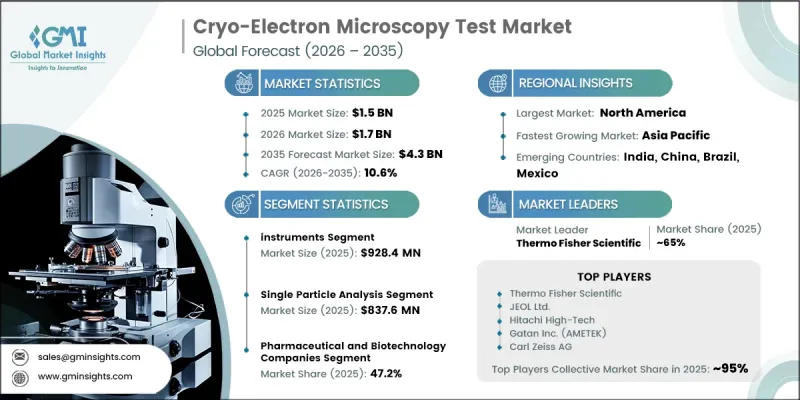
全球冷凍電鏡市場預計到 2025 年將達到 15 億美元,年複合成長率為 10.6%,到 2035 年將達到 43 億美元。
由於冷凍電鏡技術在生命科學、生物醫學研究和藥物開發領域持續廣泛應用,其市場正經歷顯著擴張。對能夠進行高精度結構分析的先進成像技術的需求不斷成長,推動了學術界和私營研究機構對該技術的採用。這項技術使研究人員能夠在維持生物結構自然狀態的同時,以極高的精度觀察其結構,使其成為現代結構生物學中不可或缺的工具。藥物研發投入的增加、對基於結構的藥物發現的日益重視以及在感染疾病研究領域應用的不斷拓展,都為市場參與企業創造了有利的成長機會。此外,生命科學研究經費的增加、影像系統的持續技術進步以及對高解析度分子分析日益成長的需求,都進一步推動了市場需求。自動化、影像處理軟體、檢測器技術和數據分析能力的改進,也進一步提高了工作流程效率和研究生產力。
| 市場範圍 | |
|---|---|
| 開始年份 | 2025 |
| 預測期 | 2026-2035 |
| 初始市場規模 | 15億美元 |
| 預測金額 | 43億美元 |
| 複合年成長率 | 10.6% |
預計到2025年,儀器業務板塊的銷售額將達到9.284億美元,並在2035年之前以61.1%的複合年成長率成長。該板塊持續引領市場成長,主要得益於研究機構、製藥公司、生物技術公司和學術實驗室對先進顯微鏡系統投資的不斷增加。對能夠提供卓越解析度和分析性能的高精度成像解決方案的需求持續成長,推動全球儀器銷售。各機構正透過持續的產品創新、提高成像精度、增強自動化功能和提升營運效率來升級其現有的實驗室基礎設施。預計在整個預測期內,先進顯微鏡系統在研究機構中的廣泛應用將進一步鞏固該板塊的主導地位。
到2025年,製藥和生物技術產業將佔據47.2%的市場。製藥和生技產業對冷凍電鏡技術的採用,源自於對精細結構分析日益成長的需求,而這種分析正是現代藥物發現和生物學研究的基礎。該技術使研究人員能夠獲得高度精確的分子訊息,從而促進目標識別、加速療法開發並提高整體研究效率。隨著對生物製藥研究、精準醫療和下一代療法開發投入的不斷增加,冷凍電鏡技術在商業研究環境中的應用也持續擴展。隨著全球製藥業創新步伐的加快,預計在整個預測期內,來自此終端用戶領域的需求將保持強勁。
預計到2025年,北美冷凍電鏡市場佔有率將達到42.3%。這一區域成長主要得益於先進的醫療基礎設施、對科研的大力投入、活性化的藥物研發活動以及成熟的生物技術和生命科學產業。生物醫學研究的持續投入、先進實驗室技術的普及以及研究機構與產業參與者之間合作的不斷深化,進一步推動了全部區域的市場需求。技術創新、科研經費的增加以及對精準醫療的日益重視,預計將鞏固北美在該領域的領先地位,並為冷凍電鏡製造商和解決方案供應商創造長期的商機。
目錄
第1章:調查方法和範圍
第2章執行摘要
第3章 行業洞察
- 產業生態系分析
- 影響產業的因素
- 促進因素
- 擴大在結構為基礎的藥物發現和藥物研發的應用;
- 增加對結構生物學研究的投資
- 設備技術進步
- 在病毒學和疫苗研發領域不斷拓展的應用
- 產業潛在風險與挑戰
- 冷凍電鏡的高昂資本投資成本
- 氦氣供應受限和營運成本上升
- 市場機遇
- 人工智慧和機器學習的融合正在加速結構化決策工作流程。
- 合約研究組織(CRO)擴大招募規模
- 促進因素
- 成長潛力分析
- 監理情勢
- 技術進步
- 最新科技趨勢
- 新興技術
- 價格趨勢分析
- 未來市場趨勢
- 波特的分析
- PESTLE分析
- 差距分析
- 人工智慧和生成式人工智慧對市場的影響
第4章 競爭情勢
- 介紹
- 企業矩陣分析
- 企業市佔率分析
- 世界
- 北美洲
- 歐洲
- 亞太地區
- 競爭定位矩陣
- 主要市場公司的競爭分析
- 主要進展
- 併購
- 夥伴關係和聯盟
- 新產品發布
- 業務拓展計劃
第5章 市場估算與預測:依產品類型分類,2022-2035年
- 裝置
- 穿透式電子顯微鏡(TEM)
- 掃描透射電子顯微鏡(STEM)
- 冷凍掃描電子顯微鏡(Cryo-SEM)
- 軟體
- 服務
- 耗材和配件
第6章 市場估計與預測:依技術分類,2022-2035年
- 單顆粒分析(SPA)
- 冷凍電子斷層掃描(Cryo-ET)
- 電子晶體學
- 其他技術
第7章 市場估計與預測:依應用領域分類,2022-2035年
- 結構生物學
- 藥物傳輸與開發
- 癌症研究
- 疫苗研究
- 細胞和基因治療
- 材料科學與奈米技術
- 其他用途
第8章 市場估算與預測:依最終用途分類,2022-2035年
- 製藥和生物技術公司
- 學術研究機構
- 受託研究機構(CRO)
- 其他最終用戶
第9章 市場估計與預測:依地區分類,2022-2035年
- 北美洲
- 美國
- 加拿大
- 歐洲
- 德國
- 英國
- 法國
- 西班牙
- 義大利
- 荷蘭
- 亞太地區
- 中國
- 印度
- 日本
- 澳洲
- 韓國
- 拉丁美洲
- 巴西
- 墨西哥
- 阿根廷
- 中東和非洲
- 沙烏地阿拉伯
- 南非
- UAE
第10章:公司簡介
- Carl Zeiss AG
- Creative Biostructure
- Direct Electron LP
- Gatan Inc.(AMETEK)
- Hitachi High-Tech Corporation
- JEOL Ltd.
- Leica Microsystems GmbH
- Nanographics GmbH
- NanoImaging Services Inc.
- Oxford Instruments
- SPT Labtech Ltd.
- Structura Biotechnology Inc.
- TESCAN Group
- Thermo Fisher Scientific
The Global Cryo-Electron Microscopy Test Market was valued at USD 1.5 billion in 2025 and is estimated to grow at a CAGR of 10.6% to reach USD 4.3 billion by 2035.
The market is experiencing significant expansion as cryo-electron microscopy continues to gain widespread acceptance across life sciences, biomedical research, and pharmaceutical development. Increasing demand for advanced imaging technologies capable of delivering highly detailed structural analysis is driving adoption across both academic and commercial research institutions. Technology enables researchers to examine biological structures with exceptional precision while preserving their natural state, making it an essential tool for modern structural biology. Rising investments in pharmaceutical research, growing emphasis on structure-based drug discovery, and expanding applications in infectious disease research are creating favorable growth opportunities for market participants. In addition, increasing funding for life science research, continuous technological advancements in imaging systems, and the growing need for high-resolution molecular analysis are strengthening market demand. Improvements in automation, image processing software, detector technologies, and data analysis capabilities are further enhancing workflow efficiency and research productivity.
| Market Scope | |
|---|---|
| Start Year | 2025 |
| Forecast Year | 2026-2035 |
| Start Value | $1.5 Billion |
| Forecast Value | $4.3 Billion |
| CAGR | 10.6% |
The instruments segment generated a USD 928.4 million in 2025 and is forecast to grow at a 61.1% CAGR through 2035. The segment continues to dominate due to increasing investments in advanced microscopy systems by research institutions, pharmaceutical companies, biotechnology organizations, and academic laboratories. Growing demand for highly accurate imaging solutions capable of delivering superior resolution and analytical performance continues to support equipment sales worldwide. Continuous product innovation, improvements in imaging precision, enhanced automation capabilities, and greater operational efficiency are encouraging organizations to upgrade existing laboratory infrastructure. Increasing installation of sophisticated microscopy systems across research facilities is expected to further strengthen the segment's leadership position throughout the forecast period.
The pharmaceutical and biotechnology companies segment accounted for 47.2% share in 2025. The widespread adoption of cryo-electron microscopy across pharmaceutical and biotechnology organizations is driven by the growing need for detailed structural analysis that supports modern drug development and biological research. Technology enables researchers to obtain highly accurate molecular information that enhances target identification, accelerates therapeutic development, and improves overall research efficiency. Increasing investments in biologics research, precision medicine, and next-generation therapeutic development continue to expand the use of cryo-electron microscopy across commercial research environments. As pharmaceutical innovation accelerates globally, demand from this end-user segment is expected to remain strong over the forecast period.
North America Cryo-Electron Microscopy Test Market captured a 42.3% share in 2025. Regional growth is supported by advanced healthcare infrastructure, strong investments in scientific research, increasing pharmaceutical research activities, and the presence of well-established biotechnology and life sciences industries. Continuous funding for biomedical research, widespread adoption of advanced laboratory technologies, and expanding collaborations between research organizations and industry participants continue to strengthen market demand across the region. Technological innovation, favorable research funding, and increasing focus on precision medicine are expected to sustain North America's leadership position while creating long-term opportunities for cryo-electron microscopy manufacturers and solution providers.
Major companies operating in the global cryo-electron microscopy test market include Carl Zeiss AG, Thermo Fisher Scientific, JEOL Ltd., Hitachi High-Tech, and Gatan Inc. (AMETEK). The competitive landscape continues to evolve as established manufacturers and specialized technology providers invest in product innovation, system enhancements, and advanced imaging capabilities to address the growing requirements of research organizations worldwide. Increasing research investments and expanding application areas are expected to further intensify competition throughout the forecast period. Companies operating in the global cryo-electron microscopy test market are focusing on continuous technological innovation, strategic collaborations, and research-driven product development to strengthen their competitive position. Leading manufacturers are investing heavily in next-generation imaging systems, automation technologies, artificial intelligence-enabled image processing, and advanced software platforms to improve analytical accuracy and laboratory productivity. Businesses are expanding their global distribution networks while strengthening service and maintenance capabilities to improve customer support and long-term retention. Strategic partnerships with academic institutions, pharmaceutical companies, and research organizations are enabling companies to accelerate technology adoption and broaden their market reach. Market participants are also increasing investments in research and development, manufacturing expansion, and customized imaging solutions to address evolving customer requirements.
Table of Contents
Chapter 1 Methodology and Scope
- 1.1 Market scope and definition
- 1.2 Research design
- 1.2.1 Research approach
- 1.2.2 Data collection methods
- 1.3 Data mining sources
- 1.3.1 Global
- 1.3.2 Regional/Country
- 1.4 Base estimates and calculations
- 1.4.1 Base year calculation
- 1.4.2 Key trends for market estimation
- 1.5 Primary research and validation
- 1.5.1 Primary sources
- 1.6 Forecast model
- 1.7 Research assumptions and limitations
Chapter 2 Executive Summary
- 2.1 Industry 360° synopsis
- 2.2 Key market trends
- 2.2.1 Regional trends
- 2.2.2 Product type trends
- 2.2.3 Technology trends
- 2.2.4 Application trends
- 2.2.5 End use trends
- 2.3 CXO perspectives: Strategic imperatives
Chapter 3 Industry Insights
- 3.1 Industry ecosystem analysis
- 3.2 Industry impact forces
- 3.2.1 Growth drivers
- 3.2.1.1 Rising adoption in structure-based drug discovery and pharmaceutical R&D
- 3.2.1.2 Growing investments in structural biology research
- 3.2.1.3 Technological advancements in devices
- 3.2.1.4 Expanding applications in virology and vaccine development
- 3.2.2 Industry pitfalls and challenges
- 3.2.2.1 High capital cost of Cryo-EM instruments
- 3.2.2.2 Helium supply constraints and elevated operational costs
- 3.2.3 Market opportunities
- 3.2.3.1 AI and ML integration accelerating structure determination workflows
- 3.2.3.2 Growing adoption by contract research organizations (CROs)
- 3.2.1 Growth drivers
- 3.3 Growth potential analysis
- 3.4 Regulatory landscape
- 3.4.1 North America
- 3.4.2 Europe
- 3.4.3 Asia Pacific
- 3.4.4 Latin America
- 3.4.5 Middle East and Africa
- 3.5 Technological advancements
- 3.5.1 Current technological trends
- 3.5.2 Emerging technologies
- 3.6 Pricing trend analysis (Driven by primary research)
- 3.7 Future market trends (Driven by primary research)
- 3.8 Porter's analysis
- 3.9 PESTEL analysis
- 3.10 Gap analysis
- 3.11 Impact of AI and Generative AI on the market (Driven by primary research)
Chapter 4 Competitive Landscape, 2025
- 4.1 Introduction
- 4.2 Company matrix analysis
- 4.3 Company market share analysis (Driven by primary research)
- 4.3.1 Global
- 4.3.2 North America
- 4.3.3 Europe
- 4.3.4 Asia Pacific
- 4.4 Competitive positioning matrix
- 4.5 Competitive analysis of major market players
- 4.6 Key developments
- 4.6.1 Mergers & acquisitions
- 4.6.2 Partnerships & collaborations
- 4.6.3 New product launches
- 4.6.4 Expansion plans
Chapter 5 Market Estimates and Forecast, By Product Type, 2022 - 2035 ($ Mn)
- 5.1 Key trends
- 5.2 Instruments
- 5.2.1 Transmission electron microscopes (TEM)
- 5.2.2 Scanning transmission electron microscopes (STEM)
- 5.2.3 Cryo-scanning electron microscopes (cryo-SEM)
- 5.3 Software
- 5.4 Services
- 5.5 Consumables and accessories
Chapter 6 Market Estimates and Forecast, By Technology, 2022 - 2035 ($ Mn)
- 6.1 Key trends
- 6.2 Single particle analysis (SPA)
- 6.3 Cryo-electron tomography (cryo-ET)
- 6.4 Electron crystallography
- 6.5 Other technologies
Chapter 7 Market Estimates and Forecast, By Application, 2022 - 2035 ($ Mn)
- 7.1 Key trends
- 7.2 Structural biology
- 7.3 Drug discovery and development
- 7.4 Cancer research
- 7.5 Vaccine research
- 7.6 Cell and gene therapy
- 7.7 Material science and nanotechnology
- 7.8 Other applications
Chapter 8 Market Estimates and Forecast, By End Use, 2022 - 2035 ($ Mn)
- 8.1 Key trends
- 8.2 Pharmaceutical and biotechnology companies
- 8.3 Academic and research institutes
- 8.4 Contract research organizations (CROs)
- 8.5 Other end users
Chapter 9 Market Estimates and Forecast, By Region, 2022 - 2035 ($ Mn)
- 9.1 Key trends
- 9.2 North America
- 9.2.1 U.S.
- 9.2.2 Canada
- 9.3 Europe
- 9.3.1 Germany
- 9.3.2 UK
- 9.3.3 France
- 9.3.4 Spain
- 9.3.5 Italy
- 9.3.6 Netherlands
- 9.4 Asia Pacific
- 9.4.1 China
- 9.4.2 India
- 9.4.3 Japan
- 9.4.4 Australia
- 9.4.5 South Korea
- 9.5 Latin America
- 9.5.1 Brazil
- 9.5.2 Mexico
- 9.5.3 Argentina
- 9.6 Middle East and Africa
- 9.6.1 Saudi Arabia
- 9.6.2 South Africa
- 9.6.3 UAE
Chapter 10 Company Profiles
- 10.1 Carl Zeiss AG
- 10.2 Creative Biostructure
- 10.3 Direct Electron LP
- 10.4 Gatan Inc. (AMETEK)
- 10.5 Hitachi High-Tech Corporation
- 10.6 JEOL Ltd.
- 10.7 Leica Microsystems GmbH
- 10.8 Nanographics GmbH
- 10.9 NanoImaging Services Inc.
- 10.10 Oxford Instruments
- 10.11 SPT Labtech Ltd.
- 10.12 Structura Biotechnology Inc.
- 10.13 TESCAN Group
- 10.14 Thermo Fisher Scientific

 冷凍電鏡市場:全球市場預測,2026-2032年
 2026年全球冷凍電鏡市場報告
 全球低溫電子顯微鏡市場
 低溫電子顯微鏡的全球市場:各類產品·服務,各技術,各電壓,各用途,各地區,機會,預測,2018年~2032年
 低溫電子顯微鏡市場報告:2031 年趨勢、預測與競爭分析