


 |
市場調查報告書
商品編碼
2109191
細胞及基因治療CDMO市場機會、成長促進因素、產業趨勢分析及2026-2035年預測Cell and Gene Therapy CDMO Market Opportunity, Growth Drivers, Industry Trend Analysis, and Forecast 2026 - 2035 |
||||||

全球細胞和基因治療 CDMO 市場預計到 2025 年將達到 38 億美元,年複合成長率為 15.7%,到 2035 年將達到 164 億美元。
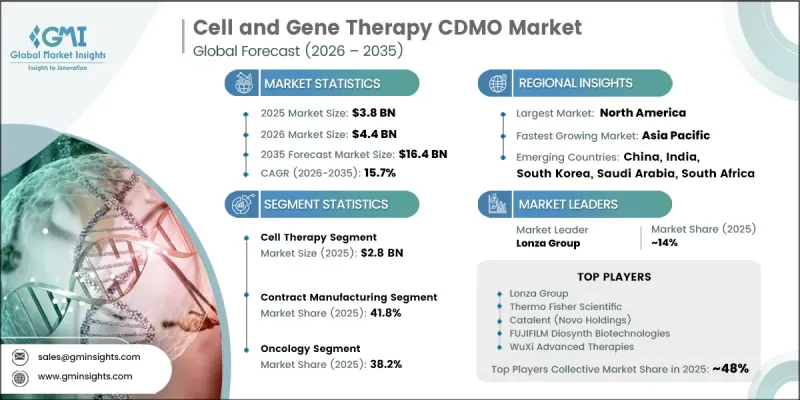
細胞和基因治療CDMO市場的成長主要受以下因素驅動:先進療法研發管線的擴展、對高度專業化生產外包的日益依賴,以及對綜合性合約開發和生產解決方案需求的不斷成長。隨著細胞和基因療法進入臨床開發和商業化階段,生物技術和製藥公司持續與經驗豐富的CDMO合作,以確保獲得先進的生產技術、減少基礎設施投資、加速產品開發並維持合規性。細胞和基因治療CDMO市場涵蓋提供產品生命週期所有階段的一體化開發和生產服務的機構。其服務能力包括製程最佳化、分析開發、技術轉移、載體生產、質體DNA生產、細胞處理、商業化和臨床生產、無菌填充和表面處理工程、品質保證、法規支援、低溫運輸管理以及供應鏈支援。憑藉這些一體化服務能力,CDMO能夠簡化生產流程,並幫助療法開發商有效地推動創新療法從早期開發到商業化生產。
| 市場範圍 | |
|---|---|
| 開始年份 | 2025 |
| 預測期 | 2026-2035 |
| 初始市場規模 | 38億美元 |
| 預計金額 | 164億美元 |
| 複合年成長率 | 15.7% |
預計到2025年,細胞治療市場規模將達28億美元。該領域的成長主要得益於細胞療法的商業化進程加快、臨床開發平臺的快速擴張,以及將技術複雜的生產營運外包給專業合約研發生產機構(CDMO)的趨勢日益成長。自體和異體細胞療法的生產均需要先進的生產能力,包括細胞處理、基因工程、細胞增殖、保存技術、品管、無菌生產和溫控物流等方面的專業知識。這些技術要求促使生物技術和製藥公司不斷與經驗豐富的生產合作夥伴攜手合作。
到2025年,契約製造領域將佔據41.8%的市場佔有率。隨著企業擴大將符合GMP規範的生產營運外包給專業服務供應商,該領域將繼續保持主導地位。先進療法的商業化,以及對可擴展生產基礎設施和高度專業化生產能力日益成長的需求,將持續推動對涵蓋從研發到商業化生產各個環節的綜合生產解決方案的需求成長。
到2025年,北美細胞和基因治療CDMO市場將佔據45.7%的佔有率。這一成長得益於成熟的生物技術產業、先進的生物製造基礎設施以及領先CDMO企業的強大影響力。對製造創新和專業化生產能力的持續投資將支持先進療法的商業化進程,並進一步鞏固該地區的領先地位。
目錄
第1章:調查方法和範圍
第2章執行摘要
第3章 行業洞察
- 產業生態系分析
- 影響產業的因素
- 促進因素
- 細胞和基因療法臨床研發管線的加速推進,正在推動合約研發生產機構(CDMO)的需求。
- 由於製造過程複雜且需要大量資金投入,因此外包是更優的選擇。
- FDA 和 EMA 的批准正在促進商業規模的生產合約。
- 產業潛在風險與挑戰
- GMP生產的高成本阻礙了小規模生物技術公司進入市場。
- 法規日益複雜,GMP標準不斷發展,為企業帶來了合規負擔。
- 市場機遇
- 亞太地區新興的CDMO中心
- 即時護理和分散式製造作為新的經營模式
- 促進因素
- 成長潛力分析
- 監理情勢
- 技術與創新展望
- 最新科技趨勢
- 新興技術
- 價格分析
- 波特的分析
- PESTLE分析
- 投資與資金籌措分析
- 全球資本利得稅 CDMO 投資趨勢(2022-2026 年)
- 政府、美國國立衛生研究院和津貼資金籌措趨勢
- 未來市場趨勢
- 人工智慧和生成式人工智慧對市場的影響
第4章 競爭情勢
- 介紹
- 企業市佔率分析
- 北美洲
- 歐洲
- 亞太地區
- 企業矩陣分析
- 主要市場公司的競爭分析
- 競爭定位矩陣
- 主要進展
- 併購
- 夥伴關係和聯盟
- 新產品發布
- 業務拓展計劃
第5章 市場估算與預測:依產品類型分類,2022-2035年
- 細胞療法
- 基因治療
- 病毒載體
- 非病毒載體
第6章 市場估計與預測:依服務業分類,2022-2035年
- 合約開發
- 契約製造
- 分析測試和品管
- 灌裝、精加工和包裝
- 監管支持
- 其他服務
第7章 市場估計與預測:依治療領域分類,2022-2035年
- 腫瘤學
- 血液疾病
- 罕見遺傳疾病
- 神經病變
- 眼科疾病
- 皮膚病
- 免疫系統疾病
- 其他治療領域
第8章 市場估算與預測:依最終用途分類,2022-2035年
- 製藥公司
- 生技公司
- 其他最終用戶
第9章 市場估計與預測:依地區分類,2022-2035年
- 北美洲
- 美國
- 加拿大
- 歐洲
- 德國
- 英國
- 法國
- 西班牙
- 義大利
- 荷蘭
- 亞太地區
- 中國
- 印度
- 日本
- 澳洲
- 韓國
- 拉丁美洲
- 巴西
- 墨西哥
- 阿根廷
- 中東和非洲
- 南非
- 沙烏地阿拉伯
- UAE
第10章:公司簡介
- AGC Biologics
- Andelyn Biosciences
- Catalent, Inc.(Novo Holdings)
- Center for Breakthrough Medicines(CBM)
- Charles River Laboratories
- Forge Biologics
- FUJIFILM Diosynth Biotechnologies
- Genezen Laboratories
- Lonza Group
- Minaris Advanced Therapies
- National Resilience
- Oxford Biomedica
- Samsung Biologics
- SK pharmteco
- Thermo Fisher Scientific
- Viralgen
- WuXi Advanced Therapies(WuXi AppTec)
The Global Cell and Gene Therapy CDMO Market was valued at USD 3.8 billion in 2025 and is estimated to grow at a CAGR of 15.7% to reach USD 16.4 billion by 2035.
Growth in the cell & gene therapy CDMO market is fueled by the expanding pipeline of advanced therapies, increasing reliance on outsourcing for highly specialized manufacturing, and rising demand for comprehensive contract development and manufacturing solutions. As more cell- and gene-based therapies move through clinical development and commercialization, biotechnology and pharmaceutical companies continue to collaborate with experienced CDMOs to gain access to advanced production technologies, reduce infrastructure investments, accelerate product development, and maintain regulatory compliance. The cell and gene therapy CDMO market includes organizations that provide integrated development and manufacturing services covering every stage of the product lifecycle. Their capabilities span process optimization, analytical development, technology transfer, vector manufacturing, plasmid DNA production, cell processing, commercial and clinical manufacturing, aseptic fill-finish operations, quality assurance, regulatory assistance, cold-chain management, and supply chain support. Through these integrated capabilities, CDMOs simplify manufacturing operations while helping therapy developers efficiently advance innovative treatments from early-stage development through commercial production.
| Market Scope | |
|---|---|
| Start Year | 2025 |
| Forecast Year | 2026-2035 |
| Start Value | $3.8 Billion |
| Forecast Value | $16.4 Billion |
| CAGR | 15.7% |
The cell therapy segment generated USD 2.8 billion in 2025. Segment growth is supported by the increasing commercialization of cell-based therapies, a rapidly expanding clinical development pipeline, and a greater preference for outsourcing technically demanding manufacturing activities to specialized CDMOs. Producing both autologous and allogeneic cell therapies requires advanced manufacturing capabilities, including expertise in cell processing, genetic engineering, cell expansion, preservation techniques, quality management, aseptic production, and temperature-controlled logistics. These technical requirements continue to encourage biotechnology and pharmaceutical companies to collaborate with experienced manufacturing partners.
The contract manufacturing segment accounted for a 41.8% share in 2025. The segment continues to maintain its leadership as companies increasingly outsource GMP-compliant manufacturing operations to specialized service providers. Rising commercialization of advanced therapies, combined with the growing need for scalable manufacturing infrastructure and highly specialized production capabilities, is driving sustained demand for comprehensive manufacturing solutions that support development through commercial-scale production.
North America Cell and Gene Therapy CDMO Market held a 45.7% share in 2025. Regional growth is supported by a well-established biotechnology industry, advanced biomanufacturing infrastructure, and the strong presence of leading contract development and manufacturing organizations. Continuous investment in manufacturing innovation and specialized production capabilities further strengthens the region's leadership while supporting the expanding commercialization of advanced therapies.
Key players operating in the cell and gene therapy CDMO market include AGC Biologics, Andelyn Biosciences, Catalent, Inc. (Novo Holdings), Center for Breakthrough Medicines (CBM), Charles River Laboratories, Forge Biologics, FUJIFILM Diosynth Biotechnologies, Genezen Laboratories, Lonza Group, Minaris Advanced Therapies, National Resilience, Oxford Biomedica, Samsung Biologics, SK pharmteco, Thermo Fisher Scientific, Viralgen, and WuXi Advanced Therapies (WuXi AppTec). Companies participating in the cell and gene therapy CDMO market are reinforcing their competitive position by expanding manufacturing capacity, investing in advanced production technologies, and strengthening research and development capabilities. Many organizations are enhancing end-to-end service portfolios to support customers throughout development and commercial manufacturing while improving production efficiency and regulatory compliance. Strategic collaborations with biotechnology and pharmaceutical companies remain a major growth strategy, enabling long-term business relationships and accelerating therapy development. Businesses are also optimizing manufacturing processes, upgrading quality systems, and expanding global operational footprints to meet rising demand.
Table of Contents
Chapter 1 Methodology and Scope
- 1.1 Market scope and definition
- 1.2 Research approach
- 1.3 Quality commitments
- 1.3.1 GMI AI policy and data integrity commitment
- 1.3.1.1 Source consistency protocol
- 1.3.1 GMI AI policy and data integrity commitment
- 1.4 Research trail and confidence scoring
- 1.4.1 Research trail components
- 1.4.2 Scoring components
- 1.5 Data collection
- 1.5.1 Partial list of primary sources
- 1.6 Data mining sources
- 1.6.1 Paid sources
- 1.6.1.1 Sources, by region
- 1.6.1 Paid sources
- 1.7 Base estimates and calculations
- 1.7.1 Revenue share analysis
- 1.7.2 Base year calculation
- 1.8 Forecast model
- 1.8.1 Quantified market impact analysis
- 1.8.1.1 Mathematical impact of growth parameters on forecast
- 1.8.1 Quantified market impact analysis
- 1.9 Research transparency addendum
- 1.9.1 Source attribution framework
- 1.9.2 Quality assurance metrics
- 1.9.3 Our commitment to trust
Chapter 2 Executive Summary
- 2.1 Industry 360° synopsis
- 2.2 Key market trends
- 2.2.1 Regional trends
- 2.2.2 Product type trends
- 2.2.3 Services trends
- 2.2.4 Therapeutic area trends
- 2.2.5 End use trends
- 2.3 CXO perspectives: Strategic imperatives
Chapter 3 Industry Insights
- 3.1 Industry ecosystem analysis
- 3.2 Industry impact forces
- 3.2.1 Growth drivers
- 3.2.1.1 Accelerating clinical pipeline of cell & gene therapies driving CDMO demand
- 3.2.1.2 High manufacturing complexity & capital requirements favoring outsourcing
- 3.2.1.3 FDA & EMA approvals catalyzing commercial-scale manufacturing contracts
- 3.2.2 Industry pitfalls and challenges
- 3.2.2.1 High Cost of GMP manufacturing limiting accessibility for small biotech
- 3.2.2.2 Regulatory complexity & evolving GMP standards creating compliance burden
- 3.2.3 Market opportunities
- 3.2.3.1 Emerging CDMO hubs in Asia Pacific
- 3.2.3.2 Point-of-care & decentralized manufacturing as an emerging business model
- 3.2.1 Growth drivers
- 3.3 Growth potential analysis
- 3.4 Regulatory landscape
- 3.4.1 North America
- 3.4.2 Europe
- 3.4.3 Asia Pacific
- 3.4.4 Latin America
- 3.4.5 MEA
- 3.5 Technology and innovation landscape
- 3.5.1 Current technological trends
- 3.5.2 Emerging technologies
- 3.6 Pricing analysis (Driven by Primary Research)
- 3.7 Porter’s analysis
- 3.8 PESTEL analysis
- 3.9 Investment & funding analysis
- 3.9.1 Global CGT CDMO investment trends (2022–2026)
- 3.9.2 Government, NIH & grant funding landscape
- 3.10 Future market trends
- 3.11 Impact of AI & generative AI on the market
Chapter 4 Competitive Landscape, 2025
- 4.1 Introduction
- 4.2 Company market share analysis
- 4.2.1 North America
- 4.2.2 Europe
- 4.2.3 Asia Pacific
- 4.3 Company matrix analysis
- 4.4 Competitive analysis of major market players
- 4.5 Competitive positioning matrix
- 4.6 Key developments
- 4.6.1 Merger and acquisition
- 4.6.2 Partnership and collaboration
- 4.6.3 New product launches
- 4.6.4 Expansion plans
Chapter 5 Market Estimates and Forecast, By Product Type, 2022 - 2035 ($ Mn)
- 5.1 Key trends
- 5.2 Cell therapy
- 5.3 Gene therapy
- 5.3.1 Viral vectors
- 5.3.2 Non-viral vectors
Chapter 6 Market Estimates and Forecast, By Services, 2022 - 2035 ($ Mn)
- 6.1 Key trends
- 6.2 Contract development
- 6.3 Contract manufacturing
- 6.4 Analytical testing & quality control
- 6.5 Fill-finish & packaging
- 6.6 Regulatory support
- 6.7 Other services
Chapter 7 Market Estimates and Forecast, By Therapeutic Area, 2022 - 2035 ($ Mn)
- 7.1 Key trends
- 7.2 Oncology
- 7.3 Hematological disorders
- 7.4 Rare genetic disorders
- 7.5 Neurological disorders
- 7.6 Ophthalmological disorders
- 7.7 Dermatological disorders
- 7.8 Immunological disorders
- 7.9 Other therapeutic areas
Chapter 8 Market Estimates and Forecast, By End Use, 2022 - 2035 ($ Mn)
- 8.1 Key trends
- 8.2 Pharmaceutical companies
- 8.3 Biotechnology companies
- 8.4 Other end users
Chapter 9 Market Estimates and Forecast, By Region, 2022 - 2035 ($ Mn)
- 9.1 Key trends
- 9.2 North America
- 9.2.1 U.S.
- 9.2.2 Canada
- 9.3 Europe
- 9.3.1 Germany
- 9.3.2 UK
- 9.3.3 France
- 9.3.4 Spain
- 9.3.5 Italy
- 9.3.6 Netherlands
- 9.4 Asia Pacific
- 9.4.1 China
- 9.4.2 India
- 9.4.3 Japan
- 9.4.4 Australia
- 9.4.5 South Korea
- 9.5 Latin America
- 9.5.1 Brazil
- 9.5.2 Mexico
- 9.5.3 Argentina
- 9.6 Middle East and Africa
- 9.6.1 South Africa
- 9.6.2 Saudi Arabia
- 9.6.3 UAE
Chapter 10 Company Profiles
- 10.1 AGC Biologics
- 10.2 Andelyn Biosciences
- 10.3 Catalent, Inc. (Novo Holdings)
- 10.4 Center for Breakthrough Medicines (CBM)
- 10.5 Charles River Laboratories
- 10.6 Forge Biologics
- 10.7 FUJIFILM Diosynth Biotechnologies
- 10.8 Genezen Laboratories
- 10.9 Lonza Group
- 10.10 Minaris Advanced Therapies
- 10.11 National Resilience
- 10.12 Oxford Biomedica
- 10.13 Samsung Biologics
- 10.14 SK pharmteco
- 10.15 Thermo Fisher Scientific
- 10.16 Viralgen
- 10.17 WuXi Advanced Therapies (WuXi AppTec)

 2026-2034年全球細胞和基因治療製造服務市場規模、佔有率、趨勢和成長分析報告
 細胞與基因治療市場-2026-2032年全球市場預測
 細胞及基因治療市場商機、成長要素、產業趨勢分析及2026-2035年預測。細胞與基因治療臨床試驗市場—2026-2032年全球市場預測
 抗體偶聯T受體療法市場:依適應症和地區分類細胞與基因治療製造服務市場-2026-2032年全球市場預測細胞和基因治療市場規模、佔有率、成長率、全球產業分析、區域分析和未來預測(2026-2034)
 細胞和基因治療臨床試驗市場規模、佔有率和成長分析:按治療方法、階段、適應症、最終用戶和地區分類——2026-2033年產業預測腫瘤細胞和基因治療市場:按治療類型、技術、適應症、最終用戶和地區分類。
 細胞和基因療法市場規模、佔有率和成長分析:按治療方法、方式、適應症、最終用戶和地區分類——2026-2033年產業預測