


 |
市場調查報告書
商品編碼
2109171
糞便處理設備市場機會、成長促進因素、產業趨勢分析及2026-2035年預測Manure Processing Equipment Market Opportunity, Growth Drivers, Industry Trend Analysis, and Forecast 2026 - 2035 |
||||||

全球糞便處理設備市場預計到 2025 年將達到 18.2 億美元,年複合成長率為 6.6%,到 2035 年將達到 34.7 億美元。
隨著日益嚴格的環境法規和對永續畜牧管理投入的不斷增加,市場需求持續變化,糞便處理設備產業正穩步擴張。旨在改善廢棄物管理實踐的法律規範鼓勵畜牧養殖戶採用先進的糞便處理技術,以提高營運效率並符合環境法規。同時,全球畜牧業的持續擴張導致畜牧廢棄物產生量增加,為設備製造商創造了長期商機。根據聯合國糧農組織(FAO)的統計數據,過去十年全球牲畜數量顯著成長,推動了對現代化畜牧廢物管理基礎設施日益成長的需求。將畜禽糞便視為寶貴資源而非廢棄物的趨勢日益增強,刺激了對能源回收和資源最佳化技術的投資,從而進一步推動了市場成長。自動化、數位化監控和智慧畜禽糞便處理系統的不斷進步也提高了商業性畜牧業的生產力並降低了勞動力需求。這些因素,加上支持性的政策舉措和不斷提高的永續性目標,將繼續推動全球糞便處理設備市場的長期擴張。
| 市場範圍 | |
|---|---|
| 開始年份 | 2025 |
| 預測期 | 2026-2035 |
| 初始市場規模 | 18.2億美元 |
| 預計金額 | 34.7億美元 |
| 複合年成長率 | 6.6% |
預計到2025年,堆肥撒佈機和噴射機市場規模將達到5.4億美元,並在2026年至2035年間以5.2%的複合年成長率成長。該細分市場繼續佔據堆肥加工設備市場的最大佔有率,因為無論採用何種堆肥方法,高效的田間施用仍然是堆肥管理的關鍵環節。監管機構日益關注養分管理和更有效率的施肥方式,促使農業經營者以先進的精準撒佈系統取代傳統設備。持續的技術創新進一步提高了撒佈精度、作業效率和環境績效,從而支撐了對該產品類型的持續需求。
預計到2025年,畜牧業務部門和酪農將佔據55.7%的市場。這主要是由於商業性畜牧業需要完善的畜禽糞便管理基礎設施,以支持日常生產活動並確保符合監管要求。市場對用於收集、運輸、分離、儲存和撒播畜禽糞便的各種設備需求旺盛,反映出大規模畜牧場對綜合廢棄物管理解決方案的需求日益成長。預計商業畜牧業的持續擴張將使整個預測期內對相關設備的強勁需求保持穩定。
預計到2025年,北美糞便處理設備市場佔有率將達到30%,這主要得益於可再生能源專案投資的增加。該地區市場受益於完善的畜禽糞便管理環境法規,鼓勵生產者投資先進的糞便處理技術。持續的合規要求,以及對永續農業實踐和可再生能源生產的日益重視,正在推動北美地區對最先進的糞便處理和管理設備的持續穩定需求。
目錄
第1章:調查方法和範圍
第2章執行摘要
第3章 行業洞察
- 產業生態系分析
- 供應鏈分析
- 供應鏈結構和關鍵位置
- 原物料採購及關鍵部件的相互依存關係
- 供應鏈中斷風險及緩解措施
- 售後服務及備品生態系統
- 影響產業的因素
- 市場促進因素
- 加強全球畜禽糞便排放的環境監管
- 牲畜數量增加及畜牧業集約化
- 擴大利用畜禽糞便製成的沼氣和可再生天然氣(RNG)。
- 對營養物回收的需求日益成長,以及循環經濟實踐的推進。
- 精密農業的普及正在推動對智慧施肥系統的需求。
- 市場限制因素
- 大量初始資本投資
- 設備運作和維護所需的技術專長和熟練勞動力短缺。
- 市場機遇
- 新興市場
- 老舊堆肥管理基礎建設的維修升級市場
- 市場促進因素
- 成長潛力分析
- 技術與創新展望
- 精準施肥管理技術
- 物聯網與遠端監控的整合
- 營養物回收及有效利用技術
- 糞便處理的自動化與機器人技術
- 沼氣淨化與可再生天然氣(RNG)技術
- 監理框架
- 北美洲
- 歐洲
- 亞太地區
- 新興市場的監管狀況
- 更嚴格的法規對設備更換週期的影響
- 未來市場趨勢
- 價格分析
- 按設備類型分類的歷史價格趨勢分析(2022-2025 年)
- 依球員類型分類的定價策略(高級球員、超值球員、成本加成球員)
- 貿易數據分析
- 按設備類別分類的進出口量和進口額趨勢
- 主要貿易走廊及關稅對跨境設備銷售的影響。
- 人工智慧和生成式人工智慧對市場的影響
- 利用人工智慧改造現有堆肥管理經營模式
- 按設備細分市場分類的生成式人工智慧用例和部署藍圖
- 人工智慧在農業領域的風險、限制與監管考量
- 波特的分析
- PESTLE分析
第4章 競爭情勢
- 介紹
- 企業市佔率分析
- 按地區
- 企業矩陣分析
- 主要市場公司的競爭分析
- 競爭定位矩陣
- 主要進展
- 併購
- 夥伴關係和聯盟
- 新產品發布
- 業務拓展計劃
第5章 市場估算與預測:依設備類型分類,2022-2035年
- 主要趨勢
- 固液分離器
- 螺旋壓機分離器
- 滾筒篩分離器
- 帶式壓機分離器
- 離心機
- 肥料撒佈器和注入器
- 撒佈器
- 拖鞋和淺噴射器
- 深層注射系統
- 肥料幫浦和攪拌器
- 離心式幫浦
- 切碎機/粉碎泵
- 潛水式攪拌器
- PTO驅動攪拌器
- 厭氧消化器
- 連續攪拌釜式反應器(CSTR)
- 推流式消化器
- 封閉式潟湖式消化池
- 堆肥設備
- 風力轉子轉向器
- 封閉式堆肥系統
- 曝氣式靜態蓄能系統
- 穀倉清潔機和傳送帶
- 拖鍊和刮刀清潔器
- 機器人畜舍清潔系統
- 皮帶輸送機和輸送機
- 堆肥烘乾機
- 旋轉滾筒乾燥機
- 皮帶式烘乾機
- 太陽能熱乾燥系統
- 儲存和容納設施
- 漿料儲存槽和筒倉
- 潟湖蓋和襯裡系統
- 堆肥滲漏預防牆和固態儲存結構
第6章 市場估價與預測:依加工流程分類,2022-2035年
- 主要趨勢
- 機械加工
- 篩檢和過濾
- 壓縮和脫水
- 離心分離
- 生物治療
- 厭氧消化
- 好氧堆肥
- 微生物處理系統
- 化學處理
- 酸化系統
- 鳥糞石沉澱與磷回收
- 聚合物聚集/凝聚
- 熱處理
- 熱乾燥系統
- 熱解和生物炭生產系統
- 氣化系統
- 複雜/整合處理系統
第7章 市場估計與預測:依糞便狀況分類,2022-2035年
- 主要趨勢
- 固態糞便處理設備
- 小規模農場(牛隻存欄量少於500頭)
- 商業規模農場(500-5000頭牲畜)
- 大型/工業化規模農場(5000頭或以上牛)
- 液態和漿狀糞便處理設備
- 對於小規模農場
- 商業規模農場
- 大型/工業化農場規模
- 半固態糞便處理設備
- 小規模農場
- 商業規模農場
- 大型/工業化規模農場
第8章 市場估算與預測:依牲畜類型分類,2022-2035年
- 主要趨勢
- 牛和牛的糞便
- 家禽糞便
- 豬和豬糞
- 馬糞
- 其他
第9章 市場估價與預測:依最終用戶分類,2022-2035年
- 主要趨勢
- 畜牧場及酪農企業
- 家禽養殖場
- 沼氣與可再生能源發電發電廠
- 地方政府和工業廢棄物管理
- 農業合作社和合約農業企業
第10章 市場估價與預測:依地區分類,2022-2035年
- 北美洲
- 美國
- 加拿大
- 歐洲
- 德國
- 英國
- 法國
- 義大利
- 西班牙
- 亞太地區
- 中國
- 印度
- 日本
- 韓國
- 澳洲
- 拉丁美洲
- 巴西
- 墨西哥
- 阿根廷
- 中東和非洲
- UAE
- 沙烏地阿拉伯
- 南非
第11章:公司簡介
- 全球領導人
- GEA Group AG
- Vogelsang GmbH & Co. KG
- Bauer Group
- McLanahan Corporation
- WAMGROUP SpA
- WELTEC BIOPOWER GmbH
- Borger GmbH
- 當地公司
- SAMSON GROUP A/S
- DVO Inc
- Joskin SA
- Kotte Landtechnik GmbH & Co. KG
- Daritech Inc.
- CRI-MAN SpA
- Fliegl Agrartechnik GmbH
- 新興企業
- NPHarvest Oy
- Circuworld BV
- Renergon Biogas AG
- FLOC Ammonia Solutions
- RethaiN Srl
- Boost Environmental Systems Inc.
- NUNOS GmbH
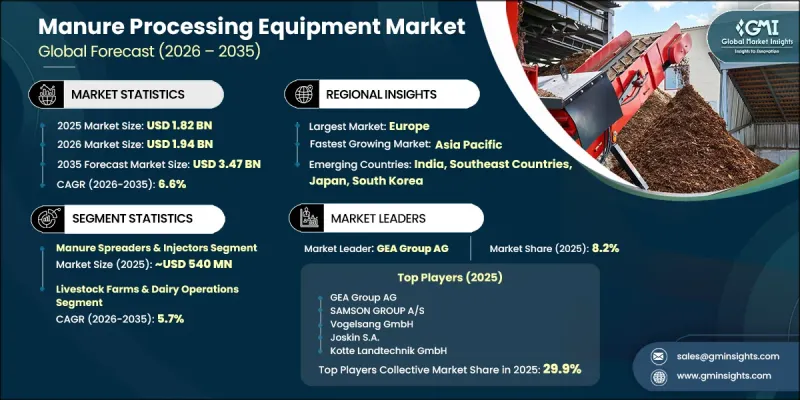
The Global Manure Processing Equipment Market was valued at USD 1.82 billion in 2025 and is estimated to grow at a CAGR of 6.6% to reach USD 3.47 billion by 2035.
The manure processing equipment industry is expanding steadily as stricter environmental regulations and increasing investments in sustainable livestock management continue to reshape market demand. Regulatory frameworks focused on improving waste management practices are encouraging livestock producers to adopt advanced manure processing technologies that enhance operational efficiency while supporting environmental compliance. At the same time, the continued expansion of the global livestock industry is increasing manure generation, creating long-term opportunities for equipment manufacturers. According to FAO statistics, global livestock populations have increased considerably over the past decade, supporting greater demand for modern manure management infrastructure. The growing transition toward utilizing manure as a valuable resource rather than a waste product is further strengthening market growth by encouraging investment in energy recovery and resource optimization technologies. Continuous advancements in automation, digital monitoring, and intelligent manure handling systems are also improving productivity and reducing labor requirements across commercial livestock operations. These factors, combined with supportive policy initiatives and rising sustainability objectives, continue to drive long-term expansion of the global manure processing equipment market.
| Market Scope | |
|---|---|
| Start Year | 2025 |
| Forecast Year | 2026-2035 |
| Start Value | $1.82 Billion |
| Forecast Value | $3.47 Billion |
| CAGR | 6.6% |
The manure spreaders & injectors segment generated USD 540 million in 2025 and is expected to grow at a CAGR of 5.2% from 2026 to 2035. This segment continues to represent the largest share of the manure processing equipment market because efficient field application remains an essential stage of manure management regardless of the processing method used. Increasing regulatory focus on nutrient management and more efficient fertilizer application is encouraging agricultural operations to replace conventional equipment with advanced precision application systems. Ongoing technological improvements are further enhancing application accuracy, operational efficiency, and environmental performance, supporting continued demand for this product category.
The livestock farms & dairy operations segment held a 55.7% share in 2025, as commercial livestock operations require comprehensive manure management infrastructure to support daily production activities and maintain regulatory compliance. Demand spans a broad range of equipment designed for manure collection, transfer, separation, storage, and land application, reflecting the increasing need for integrated waste management solutions across large-scale livestock facilities. Continued expansion of commercial livestock production is expected to sustain strong equipment demand throughout the forecast period.
North America Manure Processing Equipment Market accounted for 30% share in 2025, supported by increasing investment in renewable energy initiatives. The regional market benefits from established environmental regulations governing livestock waste management, encouraging producers to invest in advanced manure processing technologies. Ongoing compliance requirements, combined with greater emphasis on sustainable agricultural practices and renewable energy production, continue to create consistent demand for modern manure handling and processing equipment across North America.
Major companies operating in the global manure processing equipment market include GEA Group AG, Vogelsang GmbH & Co. KG, Bauer Group, McLanahan Corporation, WAMGROUP S.p.A., WELTEC BIOPOWER GmbH, Borger GmbH, SAMSON GROUP A/S, DVO Inc., Joskin S.A., Kotte Landtechnik GmbH & Co. KG, Daritech Inc., CRI-MAN S.p.A., Fliegl Agrartechnik GmbH, NPHarvest Oy, Circuworld B.V., Renergon Biogas AG, FLOC Ammonia Solutions, RethaiN S.r.l., Boost Environmental Systems Inc., and NUNOS GmbH Companies operating in the manure processing equipment market are strengthening their market position by expanding product portfolios, investing in advanced equipment technologies, and enhancing automation capabilities to improve operational efficiency. Manufacturers are focusing on developing integrated manure management solutions that support sustainability goals while helping customers meet evolving environmental regulations. Strategic partnerships with agricultural organizations, technology providers, and renewable energy developers are expanding market reach and creating new business opportunities. Companies are also increasing investments in research and development to improve equipment performance, reduce maintenance requirements, and enhance digital monitoring capabilities.
Table of Contents
Chapter 1 Methodology & Scope
- 1.1 Research approach
- 1.2 Quality Commitments
- 1.2.1 GMI AI policy & data integrity commitment
- 1.2.1.1 Source consistency protocol
- 1.2.1 GMI AI policy & data integrity commitment
- 1.3 Research Trail & Confidence Scoring
- 1.3.1 Research Trail Components
- 1.3.2 Scoring Components
- 1.4 Data Collection
- 1.4.1 Partial list of primary sources
- 1.5 Data mining sources
- 1.5.1 Paid sources
- 1.5.1.1 Sources, by region
- 1.5.1 Paid sources
- 1.6 Base estimates and calculations
- 1.6.1 Base year calculation for any one approach
- 1.7 Forecast model
- 1.7.1 Quantified market impact analysis
- 1.7.1.1 Mathematical impact of growth parameters on forecast
- 1.7.1 Quantified market impact analysis
- 1.8 Research transparency addendum
- 1.8.1 Source attribution framework
- 1.8.2 Quality assurance metrics
- 1.8.2.1 Our commitment to trust
Chapter 2 Executive Summary
- 2.1 Industry 360° synopsis, 2022 – 2035
- 2.2 Key market trends
- 2.2.1 Region
- 2.2.2 Equipment Type
- 2.2.3 Treatment Process
- 2.2.4 Manure State
- 2.2.5 Livestock Source
- 2.2.6 End-user
Chapter 3 Industry Insights
- 3.1 Industry ecosystem analysis
- 3.2 Supply chain analysis
- 3.2.1 Supply Chain Structure & Key Nodes
- 3.2.2 Raw Material Sourcing & Critical Component Dependencies
- 3.2.3 Supply Chain Disruption Risks & Mitigation Strategies
- 3.2.4 Aftermarket Services & Spare Parts Ecosystem
- 3.3 Industry Impact Forces
- 3.3.1 Market drivers
- 3.3.1.1 Tightening Environmental Regulations on Livestock Waste Discharge Globally
- 3.3.1.2 Rising Livestock Population & Intensification of Animal Husbandry Operations
- 3.3.1.3 Growing Adoption of Biogas & Renewable Natural Gas (RNG) from Manure Feedstock
- 3.3.1.4 Increasing Demand for Nutrient Recovery & Circular Economy Practices
- 3.3.1.5 Precision Agriculture Adoption Driving Demand for Smart Manure Equipment
- 3.3.2 Market restraints
- 3.3.2.1 High Initial Capital Investment
- 3.3.2.2 Lack of Technical Expertise & Skilled Labor for Equipment Operation & Maintenance
- 3.3.3 Market opportunities
- 3.3.3.1 Emerging Markets
- 3.3.3.2 Retrofit & Upgrade Market for Aging Manure Management Infrastructure
- 3.3.1 Market drivers
- 3.4 Growth potential analysis
- 3.5 Technology & innovation landscape
- 3.5.1 Precision Manure Management Technologies
- 3.5.2 IoT & Remote Monitoring Integration
- 3.5.3 Nutrient Recovery & Valorization Technologies
- 3.5.4 Automation & Robotics in Manure Handling
- 3.5.5 Biogas Upgrading & Renewable Natural Gas (RNG) Technologies
- 3.6 Regulatory framework
- 3.6.1 North America
- 3.6.2 Europe
- 3.6.3 Asia Pacific
- 3.6.4 Emerging Market Regulatory Landscape
- 3.6.5 Impact of Regulatory Tightening on Equipment Upgrade Cycles
- 3.7 Future market trends
- 3.8 Pricing analysis (driven by primary research)
- 3.8.1 Historical Price Trend Analysis by Equipment Type (2022–2025) (Driven by Primary Research)
- 3.8.2 Pricing Strategy by Player Type (Premium / Value / Cost-plus) (Driven by Primary Research)
- 3.9 Trade data analysis (HS Code - 84324100) (driven by primary research)
- 3.9.1 Import/Export Volume & Value Trends by Equipment Category (Driven by Primary Research)
- 3.9.2 Key Trade Corridors & Tariff Impact on Cross-Border Equipment Sales (Driven by Primary Research)
- 3.10 Impact of AI & generative AI on the market
- 3.10.1 AI-Driven Disruption of Existing Manure Management Business Models
- 3.10.2 GenAI Use Cases & Adoption Roadmap by Equipment Segment
- 3.10.3 Risks, Limitations & Regulatory Considerations for AI in Agriculture
- 3.11 Porter’s analysis
- 3.12 PESTEL analysis
Chapter 4 Competitive Landscape, 2025
- 4.1 Introduction
- 4.2 Company market share analysis
- 4.2.1 By Region
- 4.2.1.1 North America
- 4.2.1.2 Europe
- 4.2.1.3 Asia Pacific
- 4.2.1.4 Latin America
- 4.2.1.5 Middle East and Africa
- 4.2.1 By Region
- 4.3 Company matrix analysis
- 4.4 Competitive analysis of major market players
- 4.5 Competitive positioning matrix
- 4.6 Key developments
- 4.6.1 Mergers & acquisitions
- 4.6.2 Partnerships & collaborations
- 4.6.3 New product launches
- 4.6.4 Expansion plans
Chapter 5 Market Estimates and Forecast, By Equipment Type, 2022 - 2035 (USD Billion) (Thousand Units)
- 5.1 Key Trends
- 5.2 Solid-Liquid Separators
- 5.2.1 Screw Press Separators
- 5.2.2 Drum Screen Separators
- 5.2.3 Belt Press Separators
- 5.2.4 Centrifugal Separators
- 5.3 Manure Spreaders & Injectors
- 5.3.1 Broadcast Surface Spreaders
- 5.3.2 Trailing Shoe & Shallow Injectors
- 5.3.3 Deep Injection Systems
- 5.4 Manure Pumps & Agitators
- 5.4.1 Centrifugal Pumps
- 5.4.2 Chopper/Macerator Pumps
- 5.4.3 Submersible Agitators
- 5.4.4 PTO-Driven Agitators
- 5.5 Anaerobic Digesters
- 5.5.1 Continuously Stirred Tank Reactors (CSTR)
- 5.5.2 Plug-Flow Digesters
- 5.5.3 Covered Lagoon Digesters
- 5.6 Composting Equipment
- 5.6.1 Windrow Turners
- 5.6.2 In-Vessel Composting Systems
- 5.6.3 Aerated Static Pile Systems
- 5.7 Barn Cleaners & Conveyors
- 5.7.1 Drag Chain & Scraper Cleaners
- 5.7.2 Robotic Barn Cleaning Systems
- 5.7.3 Belt & Screw Conveyors
- 5.8 Manure Dryers
- 5.8.1 Rotary Drum Dryers
- 5.8.2 Belt Dryers
- 5.8.3 Solar-Assisted Drying Systems
- 5.9 Storage & Containment Equipment
- 5.9.1 Slurry Storage Tanks & Silos
- 5.9.2 Lagoon Covers & Liner Systems
- 5.9.3 Manure Weeping Walls & Solid Storage Structures
Chapter 6 Market Estimates and Forecast, By Treatment Process, 2022 - 2035 (USD Billion) (Thousand Units)
- 6.1 Key Trends
- 6.2 Mechanical Treatment
- 6.2.1 Screening & Filtration
- 6.2.2 Pressing & Dewatering
- 6.2.3 Centrifugation
- 6.3 Biological Treatment
- 6.3.1 Anaerobic Digestion
- 6.3.2 Aerobic Composting
- 6.3.3 Microbial Treatment Systems
- 6.4 Chemical Treatment
- 6.4.1 Acidification Systems
- 6.4.2 Struvite Precipitation & Phosphorus Recovery
- 6.4.3 Polymer Flocculation & Coagulation
- 6.5 Thermal Treatment
- 6.5.1 Thermal Drying Systems
- 6.5.2 Pyrolysis & Biochar Production Systems
- 6.5.3 Gasification Systems
- 6.6 Combined/Integrated Treatment Systems
Chapter 7 Market Estimates and Forecast, By Manure State, 2022 - 2035 (USD Billion) (Thousand Units)
- 7.1 Key Trends
- 7.2 Solid Manure Processing Equipment
- 7.2.1 Small Farm Scale (<500 Animal Units)
- 7.2.2 Commercial Farm Scale (500–5,000 Animal Units)
- 7.2.3 Large/Industrial Farm Scale (>5,000 Animal Units)
- 7.3 Liquid & Slurry Manure Processing Equipment
- 7.3.1 Small Farm Scale
- 7.3.2 Commercial Farm Scale
- 7.3.3 Large/Industrial Farm Scale
- 7.4 Semi-Solid Manure Processing Equipment
- 7.5 Small Farm Scale
- 7.6 Commercial Farm Scale
- 7.7 Large/Industrial Farm Scale
Chapter 8 Market Estimates and Forecast, By Livestock Source, 2022 - 2035 (USD Billion) (Thousand Units)
- 8.1 Key Trends
- 8.2 Cattle & Dairy Manure
- 8.3 Poultry Manure
- 8.4 Swine & Pig Manure
- 8.5 Horse Manure
- 8.6 Others
Chapter 9 Market Estimates and Forecast, By End-user, 2022 - 2035 (USD Billion) (Thousand Units)
- 9.1 Key Trends
- 9.2 Livestock Farms & Dairy Operations
- 9.3 Poultry Farms
- 9.4 Biogas & Renewable Energy Plants
- 9.5 Municipal & Industrial Waste Management
- 9.6 Agricultural Cooperatives & Contract Farming Operations
Chapter 10 Market Estimates & Forecast, By Region, 2022 – 2035, (USD Billion) (Thousand Units)
- 10.1 Key trends
- 10.2 North America
- 10.2.1 U.S.
- 10.2.2 Canada
- 10.3 Europe
- 10.3.1 Germany
- 10.3.2 U.K.
- 10.3.3 France
- 10.3.4 Italy
- 10.3.5 Spain
- 10.4 Asia Pacific
- 10.4.1 China
- 10.4.2 India
- 10.4.3 Japan
- 10.4.4 South Korea
- 10.4.5 Australia
- 10.5 Latin America
- 10.5.1 Brazil
- 10.5.2 Mexico
- 10.5.3 Argentina
- 10.6 MEA
- 10.6.1 UAE
- 10.6.2 Saudi Arabia
- 10.6.3 South Africa
Chapter 11 Company Profiles
- 11.1 Global Leader
- 11.1.1 GEA Group AG
- 11.1.2 Vogelsang GmbH & Co. KG
- 11.1.3 Bauer Group
- 11.1.4 McLanahan Corporation
- 11.1.5 WAMGROUP S.p.A.
- 11.1.6 WELTEC BIOPOWER GmbH
- 11.1.7 Borger GmbH
- 11.2 Regional Players
- 11.2.1 SAMSON GROUP A/S
- 11.2.2 DVO Inc
- 11.2.3 Joskin S.A.
- 11.2.4 Kotte Landtechnik GmbH & Co. KG
- 11.2.5 Daritech Inc.
- 11.2.6 CRI-MAN S.p.A.
- 11.2.7 Fliegl Agrartechnik GmbH
- 11.3 Emerging Players
- 11.3.1 NPHarvest Oy
- 11.3.2 Circuworld B.V.
- 11.3.3 Renergon Biogas AG
- 11.3.4 FLOC Ammonia Solutions
- 11.3.5 RethaiN S.r.l.
- 11.3.6 Boost Environmental Systems Inc.
- 11.3.7 NUNOS GmbH

 自動化餵料市場預測至2034年—按產品類型、技術、分銷管道、最終用戶和地區分類的全球分析
 山羊自動飲水系統市場規模、佔有率和成長分析:按類型、材質、應用、最終用途產業和地區分類-2026-2033年產業預測
 液壓擠壓槽市場規模、佔有率和成長分析:按產品類型、動力來源、牲畜類型、應用、最終用戶、分銷管道和地區分類-2026-2033年產業預測
 家禽育雛器、餵食器和飲水器市場規模、佔有率和成長分析:按產品類型、應用、最終用途、通路和地區分類-2026-2033年產業預測自動化飼餵市場預測至2034年-全球分析(按自動化類型、牲畜類型、企業規模、個人飼餵設備、飼料、最終用戶和地區分類)
 2026 年至 2035 年糞便處理設備市場的商業機會、成長要素、產業趨勢和預測。
 全球自動化送料系統市場規模、佔有率、趨勢及成長分析報告(2026-2034)
 2026年全球牲畜飲水系統市場報告
 牲畜通道及處理設備市場:依設備類型、動物種類、操作方式、材料、部署方式、通路、最終用途分類,全球預測,2026-2032年牲畜飼料和飲水分配器市場:按產品類型、動物種類、自動化程度、材料、銷售管道和最終用戶分類,全球預測,2026-2032年