


 |
市場調查報告書
商品編碼
2109157
OCTG市場機會、成長促進因素、產業趨勢分析及2026-2035年預測。OCTG (Oil Country Tubular Goods) Market Opportunity, Growth Drivers, Industry Trend Analysis, and Forecast 2026 - 2035 |
||||||

全球輸油管(OCTG)市場預計到 2025 年將達到 213 億美元,年複合成長率為 5.8%,到 2035 年將達到 374 億美元。
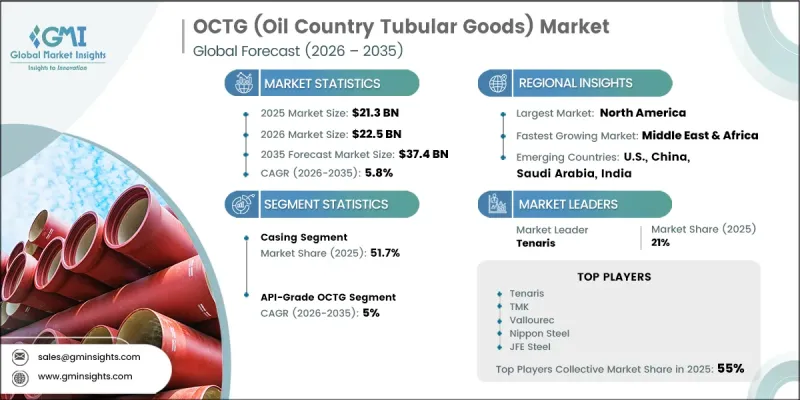
由於上游油氣探勘投資的持續成長、鑽井活動的活性化以及陸上和海上項目對先進油管解決方案需求的不斷成長,輸油管(OCTG)市場正在蓬勃發展。非傳統資源開發的擴張、深海探勘的活性化以及高性能優質連接技術的日益普及也推動了市場擴張。不斷變化的全球貿易政策以及對區域性鋼管產品日益成長的偏好也在影響該行業的整體供應鏈策略和競爭地位。隨著鑽井作業日益複雜,營運商正在加速轉向使用專為承受更高壓力、溫度和機械應力條件而設計的專用OCTG產品。與傳統的螺紋連接相比,優質連接系統具有更優異的密封性能、更高的耐久性和更高的可靠性,因此其重要性日益凸顯。這些因素正在重塑籌資策略,並為提供先進OCTG解決方案的製造商創造新的機會。預計在預測期內,日益惡劣的鑽井環境和對提高井筒完整性的需求將支撐全球輸油管管(OCTG)市場的長期需求成長。
| 市場範圍 | |
|---|---|
| 開始年份 | 2025 |
| 預測期 | 2026-2035 |
| 起始金額 | 213億美元 |
| 預測金額 | 374億美元 |
| 複合年成長率 | 5.8% |
套管市佔率佔比達51.7%,預計到2035年將以5.5%的複合年成長率成長。套管仍然是鑽井作業中不可或缺的組成部分,它提供結構支撐、保護油井並有助於管理整個井深範圍內的壓力狀況。套管的這一關鍵作用使其成為探勘和生產活動中必不可少的投資。隨著營運商對整體油井性能和可靠性的需求不斷成長,針對複雜鑽井環境設計的高強度套管產品的需求持續推動著該細分市場的成長。
預計到2025年,API標準油田管材(OCTG)市佔率將達到61.7%,並在2035年之前以5%的複合年成長率成長。由於其成本效益高、性能可靠且適用於各種常規鑽井作業,API標準油管持續保持較高的採用率。 J55、K55、N80、L80、C90、T95、P110和Q125等產品為作業者提供了多種規格選擇,以適應不同的井況。 API標準產品在大規模鑽井作業的大規模探勘和生產專案中,持續發揮重要作用,為高效的採購系統和可靠的效能提供支援。
預計到2025年,北美輸油管(OCTG)市佔率將達到36.8%。該地區市場強勁成長主要得益於上游產業的蓬勃發展、國內產能的穩健以及對先進鑽井技術的持續投入。美國仍然是區域成長的主要驅動力,這得益於石油生產效率的提高、鑽井技術的進步以及對高品質管材日益成長的需求。持續的近海開發舉措和有利的能源政策預計將進一步推動全部區域對油井管材的需求成長。
目錄
第1章:調查方法和範圍
第2章執行摘要
第3章 行業洞察
- 產業生態系分析
- 原物料供應商
- 管道及管道製造商
- 螺紋加工、連接和表面處理工程
- 銷售代理商和管道服務中心
- 監理情勢
- 技術與創新展望
- 先進冶金和合金開發
- 高階連接技術的演進
- 智慧管狀產品
- 防腐蝕塗層及表面處理技術
- 油田管材的數位孿生和預測性維護分析
- 影響產業的因素
- 成長促進因素
- 產業潛在風險與挑戰
- 成長潛力分析
- 波特的分析
- PESTLE分析
- 投資與資金籌措分析
- 上游產業(油氣探勘開發)的資本投資趨勢
- 生產能力投資及待開發區工廠建設趨勢
- 油田管材供應鏈中的併購活動與策略整合
- 人工智慧和生成式人工智慧對市場的影響
- 利用人工智慧改造現有經營模式
- 生成式人工智慧的應用案例與實施藍圖
- 風險、限制和監管考量
- 將永續發展措施與工業4.0結合
- 未來展望與策略機遇
第4章 競爭情勢
- 介紹
- 企業市佔率分析:按地區分類
- 北美洲
- 歐洲
- 亞太地區
- 中東和非洲
- 拉丁美洲
- 主要進展
- 重要合作夥伴關係和合作
- 主要併購活動
- 產品創新和新產品發布
- 市場擴大策略
- 競爭定位矩陣
- 排名分類標準與遴選標準
- 按收入、地區和創新能力分類的層級定位矩陣。
第5章 市場規模及預測:依產品分類,2022-2035年
- 套管
- 管道
- 鑽桿
- 其他
第6章 市場規模及預測:依製造流程分類,2022-2035年
- 無縫的
- 焊接
第7章 市場規模及預測:依等級分類,2022-2035年
- API
- 優質的
第8章 市場規模及預測:依應用領域分類,2022-2035年
- 陸上
- 離岸
- 淺的
- 深的
- 超深海
第9章 市場規模及預測:依地區分類,2022-2035年
- 北美洲
- 美國
- 加拿大
- 墨西哥
- 歐洲
- 俄羅斯
- 挪威
- 德國
- 英國
- 法國
- 荷蘭
- 亞太地區
- 中國
- 印度
- 日本
- 韓國
- 澳洲
- 中東和非洲
- 沙烏地阿拉伯
- 伊拉克
- UAE
- 科威特
- 卡達
- 奈及利亞
- 安哥拉
- 拉丁美洲
- 巴西
- 阿根廷
第10章:公司簡介
- ArcelorMittal
- Axis Pipe and Tube
- Benteler
- Borusan Pipe
- Baowu Steel
- ChelPipe
- Evraz
- Hilong
- Hunting
- ILJIN
- JFE Steel
- Jindal
- Nippon Steel
- PTC Liberty Tubulars
- SeAH Steel
- Sandvik Materials Technology
- Tenaris
- TMK
- Tata Steel
- TPCO
- United States Steel
- Vallourec
The Global Oil Country Tubular Goods (OCTG) Market was valued at USD 21.3 billion in 2025 and is estimated to grow at a CAGR of 5.8% to reach USD 37.4 billion by 2035.
The OCTG (Oil Country Tubular Goods) Market is witnessing growth due to continued investments in upstream oil and gas exploration, increasing drilling activity, and rising demand for advanced tubular solutions across onshore and offshore projects. Market expansion is supported by growing development of unconventional resources, deepwater exploration activities, and the increasing adoption of high-performance premium connection technologies. Changes in global trade policies and stronger preference for regionally produced steel tubular products are also influencing supply chain strategies and competitive positioning across the industry. As drilling operations become more complex, operators are increasingly shifting toward specialized OCTG products designed to withstand higher pressure, temperature, and mechanical stress conditions. Premium connection systems are gaining importance as they provide enhanced sealing performance, improved durability, and greater reliability compared with conventional threaded connections. These factors are reshaping procurement strategies and creating new opportunities for manufacturers offering advanced OCTG solutions. The continued expansion of challenging drilling environments and the need for improved well integrity are expected to support long-term demand growth for the Global OCTG (Oil Country Tubular Goods) Market throughout the forecast period.
| Market Scope | |
|---|---|
| Start Year | 2025 |
| Forecast Year | 2026-2035 |
| Start Value | $21.3 Billion |
| Forecast Value | $37.4 Billion |
| CAGR | 5.8% |
The casing segment held 51.7% share, growing at a CAGR of 5.5% through 2035. Casing remains a critical component in drilling operations because it provides structural support, protects the wellbore, and helps manage pressure conditions throughout the entire well depth. The essential role of casing makes it a required investment across exploration and production activities. Increasing demand for high-strength casing products designed for complex drilling environments continues to support segment growth as operators seek improved well performance and reliability.
API-grade OCTG segment held 61.7% share in 2025 and is projected to grow at a CAGR of 5% through 2035. Standardized API tubular grades continue to maintain strong adoption due to their cost efficiency, proven performance, and suitability across a wide range of conventional drilling applications. Products such as J55, K55, N80, L80, C90, T95, P110, and Q125 provide operators with a broad range of specifications for different well conditions. High-volume drilling operations continue to rely on API-grade products because they support efficient procurement practices and offer dependable performance for large-scale exploration and production programs.
North America OCTG (Oil Country Tubular Goods) Market accounted for 36.8% share in 2025. The region's market strength is primarily supported by extensive upstream activities, strong domestic production capabilities, and continued investments in advanced drilling technologies. The United States remains the key contributor to regional growth, supported by increasing oil production efficiency, improved drilling methods, and greater demand for high-quality tubular products. Ongoing offshore development initiatives and supportive energy policies are expected to provide additional momentum for OCTG demand across the region.
Major companies operating in the Global OCTG (Oil Country Tubular Goods) Market include Tenaris S.A., Vallourec S.A., TMK Group, Nippon Steel Corporation, JFE Steel Corporation, and United States Steel Corporation. Companies operating in the oil country tubular goods (OCTG) market are strengthening their market position by expanding production capabilities, developing advanced tubular technologies, and improving product quality to meet evolving drilling requirements. Manufacturers are investing in premium connection solutions, high-strength steel grades, and corrosion-resistant products to address demand from complex oil and gas projects. Strategic partnerships with energy companies, regional expansion initiatives, and investments in manufacturing facilities are helping businesses enhance supply reliability and increase market penetration. Companies are also focusing on research and development to improve product durability, operational efficiency, and performance under demanding conditions.
Table of Contents
Chapter 1 Methodology & Scope
- 1.1 Research approach
- 1.2 Quality commitments
- 1.2.1 GMI AI policy & data integrity commitment
- 1.2.1.1 Source consistency protocol
- 1.2.1 GMI AI policy & data integrity commitment
- 1.3 Research trail & confidence scoring
- 1.3.1 Research trail components
- 1.3.2 Scoring components
- 1.4 Data collection
- 1.4.1 Partial list of primary sources
- 1.5 Data mining sources
- 1.5.1 Paid sources
- 1.5.1.1 Sources, by region
- 1.5.1 Paid sources
- 1.6 Base estimates and calculations
- 1.6.1 Base year calculation for any one approach
- 1.7 Market estimates & forecasts parameters
- 1.8 Forecast model
- 1.8.1 Quantified market impact analysis
- 1.8.1.1 Mathematical impact of growth parameters on forecast
- 1.8.1 Quantified market impact analysis
- 1.9 Research transparency addendum
- 1.9.1 Source attribution framework
- 1.9.2 Quality assurance metrics
- 1.9.3 Our commitment to trust
- 1.10 Market definitions
Chapter 2 Executive Summary
- 2.1 Industry synopsis, 2022 - 2035
- 2.1.1 Business trends
- 2.1.2 Product trends
- 2.1.3 Grade trends
- 2.1.4 Manufacturing process trends
- 2.1.5 Application trends
- 2.1.6 Regional trends
Chapter 3 Industry Insights
- 3.1 Industry ecosystem analysis
- 3.1.1 Raw material suppliers
- 3.1.2 Tube & pipe manufacturers
- 3.1.3 Threading, coupling & finishing operations
- 3.1.4 Distributors & pipe service centers
- 3.2 Regulatory landscape
- 3.3 Technology & innovation landscape
- 3.3.1 Advanced metallurgy & alloy development
- 3.3.2 Premium connection technology evolution
- 3.3.3 Smart & intelligent tubulars
- 3.3.4 Anti-corrosion coating & surface treatment technologies
- 3.3.5 Digital twin & predictive failure analytics for octg
- 3.4 Industry impact forces
- 3.4.1 Growth drivers
- 3.4.2 Industry pitfalls & challenges
- 3.5 Growth potential analysis
- 3.6 Porter's analysis
- 3.6.1 Bargaining power of suppliers
- 3.6.2 Bargaining power of buyers
- 3.6.3 Threat of new entrants
- 3.6.4 Threat of substitutes
- 3.7 PESTEL analysis
- 3.7.1 Political factors
- 3.7.2 Economic factors
- 3.7.3 Social factors
- 3.7.4 Technological factors
- 3.7.5 Legal factors
- 3.7.6 Environmental factors
- 3.8 Investment & funding analysis
- 3.8.1 Upstream E&P capital expenditure trends
- 3.8.2 Manufacturing capacity investment & greenfield plant activity
- 3.8.3 M&A activity & strategic consolidation in octg supply chain
- 3.9 Impact of AI & Generative AI on the market (Driven by Primary Research)
- 3.9.1 AI-Driven disruption of existing business models
- 3.9.2 GenAI use cases & adoption roadmap
- 3.9.3 Risks, limitations & regulatory considerations
- 3.10 Sustainability initiatives & industry 4.0 integration
- 3.11 Future outlook & strategic opportunities
Chapter 4 Competitive Landscape, 2026
- 4.1 Introduction
- 4.2 Company market share analysis, by region, 2025
- 4.2.1 North America
- 4.2.2 Europe
- 4.2.3 Asia Pacific
- 4.2.4 Middle East & Africa
- 4.2.5 Latin America
- 4.3 Key developments
- 4.3.1 Key partnerships & collaborations
- 4.3.2 Major M&A activities
- 4.3.3 Product innovations & launches
- 4.3.4 Market expansion strategies
- 4.4 Competitive positioning matrix
- 4.4.1 Tier classification criteria & qualifying thresholds
- 4.4.2 Tier positioning matrix by revenue, geography & innovation
Chapter 5 Market Size and Forecast, By Product, 2022 - 2035 (USD Million)
- 5.1 Key trends
- 5.2 Casing
- 5.3 Tubing
- 5.4 Drill pipe
- 5.5 Others
Chapter 6 Market Size and Forecast, By Manufacturing Process, 2022 - 2035 (USD Million)
- 6.1 Key trends
- 6.2 Seamless
- 6.3 Welded
Chapter 7 Market Size and Forecast, By Grade, 2022 - 2035 (USD Million)
- 7.1 Key trends
- 7.2 API
- 7.3 Premium
Chapter 8 Market Size and Forecast, By Application, 2022 - 2035 (USD Million)
- 8.1 Key trends
- 8.2 Onshore
- 8.3 Offshore
- 8.3.1 Shallow
- 8.3.2 Deep
- 8.3.3 Ultra-deep
Chapter 9 Market Size and Forecast, By Region, 2022 - 2035 (USD Million)
- 9.1 Key trends
- 9.2 North America
- 9.2.1 U.S.
- 9.2.2 Canada
- 9.2.3 Mexico
- 9.3 Europe
- 9.3.1 Russia
- 9.3.2 Norway
- 9.3.3 Germany
- 9.3.4 United Kingdom
- 9.3.5 France
- 9.3.6 Netherlands
- 9.4 Asia Pacific
- 9.4.1 China
- 9.4.2 India
- 9.4.3 Japan
- 9.4.4 South Korea
- 9.4.5 Australia
- 9.5 Middle East & Africa
- 9.5.1 Saudi Arabia
- 9.5.2 Iraq
- 9.5.3 UAE
- 9.5.4 Kuwait
- 9.5.5 Qatar
- 9.5.6 Nigeria
- 9.5.7 Angola
- 9.6 Latin America
- 9.6.1 Brazil
- 9.6.2 Argentina
Chapter 10 Company Profiles
- 10.1 ArcelorMittal
- 10.2 Axis Pipe and Tube
- 10.3 Benteler
- 10.4 Borusan Pipe
- 10.5 Baowu Steel
- 10.6 ChelPipe
- 10.7 Evraz
- 10.8 Hilong
- 10.9 Hunting
- 10.10 ILJIN
- 10.11 JFE Steel
- 10.12 Jindal
- 10.13 Nippon Steel
- 10.14 PTC Liberty Tubulars
- 10.15 SeAH Steel
- 10.16 Sandvik Materials Technology
- 10.17 Tenaris
- 10.18 TMK
- 10.19 Tata Steel
- 10.20 TPCO
- 10.21 United States Steel
- 10.22 Vallourec

 石油和天然氣管道市場:2026-2032年全球市場預測(按產品類型、製造流程、加工方法、材質、外徑、應用和業務類型分類)
 輸油管產品市場報告:依產品、製造流程、等級、應用及地區分類,2026-2034年
 2026年全球油田鋼管市場報告
 全球油田管材 (OCTG) 市場:市場規模、佔有率、成長率、行業分析、依類型、應用和地區劃分的考慮因素以及未來預測 (2026-2034)
 油田管材市場規模、佔有率及成長分析(依製造流程、產品、尺寸、等級、應用及地區分類)-2026-2033年產業預測
 油田管材市場-全球產業規模、佔有率、趨勢、機會及預測,依部署地點(海上及陸上)、產業(上游、下游)、地區及競爭格局分類,2020-2030年預測
 全球輸油管(OCTG)市場
 石油管材市場規模及預測(2025-2031)、全球及地區佔有率、趨勢及成長機會分析報告涵蓋範圍:依製程、產品、應用及地理分類
 2025-2029年全球輸油管(OCTG)市場
 拉丁美洲輸油管-市場佔有率分析、產業趨勢與成長預測(2025-2030 年)