

 |
市場調查報告書
商品編碼
2109140
3D紡織品市場機會、成長促進因素、產業趨勢分析及2026-2035年預測3D Weaving Market Opportunity, Growth Drivers, Industry Trend Analysis, and Forecast 2026 - 2035 |
||||||

全球 3D 紡織品市場預計到 2025 年將達到 5.24 億美元,並以 10.1% 的複合年成長率成長,到 2035 年達到 14 億美元。
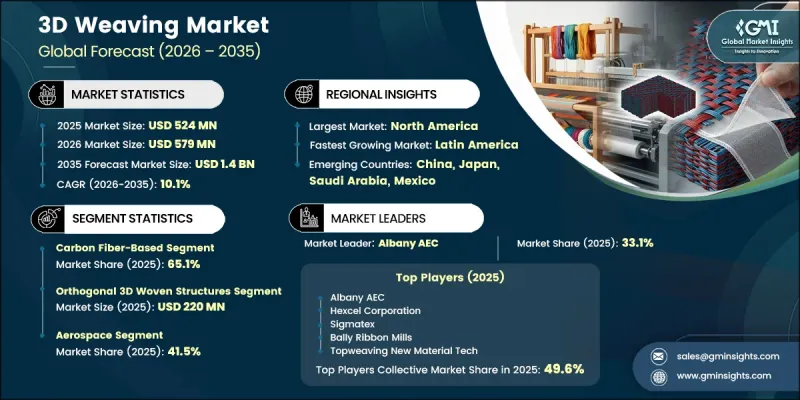
隨著兼具卓越機械強度和長期可靠性的輕質高性能複合材料在各行各業的重要性日益凸顯,該市場正持續成長。對能夠提高生產精度並最大限度減少材料浪費的先進製造流程的需求不斷成長,進一步推動了市場擴張。製造商正穩步採用3D編織技術來生產複雜的複合材料結構,這些結構具有更高的結構完整性、更強的抗衝擊性和更佳的尺寸穩定性。對複合材料創新投入的增加,以及對耐用高效工程解決方案日益成長的需求,正在加速多個工業領域的技術應用。此外,對更輕量化零件、更高營運效率和更佳產品整體性能的日益關注,也推動了3D編織複合材料的廣泛應用。織布機、材料開發和自動化生產方法的持續技術進步也創造了有利的成長機遇,預計3D編織市場將在預測期內保持持續成長。
| 市場範圍 | |
|---|---|
| 開始年份 | 2025 |
| 預測期 | 2026-2035 |
| 起始金額 | 5.24億美元 |
| 預測金額 | 14億美元 |
| 複合年成長率 | 10.1% |
碳纖維複合材料憑藉其高強度、輕量化、優異的剛性、卓越的抗疲勞性和出色的耐腐蝕性,預計到2025年將佔據65.1%的市場佔有率。這些優異的性能使碳纖維成為製造需要長使用壽命和高結構效率的先進複合材料零件的理想材料。在對輕質工程材料需求不斷成長以及對下一代交通運輸和高性能工業應用領域投資不斷增加的推動下,該領域的領先地位持續鞏固。製造商青睞碳纖維的另一個原因是,它能夠幫助他們在減輕重量和提高營運效率的同時,增強產品的耐用性。
預計2025年,正交3D編織結構市場規模將達2.2億美元。此細分市場持續成長的原因在於其在複合材料整個厚度方向上具有卓越的增強效果、更高的抗分層性能以及優異的載荷分佈能力。這些結構優勢使製造商能夠開發出具有更高機械性能且耐久性更強的複合材料零件,同時也能降低材料的整體重量。預計在預測期內,對先進結構複合材料日益成長的需求以及製造技術的不斷創新將進一步推動正交3D編織結構的應用。
預計到2025年,北美3D紡織品市佔率將達到34.1%。該地區的成長主要得益於對先進製造能力的投資增加、輕質複合材料的日益普及以及高性能工業應用的持續發展。積極的研發投入、技術創新以及對高耐久性複合材料解決方案日益成長的需求,正在推動3D紡織品技術在全部區域得到更廣泛的應用。此外,強大的工業基礎設施和對下一代生產技術的持續投資,也鞏固了該地區在全球市場的主導地位。
目錄
第1章:調查方法和範圍
第2章執行摘要
第3章 行業洞察
- 產業生態系分析
- 供應商情況
- 利潤率
- 成本結構
- 每個階段增加的價值
- 影響價值鏈的因素
- 中斷
- 影響產業的因素
- 成長促進因素
- 對輕質高強度複合材料的需求日益成長
- 在航太和國防領域的應用日益廣泛。
- 可再生能源基礎設施的擴張
- 人們越來越關注先進製造和近淨成形生產
- 增加複合材料研發與創新的投資
- 產業潛在風險與挑戰
- 高昂的製造成本和設備成本
- 複雜的生產流程和擴充性限制
- 市場機遇
- 在航太、國防和太空探勘領域不斷擴大應用。
- 自動化織布機和數位製造技術的進步
- 成長促進因素
- 成長潛力分析
- 監理情勢
- 北美洲
- 歐洲
- 亞太地區
- 拉丁美洲
- 中東和非洲
- 波特的分析
- PESTLE分析
- 技術與創新展望
- 最新科技趨勢
- 新興技術
- 價格趨勢
- 按地區
- 依產品
- 定價策略
- 新興經營模式
- 合規要求
- 專利和智慧財產權分析
第4章 競爭情勢
- 介紹
- 企業市佔率分析
- 按地區
- 北美洲
- 歐洲
- 亞太地區
- 拉丁美洲
- 中東和非洲
- 市場集中度分析
- 按地區
- 主要公司的競爭標竿分析
- 財務績效比較
- 收入
- 利潤率
- R&D
- 產品系列比較
- 產品線寬度
- 科技
- 創新
- 區域擴張比較
- 全球擴張分析
- 服務網路覆蓋
- 按地區分類的市場滲透率
- 競爭定位矩陣
- 領導者
- 挑戰者
- 追蹤者
- 小眾玩家
- 戰略展望矩陣
- 財務績效比較
- 主要進展
- 併購
- 夥伴關係和聯盟
- 技術進步
- 擴張和投資策略
- 數位轉型計劃
- 新興企業競爭公司和新創企業的發展趨勢
第5章 市場估算與預測:依紡織材料分類,2022-2035年
- 碳纖維
- 玻璃纖維
- 醯胺纖維
- 陶瓷纖維
- 天然纖維/玄武岩纖維
- 其他
第6章 市場估算與預測:依紡織品結構分類,2022-2035年
- 正交3D編織織物結構
- 角度互鎖編織結構
- 層間編織結構
- 其他
第7章 市場估計與預測:依最終用途產業分類,2022-2035年
- 航太
- 防禦
- 車
- 風力
- 海上
- 建築和基礎設施
- 其他
第8章 市場估計與預測:依地區分類,2022-2035年
- 北美洲
- 美國
- 加拿大
- 歐洲
- 德國
- 英國
- 法國
- 西班牙
- 義大利
- 俄羅斯
- 亞太地區
- 中國
- 印度
- 日本
- 澳洲
- 韓國
- 拉丁美洲
- 巴西
- 墨西哥
- 阿根廷
- 中東和非洲
- 南非
- 沙烏地阿拉伯
- UAE
第9章:公司簡介
- 全球主要公司
- Albany AEC
- Bally Ribbon Mills
- Hexcel Corporation
- Sigmatex
- Topweaving New Material Tech
- 該地區的主要公司
- 北美洲
- Owens Corning
- Tex Tech Industries
- TEAM, Inc.
- Textum OpCo LLC.
- 亞太地區
- Shikibo Ltd.
- Tantra Composite Pvt. Ltd.
- Metyx Composites
- 歐洲
- SAERTEX GmbH &Co. KG
- SGL Carbon SE
- Biteam AB
- Gerster TechTex GmbH
- M. Wright &Sons Ltd.
- 北美洲
- 小眾玩家/顛覆者
- 3TEX Inc.
- Texonic Inc.
- 3D Weaving SA
- 3Dwovens Composites
- Unspun
The Global 3D Weaving Market was valued at USD 524 million in 2025 and is estimated to grow at a CAGR of 10.1% to reach USD 1.4 billion by 2035.
The market continues to gain momentum as industries increasingly prioritize lightweight, high-performance composite materials capable of delivering superior mechanical strength and long-term reliability. Rising demand for advanced manufacturing processes that improve production precision while minimizing material waste is further supporting market expansion. Manufacturers are steadily adopting 3D weaving technologies to produce complex composite structures with enhanced structural integrity, improved impact resistance, and greater dimensional stability. Growing investments in composite material innovation, coupled with the need for durable and efficient engineering solutions, continue to accelerate technology adoption across multiple industrial sectors. In addition, increasing focus on reducing component weight, enhancing operational efficiency, and improving overall product performance is encouraging broader implementation of 3D woven composites. Continuous technological advancements in weaving equipment, material development, and automated production methods are also creating favorable growth opportunities, positioning the 3D weaving market for sustained expansion throughout the forecast period.
| Market Scope | |
|---|---|
| Start Year | 2025 |
| Forecast Year | 2026-2035 |
| Start Value | $524 Million |
| Forecast Value | $1.4 Billion |
| CAGR | 10.1% |
The carbon fiber-based segment captured a 65.1% share in 2025 supported by its exceptional combination of high strength, low weight, outstanding stiffness, superior fatigue resistance, and excellent protection against corrosion. These performance characteristics make carbon fiber an ideal material for manufacturing advanced composite components that require long service life and high structural efficiency. Growing demand for lightweight engineering materials, combined with increasing investments in next-generation transportation and high-performance industrial applications, continues to reinforce the dominance of this segment. Manufacturers also favor carbon fiber because it helps improve product durability while supporting weight reduction and enhanced operational efficiency.
The orthogonal 3D woven structures segment generated USD 220 million in 2025. The segment continues to expand because it offers excellent reinforcement through the thickness of composite materials, improves resistance to layer separation, and delivers superior load distribution capabilities. These structural benefits enable manufacturers to develop highly durable composite components with improved mechanical performance while reducing overall material weight. Increasing demand for advanced structural composites and ongoing innovation in manufacturing technologies are expected to further strengthen the adoption of orthogonal 3D woven structures throughout the forecast period.
North America 3D Weaving Market held a 34.1% share in 2025. Regional growth is being driven by expanding investments in advanced manufacturing capabilities, increasing adoption of lightweight composite materials, and the continued development of high-performance industrial applications. Strong research and development activities, technological innovation, and growing demand for durable composite solutions are encouraging broader implementation of 3D weaving technologies across the region. Supportive industrial infrastructure and continuous investments in next-generation production techniques are also contributing to the region's leadership in the global market.
Prominent companies operating in the Global 3D weaving market include 3D Weaving SA, 3Dwovens Composites, 3TEX Inc., Albany AEC, Bally Ribbon Mills, Biteam AB, Gerster TechTex GmbH, Hexcel Corporation, M. Wright & Sons Ltd., Metyx Composites, Owens Corning, SAERTEX GmbH & Co. KG, SGL Carbon SE, Shikibo Ltd., Sigmatex, T.E.A.M., Inc., Tantra Composite Pvt. Ltd., Tex Tech Industries, Texonic Inc., Textum OpCo LLC, Topweaving New Material Tech Co., Ltd., and Unspun. Leading participants in the 3D Weaving Market are strengthening their competitive position through continuous investment in product innovation, advanced weaving technologies, and high-performance composite material development. Companies are expanding manufacturing capacity to address rising global demand while improving production efficiency through automation and digital manufacturing solutions. Strategic collaborations with material suppliers, technology providers, and industrial manufacturers are enabling faster commercialization of advanced composite products. Many organizations are also increasing research and development spending to enhance material performance, optimize weaving techniques, and introduce customized solutions for diverse industrial requirements. Geographic expansion into emerging markets, long-term supply agreements, and customer-focused product development remain key priorities. In addition, businesses are emphasizing sustainable manufacturing practices, operational efficiency, and quality improvements to strengthen brand value, expand their customer base, and secure a stronger foothold in the evolving global 3D weaving market.
Table of Contents
Chapter 1 Methodology and Scope
- 1.1 Market scope and definition
- 1.2 Research design
- 1.2.1 Research approach
- 1.2.2 Data collection methods
- 1.3 Data mining sources
- 1.3.1 Global
- 1.3.2 Regional/Country
- 1.4 Base estimates and calculations
- 1.4.1 Base year calculation
- 1.4.2 Key trends for market estimation
- 1.5 Primary research and validation
- 1.5.1 Primary sources
- 1.6 Forecast model
- 1.7 Research assumptions and limitations
Chapter 2 Executive Summary
- 2.1 Industry 360° synopsis, 2022 - 2035
- 2.2 Key market trends
- 2.2.1 Fiber material trends
- 2.2.2 Weave Architecture trends
- 2.2.3 End-use industry trends
- 2.2.4 Regional trends
- 2.3 TAM Analysis, 2026-2035
- 2.4 CXO perspectives: Strategic imperatives
Chapter 3 Industry Insights
- 3.1 Industry ecosystem analysis
- 3.1.1 Supplier Landscape
- 3.1.2 Profit Margin
- 3.1.3 Cost structure
- 3.1.4 Value addition at each stage
- 3.1.5 Factor affecting the value chain
- 3.1.6 Disruptions
- 3.2 Industry impact forces
- 3.2.1 Growth drivers
- 3.2.1.1 Increasing demand for lightweight, high-strength composite materials
- 3.2.1.2 Growing adoption in aerospace and defense applications
- 3.2.1.3 Expansion of renewable energy infrastructure
- 3.2.1.4 Increasing focus on advanced manufacturing and near-net-shape production
- 3.2.1.5 Growing investment in composite material research and innovation
- 3.2.2 Industry pitfalls and challenges
- 3.2.2.1 High manufacturing and equipment costs
- 3.2.2.2 Complex production processes and limited scalability
- 3.2.3 Market opportunities
- 3.2.3.1 Growing adoption in aerospace, defense, and space exploration
- 3.2.3.2 Advancements in automated weaving and digital manufacturing technologies
- 3.2.1 Growth drivers
- 3.3 Growth potential analysis
- 3.4 Regulatory landscape
- 3.4.1 North America
- 3.4.2 Europe
- 3.4.3 Asia Pacific
- 3.4.4 Latin America
- 3.4.5 Middle East & Africa
- 3.5 Porter's analysis
- 3.6 PESTEL analysis
- 3.7 Technology and Innovation landscape
- 3.7.1 Current technological trends
- 3.7.2 Emerging technologies
- 3.8 Price trends
- 3.8.1 By region
- 3.8.2 By product
- 3.9 Pricing Strategies
- 3.10 Emerging Business Models
- 3.11 Compliance Requirements
- 3.12 Patent and IP analysis
Chapter 4 Competitive Landscape, 2025
- 4.1 Introduction
- 4.2 Company market share analysis
- 4.2.1 By region
- 4.2.1.1 North America
- 4.2.1.2 Europe
- 4.2.1.3 Asia Pacific
- 4.2.1.4 Latin America
- 4.2.1.5 Middle East & Africa
- 4.2.2 Market concentration analysis
- 4.2.1 By region
- 4.3 Competitive benchmarking of key players
- 4.3.1 Financial performance comparison
- 4.3.1.1 Revenue
- 4.3.1.2 Profit margin
- 4.3.1.3 R&D
- 4.3.2 Product portfolio comparison
- 4.3.2.1 Product range breadth
- 4.3.2.2 Technology
- 4.3.2.3 Innovation
- 4.3.3 Geographic presence comparison
- 4.3.3.1 Global footprint analysis
- 4.3.3.2 Service network coverage
- 4.3.3.3 Market penetration by region
- 4.3.4 Competitive positioning matrix
- 4.3.4.1 Leaders
- 4.3.4.2 Challengers
- 4.3.4.3 Followers
- 4.3.4.4 Niche players
- 4.3.5 Strategic outlook matrix
- 4.3.1 Financial performance comparison
- 4.4 Key developments
- 4.4.1 Mergers and acquisitions
- 4.4.2 Partnerships and collaborations
- 4.4.3 Technological advancements
- 4.4.4 Expansion and investment strategies
- 4.4.5 Digital transformation initiatives
- 4.5 Emerging/ startup competitors landscape
Chapter 5 Market Estimates and Forecast, By Fiber Material, 2022 - 2035 (USD Million)
- 5.1 Key trends
- 5.2 Carbon fiber-based
- 5.3 Glass fiber-based
- 5.4 Aramid fiber-based
- 5.5 Ceramic fiber-based
- 5.6 Natural & basalt fiber-based
- 5.7 Others
Chapter 6 Market Estimates and Forecast, By Weave Architecture, 2022 - 2035 (USD Million)
- 6.1 Key trends
- 6.2 Orthogonal 3D woven structures
- 6.3 Angle-interlock woven structures
- 6.4 Layer-to-layer woven structures
- 6.5 Others
Chapter 7 Market Estimates and Forecast, By End-Use Industry, 2022 - 2035 (USD Million)
- 7.1 Key trends
- 7.2 Aerospace
- 7.3 Defense
- 7.4 Automotive
- 7.5 Wind energy
- 7.6 Marine
- 7.7 Construction & infrastructure
- 7.8 Others
Chapter 8 Market Estimates and Forecast, By Region, 2022 - 2035 (USD Million)
- 8.1 Key trends
- 8.2 North America
- 8.2.1 U.S.
- 8.2.2 Canada
- 8.3 Europe
- 8.3.1 Germany
- 8.3.2 UK
- 8.3.3 France
- 8.3.4 Spain
- 8.3.5 Italy
- 8.3.6 Russia
- 8.4 Asia Pacific
- 8.4.1 China
- 8.4.2 India
- 8.4.3 Japan
- 8.4.4 Australia
- 8.4.5 South Korea
- 8.5 Latin America
- 8.5.1 Brazil
- 8.5.2 Mexico
- 8.5.3 Argentina
- 8.6 Middle East and Africa
- 8.6.1 South Africa
- 8.6.2 Saudi Arabia
- 8.6.3 UAE
Chapter 9 Company Profiles
- 9.1 Global Key Players
- 9.1.1 Albany AEC
- 9.1.2 Bally Ribbon Mills
- 9.1.3 Hexcel Corporation
- 9.1.4 Sigmatex
- 9.1.5 Topweaving New Material Tech
- 9.2 Regional key players
- 9.2.1 North America
- 9.2.1.1 Owens Corning
- 9.2.1.2 Tex Tech Industries
- 9.2.1.3 T.E.A.M., Inc.
- 9.2.1.4 Textum OpCo LLC.
- 9.2.2 Asia Pacific
- 9.2.2.1 Shikibo Ltd.
- 9.2.2.2 Tantra Composite Pvt. Ltd.
- 9.2.2.3 Metyx Composites
- 9.2.3 Europe
- 9.2.3.1 SAERTEX GmbH & Co. KG
- 9.2.3.2 SGL Carbon SE
- 9.2.3.3 Biteam AB
- 9.2.3.4 Gerster TechTex GmbH
- 9.2.3.5 M. Wright & Sons Ltd.
- 9.2.1 North America
- 9.3 Niche Players/Disruptors
- 9.3.1 3TEX Inc.
- 9.3.2 Texonic Inc.
- 9.3.3 3D Weaving SA
- 9.3.4 3Dwovens Composites
- 9.3.5 Unspun

 全球3D紡織品市場規模、佔有率、趨勢和成長分析報告(2026-2034)
 全球3D紡織品市場規模調查與預測:按產品類型、應用、材料、最終用戶和地區分類的預測(2026-2035年)
 3D紡織品市場:按材料、應用、技術和地區分類
 3D紡織品市場:依機器類型、應用和終端用戶產業劃分-全球預測至2036年
 3D 編織市場,按產品類型、按應用、按材料、按技術、按最終用戶、按國家和地區 - 2025 年至 2032 年全球行業分析、市場規模、市場佔有率和預測
 全球 3D 紡織品市場(至 2030 年)按產品類型(玻璃纖維、複合纖維、間隔物、碳纖維、客製化 3D 編織)和應用(結構部件、防護材料、加固材料、隔熱隔音、熱防護)分類