


 |
市場調查報告書
商品編碼
2102000
螺旋式鼓風機市場機會、成長要素、產業趨勢分析及2026-2035年預測。Helical Screw Blowers Market Opportunity, Growth Drivers, Industry Trend Analysis, and Forecast 2026 - 2035 |
||||||

全球螺旋式鼓風機市場預計到 2025 年將達到 13 億美元,年複合成長率為 5.8%,到 2035 年將達到 23 億美元。
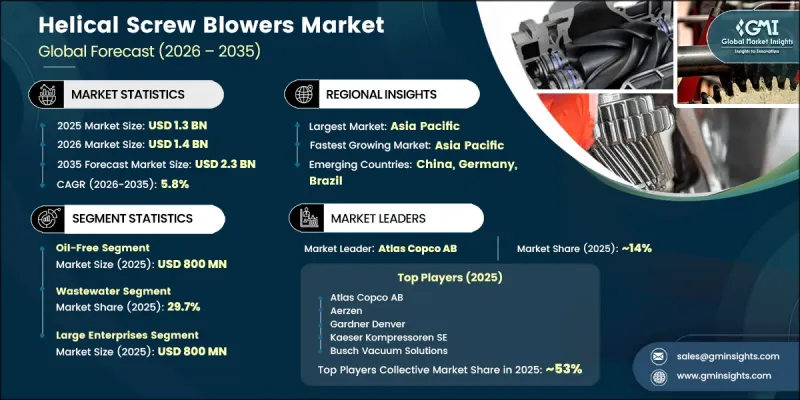
隨著節能型空氣壓縮技術在各行業日益受到重視,其在降低能耗的同時提升運行性能,市場發展勢頭持續強勁。螺旋式鼓風機正被多個終端應用領域廣泛採用,這主要得益於工業現代化投資的增加以及對經濟高效、可靠鼓風機系統需求的成長。不斷完善的污水處理基礎設施、對降低營運成本的日益重視以及對永續工業運營的日益關注,都為市場成長創造了機會。此外,先進控制技術、智慧監控功能和變頻驅動(VSD)系統的整合,正在提升設備的效率、運作柔軟性和全生命週期性能。製造商也致力於提供高性能鼓風機解決方案,以減少維護需求、提高氣流穩定性並增強可靠性。隨著各行業生產設施的現代化改造以及對高效製程設備的持續投資,在工業應用領域對先進容積式鼓風機技術的需求不斷成長的推動下,預計螺旋式鼓風機市場將在預測期內穩步擴張。
| 市場範圍 | |
|---|---|
| 開始年份 | 2025 |
| 預測期 | 2026-2035 |
| 上市時的市場規模 | 13億美元 |
| 預測金額 | 23億美元 |
| 複合年成長率 | 5.8% |
預計到2025年,無油市場規模將達8億美元。隨著眾多產業需要潔淨的壓縮空氣來支援關鍵的生產流程並維持高標準的運行,對無油鼓風機系統的需求持續成長。這些系統能夠提供潔淨的氣流,同時最大限度地減少維護需求並提高整體製程可靠性。它們性能穩定、效率高、運作可靠,是空氣純度是主要運作要求的應用的理想選擇。對先進無油技術的持續投資有望進一步增強該領域的長期成長前景。
2025年,污水處理領域佔了29.7%的市場。由於生物處理過程需要在受控壓力條件下穩定、持續地供應壓縮空氣,因此污水處理仍然是螺旋鼓風機最重要的應用領域之一。污水處理設施的擴建、現有基礎設施的現代化改造以及水資源管理專案投資的增加,都推動了對這些系統的持續需求。螺旋鼓風機能夠提供可靠的氣流,同時提高能源效率,使其成為市政和工業污水處理設施長期運作的理想選擇。
美國螺旋鼓風機市場預計到2025年將達到3億美元,並在2026年至2035年間以5.9%的複合年成長率成長。市場擴張的促進因素包括對工業基礎設施的持續投資、廢水處理設施的現代化改造以及製造業整體節能設備日益成長的需求。老舊鼓風機系統的不斷更新換代,以及工業發展的不斷推進和過程自動化舉措的實施,正在加速全國範圍內先進螺旋鼓風機技術的應用。
目錄
第1章:調查方法和範圍
第2章執行摘要
第3章 行業洞察
- 產業生態系分析
- 供應商情況
- 影響價值鏈的因素
- 價值鏈各階段的利潤率分析
- 中斷
- 前景
- 影響產業的因素
- 促進因素
- 市場比較傳統羅茨式/羅茨式技術更節能的工業鼓風機解決方案的需求日益成長。
- 全球擴大市政和工業廢水處理基礎設施
- 嚴格的環境和噪音排放法規正在推動技術變革。
- 市場限制因素
- 前期投入巨大是阻礙中小企業和新興市場採用此技術的主要因素。
- 偏遠地區和二、三線工業區缺乏技術熟練的維修技師。
- 市場機遇
- 將物聯網、智慧感測器和預測性維護技術整合到鼓風機組件中
- 擴大通風技術在水產養殖和園藝的應用。
- 促進因素
- 成長潛力分析
- 未來市場趨勢
- 技術與創新展望
- 最新科技趨勢
- 新興技術
- 新型轉子輪廓技術(3x5、VHX、混合輪廓)
- VFD/VSD 整合及變速控制發展趨勢
- 智慧鼓風機系統
- 隔音罩和降噪技術創造新
- 價格分析
- 對過去價格趨勢的分析
- 依球員類型分類的定價策略(高級球員、超值球員、成本加成球員)
- 監理情勢
- 能源效率標準(ISO 1217,歐盟生態設計指令)
- 環境和排放氣體法令遵循
- 工業噪音法規(歐盟機械指令、美國職業安全與健康管理局)
- 食品藥物等級空氣品質標準(FDA 21 CFR,歐盟 GMP)
- 貿易數據分析
- 主要貿易路線及關稅的影響
- 貿易政策與區域貿易協定的變化
- 供應鏈分析
- 原物料採購
- 主要一級和二級供應商概覽
- 供應鏈風險與中斷評估
- 人工智慧和生成式人工智慧對市場的影響
- 利用人工智慧改造現有經營模式
- 按細分市場分類的生成式人工智慧用例和部署藍圖
- 風險、限制和監管考量
- 生產能力和生產情況
- 設備產能:按地區和主要生產商分類
- 運轉率和擴張計劃
- 波特五力分析
- PESTLE分析
第4章 競爭情勢
- 介紹
- 企業市佔率分析
- 按地區
- 企業矩陣分析
- 主要市場公司的競爭分析
- 競爭定位矩陣
- 主要進展
- 併購
- 夥伴關係和聯盟
- 新產品發布
- 業務拓展計劃
第5章 市場估算與預測:以潤滑方式分類,2022-2035年
- 無油
- 注入油
第6章 市場估計與預測:依驅動系統分類,2022-2035年
- 直驅
- 皮帶傳動
第7章 市場估價與預測:依轉子輪廓類型分類,2022-2035年
- 標準雙螺桿(2x4型材)
- 高效能雙螺桿(3x5型材)
- 可變螺旋輪廓 (VHX)
- 三葉螺旋(3+4混合輪廓)
第8章 市場估計與預測:依產能分類,2022-2035年
- 低流量(500 立方英尺/分鐘或更少/14 立方米/分鐘或更少)
- 中等流量(500-2,500 立方英尺/分鐘/14-71 立方米/分鐘)
- 高流量(2,500-6,000 立方英尺/分鐘/71-170 立方米/分鐘)
第9章 市場估算與預測:依馬達功率範圍分類,2022-2035年
- 小功率(37千瓦或以下)
- 中功率(37-160千瓦)
- 高輸出功率(160千瓦或以上)
第10章 市場估計與預測:依速度控制分類,2022-2035年
- 勻速
- 變頻驅動器(VSD/VFD)
第11章 市場估計與預測:依應用領域分類,2022-2035年
- 污水處理
- 都市污水處理
- 工業污水處理
- 化工/石油化工
- 製程氣體處理
- 化學產品的氣動輸送
- 食品/飲料
- 食品氣動輸送
- 發酵和製程通氣
- 製藥
- 無菌空氣供應
- API生產製程和片劑包覆中的通風
- 發電
- 燃燒空氣供應
- 採用氣力輸送方式處置灰渣
- 水泥
- 水泥粉的氣動輸送
- 窯爐燃燒空氣
- 鋼鐵廠
- 採礦和通風
- 其他(水產養殖、園藝、一般工業運輸)
第12章 市場估算與預測:依最終使用者規模分類,2022-2035年
- 大公司
- 中小企業
第13章 市場估計與預測:依通路分類,2022-2035年
- 直銷
- 間接銷售
第14章 市場估計與預測:依地區分類,2022-2035年
- 北美洲
- 美國
- 加拿大
- 歐洲
- 英國
- 德國
- 法國
- 義大利
- 西班牙
- 俄羅斯
- 亞太地區
- 中國
- 印度
- 日本
- 韓國
- 澳洲
- 拉丁美洲
- 巴西
- 墨西哥
- 中東和非洲
- 南非
- 沙烏地阿拉伯
- UAE
第15章:公司簡介
- 世界公司
- Atlas Copco AB
- Aerzener Maschinenfabrik GmbH(Aerzen)
- Kaeser Kompressoren SE
- Gardner Denver
- Elmo Rietschle
- 該地區的領先企業
- Robuschi SpA
- Busch Vacuum Solutions
- Spencer Turbine Company
- Tuthill Corporation
- Hibon SAS
- 新興企業
- Sullair LLC
- Continental Industrie SAS
- Shandong Zhangqiu Blower Co., Ltd.
- Neuman & Esser Group
- Piller Blowers & Compressors GmbH
- Universal Blower Pac
- Airtech International
- Howden Group(Chart Industries)
- Everest Blowers Systems Pvt. Ltd.
- Neuros Co., Ltd.
- SKF(Blower Systems Division)
The Global Helical Screw Blowers Market was valued at USD 1.3 billion in 2025 and is estimated to grow at a CAGR of 5.8% to reach USD 2.3 billion by 2035.
The market continues to gain momentum as industries increasingly prioritize energy-efficient air compression technologies that improve operational performance while lowering energy consumption. Growing investment in industrial modernization, combined with the need for cost-effective and reliable blower systems, is encouraging the adoption of helical screw blowers across multiple end-use sectors. The expansion of wastewater treatment infrastructure, rising focus on reducing operating expenses, and increasing emphasis on sustainable industrial operations are creating favorable opportunities for market growth. In addition, the integration of advanced control technologies, intelligent monitoring capabilities, and variable speed drive (VSD) systems is improving equipment efficiency, operational flexibility, and lifecycle performance. Manufacturers are also focusing on delivering high-performance blower solutions that offer lower maintenance requirements, improved airflow consistency, and enhanced reliability. As industries continue to modernize production facilities and invest in efficient process equipment, the Helical Screw Blower Market is expected to witness steady expansion throughout the forecast period, supported by growing demand for advanced positive displacement blower technologies across industrial applications.
| Market Scope | |
|---|---|
| Start Year | 2025 |
| Forecast Year | 2026-2035 |
| Start Value | $1.3 Billion |
| Forecast Value | $2.3 Billion |
| CAGR | 5.8% |
The oil-free segment generated USD 800 million in 2025. Demand for oil-free blower systems continues to increase because many industries require contamination-free compressed air to support critical manufacturing processes and maintain high operational standards. These systems deliver clean airflow while minimizing maintenance requirements and improving overall process reliability. Their ability to provide consistent performance, enhanced efficiency, and dependable operation makes them preferred choice for applications where air purity remains a primary operational requirement. Continued investment in advanced oil-free technologies is expected to strengthen the segment's long-term growth prospects.
The wastewater segment accounted for 29.7% share in 2025. Wastewater treatment continues to represent one of the most significant application areas for helical screw blowers because biological treatment processes require a continuous supply of stable compressed airflow under controlled pressure conditions. The growing expansion of wastewater treatment facilities, modernization of existing infrastructure, and increasing investments in water management projects are supporting sustained demand for these systems. Their capability to deliver reliable airflow with improved energy efficiency makes them well suited for long-term operation across municipal and industrial wastewater treatment facilities.
U.S. Helical Screw Blowers Market was valued at USD 300 million in 2025 and is projected to grow at a CAGR of 5.9% between 2026 and 2035. Market expansion is supported by ongoing investments in industrial infrastructure, modernization of wastewater treatment facilities, and rising demand for energy-efficient equipment across manufacturing operations. Increasing replacement of aging blower systems, coupled with continued industrial development and expanding process automation initiatives, is encouraging the adoption of advanced helical screw blowers technologies throughout the country.
Key players operating in the Global Helical Screw Blowers Market include Atlas Copco AB, Aerzener Maschinenfabrik GmbH (Aerzen), Kaeser Kompressoren SE, Gardner Denver, Elmo Rietschle, Robuschi S.p.A., Busch Vacuum Solutions, Spencer Turbine Company, Tuthill Corporation, Hibon S.A.S., Sullair LLC, Continental Industrie SAS, Shandong Zhangqiu Blower Co., Ltd., Neuman & Esser Group, Piller Blowers & Compressors GmbH, Universal Blower Pac, Airtech International, Howden Group (Chart Industries), Everest Blowers Systems Pvt. Ltd., Neuros Co., Ltd., and SKF (Blower Systems Division). Companies operating in the Helical Screw Blowers Market are strengthening their market position by investing in product innovation, energy-efficient technologies, and intelligent blower systems that improve operational performance while lowering lifecycle costs. Manufacturers are expanding their product portfolios with advanced oil-free solutions, integrating digital monitoring capabilities, and incorporating variable speed drive technologies to enhance efficiency and reliability.
Table of Contents
Chapter 1 Methodology and Scope
- 1.1 Market scope and definition
- 1.2 Research design
- 1.2.1 Research approach
- 1.2.2 Data collection methods
- 1.3 Data mining sources
- 1.3.1 Global
- 1.3.2 Regional/Country
- 1.4 Base estimates and calculations
- 1.4.1 Base year calculation
- 1.4.2 Key trends for market estimation
- 1.5 Primary research and validation
- 1.5.1 Primary sources
- 1.6 Forecast model
- 1.7 Research assumptions and limitations
Chapter 2 Executive Summary
- 2.1 Industry 360° synopsis
- 2.2 Key market trends
- 2.3 Regional
- 2.4 Lubrication type
- 2.5 Drive configuration
- 2.6 Rotor profile type
- 2.7 Capacity
- 2.8 Motor power range
- 2.9 Speed control
- 2.10 Application
- 2.11 End user scale
- 2.12 Distribution channel
Chapter 3 Industry Insights
- 3.1 Industry ecosystem analysis
- 3.1.1 Supplier landscape
- 3.1.2 Factor affecting the value chain
- 3.1.3 Profit margin analysis by value chain stage
- 3.1.4 Disruptions
- 3.1.5 Future outlook
- 3.2 Industry impact forces
- 3.2.1 Growth drivers
- 3.2.1.1 Rising demand for energy-efficient industrial blower solutions over conventional lobe/roots technology
- 3.2.1.2 Expanding municipal & industrial wastewater treatment infrastructure globally
- 3.2.1.3 Stringent environmental & noise emission regulations driving technology shift
- 3.2.2 Market restraints
- 3.2.2.1 High initial capital investment deterring SME & emerging-market adoption
- 3.2.2.2 Shortage of skilled service technicians in remote & tier-II/III industrial regions
- 3.2.3 Market opportunities
- 3.2.3.1 Integration of IoT, smart sensors & predictive maintenance technologies in blower packages
- 3.2.3.2 Expanding applications in aquaculture & horticulture aeration
- 3.2.1 Growth drivers
- 3.3 Growth potential analysis
- 3.4 Future market trends
- 3.5 Technology and innovation landscape
- 3.5.1 Current technological trends
- 3.5.2 Emerging technologies
- 3.5.3 Emerging rotor profile technologies (3×5, VHX, hybrid profiles)
- 3.5.4 VFD/VSD integration & variable speed control trends
- 3.5.5 Smart blower systems
- 3.5.6 Acoustic enclosure & noise reduction innovations
- 3.6 Pricing analysis (driven by primary research)
- 3.6.1 Historical price trend analysis
- 3.6.2 Pricing strategy by player type (premium / value / cost-plus)
- 3.7 Regulatory landscape
- 3.7.1 Energy efficiency standards (ISO 1217, EU Ecodesign Directive)
- 3.7.2 Environmental & emission compliance regulations
- 3.7.3 Industrial noise compliance standards (EU Machinery Directive, OSHA)
- 3.7.4 Food & pharma grade air quality standards (FDA 21 CFR, EU GMP)
- 3.8 Trade data analysis (driven by paid database) (HS Code- 84145930)
- 3.8.1 Key trade corridors & tariff impact
- 3.8.2 Trade policy changes & regional trade agreements
- 3.9 Supply chain analysis
- 3.9.1 Raw material sourcing
- 3.9.2 Key Tier-1 & Tier-2 supplier landscape
- 3.9.3 Supply chain risk & disruption assessment
- 3.10 Impact of AI & generative AI on the market
- 3.10.1 AI-driven disruption of existing business models
- 3.10.2 GenAI use cases & adoption roadmap by segment
- 3.10.3 Risks, limitations & regulatory considerations
- 3.11 Capacity & production landscape (driven by primary research)
- 3.11.1 Installed capacity by region & key producer
- 3.11.2 Capacity utilization rates & expansion pipelines
- 3.12 Porter's five forces analysis
- 3.13 PESTEL analysis
Chapter 4 Competitive Landscape, 2025
- 4.1 Introduction
- 4.2 Company market share analysis
- 4.2.1 By region
- 4.2.1.1 North America
- 4.2.1.2 Europe
- 4.2.1.3 Asia Pacific
- 4.2.1.4 Latin America
- 4.2.1.5 Middle East and Africa
- 4.2.1 By region
- 4.3 Company matrix analysis
- 4.4 Competitive analysis of major market players
- 4.5 Competitive positioning matrix
- 4.6 Key developments
- 4.6.1 Mergers & acquisitions
- 4.6.2 Partnerships & collaborations
- 4.6.3 New product launches
- 4.6.4 Expansion plans
Chapter 5 Market Estimates & Forecast, By Lubrication Type, 2022-2035 (USD Billion) (Thousand Units)
- 5.1 Key trends
- 5.2 Oil-free
- 5.3 Oil-injected
Chapter 6 Market Estimates & Forecast, By Drive Configuration, 2022-2035 (USD Billion) (Thousand Units)
- 6.1 Key trends
- 6.2 Direct drive
- 6.3 Belt drive
Chapter 7 Market Estimates & Forecast, By Rotor Profile Type, 2022-2035 (USD Billion) (Thousand Units)
- 7.1 Key trends
- 7.2 Standard twin-screw (2×4 Profile)
- 7.3 High-efficiency twin-screw (3×5 Profile)
- 7.4 Variable helix profile (VHX)
- 7.5 Tri-lobe helical (3+4 Hybrid Profile)
Chapter 8 Market Estimates & Forecast, By Capacity, 2022-2035 (USD Billion) (Thousand Units)
- 8.1 Key trends
- 8.2 Low flow (up to 500 cfm / ≤ 14 m³/min)
- 8.3 Medium flow (500–2,500 cfm / 14–71 m³/min)
- 8.4 High flow (2,500–6,000 cfm / 71–170 m³/min)
Chapter 9 Market Estimates & Forecast, By Motor Power Range, 2022-2035 (USD Billion) (Thousand Units)
- 9.1 Key trends
- 9.2 Small power (up to 37 kW)
- 9.3 Medium power (37–160 kW)
- 9.4 Large power (above 160 kW)
Chapter 10 Market Estimates & Forecast, By Speed Control, 2022-2035 (USD Billion) (Thousand Units)
- 10.1 Key trends
- 10.2 Fixed speed
- 10.3 Variable speed drive (VSD/VFD)
Chapter 11 Market Estimates & Forecast, By Application, 2022-2035 (USD Billion) (Thousand Units)
- 11.1 Key trends
- 11.2 Wastewater treatment
- 11.2.1 Municipal wastewater treatment
- 11.2.2 Industrial wastewater treatment
- 11.3 Chemicals & petrochemicals
- 11.3.1 Process gas handling
- 11.3.2 Pneumatic conveying of chemicals
- 11.4 Food & beverage
- 11.4.1 Food-grade pneumatic conveying
- 11.4.2 Fermentation & process aeration
- 11.5 Pharmaceuticals
- 11.5.1 Sterile air supply
- 11.5.2 API process & tablet coating aeration
- 11.6 Power generation
- 11.6.1 Combustion air supply
- 11.6.2 Pneumatic ash handling
- 11.7 Cement
- 11.7.1 Pneumatic cement powder conveying
- 11.7.2 Kiln combustion air
- 11.8 Steel plants
- 11.9 Mining & ventilation
- 11.10 Others (aquaculture, horticulture, general industrial conveying)
Chapter 12 Market Estimates & Forecast, By End User Scale, 2022-2035 (USD Billion) (Thousand Units)
- 12.1 Key trends
- 12.2 Large enterprises
- 12.3 Small & medium enterprises (SMEs)
Chapter 13 Market Estimates & Forecast, By Distribution Channel, 2022-2035 (USD Billion) (Thousand Units)
- 13.1 Key trends
- 13.2 Direct sales
- 13.3 Indirect sales
Chapter 14 Market Estimates & Forecast, By Region, 2022-2035 (USD Billion) (Thousand Units)
- 14.1 Key trends
- 14.2 North America
- 14.2.1 U.S.
- 14.2.2 Canada
- 14.3 Europe
- 14.3.1 UK
- 14.3.2 Germany
- 14.3.3 France
- 14.3.4 Italy
- 14.3.5 Spain
- 14.3.6 Russia
- 14.4 Asia Pacific
- 14.4.1 China
- 14.4.2 India
- 14.4.3 Japan
- 14.4.4 South Korea
- 14.4.5 Australia
- 14.5 Latin America
- 14.5.1 Brazil
- 14.5.2 Mexico
- 14.6 MEA
- 14.6.1 South Africa
- 14.6.2 Saudi Arabia
- 14.6.3 UAE
Chapter 15 Company Profiles
- 15.1 Global Players
- 15.1.1 Atlas Copco AB
- 15.1.2 Aerzener Maschinenfabrik GmbH (Aerzen)
- 15.1.3 Kaeser Kompressoren SE
- 15.1.4 Gardner Denver
- 15.1.5 Elmo Rietschle
- 15.2 Regional Champions
- 15.2.1 Robuschi S.p.A.
- 15.2.2 Busch Vacuum Solutions
- 15.2.3 Spencer Turbine Company
- 15.2.4 Tuthill Corporation
- 15.2.5 Hibon S.A.S.
- 15.3 Emerging Players
- 15.3.1 Sullair LLC
- 15.3.2 Continental Industrie SAS
- 15.3.3 Shandong Zhangqiu Blower Co., Ltd.
- 15.3.4 Neuman & Esser Group
- 15.3.5 Piller Blowers & Compressors GmbH
- 15.3.6 Universal Blower Pac
- 15.3.7 Airtech International
- 15.3.8 Howden Group (Chart Industries)
- 15.3.9 Everest Blowers Systems Pvt. Ltd.
- 15.3.10 Neuros Co., Ltd.
- 15.3.11 SKF (Blower Systems Division)

 全球螺旋式鼓風機市場規模、佔有率、趨勢和成長分析報告(2026-2034年)
 螺旋式鼓風機市場分析及預測(至2035年):依類型、產品類型、服務、技術、組件、應用、材質、最終用戶及功能分類
 螺旋鼓風機的全球市場