


 |
市場調查報告書
商品編碼
2101988
木質甲板市場機會、成長要素、產業趨勢分析及 2026-2035 年預測。Wooden Decking Market Opportunity, Growth Drivers, Industry Trend Analysis, and Forecast 2026 - 2035 |
||||||

預計到 2025 年,全球木製甲板市場價值將達到 85 億美元,並將以 2.8% 的複合年成長率成長,到 2035 年達到 112 億美元。
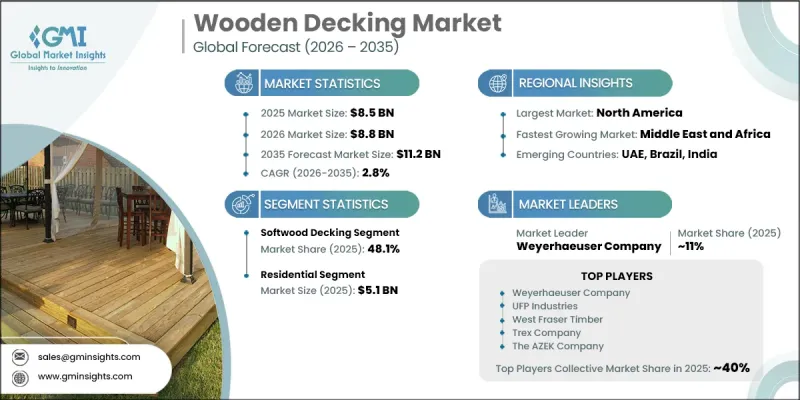
新興市場不斷成長的建築需求、中產階級日益提高的住宅擁有率以及先進木材加工技術的廣泛應用,共同推動了市場成長。隨著消費者和建築商在天然木材的傳統魅力與日益豐富的替代甲板材料之間尋求平衡,木甲板行業正在逐步轉型。儘管複合材料正與傳統木製品競爭,但對優質木材、認證材料和複合板解決方案的需求仍然強勁,為市場成長提供了機會。人們對戶外休閒空間和美觀住宅環境的日益偏好,仍然是市場擴張的關鍵驅動力。在歐洲、北美和其他已開發地區,住宅擴大投資於戶外生活空間,將其作為更廣泛的房屋翻新和生活方式提升趨勢的一部分。此外,永續林業實踐和提高木材耐久性的加工技術的應用,也進一步鞏固了木甲板在高階建築領域的地位。
| 市場範圍 | |
|---|---|
| 開始年份 | 2025 |
| 預測期 | 2026-2035 |
| 上市時的市場規模 | 85億美元 |
| 預測金額 | 112億美元 |
| 複合年成長率 | 2.8% |
預計到2025年,軟木甲板市佔率將達到48.1%,主要得益於住宅和DIY項目的強勁需求。防腐松木、花旗松和雪松等木材製成的產品因其價格實惠、供應充足且適用於各種戶外用途,繼續引領市場。軟木的成本優勢仍然是其普及的主要驅動力,在北美市場,防腐木材的價格通常約為每英尺2至4美元。透過家居裝飾商店建立的廣泛分銷網路和成熟的供應鏈進一步鞏固了軟木甲板在主流住宅甲板應用領域的地位。
到2025年,住宅用途市場將佔據59.3%的市場。該領域的需求主要由住宅露台的安裝、戶外平台的開發以及住宅項目中陽台的應用所驅動。成熟市場的翻新需求和新興經濟體住宅的成長也支撐了這一成長。消費者持續重視能提升房產價值及改善生活品質的美觀戶外空間。在北美,典型的住宅露台專案通常由專業承包商安裝300至600平方英尺的加壓軟木或複合材料,材料成本為每個專案2000至8000美元不等。隨著優質材料、熱處理木材和高階露台解決方案的日益普及,這個價格區間也將持續上漲。
預計北美木質露台市場規模將在2025年達到33億美元,並在2035年達到38億美元,複合年成長率為1.2%。該地區成長放緩反映了市場成熟以及來自複合材料露台等替代品的競爭加劇。由於該地區擁有成熟的生產網路和充足的供應,防腐處理的南方黃松仍然佔據著相當大的銷售量佔有率。然而,隨著消費者偏好的變化以及對舊露台更換需求的增加,熱處理木材和複合材料產品的採用率正在逐步提高。尤其是在那些重視外觀、耐用性和提升戶外空間美感的市場中,這些需求正在影響著消費者的露台更換決策。
目錄
第1章:調查方法
第2章執行摘要
第3章 行業洞察
- 產業生態系分析
- 供應商情況
- 製造商
- 中斷
- 最終用戶
- 利潤率分析
- 每個階段增加的價值
- 影響價值鏈的因素
- 影響產業的因素
- 促進因素
- 擴大戶外生活空間與以生活方式主導的投資
- 都市化和住宅建設擴張
- 綠建築標準和永續建築的強制性規定
- 熱處理木材的興起及其在性能方面的定位。
- 產業潛在風險與挑戰
- 木材資源的限制與森林砍伐法規
- 原物料價格波動及加工化學品成本
- 來自非木材替代品的競爭
- 機會
- 促進因素
- 成長潛力分析
- 技術與創新展望
- 最新科技趨勢
- 新興技術
- 價格分析
- 按產品類型分析歷史價格趨勢
- 依球員類型分類的定價策略(高級球員、超值球員、成本加成球員)
- 貿易數據分析
- 進出口量及進口額趨勢
- 主要貿易路線及關稅的影響
- 監理情勢
- 標準和合規要求
- 區域監理框架
- 認證標準
- 波特的分析
- PESTLE分析
- 人工智慧和生成式人工智慧對市場的影響
- 利用人工智慧改造現有經營模式
- 按細分市場分類的生成式人工智慧用例和部署藍圖
- 風險、限制和監管考量
第4章 競爭情勢
- 介紹
- 企業市佔率分析
- 按地區
- 企業矩陣分析
- 主要市場公司的競爭分析
- 競爭定位矩陣
- 主要進展
- 併購
- 夥伴關係和聯盟
- 新產品發布
- 業務拓展計劃
第5章 市場估價與預測:依木材類型分類,2022-2035年
- 針葉木甲板木材
- 雪松木甲板材料
- 松木甲板
- 紅木和紅杉木甲板材料
- 雲杉和其他
- 硬木甲板
- 熱帶硬木甲板
- 溫帶硬木甲板
- 熱處理木甲板
- 木塑複合材料(WPC)甲板
第6章 市場估價與預測:依安裝類型分類,2022-2035年
- 室內的
- 戶外的
第7章 市場估計與預測:依應用領域分類,2022-2035年
- 扶手
- 地面
- 牆
- 其他
第8章 市場估算與預測:依最終用途分類,2022-2035年
- 住宅
- 新建住宅
- 住宅翻新重建
- 商業的
- 飯店、度假村、招待
- 餐廳及餐飲服務業
- 零售、辦公室和混合用途的商業開發。
- 公共基礎設施和公共機構
- 步道、碼頭、水岸基礎設施
- 公園、休閒區、都市綠化
- 地方政府和國家政府項目
- 工業及其他
第9章 市場估價與預測:依通路分類,2022-2035年
- 直銷
- 間接銷售
第10章 市場估價與預測:依地區分類,2022-2035年
- 北美洲
- 美國
- 加拿大
- 歐洲
- 德國
- 英國
- 法國
- 義大利
- 西班牙
- 瑞典
- 荷蘭
- 亞太地區
- 中國
- 印度
- 日本
- 韓國
- 澳洲
- 印尼
- 拉丁美洲
- 巴西
- 墨西哥
- 阿根廷
- 中東和非洲
- 沙烏地阿拉伯
- UAE
- 南非
第11章:公司簡介
- 世界公司
- Trex Company, Inc.
- The AZEK Company
- Fortune Brands Innovations
- UFP Industries, Inc
- Weyerhaeuser Company
- West Fraser Timber Co. Ltd.
- UPM-Kymmene Corporation
- 本地公司
- Metsa Wood
- Setra Group AB
- Thermory AS
- Kebony AS
- Silvadec
- MoistureShield
- Nova USA Wood Products
-
- Accsys Technologies
- The Millboard Company
- Cali
- DuraLife Decking & Railing Systems
- Futurewood Pty Ltd
- NewTechWood
- Envision Building Products
The Global Wooden Decking Market was valued at USD 8.5 billion in 2025 and is estimated to grow at a CAGR of 2.8% to reach USD 11.2 billion by 2035.
Market growth is supported by construction expansion across developing economies, increasing homeownership among middle-income populations, and growing adoption of advanced wood treatment technologies. The wooden decking industry is experiencing a gradual transformation as consumers and builders balance the traditional appeal of natural wood with the growing availability of alternative decking materials. While composite solutions are creating competitive pressure for conventional wood products, demand for premium timber, certified materials, and engineered wood solutions continues to provide growth opportunities. Increasing preference for outdoor recreational areas and aesthetically appealing residential environments remains a major factor supporting market expansion. Across Europe, North America, and other developed regions, homeowners are increasingly investing in exterior living spaces as part of broader renovation and lifestyle improvement trends. The adoption of sustainable forestry practices and enhanced wood durability treatments is also strengthening the position of wooden decking in premium construction segments.
| Market Scope | |
|---|---|
| Start Year | 2025 |
| Forecast Year | 2026-2035 |
| Start Value | $8.5 Billion |
| Forecast Value | $11.2 Billion |
| CAGR | 2.8% |
The softwood decking segment accounted for 48.1% share 2025 owing to strong demand in residential construction and do-it-yourself projects. Products made from pressure-treated pine, Douglas fir, and cedar continue to dominate because of their affordability, accessibility, and suitability for a wide range of outdoor applications. The cost advantage of softwood materials remains a major factor supporting their adoption, with pressure-treated lumber typically available at approximately USD 2-4 per linear foot in North American markets. Extensive distribution through home improvement retailers and established supply chains further reinforces the segment's strong presence in mainstream residential decking applications.
The residential application segment held 59.3% share in 2025. Demand within this segment is primarily driven by residential deck installations, outdoor terrace development, and balcony applications in housing projects. Growth is supported by renovation activity in mature markets and increasing residential construction in emerging economies. Residential consumers continue to prioritize attractive outdoor spaces that enhance property value and improve lifestyle experiences. Typical residential decking projects in North America involving 300-600 square feet of pressure-treated softwood or composite materials installed by specialized contractors generate material values ranging from USD 2,000-8,000 per project. This value range continues to increase as premium materials, thermally modified wood, and higher-end decking solutions gain wider acceptance.
North America Wooden Decking Market generated USD 3.3 billion in 2025 and is expected to reach USD 3.8 billion by 2035 at a CAGR of 1.2%. The slower regional growth rate reflects the maturity of the market and increasing competition from composite decking alternatives. Pressure-treated southern yellow pine continues to represent a significant volume category due to established production networks and strong regional availability. However, changing consumer preferences are gradually encouraging greater adoption of thermally modified wood and composite products as older decking installations require replacement. Demand for premium appearances, enhanced durability, and improved outdoor aesthetics is influencing replacement decisions, particularly in markets where consumers prioritize upgraded materials and long-term performance.
Major companies operating in the global wooden decking market include Weyerhaeuser Company, Trex Company, Inc., The AZEK Company, UFP Industries, Inc., Fortune Brands Innovations, West Fraser Timber Co. Ltd., UPM-Kymmene Corporation, and Metsa Wood. Companies operating in the global wooden decking market are focusing on product innovation, sustainable sourcing, strategic expansion, and enhanced customer engagement to strengthen their market position. Leading manufacturers are investing in advanced wood treatment technologies, environmentally responsible production methods, and premium product development to meet changing consumer preferences. Companies are also expanding their product portfolios with durable, low-maintenance, and aesthetically improved decking solutions to compete with alternative materials. Strategic partnerships with distributors, contractors, and construction companies help businesses improve market reach and strengthen supply capabilities.
Table of Contents
Chapter 1 Research methodology
- 1.1 Research approach
- 1.2 Quality Commitments
- 1.2.1 GMI AI policy & data integrity commitment
- 1.2.1.1 Source consistency protocol
- 1.2.1 GMI AI policy & data integrity commitment
- 1.3 Research trail & confidence scoring
- 1.3.1 Research trail components
- 1.3.2 Scoring components
- 1.4 Data Collection
- 1.4.1 Partial list of primary sources
- 1.5 Data mining sources
- 1.5.1 Paid sources
- 1.5.1.1 Sources, by region
- 1.5.1 Paid sources
- 1.6 Base estimates and calculations
- 1.6.1 Base year calculation
- 1.7 Forecast model
- 1.7.1 Quantified market impact analysis
- 1.7.1.1 Mathematical impact of growth parameters on forecast
- 1.7.1 Quantified market impact analysis
- 1.8 Research transparency addendum
- 1.8.1 Source attribution framework
- 1.8.2 Quality assurance metrics
- 1.8.3 Our commitment to trust
Chapter 2 Executive Summary
- 2.1 Industry 360° synopsis
- 2.2 Business trends
- 2.3 Regional
- 2.4 Wood type
- 2.5 Installation
- 2.6 Application
- 2.7 End use
- 2.8 Distribution channel
Chapter 3 Industry Insights
- 3.1 Industry ecosystem analysis
- 3.1.1 Supplier landscape
- 3.1.2 Manufacturers
- 3.1.3 Distributors
- 3.1.4 End users
- 3.1.5 Profit margin analysis
- 3.1.6 Value addition at each stage
- 3.1.7 Factor affecting the value chain
- 3.2 Industry impact forces
- 3.2.1 Growth drivers
- 3.2.1.1 Outdoor Living Space Expansion and Lifestyle-Driven Investment
- 3.2.1.2 Urbanization and Residential Construction Growth
- 3.2.1.3 Green Building Codes and Sustainable Construction Mandates
- 3.2.1.4 Rise of Thermally Modified Wood and Performance Positioning
- 3.2.2 Industry pitfalls & challenges
- 3.2.2.1 Timber Resource Constraints and Deforestation Regulations
- 3.2.2.2 Raw Material Price Volatility and Treatment Chemical Costs
- 3.2.2.3 Competition from Non-Wood Alternatives
- 3.2.3 Opportunities
- 3.2.1 Growth drivers
- 3.3 Growth potential analysis
- 3.4 Technology and innovation landscape
- 3.4.1 Current technological trends
- 3.4.2 Emerging technologies
- 3.5 Pricing analysis (driven by primary research)
- 3.5.1 Historical price trend analysis by product category
- 3.5.2 Pricing strategy by player type (premium / value / cost-plus)
- 3.6 Trade data analysis (based on paid database)
- 3.6.1 Import/export volume & value trends
- 3.6.2 Key trade corridors & tariff impact
- 3.7 Regulatory landscape
- 3.7.1 Standards and compliance requirements
- 3.7.2 Regional regulatory frameworks
- 3.7.3 Certification standards
- 3.8 Porter's analysis
- 3.9 PESTEL analysis
- 3.10 Impact of AI & generative AI on the market
- 3.10.1 AI-driven disruption of existing business models
- 3.10.2 GenAI use cases & adoption roadmap by segment
- 3.10.3 Risks, limitations & regulatory considerations
Chapter 4 Competitive Landscape, 2025
- 4.1 Introduction
- 4.2 Company market share analysis
- 4.2.1 By Region
- 4.2.1.1 North America
- 4.2.1.2 Europe
- 4.2.1.3 Asia Pacific
- 4.2.1.4 Latin America
- 4.2.1.5 Middle East & Africa
- 4.2.1 By Region
- 4.3 Company matrix analysis
- 4.4 Competitive analysis of major market players
- 4.5 Competitive positioning matrix
- 4.6 Key developments
- 4.6.1 Mergers & acquisitions
- 4.6.2 Partnerships & collaborations
- 4.6.3 New product launches
- 4.6.4 Expansion plans
Chapter 5 Market Estimates & Forecast, By Wood type, 2022 - 2035, (USD Billion)
- 5.1 Key trends
- 5.2 Softwood decking
- 5.2.1 Cedar decking
- 5.2.2 Pine decking
- 5.2.3 Redwood & sequoia decking
- 5.2.4 Spruce and others
- 5.3 Hardwood decking
- 5.3.1 Tropical hardwood decking
- 5.3.2 Temperate hardwood decking
- 5.4 Thermally modified wood decking
- 5.5 Wood-Plastic Composite (WPC) decking
Chapter 6 Market Estimates & Forecast, By Installation, 2022 - 2035, (USD Billion)
- 6.1 Key trends
- 6.2 Indoor
- 6.3 Outdoor
Chapter 7 Market Estimates & Forecast, By Application, 2022 - 2035, (USD Billion)
- 7.1 Key trends
- 7.2 Railing
- 7.3 Floor
- 7.4 Wall
- 7.5 Others
Chapter 8 Market Estimates & Forecast, By End use, 2022 - 2035, (USD Billion)
- 8.1 Key trends
- 8.2 Residential
- 8.2.1 New residential construction
- 8.2.2 Residential renovation & replacement
- 8.3 Commercial
- 8.3.1 Hotels, resorts & hospitality
- 8.3.2 Restaurants & foodservice
- 8.3.3 Retail, office & mixed-use commercial developments
- 8.4 Public infrastructure & institutional
- 8.4.1 Boardwalks, piers & waterfront infrastructure
- 8.4.2 Parks, recreation areas & urban landscaping
- 8.4.3 Municipal & government projects
- 8.5 Industrial & others
Chapter 9 Market Estimates & Forecast, By Distribution channel, 2022 - 2035, (USD Billion)
- 9.1 Key trends
- 9.2 Direct sales
- 9.3 Indirect sales
Chapter 10 Market Estimates & Forecast, By Region, 2022 - 2035, (USD Billion)
- 10.1 Key trends
- 10.2 North America
- 10.2.1 U.S.
- 10.2.2 Canada
- 10.3 Europe
- 10.3.1 Germany
- 10.3.2 UK
- 10.3.3 France
- 10.3.4 Italy
- 10.3.5 Spain
- 10.3.6 Sweden
- 10.3.7 Netherlands
- 10.4 Asia Pacific
- 10.4.1 China
- 10.4.2 India
- 10.4.3 Japan
- 10.4.4 South Korea
- 10.4.5 Australia
- 10.4.6 Indonesia
- 10.5 Latin America
- 10.5.1 Brazil
- 10.5.2 Mexico
- 10.5.3 Argentina
- 10.6 Middle East and Africa
- 10.6.1 Saudi Arabia
- 10.6.2 UAE
- 10.6.3 South Africa
Chapter 11 Company Profiles
- 11.1 Global Players
- 11.1.1 Trex Company, Inc.
- 11.1.2 The AZEK Company
- 11.1.3 Fortune Brands Innovations
- 11.1.4 UFP Industries, Inc
- 11.1.5 Weyerhaeuser Company
- 11.1.6 West Fraser Timber Co. Ltd.
- 11.1.7 UPM-Kymmene Corporation
- 11.2 Regional Players
- 11.2.1 Metsa Wood
- 11.2.2 Setra Group AB
- 11.2.3 Thermory AS
- 11.2.4 Kebony AS
- 11.2.5 Silvadec
- 11.2.6 MoistureShield
- 11.2.7 Nova USA Wood Products
- 11.3 Emerging Players & Innovators
- 11.3.1 Accsys Technologies
- 11.3.2 The Millboard Company
- 11.3.3 Cali
- 11.3.4 DuraLife Decking & Railing Systems
- 11.3.5 Futurewood Pty Ltd
- 11.3.6 NewTechWood
- 11.3.7 Envision Building Products


