

 |
市場調查報告書
商品編碼
2101987
2026 年至 2035 年球拍運動產品市場的商業機會、成長要素、產業趨勢分析與預測。Racket Sports Products Market Opportunity, Growth Drivers, Industry Trend Analysis, and Forecast 2026 - 2035 |
||||||

全球球拍運動器材市場預計到 2025 年將達到 110 億美元,年複合成長率為 6.1%,到 2035 年將達到 199 億美元。
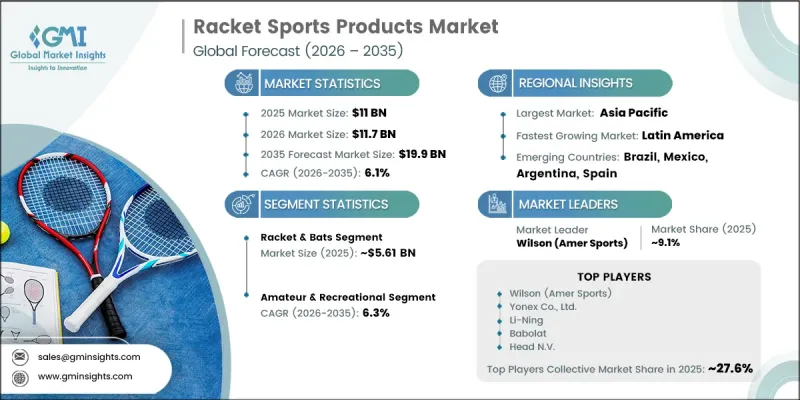
隨著參與人數在多個球拍運動類別中持續成長,市場正經歷變革,為全球器材製造商和零售商創造了新的機會。消費者對便利休閒活動的興趣日益濃厚,體育基礎設施不斷完善,以及成人參與度的提高,都支撐著從高級產品到入門級各類器材的持續需求。透過數位化零售平台更深入參與互動、提高產品認知度以及拓展教學內容的獲取管道,消費者能夠做出更明智的購買決策,並投資於更高品質的產品。同時,製造商不斷推出技術先進的器材,旨在提升性能、耐用性和用戶體驗,從而滿足從休閒到競技玩家的穩定更換需求。零售商也受益於消費者對高級產品日益成長的偏好,因為高附加價值器材相比傳統產品能夠帶來更高的利潤率。持續的產品創新、消費者參與度的提升、分銷網路的拓展以及對專業運動配件需求的成長,預計將在整個預測期內維持市場的穩健成長,並在成熟和新興區域市場創造新的商機。
| 市場範圍 | |
|---|---|
| 開始年份 | 2025 |
| 預測期 | 2026-2035 |
| 初始市場規模 | 110億美元 |
| 預測金額 | 199億美元 |
| 複合年成長率 | 6.1% |
預計到2025年,球拍和球棒市場銷售額將達到56.1億美元,並在2026年至2035年間以5.5%的複合年成長率成長。該細分市場繼續佔據全球球拍運動產品市場的最大佔有率,這主要得益於穩定的產品更換需求、持續的產品創新以及消費者對耐用性、性能和舒適度更高的裝備日益成長的偏好。製造商正致力於先進材料技術、輕量化設計和精良的產品設計,以滿足休閒和專業用戶不斷變化的需求,這將支撐該細分市場在預測期內的穩定成長。
預計到2025年,業餘和休閒市場將佔據67.4%的市場佔有率,並在2026年至2035年間以6.3%的複合年成長率成長。市場擴張的驅動力在於越來越多的消費者出於健身、休閒和社交目的而參與球拍運動。產品認知度的提高、品牌知名度的增強以及休閒玩家對高性能裝備投資意願的增強,進一步推動了該細分市場的需求。隨著參與人數的增加,製造商正在推出兼具價格優勢和先進性能的產品,以吸引更廣泛的客戶群。
預計2025年,北美球拍運動器材市場規模將達30億美元,市佔率27.5%,2035年將達51億美元。儘管該地區的成長率仍低於全球平均水平,但得益於成熟的消費群、較高的體育用品支出以及高級產品的廣泛供應,該市場持續受益。完善的零售基礎設施、休閒運動參與度的提高、不斷拓展的線上銷售管道以及持續的產品創新,預計將在未來幾年內維持全部區域的穩定需求。
全球球拍運動器材市場的主要參與者包括 Head NV、Wilson Sporting Goods Co.、Diadem Sports、Karakal、Yonex Co., Ltd.、李寧股份有限公司、JOOLA International、Engage Pickleball、Tecnifibre(Lacosteak)、Princeman Sports、Butterfly(Tamasuull Co., Sport.BetsBull. Sports(住友橡膠工業株式會社)、CRBN Pickleball、RSL(Reinforced Shuttlecock Ltd.)、Babolat、FZ Forza(Forza Badminton)和 Nox Sport。這些公司正透過產品創新、輕量化材料、先進的製造技術以及對高性能器材研發的投入來鞏固其市場地位。許多製造商在拓展高級產品線的同時,也推出了價格較親民的產品來吸引新客戶。此外,為了擴大市場覆蓋率,各公司都在努力拓展銷售管道,增強電商能力,並加強與專業運動用品零售商的合作。與職業運動員、體育組織和訓練機構建立策略合作夥伴關係,也旨在提升品牌知名度和客戶參與。
目錄
第1章:調查方法和範圍
第2章執行摘要
第3章 行業洞察
- 產業生態系分析
- 供應商情況
- 利潤率
- 每個階段增加的價值
- 影響價值鏈的因素
- 影響產業的因素
- 促進因素
- 人們日益增強的健康和健身意識正在推動全球公眾參與球拍運動。
- 板式網球和匹克球的爆炸性成長正在創造新的器材需求領域。
- 增加對全球體育基礎設施和球場建設的投資
- 人工智慧驅動的智慧球拍技術和性能分析是推優質化。
- 產業潛在風險與挑戰
- 高性能設備的高成本阻礙了其進一步的市場滲透。
- 仿冒品氾濫會損害品牌價值和消費者信任。
- 機會
- 新興市場,尤其是中產階級消費群不斷壯大的市場(印度、東南亞、拉丁美洲)
- D2C、數位化與全通路商務:協助提升消費者互動體驗
- 依照 CSRD 和 ESG 投資指南,進行永續和環保的產品開發。
- 針對學院、聯合會和企業健康計畫的B2B銷售。
- 促進因素
- 成長潛力分析
- 供應鏈分析
- 主要原料產地
- 製造業和海外生產基地的集中
- 供應鏈脆弱性與風險緩解策略
- 新冠疫情後近岸外包與回流外包的趨勢
- 未來市場趨勢
- 技術與創新展望
- 最新科技趨勢
- 新興技術
- 監理情勢
- 關於體育用品的國際貿易和進出口法規
- 符合 REACH 和 RoHS(歐洲)標準
- CSRD對製造商的永續發展報告義務
- 體育統籌機構(ITF、BWF、WSF、ITTF、FIP)的器材標準
- 反假冒和智慧財產權法規
- 貿易數據分析
- 按產品類型和地區分類的進出口數量和價值趨勢。
- 主要貿易走廊及關稅對球拍運動器材經銷的影響
- 人工智慧和生成式人工智慧對市場的影響
- 人工智慧驅動的現有經營模式轉型(智慧零售、個人化、D2C)
- 按細分市場分類的生成式人工智慧用例和實施藍圖(人工智慧教練平台、智慧球拍、庫存管理人工智慧)
- 人工智慧在體育器材領域的風險、限制與監管考量
- 價格分析
- 依產品類型和品牌層級進行歷史價格趨勢分析。
- 依球員類型分類的定價策略(高級球員、超值球員、成本加成球員)
- 波特的分析
- PESTLE分析
- 消費行為分析
第4章 競爭情勢
- 介紹
- 企業市佔率分析
- 企業矩陣分析
- 主要市場公司的競爭分析
- 競爭定位矩陣
- 主要進展
- 併購
- 夥伴關係和聯盟
- 新產品發布
- 業務拓展計劃
第5章 市場估算與預測:依產品類型分類,2022-2035年
- 主要趨勢
- 球拍
- 網球拍
- 羽毛球拍
- 果汁汽水拍
- 乒乓球拍和球拍
- 板式網球和新興運動球拍
- 球和羽毛球
- 網球
- 羽毛球
- 果汁汽水
- 乒乓球
- 板式網球
- 鞋類
- 網球鞋
- 羽毛球鞋
- 多功能運動鞋類
- 服飾
- 高性能上衣和褲子
- 壓力衣和貼身層
- 外套和保暖服
- 箱包
- 球拍包
- 背包和斜背包
- 手推車和帶輪行李箱
- 配件
- 串線和串線服務
- 握把和外握把
- 防護眼鏡產品
- 減振器和衝擊吸收器
- 腕帶和頭帶
- 拋球器、制球機、訓練器材
第6章 市場估計與預測:依運動類型分類,2022-2035年
- 主要趨勢
- 網球
- 職業錦標賽等級
- 適用於俱樂部和中級球員
- 初級和青少年級別
- 羽毛球
- 職業錦標賽等級
- 適用於俱樂部和中級球員
- 休閒級
- 乒乓球
- 專業/比賽用途
- 休閒休閒等級
- 果汁汽水
- 針對職業賽事
- 俱樂部休閒等級
- 板式網球
- 專業級
- 業餘/休閒級
第7章 市場估計與預測:依價格區間分類,2022-2035年
- 主要趨勢
- 低的
- 中等的
- 高的
第8章 市場估算與預測:依最終用戶分類,2022-2035年
- 主要趨勢
- 職業球員
- 巡迴賽等級和精英運動員
- 半職業和俱樂部附屬的競技運動員
- 業餘和休閒玩家
- 成人休閒玩家
- 青少年球員
- 資深球員(65歲以上)
- 培訓機構及教育機構
- 體育學院和訓練中心
- 學校和大學
- 企業健康與款待
第9章 市場估價與預測:依通路分類,2022-2035年
- 主要趨勢
- 體育用品專賣店
- 獨立運動用品專賣店
- 品牌自營單品牌店
- 線上零售
- 品牌官方D2C網站和應用程式
- 第三方電子商務平台
- 社群電商和直播零售
- 大賣場和超級市場
- 大型國際零售商
- 大型區域零售連鎖店
- 面向機構/直接銷售(B2B)
- 體育學院和訓練設施
- 國家聯合會、俱樂部、協會
- 其他
第10章 市場估價與預測:依地區分類,2022-2035年
- 主要趨勢
- 北美洲
- 美國
- 加拿大
- 歐洲
- 德國
- 法國
- 英國
- 義大利
- 西班牙
- 亞太地區
- 中國
- 日本
- 印度
- 澳洲
- 韓國
- 拉丁美洲
- 巴西
- 墨西哥
- 阿根廷
- 中東和非洲
- 沙烏地阿拉伯
- UAE
- 南非
第11章:公司簡介
- Global Leaders
- Yonex Co., Ltd.
- Wilson Sporting Goods Co.
- Babolat
- Head NV
- Victor Rackets Industrial Corp.
- Li-Ning Company Ltd.
- Butterfly(Tamasu Co., Ltd.)
- 本地公司
- Tecnifibre(Lacoste Group)
- Bullpadel
- Dunlop Sports(Sumitomo Rubber Industries)
- Prince Sports
- FZ Forza(Forza Badminton)
- Karakal
- RSL(Reinforced Shuttlecock Ltd.)
- 新興企業
- Selkirk Sport
- Engage Pickleball
- JOOLA(now JOOLA International)
- Nox Sport
- CRBN Pickleball
- Diadem Sports
- Six Zero
The Global Racket Sports Products Market was valued at USD 11 billion in 2025 and is estimated to grow at a CAGR of 6.1% to reach USD 19.9 billion by 2035.
The market is experiencing transformation as participation continues to expand across multiple racket sport categories, creating new opportunities for equipment manufacturers and retailers worldwide. Growing consumer interest in accessible recreational activities, improving sports infrastructure, and expanding participation among adults are contributing to sustained demand for premium and entry-level equipment alike. Rising engagement through digital retail platforms, enhanced product awareness, and increasing access to instructional content are encouraging consumers to make more informed purchasing decisions and invest in higher-quality products. At the same time, manufacturers are introducing technologically advanced equipment designed to improve performance, durability, and user experience, supporting steady replacement demand across recreational and competitive players. Retailers are also benefiting from an increasing preference for premium product ranges, as higher-value equipment delivers stronger profit margins than conventional alternatives. Continued product innovation, expanding consumer participation, broader distribution networks, and rising demand for specialized sporting accessories are expected to maintain healthy market growth throughout the forecast period while creating new revenue opportunities across established and emerging regional markets.
| Market Scope | |
|---|---|
| Start Year | 2025 |
| Forecast Year | 2026-2035 |
| Start Value | $11 Billion |
| Forecast Value | $19.9 Billion |
| CAGR | 6.1% |
The racket and bats segment generated USD 5.61 billion in 2025 and is anticipated to grow at a CAGR of 5.5% between 2026 and 2035. The segment continues to account for the largest share of the global racket sports products market due to consistent replacement demand, continuous product innovation, and increasing consumer preference for equipment that delivers improved durability, performance, and playing comfort. Manufacturers are focusing on advanced material technologies, lightweight designs, and enhanced product engineering to meet the evolving expectations of both recreational and professional users, supporting steady segment growth throughout the forecast period.
The amateur and recreational segment held 67.4% share in 2025 and is forecast to grow at a CAGR of 6.3% from 2026 to 2035. Market expansion is supported by the growing number of consumers participating in racket sports for fitness, leisure, and social engagement. Increasing product awareness, stronger brand recognition, and rising willingness among recreational players to invest in performance-oriented equipment continue to strengthen demand across this segment. As participation broadens, manufacturers are introducing products that balance affordability with advanced performance features to appeal to a wider customer base.
North America Racket Sports Products Market held 27.5% share in 2025, accounting for USD 3 billion, and is projected to reach USD 5.1 billion by 2035. Although regional growth remains below the global average, the market continues to benefit from an established consumer base, high spending on sporting goods, and widespread availability of premium products. Strong retail infrastructure, increasing participation in recreational sports, expanding online sales channels, and continuous product innovation are expected to sustain steady demand across the region over the coming years.
The major companies operating in the global racket sports products market include Head N.V., Wilson Sporting Goods Co., Diadem Sports, Karakal, Yonex Co., Ltd., Li-Ning Company Ltd., JOOLA International, Engage Pickleball, Tecnifibre (Lacoste Group), Prince Sports, Butterfly (Tamasu Co., Ltd.), Bullpadel, Victor Rackets Industrial Corp., Selkirk Sport, Dunlop Sports (Sumitomo Rubber Industries), CRBN Pickleball, RSL (Reinforced Shuttlecock Ltd.), Babolat, FZ Forza (Forza Badminton), and Nox Sport. Companies operating in the racket sports products market are strengthening their market position by investing in product innovation, lightweight materials, advanced manufacturing technologies, and performance-focused equipment development. Many manufacturers are expanding their premium product portfolios while introducing affordable options to attract new consumers. Businesses are also enhancing direct-to-consumer sales channels, strengthening e-commerce capabilities, and expanding partnerships with specialty sporting goods retailers to improve market reach. Strategic collaborations with professional athletes, sports organizations, and training academies are increasing brand visibility and customer engagement.
Table of Contents
Chapter 1 Methodology & Scope
- 1.1 Market scope and definition
- 1.2 Research design
- 1.2.1 Research approach
- 1.2.2 Data collection methods
- 1.3 Data mining sources
- 1.3.1 Global
- 1.3.2 Regional/Country
- 1.4 Base estimates and calculations
- 1.4.1 Base year calculation
- 1.4.2 Key trends for market estimation
- 1.5 Primary research and validation
- 1.5.1 Primary sources
- 1.6 Forecast model
- 1.7 Research assumptions and limitations
Chapter 2 Executive Summary
- 2.1 Industry 360° synopsis
- 2.2 Key market trends
- 2.2.1 Region
- 2.2.2 Product Type
- 2.2.3 Sports Type
- 2.2.4 Price Range
- 2.2.5 End-user
- 2.2.6 Distribution Channel
Chapter 3 Industry Insights
- 3.1 Industry ecosystem analysis
- 3.1.1 Supplier landscape
- 3.1.2 Profit margin
- 3.1.3 Value addition at each stage
- 3.1.4 Factor affecting the value chain
- 3.2 Industry impact forces
- 3.2.1 Growth drivers
- 3.2.1.1 Rising Health & Fitness Consciousness Driving Mass Participation in Racket Sports Globally
- 3.2.1.2 Explosive Growth of Padel & Pickleball Creating New Equipment Demand Verticals
- 3.2.1.3 Increasing Sports Infrastructure Investment & Court Construction Worldwide
- 3.2.1.4 AI-Enabled Smart Racket Technology & Performance Analytics Driving Premiumization
- 3.2.2 Industry pitfalls & challenges
- 3.2.2.1 High Cost of Premium Performance-Grade Equipment Limiting Broader Market Penetration
- 3.2.2.2 Proliferation of Counterfeit Products Undermining Brand Value & Consumer Trust
- 3.2.3 Opportunities
- 3.2.3.1 Emerging Markets (India, Southeast Asia, Latin America) with Growing Middle-Class Consumer Base
- 3.2.3.2 D2C Digital & Omnichannel Commerce Unlocking Premium Consumer Engagement
- 3.2.3.3 Sustainable & Eco-Friendly Product Development Aligned with CSRD & ESG Investment Mandates
- 3.2.3.4 Institutional & B2B Sales to Academies, Federations & Corporate Wellness Programs
- 3.2.1 Growth drivers
- 3.3 Growth potential analysis
- 3.4 Supply Chain Analysis
- 3.4.1 Key Raw Material Sourcing Geographies
- 3.4.2 Manufacturing Concentration & Offshore Production Hubs
- 3.4.3 Supply Chain Vulnerabilities & Risk Mitigation Strategies
- 3.4.4 Nearshoring & Reshoring Trends Post-COVID
- 3.5 Future market trends
- 3.6 Technology and innovation landscape
- 3.6.1 Current technological trends
- 3.6.2 Emerging technologies
- 3.7 Regulatory landscape
- 3.7.1 Global Trade & Import/Export Regulations for Sporting Goods
- 3.7.2 REACH & RoHS Compliance (Europe)
- 3.7.3 CSRD Sustainability Reporting Obligations for Manufacturers
- 3.7.4 Sports Governing Body Equipment Standards (ITF, BWF, WSF, ITTF, FIP)
- 3.7.5 Anti-Counterfeit & Intellectual Property Regulations
- 3.8 Trade data analysis (HS Code - 9506)
- 3.8.1 Import/Export Volume & Value Trends by Product Category & Region (Driven by Primary Research)
- 3.8.2 Key Trade Corridors & Tariff Impact on Racket Sports Product Flows (Driven by Primary Research)
- 3.9 Impact of AI & generative AI on the market
- 3.9.1 AI-Driven Disruption of Existing Business Models (Smart Retail, Personalization, D2C)
- 3.9.2 GenAI Use Cases & Adoption Roadmap by Segment (AI Coaching Platforms, Smart Rackets, Inventory AI)
- 3.9.3 Risks, Limitations & Regulatory Considerations of AI in Sports Equipment
- 3.10 Pricing Analysis
- 3.10.1 Historical Price Trend Analysis by Product Type & Brand Tier (Driven by Primary Research)
- 3.10.2 Pricing Strategy by Player Type (Premium / Value / Cost-plus) (Driven by Primary Research)
- 3.11 Porter's analysis
- 3.12 PESTEL analysis
- 3.13 Consumer Behaviour Analysis
Chapter 4 Competitive Landscape, 2025
- 4.1 Introduction
- 4.2 Company market share analysis
- 4.3 Company matrix analysis
- 4.4 Competitive analysis of major market players
- 4.5 Competitive positioning matrix
- 4.6 Key developments
- 4.6.1 Mergers & acquisitions
- 4.6.2 Partnerships & collaborations
- 4.6.3 New product launches
- 4.6.4 Expansion plans
Chapter 5 Market Estimates & Forecast, By Product Type, 2022 - 2035, (USD Billion) (Million Units)
- 5.1 Key Trends
- 5.2 Rackets & Bats
- 5.2.1 Tennis Rackets
- 5.2.2 Badminton Rackets
- 5.2.3 Squash Rackets
- 5.2.4 Table Tennis Bats & Paddles
- 5.3 Padel & Emerging Sport Rackets
- 5.4 Balls & Shuttlecocks
- 5.4.1 Tennis Balls
- 5.4.2 Shuttlecocks
- 5.4.3 Squash Balls
- 5.4.4 Table Tennis Balls
- 5.4.5 Padel Balls
- 5.5 Footwear
- 5.5.1 Tennis Footwear
- 5.5.2 Badminton Footwear
- 5.5.3 Multi-Sport Court Footwear
- 5.6 Apparel
- 5.6.1 Performance Tops & Bottoms
- 5.6.2 Compression Wear & Base Layers
- 5.6.3 Outerwear & Warm-Up Gear
- 5.7 Bags & Cases
- 5.7.1 Racket Bags
- 5.7.2 Backpacks & Sling Bags
- 5.7.3 Trolley & Wheeled Bags
- 5.8 Accessories
- 5.8.1 Strings & Stringing Services
- 5.8.2 Grips & Overgrips
- 5.8.3 Protective Eyewear
- 5.8.4 Vibration Dampeners & Shock Absorbers
- 5.8.5 Wristbands & Headbands
- 5.8.6 Ball Hoppers, Ball Machines & Training Aids
Chapter 6 Market Estimates & Forecast, By Sport Type, 2022 - 2035, (USD Billion) (Million Units)
- 6.1 Key Trends
- 6.2 Tennis
- 6.2.1 Professional & Tournament Grade
- 6.2.2 Club & Intermediate Grade
- 6.2.3 Beginner & Junior Grade
- 6.3 Badminton
- 6.3.1 Professional & Tournament Grade
- 6.3.2 Club & Intermediate Grade
- 6.3.3 Recreational Grade
- 6.4 Table Tennis
- 6.4.1 Professional & Competition Grade
- 6.4.2 Recreational & Leisure Grade
- 6.5 Squash
- 6.5.1 Professional & Tournament Grade
- 6.5.2 Club & Recreational Grade
- 6.6 Padel
- 6.6.1 Professional Grade
- 6.6.2 Amateur & Recreational Grade
Chapter 7 Market Estimates & Forecast, By Price Range, 2022 - 2035, (USD Billion) (Million Units)
- 7.1 Key Trends
- 7.2 Low
- 7.3 Medium
- 7.4 High
Chapter 8 Market Estimates & Forecast, By End-user, 2022 - 2035, (USD Billion) (Million Units)
- 8.1 Key Trends
- 8.2 Professional Players
- 8.2.1 Tour-Level & Elite Competitive Athletes
- 8.2.2 Semi-Professional & Club Competitive Players
- 8.3 Amateur & Recreational Players
- 8.3.1 Adult Recreational Players
- 8.3.2 Youth & Junior Players
- 8.3.3 Senior (65+) Players
- 8.4 Training Academies & Institutions
- 8.4.1 Sports Academies & Training Centers
- 8.4.2 Schools & Universities
- 8.4.3 Corporate Wellness & Hospitality
Chapter 9 Market Estimates & Forecast, By Distribution Channel, 2022 - 2035, (USD Billion) (Million Units)
- 9.1 Key Trends
- 9.2 Specialty Sports Retail Stores
- 9.2.1 Independent Specialty Retailers
- 9.2.2 Brand-Owned Mono-Brand Stores
- 9.3 Online Retail
- 9.3.1 Brand D2C Websites & Apps
- 9.3.2 Third-Party E-Commerce Platforms
- 9.3.3 Social Commerce & Live-Stream Retail
- 9.4 Hypermarkets & Supermarkets
- 9.4.1 International Mass Retailers
- 9.4.2 Regional Mass Retail Chains
- 9.5 Institutional/Direct Sales (B2B)
- 9.5.1 Sports Academies & Training Facilities
- 9.5.2 National Federations, Clubs & Associations
- 9.6 Others
Chapter 10 Market Estimates & Forecast, By Region, 2022 - 2035, (USD Billion) (Million Units)
- 10.1 Key Trends
- 10.2 North America
- 10.2.1 U.S.
- 10.2.2 Canada
- 10.3 Europe
- 10.3.1 Germany
- 10.3.2 France
- 10.3.3 UK
- 10.3.4 Italy
- 10.3.5 Spain
- 10.4 Asia Pacific
- 10.4.1 China
- 10.4.2 Japan
- 10.4.3 India
- 10.4.4 Australia
- 10.4.5 South Korea
- 10.5 Latin America
- 10.5.1 Brazil
- 10.5.2 Mexico
- 10.5.3 Argentina
- 10.6 MEA
- 10.6.1 Saudi Arabia
- 10.6.2 UAE
- 10.6.3 South Africa
Chapter 11 Company Profiles
- 11.1 Global Leaders
- 11.1.1 Yonex Co., Ltd.
- 11.1.2 Wilson Sporting Goods Co.
- 11.1.3 Babolat
- 11.1.4 Head N.V.
- 11.1.5 Victor Rackets Industrial Corp.
- 11.1.6 Li-Ning Company Ltd.
- 11.1.7 Butterfly (Tamasu Co., Ltd.)
- 11.2 Regional Players
- 11.2.1 Tecnifibre (Lacoste Group)
- 11.2.2 Bullpadel
- 11.2.3 Dunlop Sports (Sumitomo Rubber Industries)
- 11.2.4 Prince Sports
- 11.2.5 FZ Forza (Forza Badminton)
- 11.2.6 Karakal
- 11.2.7 RSL (Reinforced Shuttlecock Ltd.)
- 11.3 Emerging Players
- 11.3.1 Selkirk Sport
- 11.3.2 Engage Pickleball
- 11.3.3 JOOLA (now JOOLA International)
- 11.3.4 Nox Sport
- 11.3.5 CRBN Pickleball
- 11.3.6 Diadem Sports
- 11.3.7 Six Zero

 全球球拍運動產品市場規模、佔有率、趨勢和成長分析報告(2026-2034)
 球拍運動器材市場-全球市場預測(2026-2032年)
 網球拍市場 - 全球產業規模、佔有率、趨勢、機會、預測:按產品類型、最終用戶、銷售管道、地區和競爭格局分類,2021-2031年
 網球拍市場規模、佔有率和成長分析:按產品、球拍規格、銷售管道、最終用戶和地區分類-2026-2033年產業預測
 2026-2030年全球球拍運動器材市場2026-2034年全球網球拍市場規模、佔有率、趨勢和成長分析報告球拍運動器材市場-全球產業規模、佔有率、趨勢、機會及預測(依產品類型、應用、銷售管道、地區及競爭格局分類,2021-2031年)
 球拍運動場地租賃市場,規模,佔有率,趨勢,產業分析報告:運動類別,各類設施,預約模式別,各終端用戶,各地區,2025年~2034年的市場預測
 網球拍的世界市場
 2031 年亞太地區網球拍市場預測 - 區域分析 - 按最終用戶、材料(石墨、鈦、碳纖維等)和配銷通路(超市和大賣場、專賣店、線上零售等)