

 |
市場調查報告書
商品編碼
2101974
智慧嬰兒床市場:商機、成長要素、產業趨勢分析及2026-2035年預測Smart Crib Market Opportunity, Growth Drivers, Industry Trend Analysis, and Forecast 2026 - 2035 |
||||||

全球智慧嬰兒床市場預計到 2025 年將達到 9.7 億美元,年複合成長率為 7.1%,到 2035 年將達到 19.6 億美元。
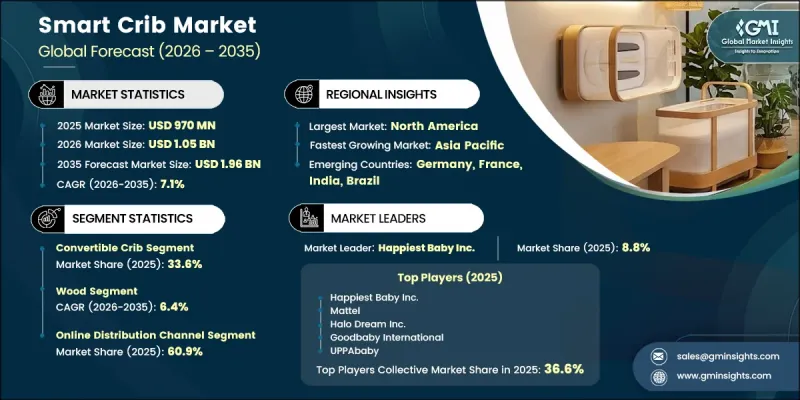
智慧嬰兒床市場的成長反映了嬰幼兒家具領域的重大轉變。傳統嬰兒床正逐漸演變為配備感測器、自動化功能和數位連接功能的智慧睡眠管理系統。隨著人們對嬰兒睡眠風險的認知不斷提高,以及智慧家庭技術的日益普及,父母對具備持續監測和先進安全功能的產品需求日益成長。人工智慧、運動偵測、生物識別辨識追蹤和遠距家長通知等技術的融合,正將智慧嬰兒床轉變為先進的嬰幼兒照護解決方案。隨著互聯嬰幼兒產品在已開發市場接受度的不斷提高,市場需求也持續成長。父母越來越重視那些能夠透過即時數據和自動回應,更詳細地了解嬰兒睡眠行為的產品,這些產品不僅提升了便利性,也創造了更安全的睡眠環境。
| 市場範圍 | |
|---|---|
| 開始年份 | 2025 |
| 預測期 | 2026-2035 |
| 初始市場規模 | 9.7億美元 |
| 預計金額 | 19.6億美元 |
| 複合年成長率 | 7.1% |
預計到2025年,多功能嬰兒床市佔率將達到33.6%,並將在2035年之前以7.8%的複合年成長率成長。可轉換型智慧嬰兒床因其能夠適應嬰兒不同成長階段而日益受到歡迎,從而實現單一產品的長期使用。這種柔軟性滿足了消費者對經濟實惠且多功能嬰兒產品的需求,尤其適合那些追求長期價值而非奢華嬰兒產品的年輕家庭。此外,一些已開發國家家庭結構的變化和出生率的下降也促使父母投資購買經久耐用且功能齊全的嬰兒家具,以便長期使用。
預計2025年,木製智慧嬰兒床市佔率將達到37.4%,複合年成長率(CAGR)為6.4%。消費者對木材的持續青睞源自於其堅固耐用、美觀大方以及適合嬰幼兒環境等優點。由於木製嬰兒床框架歷來與可靠性和品質聯繫在一起,因此在北美和歐洲仍然很受歡迎。此外,消費者對永續來源材料的需求也不斷成長,例如,經FSC認證的山毛櫸、橡木和松木等永續木材在高級產品中越來越常見。在父母環保意識日益增強的推動下,製造商正擴大將永續材料和環保生產方法融入智慧嬰兒床的設計中。
預計到2025年,北美智慧嬰兒床市佔率將達到35.5%,並在2035年之前以5.3%的複合年成長率成長。該地區的成長主要得益於消費者較高的購買力、智慧家庭技術的普及以及父母對嬰兒安全措施日益增強的意識。完善的安全標準和消費者對智慧嬰兒產品不斷成長的需求持續影響著他們的購買決策,促使更多家庭選擇配備監控功能、警報系統和自動化舒適功能的智慧嬰兒床。
目錄
第1章:調查方法
第2章執行摘要
第3章 行業洞察
- 產業生態系分析
- 影響價值鏈的因素
- 利潤率分析
- 中斷
- 前景
- 製造商
- 中斷
- 供應商情況
- 主要新聞和舉措
- 技術與創新展望
- 監理情勢
- 對產業的影響
- 促進因素
- 產業潛在風險與挑戰
- 機會
- 波特的分析
- PESTLE分析
- 價格分析
- 2019-2024年歷史價格趨勢分析
- 定價策略:按業務類型分類
- 貿易數據分析
- 進出口量及進口額趨勢
- 主要貿易路線及關稅的影響
- 人工智慧和生成式人工智慧對市場的影響
- 利用人工智慧改造現有經營模式
- 按細分市場分類的生成式人工智慧用例和部署藍圖
- 風險、限制和監管考量
- 目前分銷基礎設施和通路滲透情況
- 按地區與業態(現代零售與傳統零售)分類的通路覆蓋率
- 缺乏最後一公里基礎設施和不斷發展的管道
第4章 競爭情勢
- 介紹
- 企業市佔率分析
- 競爭定位矩陣
- 戰略展望矩陣
- 主要市場公司的競爭分析
- 主要進展
- 併購
- 夥伴關係和聯盟
- 新產品發布
- 業務拓展計劃
第5章 市場估算與預測:依產品類型分類,2022-2035年
- 標準嬰兒床
- 可攜式嬰兒床
- 可轉換式嬰兒床
- 多功能嬰兒床
第6章 市場估計與預測:依材料分類,2022-2035年
- 聚酯纖維
- 棉布
- 鋁
- 樹
- 金屬
- 其他(羽絨、網眼、混紡等)
第7章 市場估計與預測:依年齡層別分類,2022-2035年
- 新生兒(0-6個月)
- 嬰兒(6-12個月)
- 幼兒(1-3歲)
第8章 市場估計與預測:依價格分類,2022-2035年
- 低的
- 中等的
- 高的
第9章 市場估計與預測:依最終用途分類,2022-2035年
- 住宅
- 商業
- 嬰兒護理中心
- 婦產科醫院及診所
- 其他(庇護所、遊樂中心)
第10章 市場估價與預測:依通路分類,2022-2035年
- 線上
- 我們的網站
- 電子商務網站
- 離線
- 大賣場和超級市場
- 專賣店
- 其他零售店
第11章 市場估價與預測:按地區分類,2022-2035年
- 北美洲
- 美國
- 加拿大
- 歐洲
- 德國
- 英國
- 法國
- 義大利
- 西班牙
- 亞太地區
- 中國
- 印度
- 日本
- 韓國
- 澳洲
- 拉丁美洲
- 巴西
- 墨西哥
- 阿根廷
- 中東和非洲
- UAE
- 沙烏地阿拉伯
- 南非
第12章:公司簡介
- 世界公司
- UPPAbaby
- Willow Innovations Inc.
- Babliss AS
- Babymoov Group
- BabyRest
- Womy Sleeper
- Lullabee
- 本地公司
- Mattel
- RBO LLC
- Nucu Health
- Newell Brands Inc.
- Happiest Baby Inc.
- Cradlewise Inc.
- Halo Dream Inc.
- 新興企業
- VALDERA
- Guangzhou Ronbei Technology Co., Ltd.
- Zhongshan Winway Infants Co., Ltd.
- FOSHAN GAB Baby Technology Co., Ltd.
- Dorel Industries Inc.
- Artsana Group SpA
- Anhui Cool Baby Science & Technology Dev. Corp.
- Yangzhou Co., Ltd.
The Global Smart Crib Market was valued at USD 970 million in 2025 and is estimated to grow at a CAGR of 7.1% to reach USD 1.96 billion by 2035.
Growth in the smart crib market reflects a major shift in the nursery furniture landscape, where conventional cribs are evolving into intelligent sleep management systems equipped with sensors, automation features, and digital connectivity. Rising awareness regarding infant sleep-related risks, along with increasing adoption of smart home technologies, is encouraging parents to seek products that provide continuous monitoring and enhanced safety features. The integration of artificial intelligence, movement detection, biometric tracking, and remote caregiver notifications is transforming smart cribs into advanced infant care solutions. Growing acceptance of connected parenting products across developed markets is further strengthening demand. Parents are increasingly prioritizing products that provide greater visibility into infant sleep behavior, improve convenience, and support safer sleeping environments through real-time data and automated responses.
| Market Scope | |
|---|---|
| Start Year | 2025 |
| Forecast Year | 2026-2035 |
| Start Value | $970 Million |
| Forecast Value | $1.96 Billion |
| CAGR | 7.1% |
The convertible crib segment accounted for 33.6% share in 2025, growing at a CAGR of 7.8% through 2035. Convertible smart cribs are gaining popularity due to their ability to adapt across different stages of early childhood, allowing families to use a single product for longer periods. This flexibility supports consumer preferences for cost-effective and multifunctional nursery solutions, especially among younger households seeking long-term value from premium baby products. Changing family structures and declining birth rates in several developed economies are also encouraging parents to invest in durable, versatile nursery furniture that delivers extended usability.
The wood-based smart cribs segment held 37.4% share in 2025 and is growing at a CAGR of 6.4%. The continued preference for wood is supported by consumer perceptions surrounding strength, durability, aesthetic appeal, and suitability for nursery environments. Wooden crib frames remain widely preferred across North American and European markets due to their traditional association with reliability and quality. The segment is also witnessing increasing demand for responsibly sourced materials, with sustainable wood options such as FSC-certified beech, oak, and pine becoming more common in premium product offerings. Growing environmental awareness among parents is encouraging manufacturers to incorporate sustainable materials and eco-conscious production practices into smart crib designs.
North America Smart Crib Market held 35.5% share in 2025 and is projected to grow at a CAGR of 5.3% through 2035. Regional growth is supported by strong consumer purchasing power, widespread adoption of smart home technologies, and increased parental awareness regarding infant safety solutions. The presence of established safety standards and growing demand for connected nursery products continue to influence purchasing decisions, encouraging families to adopt smart cribs with monitoring, alert systems, and automated comfort features.
Major players operating in the global smart crib industry are Cradlewise Inc., Happiest Baby Inc., Dorel Industries Inc., Artsana Group S.p.A., Halo Dream Inc., Newell Brands Inc., Babymoov Group, UPPAbaby, Mattel, BabyRest, Anhui Cool Baby Science & Technology Dev. Corp., Guangzhou Ronbei Technology Co., Ltd., FOSHAN GAB Baby Technology Co., Ltd., Nucu Health, Willow Innovations Inc., Babliss AS, Lullabee, RBO LLC, VALDERA, Womy Sleeper, Yangzhou Co., Ltd., and Zhongshan Winway Infants Co., Ltd. Companies operating in the smart crib market are focusing on product innovation, technology integration, strategic collaborations, and customer-centric solutions to strengthen their market presence. Manufacturers are investing in artificial intelligence, sensor technologies, mobile connectivity, and automated sleep assistance features to improve product functionality and differentiate their offerings. Companies are also expanding product portfolios by introducing multifunctional designs, sustainable materials, and enhanced safety capabilities that align with evolving parental expectations. Partnerships with technology providers and investments in smart home compatibility are helping companies improve product adoption.
Table of Contents
Chapter 1 Research Methodology
- 1.1 Research approach
- 1.2 Quality Commitments
- 1.2.1 GMI AI policy & data integrity commitment
- 1.2.1.1 Source consistency protocol
- 1.2.1 GMI AI policy & data integrity commitment
- 1.3 Research Trail & Confidence Scoring
- 1.3.1 Research Trail Components
- 1.3.2 Scoring Components
- 1.4 Data Collection
- 1.4.1 Partial list of primary sources
- 1.5 Data mining sources
- 1.5.1 Paid sources
- 1.5.1.1 Sources, by region
- 1.5.1 Paid sources
- 1.6 Base estimates and calculations
- 1.6.1 Base year calculation for any one approach
- 1.7 Forecast model
- 1.7.1 Quantified market impact analysis
- 1.7.1.1 Mathematical impact of growth parameters on forecast
- 1.7.1 Quantified market impact analysis
- 1.8 Research transparency addendum
- 1.8.1 Source attribution framework
- 1.8.2 Quality assurance metrics
- 1.8.3 Our commitment to trust
Chapter 2 Executive Summary
- 2.1 Industry 360° synopsis, 2022 - 2035
- 2.2 Key market trends
- 2.2.1 Regional
- 2.2.2 Product Type
- 2.2.3 Material
- 2.2.4 Age Group
- 2.2.5 Price
- 2.2.6 End Use
- 2.2.7 Distribution Channel
Chapter 3 Industry Insights
- 3.1 Industry ecosystem analysis
- 3.1.1 Factor affecting the value chain
- 3.1.2 Profit margin analysis
- 3.1.3 Disruptions
- 3.1.4 Future outlook
- 3.1.5 Manufacturers
- 3.1.6 Distributors
- 3.2 Supplier landscape
- 3.3 Key news & initiatives
- 3.4 Technology & Innovation Landscape
- 3.5 Regulatory landscape
- 3.6 Impact on forces
- 3.6.1 Growth drivers
- 3.6.2 Industry pitfalls & challenges
- 3.6.3 Opportunities
- 3.7 Porter's analysis
- 3.8 PESTEL analysis
- 3.9 Pricing analysis (driven by primary research)
- 3.9.1 Historical Price Trend Analysis, 2019-2024 (Driven by Primary Research)
- 3.9.2 Pricing Strategy by Player Type (Driven by Primary Research)
- 3.10 Trade data analysis (driven by paid database)
- 3.10.1 Import/Export Volume & Value Trends (Driven by Primary Research)
- 3.10.2 Key Trade Corridors & Tariff Impact (Driven by Primary Research)
- 3.11 Impact of AI & Generative AI on the Market
- 3.11.1 AI-Driven Disruption of Existing Business Models
- 3.11.2 GenAI Use Cases & Adoption Roadmap by Segment
- 3.11.3 Risks, Limitations & Regulatory Considerations
- 3.12 Distribution Infrastructure & Channel Penetration Landscape (Driven by Primary Research)
- 3.12.1 Channel Coverage by Region & Format (Modern vs. Traditional Trade) (Driven by Primary Research)
- 3.12.2 Last-Mile Infrastructure Gaps & Emerging Channel Shifts (Driven by Primary Research)
Chapter 4 Competitive Landscape, 2025
- 4.1 Introduction
- 4.2 Company market share analysis
- 4.3 Competitive positioning matrix
- 4.4 Strategic outlook matrix
- 4.5 Competitive analysis of major market players
- 4.6 Key developments
- 4.6.1 Mergers & acquisitions
- 4.6.2 Partnerships & collaborations
- 4.6.3 New product launches
- 4.6.4 Expansion plans
Chapter 5 Market Estimates and Forecast, By Product type, 2022 - 2035 (USD Million, Thousand Units)
- 5.1 Key trends
- 5.2 Standard crib
- 5.3 Portable crib
- 5.4 Convertible crib
- 5.5 Multi-purpose crib
Chapter 6 Market Estimates and Forecast, By Material, 2022 - 2035 (USD Million, Thousand Units)
- 6.1 Key trends
- 6.2 Polyester
- 6.3 Cotton
- 6.4 Aluminum
- 6.5 Wood
- 6.6 Metal
- 6.7 Other (down, Mesh, Mix etc.)
Chapter 7 Market Estimates and Forecast, By Age Group, 2022 - 2035 (USD Million, Thousand Units)
- 7.1 Key trends
- 7.2 Newborn (0-6)
- 7.3 Infant (6-12)
- 7.4 Toddler (1-3)
Chapter 8 Market Estimates and Forecast, By Price, 2022 - 2035 (USD Million, Thousand Units)
- 8.1 Key trends
- 8.2 Low
- 8.3 Medium
- 8.4 High
Chapter 9 Market Estimates and Forecast, By End Use, 2022 - 2035 (USD Million, Thousand Units)
- 9.1 Key trends
- 9.2 Residential
- 9.3 Commercial
- 9.3.1 Baby care center
- 9.3.2 Maternity hospitals & healthcare clinics
- 9.3.3 Other (baby asylums, playcenters)
Chapter 10 Market Estimates and Forecast, By Distribution Channel, 2022 - 2035 (USD Million, Thousand Units)
- 10.1 Key trends
- 10.2 Online
- 10.2.1 Company's website
- 10.2.2 E-Commerce website
- 10.3 Offline
- 10.3.1 Hypermarkets/supermarkets
- 10.3.2 Specialty store
- 10.3.3 Other retail stores
Chapter 11 Market Estimates & Forecast, By Region, 2022 - 2035, (USD Million, Thousand Units)
- 11.1 Key trends
- 11.2 North America
- 11.2.1 U.S.
- 11.2.2 Canada
- 11.3 Europe
- 11.3.1 Germany
- 11.3.2 U.K.
- 11.3.3 France
- 11.3.4 Italy
- 11.3.5 Spain
- 11.4 Asia Pacific
- 11.4.1 China
- 11.4.2 India
- 11.4.3 Japan
- 11.4.4 South Korea
- 11.4.5 Australia
- 11.5 Latin America
- 11.5.1 Brazil
- 11.5.2 Mexico
- 11.5.3 Argentina
- 11.6 MEA
- 11.6.1 UAE
- 11.6.2 Saudi Arabia
- 11.6.3 South Africa
Chapter 12 Company Profiles
- 12.1 Global players
- 12.1.1 UPPAbaby
- 12.1.2 Willow Innovations Inc.
- 12.1.3 Babliss AS
- 12.1.4 Babymoov Group
- 12.1.5 BabyRest
- 12.1.6 Womy Sleeper
- 12.1.7 Lullabee
- 12.2 Regional players
- 12.2.1 Mattel
- 12.2.2 RBO LLC
- 12.2.3 Nucu Health
- 12.2.4 Newell Brands Inc.
- 12.2.5 Happiest Baby Inc.
- 12.2.6 Cradlewise Inc.
- 12.2.7 Halo Dream Inc.
- 12.3 Emerging players
- 12.3.1 VALDERA
- 12.3.2 Guangzhou Ronbei Technology Co., Ltd.
- 12.3.3 Zhongshan Winway Infants Co., Ltd.
- 12.3.4 FOSHAN GAB Baby Technology Co., Ltd.
- 12.3.5 Dorel Industries Inc.
- 12.3.6 Artsana Group S.p.A.
- 12.3.7 Anhui Cool Baby Science & Technology Dev. Corp.
- 12.3.8 Yangzhou Co., Ltd.

 嬰兒床與搖籃市場-2026-2032年全球市場預測嬰兒床市場-2026-2032年全球市場預測
 嬰兒床和嬰兒搖籃市場規模、佔有率、趨勢和預測:按產品類型、設計類型、材料、銷售管道和地區分類,2026-2034 年
 嬰兒床市場:依產品類型、材質、銷售管道和地區分類
 嬰兒床市場 - 全球產業規模、佔有率、趨勢、機會及預測(依產品、材料、銷售管道、地區及競爭格局分類,2021-2031年)可轉換型智慧嬰兒床市場:按連接方式、性別、價格範圍、產品類型和分銷管道分類-2026-2032年全球預測攜帶式智慧嬰兒床市場按產品類型、技術水準和最終用戶分類-全球預測,2026-2032年電動嬰兒床市場按材質、價格範圍、產品類型、最終用戶和分銷管道分類-2026-2032年全球預測
 嬰兒床市場規模、佔有率和成長分析(按類型、年齡層、材料、設計、安全特性、最終用途和地區分類)-2026-2033年產業預測智慧嬰兒床市場-全球產業規模、佔有率、趨勢、機會和預測,按類型(標準嬰兒床、可轉換嬰兒床、攜帶式嬰兒床、多功能嬰兒床)、配銷通路(線上、線下)、地區和競爭格局分類,2020-2030年預測