


 |
市場調查報告書
商品編碼
2101970
整合式暖通空調系統市場:商業機會、成長要素、產業趨勢分析及2026-2035年預測Integrated Air Conditioning Systems Market Opportunity, Growth Drivers, Industry Trend Analysis, and Forecast 2026 - 2035 |
||||||

全球整合式空調系統市場預計到 2025 年將達到 125 億美元,年複合成長率為 5.4%,到 2035 年將達到 211 億美元。
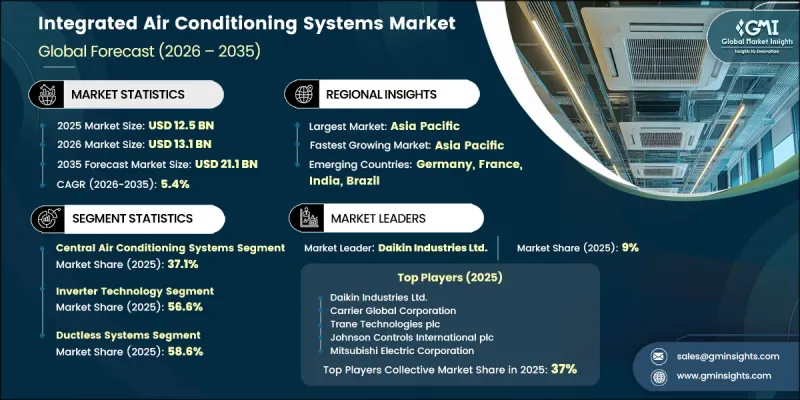
亞太地區建設活動的活性化以及北美和歐洲日益嚴格的能源性能法規推動了市場擴張,這些因素正在影響暖通空調(HVAC)系統的採購決策和技術升級。都市區成長、開發中國家消費者購買力的提升以及旨在減少高全球暖化潛值(GWP)冷媒使用的監管措施,都在推動對先進的變頻驅動和智慧整合式HVAC解決方案的需求。智慧建築基礎設施的日益普及也加速了連網多區域冷卻系統的部署。包括美國商業建築的ASHRAE 90.1-2025標準在內的能源效率標準,正鼓勵開發商和業主從早期規劃和設計階段就開始實施高性能HVAC系統。 LEED和BREEAM認證在商業房地產中的日益普及,進一步增加了北美、歐洲和東亞地區對永續冷卻技術的需求。亞太地區擁有豐富的商業建築儲備和快速成長的新建築開發項目,因此持續提供龐大的商機。
| 市場範圍 | |
|---|---|
| 開始年份 | 2025 |
| 預測期 | 2026-2035 |
| 上市時的市場規模 | 125億美元 |
| 預計金額 | 211億美元 |
| 複合年成長率 | 5.4% |
到2025年,中央空調系統市佔率將達到37.1%。此細分市場強勁的市場地位歸功於其在大規模商業和公共設施中的廣泛應用,在這些設施中,集中式冷卻基礎設施、空氣分配網路和高容量性能至關重要。已開發市場商業建築專案的擴張和更新需求正在推動該細分市場的成長。高階商用冷卻解決方案,如開利AquaForce系列冷卻器和特靈CenTraVac離心式冷卻器平台,在可靠度能和可擴展容量至關重要的應用領域,仍是該細分市場的領先解決方案。
預計到2025年,變頻空調系統市佔率將達到56.6%,並在2035年之前以7.7%的複合年成長率成長。受日益嚴格的能源效率要求、消費者對電費成本意識的增強以及傳統空調和變頻空調系統價格差距縮小等因素的推動,該細分市場有望成為所有技術和產品類型中成長最快的。在許多開發中國家,高效變頻空調的親民以及傳統成本限制的放寬,正推動著消費者和企業對其的廣泛採用。
預計到2025年,亞太地區一體化空調系統市佔率將達到34.96%。中國和印度仍將是主要的需求中心,儘管兩國市場環境存在差異。中國市場的成長主要得益於廣泛的商業基礎設施建設,包括資料中心、工業設施和綜合用途項目,在這些項目中,VRF和中央空調技術仍然是首選。美的VRF「Multi V」平台和格力「GMV6」平台已在許多大型商業設施中實用化。
目錄
第1章:調查方法
第2章執行摘要
第3章 行業洞察
- 產業生態系分析
- 影響價值鏈的因素
- 利潤率分析
- 中斷
- 前景
- 製造商
- 中斷
- 供應商情況
- 主要新聞和舉措
- 技術與創新展望
- 監理情勢
- 對產業的影響
- 促進因素
- 產業潛在風險與挑戰
- 機會
- 波特的分析
- PESTLE分析
- 價格分析
- 2019-2024年歷史價格趨勢分析
- 定價策略:按業務類型分類
- 貿易數據分析
- 進出口量及進口額趨勢
- 主要貿易路線及關稅的影響
- 人工智慧和生成式人工智慧對市場的影響
- 利用人工智慧改造現有經營模式
- 按細分市場分類的生成式人工智慧用例和部署藍圖
- 風險、限制和監管考量
- 生產能力和生產情況
- 按地區和主要生產商分類的已安裝產能
- 運轉率和擴張計劃
第4章 競爭情勢
- 介紹
- 企業市佔率分析
- 競爭定位矩陣
- 戰略展望矩陣
- 主要市場公司的競爭分析
- 主要進展
- 併購
- 夥伴關係和聯盟
- 新產品發布
- 業務拓展計劃
第5章 市場估算與預測:依產品類型分類,2022-2035年
- 中央空調系統
- 無管道分離式空調系統:
- 混合系統
- 整體空調系統
- VRF(可變冷媒流量)系統
第6章 市場估計與預測:依技術分類,2022-2035年
- 逆變器技術
- 非逆變器技術
第7章 市場估計與預測:依能源來源分類,2022-2035年
- 電的
- 氣體
- 混合系統
第8章 市場估計與預測:依應用領域分類,2022-2035年
- 住宅
- 商業
- 產業
- 其他(交通運輸等)
第9章 市場估價與預測:依分銷系統分類,2022-2035年
- 風管系統
- 無管道系統
第10章:預測:依地區分類,2022-2035年
- 北美洲
- 美國
- 加拿大
- 歐洲
- 德國
- 英國
- 法國
- 義大利
- 西班牙
- 亞太地區
- 中國
- 印度
- 日本
- 韓國
- 澳洲
- 拉丁美洲
- 巴西
- 墨西哥
- 阿根廷
- 中東和非洲
- UAE
- 沙烏地阿拉伯
- 南非
第11章:公司簡介
- 世界公司
- Daikin Industries Ltd.
- Carrier Global Corporation
- Trane Technologies plc
- Johnson Controls International plc
- Mitsubishi Electric Corporation
- LG Electronics Inc.
- Midea Group Co., Ltd.
- Panasonic Holdings Corporation
- 本地公司
- Gree Electric Appliances Inc. of Zhuhai
- GENERAL Inc.
- Lennox International Inc.
- Voltas Limited
- Blue Star Limited
- Samsung Electronics Co., Ltd.
- 新興企業
- AAON Inc.
- Haier Smart Home Co., Ltd.
- Rheem Manufacturing Company
- Qingdao Hisense HVAC Equipment Co., Ltd.
- TCL
- AUX Group
- Systemair AB
The Global Integrated Air Conditioning Systems Market was valued at USD 12.5 billion in 2025 and is estimated to grow at a CAGR of 5.4% to reach USD 21.1 billion by 2035.
Market expansion is shaped by rising construction activity in Asia Pacific, along with stricter energy performance regulations across North America and Europe that are influencing HVAC purchasing decisions and technology upgrades. Growing urban populations, improving consumer purchasing power in developing economies, and regulatory efforts to reduce the use of high-global warming potential (GWP) refrigerants are increasing demand for advanced inverter-driven and intelligent integrated air conditioning solutions. The growing adoption of smart building infrastructure is also accelerating the deployment of connected, multi-zone cooling systems. Energy efficiency standards, including ASHRAE Standard 90.1-2025 for commercial buildings in the United States, are encouraging developers and facility owners to incorporate higher-performance HVAC systems during initial planning and design stages. Increasing acceptance of LEED and BREEAM certifications in commercial properties is further strengthening the need for sustainable cooling technologies across North America, Europe, and East Asia. Asia Pacific continues to represent a major opportunity area due to its strong commercial construction pipeline and rapid growth in new building developments.
| Market Scope | |
|---|---|
| Start Year | 2025 |
| Forecast Year | 2026-2035 |
| Start Value | $12.5 Billion |
| Forecast Value | $21.1 Billion |
| CAGR | 5.4% |
The central air conditioning systems segment held 37.1% share in 2025. Their strong market presence is attributed to widespread adoption in large commercial and institutional buildings where centralized cooling infrastructure, air distribution networks, and high-capacity performance are essential. Expansion of commercial construction projects and replacement activities in developed markets are supporting segment growth. Premium commercial cooling solutions, including Carrier's AquaForce chiller series and Trane's CenTraVac centrifugal chiller platform, continue to represent advanced solutions within this segment, serving applications where dependable cooling performance and scalable capacity are important considerations.
The inverter-based systems segment held 56.6% share in 2025 and is expected to grow at a CAGR of 7.7% through 2035. This segment is projected to experience the fastest expansion among all technology and product categories due to increasing energy efficiency requirements, rising electricity cost awareness, and declining price differences between conventional and inverter-based systems. In many developing economies, efficient inverter air conditioning units have become more affordable, reducing the previous cost-related limitations and encouraging broader adoption among consumers and businesses.
Asia Pacific Integrated Air Conditioning Systems Market held 34.96% share in 2025. China and India continue to act as key demand centers, although market conditions vary between the two countries. China's market growth is supported by extensive commercial infrastructure development, including data centers, industrial facilities, and mixed-use projects, where VRF and central air conditioning technologies remain preferred choices. Midea's VRF Multi V and Gree's GMV6 platform are commercially utilized across several large-scale commercial installations.
Major players operating in the global integrated air conditioning systems industry are AAON Inc., Daikin Industries Ltd., Mitsubishi Electric Corporation, Carrier Global Corporation, Gree Electric Appliances Inc. of Zhuhai, LG Electronics Inc., Trane Technologies plc, AUX Group, Haier Smart Home Co., Ltd., Johnson Controls International plc, Midea Group Co., Ltd., Panasonic Holdings Corporation, Blue Star Limited, Rheem Manufacturing Company, Lennox International Inc., Samsung Electronics Co., Ltd., Systemair AB, TCL, GENERAL Inc., Qingdao Hisense HVAC Equipment Co., Ltd. Companies operating in the integrated air conditioning systems market are focusing on strategies such as product innovation, energy-efficient technology development, smart connectivity integration, and expansion into emerging markets to improve their competitive position. Manufacturers are investing in advanced inverter technologies, IoT-enabled HVAC platforms, and environmentally friendly refrigerant solutions to address changing customer expectations and regulatory requirements. Strategic partnerships, regional manufacturing expansion, mergers, acquisitions, and strengthened distribution networks are also being used to increase market penetration.
Table of Contents
Chapter 1 Research Methodology
- 1.1 Research approach
- 1.2 Quality Commitments
- 1.2.1 GMI AI policy & data integrity commitment
- 1.2.1.1 Source consistency protocol
- 1.2.1 GMI AI policy & data integrity commitment
- 1.3 Research Trail & Confidence Scoring
- 1.3.1 Research Trail Components
- 1.3.2 Scoring Components
- 1.4 Data Collection
- 1.4.1 Partial list of primary sources
- 1.5 Data mining sources
- 1.5.1 Paid sources
- 1.5.1.1 Sources, by region
- 1.5.1 Paid sources
- 1.6 Base estimates and calculations
- 1.6.1 Base year calculation for any one approach
- 1.7 Forecast model
- 1.7.1 Quantified market impact analysis
- 1.7.1.1 Mathematical impact of growth parameters on forecast
- 1.7.1 Quantified market impact analysis
- 1.8 Research transparency addendum
- 1.8.1 Source attribution framework
- 1.8.2 Quality assurance metrics
- 1.8.3 Our commitment to trust
Chapter 2 Executive Summary
- 2.1 Industry 360° synopsis, 2022 - 2035
- 2.2 Key market trends
- 2.2.1 Regional
- 2.2.2 Product Type
- 2.2.3 Technology
- 2.2.4 Energy Source
- 2.2.5 Application
- 2.2.6 Distribution System
Chapter 3 Industry Insights
- 3.1 Industry ecosystem analysis
- 3.1.1 Factor affecting the value chain
- 3.1.2 Profit margin analysis
- 3.1.3 Disruptions
- 3.1.4 Future outlook
- 3.1.5 Manufacturers
- 3.1.6 Distributors
- 3.2 Supplier landscape
- 3.3 Key news & initiatives
- 3.4 Technology & Innovation Landscape
- 3.5 Regulatory landscape
- 3.6 Impact on forces
- 3.6.1 Growth drivers
- 3.6.2 Industry pitfalls & challenges
- 3.6.3 Opportunities
- 3.7 Porter's analysis
- 3.8 PESTEL analysis
- 3.9 Pricing analysis (driven by primary research)
- 3.9.1 Historical Price Trend Analysis, 2019-2024 (Driven by Primary Research)
- 3.9.2 Pricing Strategy by Player Type (Driven by Primary Research)
- 3.10 Trade data analysis (driven by paid database)
- 3.10.1 Import/Export Volume & Value Trends (Driven by Primary Research)
- 3.10.2 Key Trade Corridors & Tariff Impact (Driven by Primary Research)
- 3.11 Impact of AI & Generative AI on the Market
- 3.11.1 AI-Driven Disruption of Existing Business Models
- 3.11.2 GenAI Use Cases & Adoption Roadmap by Segment
- 3.11.3 Risks, Limitations & Regulatory Considerations
- 3.12 Capacity & Production Landscape (Driven by Primary Research)
- 3.12.1 Manufacturing Capacity Installed by Region & Key Producer (Driven by Primary Research)
- 3.12.2 Capacity Utilization Rates & Expansion Pipelines (Driven by Primary Research)
Chapter 4 Competitive Landscape, 2025
- 4.1 Introduction
- 4.2 Company market share analysis
- 4.3 Competitive positioning matrix
- 4.4 Strategic outlook matrix
- 4.5 Competitive analysis of major market players
- 4.6 Key developments
- 4.6.1 Mergers & acquisitions
- 4.6.2 Partnerships & collaborations
- 4.6.3 New product launches
- 4.6.4 Expansion plans
Chapter 5 Market Estimates and Forecast, By Product Type, 2022 - 2035 (USD Billion, Units)
- 5.1 Key trends
- 5.2 Central air conditioning systems
- 5.3 Ductless split systems:
- 5.4 Hybrid systems
- 5.5 Packaged air conditioning systems
- 5.6 VRF (Variable Refrigerant Flow) systems
Chapter 6 Market Estimates and Forecast, By Technology, 2022 - 2035 (USD Billion, Units)
- 6.1 Key trends
- 6.2 Inverter technology
- 6.3 Non-inverter technology
Chapter 7 Market Estimates and Forecast, By Energy Source, 2022 - 2035 (USD Billion, Units)
- 7.1 Key trends
- 7.2 Electric
- 7.3 Gas
- 7.4 Hybrid systems
Chapter 8 Market Estimates and Forecast, By Application, 2022 - 2035 (USD Billion, Units)
- 8.1 Key trends
- 8.2 Residential
- 8.3 Commercial
- 8.4 Industrial
- 8.5 Others (transportation, etc.)
Chapter 9 Market Estimates and Forecast, By Distribution System, 2022 - 2035 (USD Billion, Units)
- 9.1 Key trends
- 9.2 Ducted systems
- 9.3 Ductless systems
Chapter 10 Forecast, By Region, 2022 - 2035, (USD Billion, Units)
- 10.1 Key trends
- 10.2 North America
- 10.2.1 U.S.
- 10.2.2 Canada
- 10.3 Europe
- 10.3.1 Germany
- 10.3.2 U.K.
- 10.3.3 France
- 10.3.4 Italy
- 10.3.5 Spain
- 10.4 Asia Pacific
- 10.4.1 China
- 10.4.2 India
- 10.4.3 Japan
- 10.4.4 South Korea
- 10.4.5 Australia
- 10.5 Latin America
- 10.5.1 Brazil
- 10.5.2 Mexico
- 10.5.3 Argentina
- 10.6 MEA
- 10.6.1 UAE
- 10.6.2 Saudi Arabia
- 10.6.3 South Africa
Chapter 11 Company Profiles
- 11.1 Global players
- 11.1.1 Daikin Industries Ltd.
- 11.1.2 Carrier Global Corporation
- 11.1.3 Trane Technologies plc
- 11.1.4 Johnson Controls International plc
- 11.1.5 Mitsubishi Electric Corporation
- 11.1.6 LG Electronics Inc.
- 11.1.7 Midea Group Co., Ltd.
- 11.1.8 Panasonic Holdings Corporation
- 11.2 Regional players
- 11.2.1 Gree Electric Appliances Inc. of Zhuhai
- 11.2.2 GENERAL Inc.
- 11.2.3 Lennox International Inc.
- 11.2.4 Voltas Limited
- 11.2.5 Blue Star Limited
- 11.2.6 Samsung Electronics Co., Ltd.
- 11.3 Emerging players
- 11.3.1 AAON Inc.
- 11.3.2 Haier Smart Home Co., Ltd.
- 11.3.3 Rheem Manufacturing Company
- 11.3.4 Qingdao Hisense HVAC Equipment Co., Ltd.
- 11.3.5 TCL
- 11.3.6 AUX Group
- 11.3.7 Systemair AB

 醫院空調系統市場:全球市場預測,2026-2032年
 資料中心暖通空調系統市場規模、佔有率和趨勢分析報告:按產品類型、部署模式、資料中心類型、地區和細分市場預測(2026-2033 年)
 全球暖通空調維護服務市場規模、佔有率、趨勢和成長分析報告(2026-2034年)
 無塵室暖通空調市場規模、佔有率和成長分析:按產品組合、無塵室潔淨度等級、最終用戶產業和地區分類-2026-2033年產業預測暖通空調維護服務市場規模、佔有率和趨勢分析報告:按服務、產品、應用、地區和細分市場預測(2026-2033 年)
 單體材料市場規模、佔有率和成長分析:按材料成分、產品形式、性能、應用、分銷管道和地區分類-2026年至2033年產業預測
 商業建築暖通空調系統及硬體市場數據概覽:2026年第一季商業建築的暖通空調系統和硬體國防暖通空調系統市場規模、佔有率和趨勢分析報告:按設備、類型、最終用途、應用、地區和細分市場預測(2026-2033 年)全球無塵室HVAC市場:市場規模、佔有率、成長率、產業分析、依類型、應用和地區劃分的分析以及未來預測(2026-2034年)