


 |
市場調查報告書
商品編碼
2101969
2026 年至 2035 年實驗真空幫浦的市場機會、成長要素、產業趨勢與預測。Laboratory Vacuum Pumps Market Opportunity, Growth Drivers, Industry Trend Analysis, and Forecast 2026 - 2035 |
||||||

全球實驗室真空幫浦市場預計到 2025 年將達到 19 億美元,年複合成長率為 6.5%,到 2035 年將達到 35 億美元。
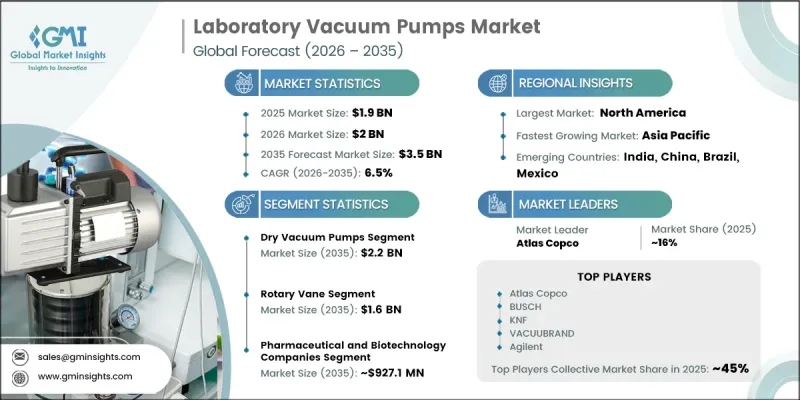
該市場的成長主要受以下因素驅動:對先進實驗室基礎設施的需求不斷成長、醫療領域診斷活動的日益普及以及製藥和生物技術領域研究活動的不斷擴展。實驗室真空幫浦是用於創建可控真空環境的關鍵儀器,可支援各種實驗操作,包括過濾、乾燥、蒸餾和分析過程。這些系統廣泛應用於製藥生產、生物技術、臨床實驗室和研究機構。實驗室真空幫浦分為乾式和濕式兩種類型,並採用轉葉、螺旋、爪式和隔膜等多種機械結構,以滿足不同的操作需求。對依賴真空技術的先進醫療和分析設備的需求不斷成長,推動了市場擴張。此外,由於疾病盛行率上升、對早期檢測的日益重視以及預防醫學實踐的普及,診斷檢查室的數量也在不斷增加,這進一步提升了對可靠實驗室真空系統的需求。獨立診斷機構、醫院檢查室和專業檢測中心的持續發展增加了檢查室的工作量,從而刺激了對高效真空設備的投資。
| 市場範圍 | |
|---|---|
| 開始年份 | 2025 |
| 預測期 | 2026-2035 |
| 初始市場規模 | 19億美元 |
| 預測金額 | 35億美元 |
| 複合年成長率 | 6.5% |
預計到2025年,乾式真空幫浦市佔率將達到59.7%。這主要得益於其諸多優勢,例如在實驗室環境中潔淨運作、維護成本低以及能源效率高。由於乾式真空幫浦無需油或液體密封系統,從而降低了精密操作過程中的污染風險,因此在製藥、生物技術和科研領域越來越受歡迎。其維持高純度環境的能力使其適用於需要受控環境和高精度性能的應用。生命科學和分析應用領域對可靠實驗室流程日益成長的需求,以及對品質的嚴格要求,持續推動乾式真空幫浦技術的應用。
預計到2025年,製藥和生技公司市場規模將達到9.271億美元。此細分市場的強勁地位歸功於真空系統在藥物研發、生產活動中的廣泛應用。這些公司在需要精確壓力控制和無菌環境的製程中依賴實驗室真空幫浦。對先進療法、生物製藥和生物相似藥研發投入的增加,進一步推動了對能夠支援複雜實驗室操作的高性能真空設備的需求。
美國實驗室真空幫浦市場預計到2025年將達到7.352億美元。北美實驗室真空幫浦市場的發展動力主要來自活躍的藥物和生物技術研發、成熟的生命科學生態系統以及對科學創新的持續投入。該地區匯聚了許多製藥公司、生物技術機構和研究中心,致力於藥物開發、先進醫學研究和實驗室創新。這些活動需要高度可控的實驗室環境,而真空幫浦在樣品製備、過濾和溶劑處理等操作中發揮至關重要的作用。
目錄
第1章:調查方法
第2章執行摘要
第3章 行業洞察
- 產業生態系分析
- 影響產業的因素
- 促進因素
- 醫療領域對診斷檢查室的需求日益成長。
- 擴大製藥和生物技術領域的研究活動
- 真空技術相關先進醫療設備的應用日益普及。
- 不斷擴大的生物製藥產業和疫苗生產
- 技術進步
- 產業潛在風險與挑戰
- 醫療設備和實驗室設備有嚴格的監管要求
- 特定真空幫浦的維護挑戰與運作成本
- 機會
- 智慧幫浦與實驗室資訊管理系統(LIMS)的整合
- 新興市場CDMO與CRO產能擴張
- 促進因素
- 成長潛力分析
- 監理情勢
- 2025年價格分析
- 技術與創新展望
- 最新科技趨勢
- 新興技術
- 未來市場趨勢
- 人工智慧和生成式人工智慧對市場的影響
- 波特的分析
- PESTLE分析
第4章 競爭情勢
- 介紹
- 企業矩陣分析
- 企業市佔率分析
- 世界
- 北美洲
- 歐洲
- 亞太地區
- LAMEA
- 主要市場公司的競爭分析
- 競爭定位矩陣
- 主要進展
- 併購
- 夥伴關係和聯盟
- 新產品發布
- 業務拓展計劃
第5章 市場估算與預測:依產品分類,2022-2035年
- 乾式真空幫浦
- 濕式真空幫浦
- 組合式真空幫浦
第6章 市場估計與預測:依技術分類,2022-2035年
- 轉葉
- 旋轉螺桿
- 旋轉爪
- 其他技術
第7章 市場估計與預測:依應用領域分類,2022-2035年
- 濾
- 乾燥
- 蒸餾法
- 其他用途
第8章 市場估算與預測:依最終用途分類,2022-2035年
- 製藥和生物技術公司
- 醫院和診斷檢查室
- 學術研究機構
- 其他最終用戶
第9章 市場估計與預測:依地區分類,2022-2035年
- 北美洲
- 美國
- 加拿大
- 歐洲
- 德國
- 英國
- 法國
- 西班牙
- 義大利
- 荷蘭
- 亞太地區
- 中國
- 日本
- 印度
- 澳洲
- 韓國
- 拉丁美洲
- 巴西
- 墨西哥
- 阿根廷
- 中東和非洲
- 南非
- 沙烏地阿拉伯
- UAE
第10章:公司簡介
- Agilent
- Atlas Copco
- BUSCH
- DEKKER
- Ebara Technologies
- EDWARDS
- gast
- Graham
- KNF
- Leybold
- PFEIFFER
- SHIMADZU
- ULVAC
- VACUUBRAND
- WELCH
The Global Laboratory Vacuum Pumps Market was valued at USD 1.9 billion in 2025 and is estimated to grow at a CAGR of 6.5% to reach USD 3.5 billion by 2035.
The market growth is supported by rising demand for advanced laboratory infrastructure, increasing diagnostic activities in healthcare, and expanding pharmaceutical and biotechnology research operations. Laboratory vacuum pumps are critical equipment designed to generate controlled vacuum conditions that support various laboratory procedures, including filtration, drying, distillation, and analytical processes. These systems are extensively used across pharmaceutical production, biotechnology applications, clinical testing facilities, and research institutions. Laboratory vacuum pumps are available in dry and wet configurations and incorporate technologies such as rotary vane, screw, claw, and diaphragm mechanisms to address diverse operational requirements. The increasing requirement for sophisticated medical and analytical equipment that depends on vacuum technology is contributing to market expansion. Additionally, the growing number of diagnostic laboratories, driven by higher disease prevalence, increasing emphasis on early detection, and rising adoption of preventive healthcare practices, is strengthening demand for reliable laboratory vacuum systems. The continued development of independent diagnostic facilities, hospital laboratories, and specialized testing centers is increasing laboratory workloads and encouraging investments in efficient vacuum equipment.
| Market Scope | |
|---|---|
| Start Year | 2025 |
| Forecast Year | 2026-2035 |
| Start Value | $1.9 Billion |
| Forecast Value | $3.5 Billion |
| CAGR | 6.5% |
The dry vacuum pumps segment accounted for 59.7% share in 2025, supported by advantages such as cleaner operation, reduced maintenance needs, and improved energy efficiency in laboratory settings. Dry vacuum pumps are increasingly preferred across pharmaceutical, biotechnology, and research environments because they operate without oil or liquid-based sealing systems, reducing contamination risks during sensitive procedures. Their ability to maintain high-purity conditions makes them suitable for applications requiring controlled environments and precise performance. The rising demand for reliable laboratory processes, combined with strict quality requirements in life science and analytical applications, continues to encourage the adoption of dry vacuum pump technologies.
The pharmaceutical and biotechnology companies segment generated USD 927.1 million in 2025. The segment's strong position is attributed to the widespread use of vacuum systems throughout pharmaceutical research, drug development, and manufacturing activities. These companies depend on laboratory vacuum pumps for processes requiring accurate pressure management and contamination-free conditions. Growing investments in advanced therapies, biologics, and biosimilar development are further increasing the need for high-performance vacuum equipment capable of supporting complex laboratory operations.
U.S. Laboratory Vacuum Pumps Market was valued at USD 735.2 million in 2025. The North America laboratory vacuum pumps market is being supported by strong pharmaceutical and biotechnology research activities, along with a well-established life sciences ecosystem and continuous investment in scientific innovation. The region includes a large base of pharmaceutical companies, biotechnology organizations, and research centers involved in drug development, advanced healthcare research, and laboratory-based innovation. These activities require highly controlled laboratory environments where vacuum pumps are essential for procedures such as sample preparation, filtration, and solvent processing.
Key companies operating in the global laboratory vacuum pumps industry include Agilent, BUSCH, Atlas Copco, EDWARDS, KNF, ULVAC, Leybold, VACUUBRAND, Graham, PFEIFFER, SHIMADZU, Ebara Technologies, DEKKER, gast, and WELCH. Companies operating in the laboratory vacuum pumps market are strengthening their market position through product innovation, technology upgrades, strategic partnerships, and expansion into emerging application areas. Manufacturers are focusing on developing energy-efficient, low-maintenance, and contamination-resistant vacuum solutions to meet the evolving needs of pharmaceutical, biotechnology, and research laboratories. Businesses are also investing in advanced engineering capabilities to improve pump performance, durability, and operational efficiency. Strategic collaborations with research organizations and end users help companies understand changing laboratory requirements and develop application-specific solutions.
Table of Contents
Chapter 1 Research Methodology
- 1.1 Research approach
- 1.2 Quality commitments
- 1.2.1 GMI AI policy & data integrity commitment
- 1.2.1.1 Source consistency protocol
- 1.2.1 GMI AI policy & data integrity commitment
- 1.3 Research trail & confidence scoring
- 1.3.1 Research trail components
- 1.3.2 Scoring components
- 1.4 Data collection
- 1.4.1 Partial list of primary sources
- 1.5 Data mining sources
- 1.5.1 Paid sources
- 1.5.1.1 Sources, by region
- 1.5.1 Paid sources
- 1.6 Base estimates and calculations
- 1.6.1 Base year calculation
- 1.7 Forecast model
- 1.7.1 Quantified market impact analysis
- 1.7.1.1 Mathematical impact of growth parameters on forecast
- 1.7.1 Quantified market impact analysis
- 1.8 Research transparency addendum
- 1.8.1 Source attribution framework
- 1.8.2 Quality assurance metrics
- 1.8.3 Our commitment to trust
Chapter 2 Executive Summary
- 2.1 Industry 360° synopsis
- 2.2 Key market trends
- 2.2.1 Regional trends
- 2.2.2 Product trends
- 2.2.3 Technology trends
- 2.2.4 Application trends
- 2.2.5 End use trends
- 2.3 CXO perspectives: Strategic imperatives
Chapter 3 Industry Insights
- 3.1 Industry ecosystem analysis
- 3.2 Industry impact forces
- 3.2.1 Growth drivers
- 3.2.1.1 Increasing demand for diagnostic laboratories in the healthcare sector
- 3.2.1.2 Growth in pharmaceutical and biotechnology research activities
- 3.2.1.3 Rising adoption of advanced medical devices requiring vacuum technology
- 3.2.1.4 Expanding biopharmaceutical industry and vaccine production
- 3.2.1.5 Technological advancements
- 3.2.2 Industry pitfalls and challenges
- 3.2.2.1 Stringent regulatory requirements for medical devices and lab equipment
- 3.2.2.2 Maintenance challenges and operational costs of certain vacuum pumps
- 3.2.3 Opportunities
- 3.2.3.1 Integration of smart pumps with laboratory information management systems (LIMS)
- 3.2.3.2 Expansion of CDMO and CRO capacities in emerging markets
- 3.2.1 Growth drivers
- 3.3 Growth potential analysis
- 3.4 Regulatory landscape
- 3.5 Pricing analysis, 2025
- 3.6 Technology and innovation landscape (Driven by Primary Research)
- 3.6.1 Current technological trends
- 3.6.2 Emerging technologies
- 3.7 Future market trends (Driven by Primary Research)
- 3.8 Impact of AI & Generative AI on the Market (Driven by Primary Research)
- 3.9 Porter's analysis
- 3.10 PESTEL analysis
Chapter 4 Competitive Landscape, 2025
- 4.1 Introduction
- 4.2 Company matrix analysis
- 4.3 Company market share analysis (Driven by Primary Research)
- 4.3.1 Global
- 4.3.2 North America
- 4.3.3 Europe
- 4.3.4 Asia Pacific
- 4.3.5 LAMEA
- 4.4 Competitive analysis of major market players
- 4.5 Competitive positioning matrix
- 4.6 Key developments
- 4.6.1 Mergers & acquisitions
- 4.6.2 Partnerships & collaborations
- 4.6.3 New product launches
- 4.6.4 Expansion plans
Chapter 5 Market Estimates and Forecast, By Product, 2022 - 2035 ($ Mn)
- 5.1 Key trends
- 5.2 Dry vacuum pumps
- 5.3 Wet vacuum pumps
- 5.4 Combination vacuum pumps
Chapter 6 Market Estimates and Forecast, By Technology, 2022 - 2035 ($ Mn)
- 6.1 Key trends
- 6.2 Rotary vane
- 6.3 Rotary screw
- 6.4 Rotary claw
- 6.5 Other technologies
Chapter 7 Market Estimates and Forecast, By Application, 2022 - 2035 ($ Mn)
- 7.1 Key trends
- 7.2 Filtering
- 7.3 Drying
- 7.4 Distillation
- 7.5 Other application
Chapter 8 Market Estimates and Forecast, By End Use, 2022 - 2035 ($ Mn)
- 8.1 Key trends
- 8.2 Pharmaceutical and biotechnology companies
- 8.3 Hospitals and diagnostic labs
- 8.4 Academic and research institutes
- 8.5 Other end users
Chapter 9 Market Estimates and Forecast, By Region, 2022 - 2035 ($ Mn)
- 9.1 Key trends
- 9.2 North America
- 9.2.1 U.S.
- 9.2.2 Canada
- 9.3 Europe
- 9.3.1 Germany
- 9.3.2 UK
- 9.3.3 France
- 9.3.4 Spain
- 9.3.5 Italy
- 9.3.6 Netherlands
- 9.4 Asia Pacific
- 9.4.1 China
- 9.4.2 Japan
- 9.4.3 India
- 9.4.4 Australia
- 9.4.5 South Korea
- 9.5 Latin America
- 9.5.1 Brazil
- 9.5.2 Mexico
- 9.5.3 Argentina
- 9.6 MEA
- 9.6.1 South Africa
- 9.6.2 Saudi Arabia
- 9.6.3 UAE
Chapter 10 Company Profiles
- 10.1 Agilent
- 10.2 Atlas Copco
- 10.3 BUSCH
- 10.4 DEKKER
- 10.5 Ebara Technologies
- 10.6 EDWARDS
- 10.7 gast
- 10.8 Graham
- 10.9 KNF
- 10.10 Leybold
- 10.11 PFEIFFER
- 10.12 SHIMADZU
- 10.13 ULVAC
- 10.14 VACUUBRAND
- 10.15 WELCH

 全球研究真空幫浦市場規模、佔有率、趨勢和成長分析報告(2026-2034)
 2026年全球可列印磁性卷材市場報告
 實驗室真空幫浦市場:按幫浦類型、真空度、幫浦速、潤滑方式和最終用戶分類-全球預測,2026-2032年永磁變頻渦旋真空幫浦市場依產品類型、真空度、運轉模式、功率等級、應用及通路分類,全球預測(2026-2032年)
 實驗室真空幫浦市場規模、佔有率及成長分析(按產品、技術、應用、最終用途和地區分類)-2026-2033年產業預測
 實驗室真空幫浦市場,按技術、按產品、按應用、按最終用途、按國家和地區 - 2025 年至 2032 年全球行業分析、市場規模、市場佔有率和預測
 實驗室用真空幫浦的全球市場:產品·技術·用途·終端用戶·不同地區的預測 (~2032年)