


 |
市場調查報告書
商品編碼
2101963
2026 年至 2035 年眼科醫療設備的市場機會、成長要素、產業趨勢與預測。Ophthalmic Devices Market Opportunity, Growth Drivers, Industry Trend Analysis, and Forecast 2026 - 2035 |
||||||

預計到 2025 年,全球眼科醫療設備市場規模將達到 507 億美元,並預計以 5.4% 的複合年成長率成長,到 2035 年達到 851 億美元。
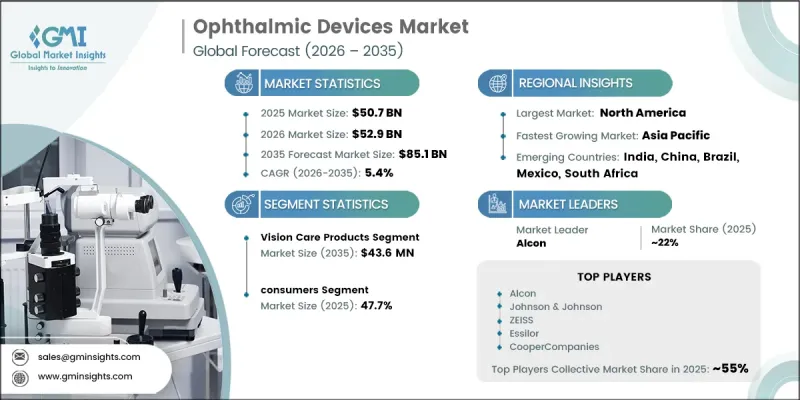
市場成長的促進因素包括:對微創眼科手術需求的不斷成長、眼科疾病盛行率的上升、眼科產品技術的持續進步以及隱形眼鏡和眼鏡日益普及。眼科醫療設備涵蓋了用於診斷、監測和治療眼科疾病的各種醫療技術,以及透過隱形眼鏡和人工水晶體等產品進行視力矯正的技術。這些解決方案在白內障、青光眼、屈光不正和其他視力相關疾病的治療中發揮著至關重要的作用。數位設備的日益普及、城市人口的不斷成長以及生活方式的改變,都導致了各年齡層視力障礙發生率的上升。同時,消費者對兼具卓越視覺效果、舒適度和現代設計的視力矯正產品的需求也日益成長。診斷技術、手術器材和視力保健產品的持續創新預計將支撐眼科醫療設備市場的長期成長。
| 市場範圍 | |
|---|---|
| 開始年份 | 2025 |
| 預測期 | 2026-2035 |
| 上市時的市場規模 | 507億美元 |
| 預測金額 | 851億美元 |
| 複合年成長率 | 5.4% |
到2025年,視力保健產品市佔率將達到51.7%。近視、遠視和散光等屈光病例的不斷增加,以及數位產品引起的眼部疲勞日益嚴重,持續推動先進視力矯正產品的需求。消費者對具備藍光過濾技術、抗反射膜和光致變色功能的創新眼鏡鏡片的偏好日益成長,進一步提升了日常視覺舒適度和眼部保護,從而刺激了市場需求。
預計到2025年,消費者細分市場將佔據47.7%的市場。市場成長的主要驅動力是公眾眼部健康意識的提高,以及因長時間使用電子螢幕和生活方式改變導致的視力問題日益增多。消費者持續追求兼具舒適性、便利性、有效性和美觀設計的視力矯正產品。日拋棄式隱形眼鏡隱形眼鏡、數位化眼科護理服務和宅配服務的日益普及,進一步鞏固了該細分市場的主導地位,並推動了市場的持續擴張。
預計到2025年,北美眼科醫療設備市佔率將達到36.6%。推動該地區市場成長的主要因素是視力相關疾病盛行率的上升,而這又源於人口老化、慢性眼部疾病發病率的增加以及對先進視力保健解決方案日益成長的需求。持續投資於尖端診斷設備、創新手術技術和高品質視力矯正產品,預計將支撐全部區域市場的持續發展。
目錄
第1章:調查方法
第2章執行摘要
第3章 行業洞察
- 產業生態系分析
- 影響產業的因素
- 促進因素
- 患有眼科疾病的人數正在增加。
- 產品技術進步
- 政府的利多政策
- 隱形眼鏡和眼鏡的使用量增加
- 產業潛在風險與挑戰
- 眼科醫療設備高成本
- 擴大再生眼科設備的應用
- 市場機遇
- 擴大高階人工水晶體和超音波超音波乳化設備的使用。
- 新興市場的擴張
- 促進因素
- 成長潛力分析
- 監理情勢
- 技術展望
- 最新科技趨勢
- 新興技術
- 價格趨勢分析
- 未來市場趨勢
- 波特的分析
- PESTLE分析
- 人工智慧和生成式人工智慧對市場的影響
- 價值鏈分析
- 永續性和環境影響
- 使用可回收材料
- 節能型製造程序
- 消費者洞察
- 治療基礎設施和臨床實施的現狀
- 差距分析
第4章 競爭情勢
- 介紹
- 企業矩陣分析
- 企業市佔率分析
- 世界
- 北美洲
- 歐洲
- 亞太地區
- 競爭定位矩陣
- 主要市場公司的競爭分析
- 主要進展
- 併購
- 夥伴關係和聯盟
- 新產品發布
- 業務拓展計劃
第5章 市場估算與預測:依產品分類,2022-2035年
- 視力保健產品
- 隱形眼鏡
- 軟式隱形眼鏡
- 硬式高透氧隱形眼鏡(RGP)
- 托里卡
- 其他隱形眼鏡
- 眼鏡鏡片
- 隱形眼鏡
- 外科器械
- 白內障手術設備
- 人工水晶體
- 用於 faco 仿真的設備
- 眼科用黏彈性裝置
- 雷射白內障手術
- 人工水晶體(IOL)注射器
- 其他白內障手術器械
- 青光眼手術器械
- 青光眼引流裝置
- 雷射治療青光眼
- 微創青光眼手術(MIGS)
- 其他青光眼手術器械
- 屈光矯正手術器械
- 準分子雷射
- 飛秒雷射
- 其他屈光矯正手術器械
- 玻璃體視網膜手術裝置
- 光凝雷射
- 照明設備
- 玻璃體視網膜手術用套件
- 玻璃體切除裝置
- 玻璃體切除探針
- 其他玻璃體視網膜手術器械
- 白內障手術設備
- 診斷和監測設備
- 自動屈光
- 生物測量儀
- 角膜地圖儀系統
- 眼底攝影機
- 角膜曲率計
- 焦度計
- 超音波影像成像設備
- 檢影鏡
- 光學生物醫學測量系統
- 光學同調斷層掃描(OCT)掃描儀
- 角膜厚度測量儀
- 周邊視野分析儀/周邊視野分析儀
- 光翼
- 檢影鏡
- 裂隙燈
- 鏡式顯微鏡
- 眼壓計
- 前導波像差分析儀
- 其他診斷和監測設備
- 眼科配件
第6章 市場估算與預測:依最終用途分類,2022-2035年
- 消費者
- 醫院
- 專科診所
- 門診手術中心
- 其他最終用戶
第7章 市場估計與預測:依地區分類,2022-2035年
- 北美洲
- 美國
- 加拿大
- 歐洲
- 德國
- 英國
- 法國
- 西班牙
- 義大利
- 荷蘭
- 亞太地區
- 中國
- 日本
- 印度
- 澳洲
- 韓國
- 拉丁美洲
- 巴西
- 墨西哥
- 阿根廷
- 中東和非洲
- 南非
- 沙烏地阿拉伯
- UAE
第8章:公司簡介
- Alcon
- Bausch+Lomb
- Canon
- COBURN TECHNOLOGIES
- CooperCompanies
- Essilor
- HAAG-STREIT GROUP
- HEINE
- HOYA
- Johnson & Johnson
- NIDEK
- ophtec
- TOPCON Healthcare
- VISIONIX
- ZEISS
- ziemer OPHTHALMOLOGY
The Global Ophthalmic Devices Market was valued at USD 50.7 billion in 2025 and is estimated to grow at a CAGR of 5.4% to reach USD 85.1 billion by 2035.
Market growth is supported by the increasing preference for minimally invasive ophthalmic procedures, the rising prevalence of eye disorders, continuous technological advancements in ophthalmic products, and the growing adoption of contact lenses and spectacles. Ophthalmic devices include a broad range of medical technologies used to diagnose, monitor, and treat eye diseases while also supporting vision correction through products such as contact lenses and intraocular lenses. These solutions play a vital role in managing conditions including cataracts, glaucoma, refractive errors, and other vision-related disorders. Increasing digital device usage, expanding urban populations, and changing lifestyle patterns have contributed to a higher incidence of visual impairment across all age groups. At the same time, consumers are increasingly seeking vision correction products that combine superior visual performance, comfort, and modern design. Continuous innovation in diagnostic technologies, surgical equipment, and vision care products is expected to sustain long-term growth in the ophthalmic devices market.
| Market Scope | |
|---|---|
| Start Year | 2025 |
| Forecast Year | 2026-2035 |
| Start Value | $50.7 Billion |
| Forecast Value | $85.1 Billion |
| CAGR | 5.4% |
The vision care products segment accounted for 51.7% share in 2025. Rising cases of refractive disorders, including myopia, hyperopia, and astigmatism, along with increasing digital eye strain, continue to drive demand for advanced vision correction products. Growing consumer preference for innovative spectacle lenses featuring blue-light filtering technology, anti-reflective coatings, and photochromic functionality has further strengthened demand by enhancing everyday visual comfort and eye protection.
The consumers segment held a 47.7% share in 2025. Market leadership is supported by increasing public awareness regarding eye health and the growing incidence of vision impairment associated with prolonged screen exposure and evolving lifestyle habits. Consumers continue to seek vision correction products that offer improved comfort, convenience, effectiveness, and attractive designs. Expanding adoption of daily disposable contact lenses, digital eye care services, and home delivery solutions has further reinforced the segment's leading position while supporting continued market expansion.
North America Ophthalmic Devices Market accounted for 36.6% share in 2025. Regional growth is driven by the increasing prevalence of vision-related disorders, supported by an aging population, rising incidence of chronic health conditions affecting eye health, and growing demand for advanced vision care solutions. Continued investment in modern diagnostic equipment, innovative surgical technologies, and high-quality vision correction products is expected to support sustained market development across the region.
Key players operating in the global ophthalmic devices market include Alcon, ZEISS, Johnson & Johnson, Essilor, CooperCompanies, Bausch + Lomb, Canon, HOYA, TOPCON Healthcare, NIDEK, Haag-Streit Group, Visionix, Coburn Technologies, HEINE, Ophtec, and Ziemer Ophthalmology. Companies operating in the ophthalmic devices market are strengthening their market presence by investing heavily in product innovation, advanced diagnostic technologies, and minimally invasive surgical solutions. Manufacturers are expanding their portfolios with technologically advanced vision care products, premium intraocular lenses, and next-generation ophthalmic imaging systems to address evolving clinical needs. Strategic collaborations with healthcare providers, optical retailers, and distribution partners are helping companies expand global reach and improve product accessibility. Businesses are also prioritizing research and development to enhance product performance, patient comfort, and clinical outcomes while introducing digital technologies that improve diagnosis and treatment efficiency.
Table of Contents
Chapter 1 Research Methodology
- 1.1 Research approach
- 1.2 Quality commitments
- 1.2.1 GMI AI policy & data integrity commitment
- 1.2.1.1 Source consistency protocol
- 1.2.1 GMI AI policy & data integrity commitment
- 1.3 Research trail & confidence scoring
- 1.3.1 Research trail components
- 1.3.2 Scoring components
- 1.4 Data collection
- 1.4.1 Partial list of primary sources
- 1.5 Data mining sources
- 1.5.1 Paid sources
- 1.5.1.1 Sources, by region
- 1.5.1 Paid sources
- 1.6 Base estimates and calculations
- 1.6.1 Base year calculation for any one approach
- 1.7 Forecast model
- 1.7.1 Quantified market impact analysis
- 1.7.1.1 Mathematical impact of growth parameters on forecast
- 1.7.1 Quantified market impact analysis
- 1.8 Research transparency addendum
- 1.8.1 Source attribution framework
- 1.8.2 Quality assurance metrics
- 1.8.3 Our commitment to trust
Chapter 2 Executive Summary
- 2.1 Industry 360° synopsis
- 2.2 Key market trends
- 2.2.1 Regional trends
- 2.2.2 Product trends
- 2.2.3 End use trends
- 2.3 CXO perspectives: Strategic imperatives
Chapter 3 Industry Insights
- 3.1 Industry ecosystem analysis
- 3.2 Industry impact forces
- 3.2.1 Growth drivers
- 3.2.1.1 Increase in number of people suffering from ophthalmic disorders
- 3.2.1.2 Technological advancements in products
- 3.2.1.3 Favorable government initiatives
- 3.2.1.4 Rising adoption of contact lenses and spectacles
- 3.2.2 Industry pitfalls and challenges
- 3.2.2.1 High cost of the ophthalmic devices
- 3.2.2.2 Increasing adoption of refurbished ophthalmic devices
- 3.2.3 Market opportunities
- 3.2.3.1 Growing adoption of premium IOLs and phacoemulsification devices
- 3.2.3.2 Expansion in emerging markets
- 3.2.1 Growth drivers
- 3.3 Growth potential analysis
- 3.4 Regulatory landscape (Driven by primary research)
- 3.4.1 North America
- 3.4.2 Europe
- 3.4.3 Asia Pacific
- 3.4.4 Latin America
- 3.4.5 MEA
- 3.5 Technology landscape
- 3.5.1 Current technological trends
- 3.5.2 Emerging technologies
- 3.6 Pricing trend analysis (Driven by primary research)
- 3.7 Future market trends
- 3.8 Porter's analysis
- 3.9 PESTEL analysis
- 3.10 Impact of AI and Generative AI on the market (Driven by primary research)
- 3.11 Value chain analysis (Driven by primary research)
- 3.12 Sustainability and environmental impact
- 3.12.1 Use of recyclable materials
- 3.12.2 Energy-efficient manufacturing processes
- 3.13 Consumer insights (Driven by primary research)
- 3.14 Treatment infrastructure & clinical adoption landscape
- 3.15 Gap analysis
Chapter 4 Competitive Landscape, 2025
- 4.1 Introduction
- 4.2 Company matrix analysis
- 4.3 Company market share analysis (Driven by primary research)
- 4.3.1 Global
- 4.3.2 North America
- 4.3.3 Europe
- 4.3.4 Asia Pacific
- 4.4 Competitive positioning matrix
- 4.5 Competitive analysis of major market players
- 4.6 Key developments
- 4.6.1 Mergers & acquisitions
- 4.6.2 Partnerships & collaborations
- 4.6.3 New product launches
- 4.6.4 Expansion plans
Chapter 5 Market Estimates and Forecast, By Product, 2022 - 2035 ($ Mn)
- 5.1 Key trends
- 5.2 Vision care products
- 5.2.1 Contact lenses
- 5.2.1.1 Soft contact lenses
- 5.2.1.2 Rigid gas permeable lenses (RGP)
- 5.2.1.3 Toric
- 5.2.1.4 Other contact lenses
- 5.2.2 Spectacle lenses
- 5.2.1 Contact lenses
- 5.3 Surgical devices
- 5.3.1 Cataract surgery devices
- 5.3.1.1 Intraocular lenses
- 5.3.1.2 Phacoemulsification devices
- 5.3.1.3 Ophthalmic viscoelastic devices
- 5.3.1.4 Cataract surgical lasers
- 5.3.1.5 IOL injectors
- 5.3.1.6 Other cataract surgery devices
- 5.3.2 Glaucoma surgery devices
- 5.3.2.1 Glaucoma drainage devices
- 5.3.2.2 Glaucoma lasers
- 5.3.2.3 Minimally invasive glaucoma surgery (MIGS)
- 5.3.2.4 Other glaucoma surgery devices
- 5.3.3 Refractive surgery devices
- 5.3.3.1 Excimer lasers
- 5.3.3.2 Femtosecond lasers
- 5.3.3.3 Other refractive surgery devices
- 5.3.4 Vitreoretinal surgery devices
- 5.3.4.1 Photocoagulation lasers
- 5.3.4.2 Illumination devices
- 5.3.4.3 Vitreoretinal packs
- 5.3.4.4 Vitrectomy machines
- 5.3.4.5 Vitrectomy probes
- 5.3.4.6 Other Vitreoretinal surgery devices
- 5.3.1 Cataract surgery devices
- 5.4 Diagnostic and monitoring devices
- 5.4.1 Autorefractor
- 5.4.2 Biometer
- 5.4.3 Corneal topography systems
- 5.4.4 Fundus cameras
- 5.4.5 Keratometers
- 5.4.6 Lensmeters
- 5.4.7 Ophthalmic ultrasound imaging systems
- 5.4.8 Ophthalmoscopes
- 5.4.9 Optical biometry systems
- 5.4.10 Optical coherence tomography scanner
- 5.4.11 Pachymeter
- 5.4.12 Perimeters/Visual field analyzers
- 5.4.13 Phoropters
- 5.4.14 Retinoscopes
- 5.4.15 Slit Lamps
- 5.4.16 Specular microscopes
- 5.4.17 Tonometer
- 5.4.18 Wavefront aberrometers
- 5.4.19 Other diagnostic and monitoring devices
- 5.5 Ophthalmic accessories
Chapter 6 Market Estimates and Forecast, By End Use, 2022 - 2035 ($ Mn)
- 6.1 Key trends
- 6.2 Consumers
- 6.3 Hospitals
- 6.4 Specialty clinics
- 6.5 Ambulatory surgery centers
- 6.6 Other end users
Chapter 7 Market Estimates and Forecast, By Region, 2022 - 2035 ($ Mn)
- 7.1 Key trends
- 7.2 North America
- 7.2.1 U.S.
- 7.2.2 Canada
- 7.3 Europe
- 7.3.1 Germany
- 7.3.2 UK
- 7.3.3 France
- 7.3.4 Spain
- 7.3.5 Italy
- 7.3.6 Netherlands
- 7.4 Asia Pacific
- 7.4.1 China
- 7.4.2 Japan
- 7.4.3 India
- 7.4.4 Australia
- 7.4.5 South Korea
- 7.5 Latin America
- 7.5.1 Brazil
- 7.5.2 Mexico
- 7.5.3 Argentina
- 7.6 Middle East and Africa
- 7.6.1 South Africa
- 7.6.2 Saudi Arabia
- 7.6.3 UAE
Chapter 8 Company Profiles
- 8.1 Alcon
- 8.2 Bausch+Lomb
- 8.3 Canon
- 8.4 COBURN TECHNOLOGIES
- 8.5 CooperCompanies
- 8.6 Essilor
- 8.7 HAAG-STREIT GROUP
- 8.8 HEINE
- 8.9 HOYA
- 8.10 Johnson & Johnson
- 8.11 NIDEK
- 8.12 ophtec
- 8.13 TOPCON Healthcare
- 8.14 VISIONIX
- 8.15 ZEISS
- 8.16 ziemer OPHTHALMOLOGY

 眼科設備市場:全球市場預測,2026-2032年眼科醫療設備市場-全球市場預測(2026-2032年)
 眼科器材:市場洞察、競爭格局及市場預測 - 2034 年
 糖尿病眼科疾病醫療設備市場規模、佔有率及成長分析:依產品類型、疾病類型、器材配置、最終用戶、便攜性、通路及地區分類-2026-2033年產業預測
 眼科檢查椅市場規模、佔有率和成長分析:按產品類型、行動類型、應用程式、最終用戶、控制方式、分銷管道和地區分類-2026-2033年產業預測
 眼科醫療設備市場:依產品類型、最終用戶和地區分類
 眼外傷治療設備市場規模、佔有率和成長分析:按產品類型、創傷類型、應用、最終用戶、分銷管道和地區分類-2026-2033年產業預測
 眼科醫療設備市場規模、佔有率和成長分析:診斷器械、治療器械、手術器械、視力矯正器械、病患監測器械,按地區分類-2026-2033年產業預測
 眼外傷治療設備市場預測至2034年-按產品、適應症、創傷嚴重程度、應用、最終用戶和地區分類的全球分析
 眼用懸浮液市場規模、佔有率和成長分析:按治療領域、適應症、劑型、最終用戶、分銷管道和地區分類-2026年至2033年產業預測