


 |
市場調查報告書
商品編碼
2101957
非處方連續血糖監測市場機會、成長要素、產業趨勢分析及2026-2035年預測OTC Continuous Glucose Monitoring Market Opportunity, Growth Drivers, Industry Trend Analysis, and Forecast 2026 - 2035 |
||||||

全球非處方(OTC)連續血糖監測市場預計到 2025 年將達到 5.282 億美元,並以 17.1% 的複合年成長率成長,到 2035 年達到 25 億美元。
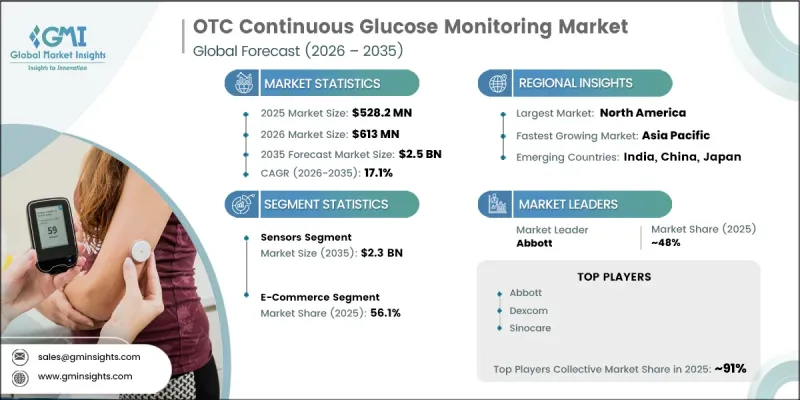
隨著消費者對便捷易用的代謝健康追蹤解決方案的需求日益成長,非處方(OTC)連續血糖監測(CGM)市場呈現強勁成長動能。 OTC CGM系統是一種穿戴式血糖監測設備,無需處方箋即可購買和使用,使連續血糖監測更加普及。雖然這些技術傳統上用於輔助糖尿病管理,但其應用範圍正在擴展到預防性健康監測,幫助人們了解並改善自身的代謝健康。預防性醫療保健實踐的日益普及以及意識提升,正在加速糖尿病患者、糖尿病前期患者和注重健康的人群對OTC CGM的接受度。感測器精度的提高、裝置體積的縮小、使用壽命的延長以及與智慧型手機和穿戴式平台的整合等技術進步,進一步提升了使用者體驗。這些進步使OTC CGM設備更加實用便捷,使其更容易被更廣泛的消費者群體所接受,並推動了預測期內的市場擴張。
| 市場範圍 | |
|---|---|
| 開始年份 | 2025 |
| 預測期 | 2026-2035 |
| 上市時的市場規模 | 5.282億美元 |
| 預測金額 | 25億美元 |
| 複合年成長率 | 17.1% |
到2025年,感測器產業將佔據91%的市場佔有率。這一主導地位得益於消費者對小型化、穿戴式且易於使用的健康監測解決方案日益成長的需求。隨著消費者將持續、非侵入性的健康追蹤放在首位,先進的感測器技術已成為非處方(OTC)連續血糖監測(CGM)系統的核心組件。輕盈舒適、盡可能減少對日常生活干擾的監測設備越來越偏好,這進一步推動了感測器在血糖值管理者和預防保健使用者中的普及。
到2025年,糖尿病前期患者和糖尿病高風險族群將佔總人口的相當大比例。全球糖尿病前期和葡萄糖代謝紊亂病例的增加是推動這群成長的主要因素。隨著人們對生活方式相關健康風險的日益關注,消費者擴大採用早期監測解決方案來追蹤血糖值,從而做出更健康的決策。預防醫學、早期療育和個人化健康管理的日益普及,進一步增強了糖尿病高風險族群對非處方動態血糖監測設備的需求。
到2025年,北美非處方(OTC)連續血糖監測市場將佔據53.9%的市場。美國尤其成為OTC連續血糖監測(CGM)設備的主要市場,這主要得益於消費者對預防醫學、代謝追蹤和個人化健康解決方案日益成長的興趣。非糖尿病使用者(包括那些注重健身和積極健康管理的人)使用量的增加,推動了CGM市場向更廣泛領域的拓展,使其從傳統的醫療監測工具轉變為更注重生活方式的健康設備。
目錄
第1章:調查方法
第2章執行摘要
第3章 行業洞察
- 產業生態系分析
- 影響產業的因素
- 促進因素
- 消費者對代謝健康和保健的興趣日益濃厚
- 拓展直接面對消費者(DTC)與訂閱模式
- 技術進步和人工智慧驅動的洞察力
- 預防醫學的改變與長壽趨勢
- 產業潛在風險與挑戰
- 高成本和有限的保險覆蓋範圍。
- 對法規和資料隱私的擔憂
- 市場機遇
- 與數位健康生態系統和穿戴式設備的整合
- 進入糖尿病和預防保健市場以外的其他市場。
- 促進因素
- 成長潛力分析
- 監理情勢
- 北美洲
- 歐洲
- 亞太地區
- 技術展望
- 最新科技趨勢
- 新興技術
- 價格趨勢分析
- 未來市場趨勢
- 波特的分析
- PESTLE分析
- 人工智慧和生成式人工智慧對市場的影響
- 價值鏈分析
- 投資與資金籌措分析
- 消費者洞察
- 非處方藥核准前後市場結構的變化
- 差距分析
第4章 競爭情勢
- 介紹
- 企業矩陣分析
- 企業市佔率分析
- 世界
- 北美洲
- 歐洲
- 亞太地區
- 競爭定位矩陣
- 主要市場公司的競爭分析
- 主要進展
- 併購
- 夥伴關係和聯盟
- 新產品發布
- 業務拓展計劃
第5章 市場估計與預測:依組件分類,2022-2035年
- 感應器
- 平台/應用
第6章 市場估計與預測:依消費者類型分類,2022-2035年
- 注重健康但沒有糖尿病的人士
- 糖尿病前期患者及高危險群
- 其他消費者類型
第7章 市場估價與預測:依通路分類,2022-2035年
- 醫院藥房
- 零售藥房
- 電子商務
第8章 市場估計與預測:依地區分類,2022-2035年
- 北美洲
- 美國
- 加拿大
- 歐洲
- 德國
- 英國
- 法國
- 西班牙
- 義大利
- 荷蘭
- 亞太地區
- 中國
- 日本
- 印度
- 澳洲
- 韓國
- 世界其他地區
第9章:公司簡介
- Abbott
- Dexcom
- January AI
- Levels Health
- Limbo(Vitals in View)
- Nutrisense
- Sinocare
- Supersapiens
- Ultrahuman Healthcare
- Veri
- Zoe
The Global OTC Continuous Glucose Monitoring Market was valued at USD 528.2 million in 2025 and is estimated to grow at a CAGR of 17.1% to reach USD 2.5 billion by 2035.
The OTC continuous glucose monitoring market is gaining strong traction as consumers increasingly seek convenient and accessible solutions for tracking metabolic health. OTC CGM systems are wearable glucose monitoring devices that can be purchased and used without a prescription, allowing broader access to continuous glucose tracking. While these technologies have traditionally supported diabetes management, their applications are expanding toward preventive health monitoring among individuals interested in understanding and improving their metabolic wellness. The growing acceptance of proactive healthcare practices, combined with rising consumer awareness, is accelerating adoption among diabetic, prediabetic, and health-focused populations. Technological improvements in sensor accuracy, device miniaturization, longer usage periods, and connectivity with smartphones and wearable platforms are further enhancing the user experience. These advancements are making OTC CGM devices more practical, convenient, and appealing for wider consumer adoption, supporting market expansion over the forecast period.
| Market Scope | |
|---|---|
| Start Year | 2025 |
| Forecast Year | 2026-2035 |
| Start Value | $528.2 Million |
| Forecast Value | $2.5 Billion |
| CAGR | 17.1% |
The sensors segment held 91% share in 2025. The leading position of sensors is supported by increasing demand for compact, wearable, and easy-to-use health monitoring solutions. As consumers prioritize continuous and non-invasive health tracking, advanced sensor technologies have become the central component of OTC CGM systems. Growing preference for lightweight, comfortable, and minimally disruptive monitoring devices is encouraging greater sensor adoption among both individuals managing glucose conditions and users focused on preventive health.
The prediabetic and at-risk individuals segment captured notable share in 2025. Rising cases of prediabetes and impaired glucose regulation worldwide are contributing significantly to the growth of this segment. Increasing concerns related to lifestyle-related health risks are encouraging consumers to adopt early monitoring solutions that help track glucose patterns and support better health decisions. The growing emphasis on preventive healthcare, early intervention, and personalized wellness management is further strengthening demand for OTC CGM devices among individuals with elevated diabetes risk.
North America OTC Continuous Glucose Monitoring Market held 53.9% share in 2025. The region, led by the U.S., represents a major market for OTC continuous glucose monitoring (CGM) devices due to increasing consumer interest in preventive healthcare, metabolic tracking, and personalized wellness solutions. Growing adoption among non-diabetic users, including individuals focused on fitness and proactive health management, is transforming CGMs from traditional medical monitoring tools into broader lifestyle-oriented health devices, thereby expanding the overall market opportunity.
Prominent players operating in the Global OTC continuous glucose monitoring industry include: Veri, Abbott, Levels Health, Dexcom, Zoe, January AI, Nutrisense, Sinocare, Ultrahuman Healthcare, Supersapiens, and Limbo (Vitals in View). Companies operating in the OTC continuous glucose monitoring market are strengthening their market position through product innovation, technology improvements, strategic partnerships, and expansion of consumer-focused health solutions. Leading participants are investing in advanced sensor technologies, improved data analytics platforms, and seamless digital integrations to enhance device performance and user engagement. Companies are also focusing on developing more affordable, accessible, and user-friendly CGM solutions to reach broader consumer groups. Expanding direct-to-consumer strategies, strengthening mobile health ecosystems, and improving personalized insights are becoming important approaches for gaining market share.
Table of Contents
Chapter 1 Research Methodology
- 1.1 Research approach
- 1.2 Quality commitments
- 1.2.1 GMI AI policy & data integrity commitment
- 1.2.1.1 Source consistency protocol
- 1.2.1 GMI AI policy & data integrity commitment
- 1.3 Research trail & confidence scoring
- 1.3.1 Research trail components
- 1.3.2 Scoring components
- 1.4 Data collection
- 1.4.1 Partial list of primary sources
- 1.5 Data mining sources
- 1.5.1 Paid sources
- 1.5.1.1 Sources, by region
- 1.5.1 Paid sources
- 1.6 Base estimates and calculations
- 1.6.1 Base year calculation for any one approach
- 1.7 Forecast model
- 1.7.1 Quantified market impact analysis
- 1.7.1.1 Mathematical impact of growth parameters on forecast
- 1.7.1 Quantified market impact analysis
- 1.8 Research transparency addendum
- 1.8.1 Source attribution framework
- 1.8.2 Quality assurance metrics
- 1.8.3 Our commitment to trust
Chapter 2 Executive Summary
- 2.1 Industry 360° synopsis
- 2.2 Key market trends
- 2.2.1 Regional trends
- 2.2.2 Component trends
- 2.2.3 Consumer type trends
- 2.2.4 Distribution channel trends
- 2.3 CXO perspectives: Strategic imperatives
Chapter 3 Industry Insights
- 3.1 Industry ecosystem analysis
- 3.2 Industry impact forces
- 3.2.1 Growth drivers
- 3.2.1.1 Rising consumer interest in metabolic health and wellness
- 3.2.1.2 Expansion of direct-to-consumer (DTC) and subscription models
- 3.2.1.3 Technological advancements and AI-powered insights
- 3.2.1.4 Shifts in preventive healthcare and longevity trends
- 3.2.2 Industry pitfalls and challenges
- 3.2.2.1 High costs and limited insurance coverage
- 3.2.2.2 Regulatory and data privacy concerns
- 3.2.3 Market opportunities
- 3.2.3.1 Integration with digital health ecosystems and wearable devices
- 3.2.3.2 Expansion into non-diabetic and preventive care markets
- 3.2.1 Growth drivers
- 3.3 Growth potential analysis
- 3.4 Regulatory landscape (Driven by primary research)
- 3.4.1 North America
- 3.4.2 Europe
- 3.4.3 Asia Pacific
- 3.5 Technology landscape
- 3.5.1 Current technological trends
- 3.5.2 Emerging technologies
- 3.6 Pricing trend analysis (Driven by primary research)
- 3.7 Future market trends
- 3.8 Porter's analysis
- 3.9 PESTEL analysis
- 3.10 Impact of AI and Generative AI on the market (Driven by primary research)
- 3.11 Value chain analysis (Driven by primary research)
- 3.12 Investment & funding analysis (Driven by primary research)
- 3.13 Consumer insights (Driven by primary research)
- 3.14 Pre- vs. Post-OTC clearance market structure shift
- 3.15 Gap analysis
Chapter 4 Competitive Landscape, 2025
- 4.1 Introduction
- 4.2 Company matrix analysis
- 4.3 Company market share analysis (Driven by primary research)
- 4.3.1 Global
- 4.3.2 North America
- 4.3.3 Europe
- 4.3.4 Asia Pacific
- 4.4 Competitive positioning matrix
- 4.5 Competitive analysis of major market players
- 4.6 Key developments
- 4.6.1 Mergers & acquisitions
- 4.6.2 Partnerships & collaborations
- 4.6.3 New product launches
- 4.6.4 Expansion plans
Chapter 5 Market Estimates and Forecast, By Component, 2022 - 2035 ($ Mn)
- 5.1 Key trends
- 5.2 Sensors
- 5.3 Platforms/Apps
Chapter 6 Market Estimates and Forecast, By Consumer Type, 2022 - 2035 ($ Mn)
- 6.1 Key trends
- 6.2 Non-diabetic health enthusiasts
- 6.3 Pre-diabetic and at-risk individuals
- 6.4 Other consumer types
Chapter 7 Market Estimates and Forecast, By Distribution Channel, 2022 - 2035 ($ Mn)
- 7.1 Key trends
- 7.2 Hospital pharmacies
- 7.3 Retail pharmacies
- 7.4 E-commerce
Chapter 8 Market Estimates and Forecast, By Region, 2022 - 2035 ($ Mn)
- 8.1 Key trends
- 8.2 North America
- 8.2.1 U.S.
- 8.2.2 Canada
- 8.3 Europe
- 8.3.1 Germany
- 8.3.2 UK
- 8.3.3 France
- 8.3.4 Spain
- 8.3.5 Italy
- 8.3.6 Netherlands
- 8.4 Asia Pacific
- 8.4.1 China
- 8.4.2 Japan
- 8.4.3 India
- 8.4.4 Australia
- 8.4.5 South Korea
- 8.5 Rest of World
Chapter 9 Company Profiles
- 9.1 Abbott
- 9.2 Dexcom
- 9.3 January AI
- 9.4 Levels Health
- 9.5 Limbo (Vitals in View)
- 9.6 Nutrisense
- 9.7 Sinocare
- 9.8 Supersapiens
- 9.9 Ultrahuman Healthcare
- 9.10 Veri
- 9.11 Zoe

 2026-2030年全球連續血糖監測(CGM)市場
 連續血糖監測系統市場:按組件、設備類型、使用時長、患者年齡層、應用、分銷管道和最終用戶分類-2026-2032年全球市場預測
 連續血糖監測市場商機、成長要素、產業趨勢分析及2026-2035年預測。
 連續血糖監測系統市場規模、佔有率、趨勢和預測:按組件、人口統計、最終用戶和地區分類,2026-2034 年
 連續血糖監測設備市場:按組件、最終用戶和地區分類
 連續血糖監測設備市場規模、佔有率和趨勢分析報告:按產品、連接方式、適應症、分銷管道、地區和細分市場預測(2026-2033 年)
 全球連續血糖監測儀市場規模、佔有率、趨勢和成長分析報告(2026-2034年)
 2026年全球即時血糖值監測(CGM)貼片市場報告2026年全球連續血糖值監測市場報告2026年全球連續血糖值監測系統市場報告