


 |
市場調查報告書
商品編碼
2101955
地源熱泵市場機會、成長要素、產業趨勢分析及2026-2035年預測。Geothermal Heat Pump Market Opportunity, Growth Drivers, Industry Trend Analysis, and Forecast 2026 - 2035 |
||||||

全球地源熱泵市場預計到 2025 年將達到 39 億美元,年複合成長率為 4.4%,到 2035 年將達到 60 億美元。
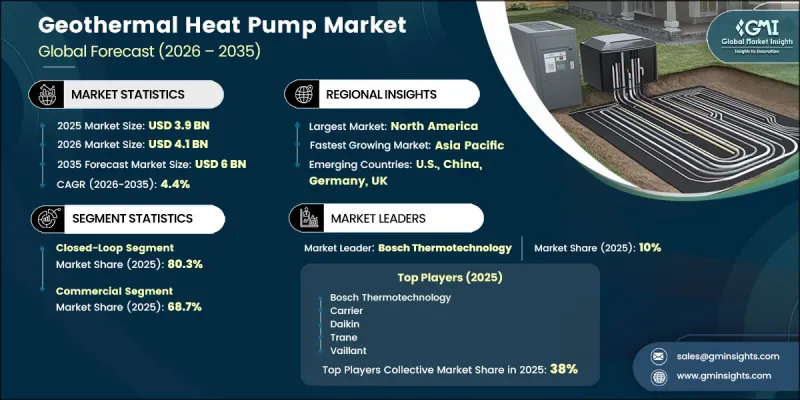
得益於建築脫碳力度加大、對節能型暖通空調技術的需求不斷成長以及對可再生供熱解決方案的政策支持力度加大,地源熱泵行業正從中受益。鑽孔技術的進步、熱水泥漿材料的改進以及變速壓縮機技術的進步,提高了系統效率,並降低了成本門檻,使其優於傳統的暖通空調系統。尤其值得一提的是,由於傳統燃料供應鏈的波動,人們對能源安全的日益擔憂正推動各國政府、企業和機構加大對低碳供熱技術的投資。地源熱泵因其電力消耗量%,且運作中不產生直接燃燒排放,從而符合溫室氣體會計系統(GHG Protocol)和ISO 14064等永續性目標和排放報告框架的要求,正變得越來越受歡迎。隨著公共和私營部門在應對氣候變遷方面加大力度,預計全球對地源熱泵系統的需求將進一步成長。
| 市場範圍 | |
|---|---|
| 開始年份 | 2025 |
| 預測期 | 2026-2035 |
| 初始市場規模 | 39億美元 |
| 預測金額 | 60億美元 |
| 複合年成長率 | 4.4% |
預計到2025年,閉合迴路系統市佔率將達到80.3%,並在2035年之前以4.3%的複合年成長率成長。這些系統能夠在各種地質條件下高效運作,無論地下水是否存在,其高度柔軟性的安裝方式也鞏固了其市場主導地位。此外,在許多地區,與開放回路系統相比,封閉回路型源熱泵的設計更具優勢,可應對更少的監管挑戰。垂直鑽孔系統廣泛應用於商業設施和高密度住宅項目,在典型的鑽孔深度下,可將地下溫度維持在約8-12 度C的恆定水平,從而在季節變化中提供穩定的熱性能。
預計到2025年,商業用途領域將佔據68.7%的市場佔有率,並將在2035年之前以4.2%的複合年成長率成長。大規模辦公大樓、醫療機構、飯店、教育機構和資料中心等商業設施非常適合安裝地源熱泵,因為這些設施的供暖和製冷需求穩定。這些設施可預測的能源需求趨勢有助於提高長期營運效率並節省成本。此外,美國所得稅法典(IRC)第48條規定的商業投資稅額扣抵允許無限制地扣除安裝系統總成本的30%,這使得地源熱泵項目相比於替換傳統供暖和製冷系統更具經濟吸引力。
預計到2025年,北美地源熱泵市佔率將達到55.9%,並在2035年之前以3.3%的複合年成長率成長。這一區域成長不僅反映了地源熱泵安裝的成熟經驗,也得益於永續性措施和政府獎勵推動的維修活動增加。美國是最大的國內市場,擁有全球最大的地源熱泵系統安裝記錄,約有127萬戶住宅和2.73萬棟商業建築安裝了該系統。美國34個州和華盛頓特區的獎勵計畫持續推動市場發展,其中包括聯邦所得稅法典(IRC)第25D條和第48條規定的聯邦激勵措施,以及各州的退稅、津貼和房產稅減免。這些財政機制提高了投資報酬率,並促進了地源熱泵在住宅和商業領域的更廣泛應用。
目錄
第1章:調查方法和範圍
第2章執行摘要
第3章 行業洞察
- 產業生態系分析
- 原物料供應及採購分析
- 影響價值鏈的因素
- 中斷
- 監理情勢
- 北美洲
- 歐洲
- 亞太地區
- 中東和非洲
- 拉丁美洲
- 影響產業的因素
- 促進因素
- 對節能建築解決方案的需求日益成長
- 政府支持措施和脫碳政策
- 人們越來越關注永續的供暖和製冷替代方案。
- 地熱系統技術的進步
- 產業潛在風險與挑戰
- 熟練專業人員短缺
- 地質和土地限制,以及經濟解決方案的可行性。
- 促進因素
- 成長潛力分析
- 技術與創新展望
- 最新科技趨勢
- 波特的分析
- PESTLE分析
- 熱泵成本結構分析
- 價格趨勢分析,2022-2035年
- 依產品
- 按地區
- 人工智慧和生成式人工智慧對市場的影響
- 利用人工智慧改造現有經營模式
- 按細分市場分類的生成式人工智慧用例和部署藍圖
- 風險、限制和監管考量
- 新機會和趨勢
- 數位化和物聯網整合
- 投資分析及未來展望
第4章 競爭情勢
- 介紹
- 企業市佔率分析:按地區分類
- 北美洲
- 歐洲
- 亞太地區
- 中東和非洲
- 拉丁美洲
- 主要市場公司的競爭分析
- 競爭定位矩陣
- 主要進展
- 併購
- 夥伴關係和聯盟
- 新產品發布
- 業務拓展計劃及資金籌措
- 按公司規模進行基準測試
- 排名分類標準與遴選標準
- 按銷售額、地區和創新能力分類的層級定位矩陣。
第5章 市場規模及預測:依產品分類,2022-2035年
- 開放回路
- 閉合迴路
- 垂直
- 橫版
- 池塘環路
第6章 市場規模及預測:依技術分類,2022-2035年
- 住宅
- 商業
- 衛生保健
- 零售
- 物流/運輸
- 辦公室
- 飯店業
- 其他
第7章 市場規模及預測:依地區分類,2022-2035年
- 北美洲
- 美國
- 加拿大
- 歐洲
- 德國
- 英國
- 法國
- 義大利
- 瑞典
- 亞太地區
- 中國
- 日本
- 澳洲
- 韓國
- 中東和非洲
- 沙烏地阿拉伯
- 土耳其
- 南非
- 拉丁美洲
- 巴西
- 墨西哥
- 阿根廷
第8章:公司簡介
- AAON
- AIREDALE INTERNATIONAL AIR CONDITIONING
- Bard HVAC
- Bosch Thermotechnology
- Carrier
- CHOFU SEISAKUSHO
- Daikin
- De Dietrich
- Finn Geotherm
- Kensa Heat Pumps
- Nibe Energy Systems
- Nordic Heat Pumps
- Guangzhou SPRSUN New Energy Technology Development
- Ochsner
- Stiebel Eltron
- Trane
- Vaillant
- Viessmann
- Waterfurnace International
- Wolf
The Global Geothermal Heat Pump Market was valued at USD 3.9 billion in 2025 and is estimated to grow at a CAGR of 4.4% to reach USD 6 billion by 2035.
The industry is benefiting from increasing efforts toward building decarbonization, rising demand for energy-efficient HVAC technologies, and stronger policy support for renewable thermal solutions. Advancements in drilling methods, improved thermal grouting materials, and variable-speed compressor technologies have enhanced system efficiency while reducing cost barriers compared with traditional HVAC alternatives. Growing concerns around energy security, particularly due to volatility in conventional fuel supply chains, are encouraging governments, businesses, and institutions to invest in low-carbon heating technologies. Geothermal heat pumps are gaining preference because they use 25-50% less electricity than conventional HVAC systems and produce no direct combustion emissions during operation, supporting sustainability goals and emissions reporting frameworks such as the GHG Protocol and ISO 14064. Increasing climate commitments across public and private sectors are expected to further strengthen demand for geothermal heat pump systems worldwide.
| Market Scope | |
|---|---|
| Start Year | 2025 |
| Forecast Year | 2026-2035 |
| Start Value | $3.9 Billion |
| Forecast Value | $6 Billion |
| CAGR | 4.4% |
The closed-loop systems segment held 80.3% share in 2025 and is projected to grow at a CAGR of 4.3% through 2035. Their market leadership is supported by broad installation flexibility, as these systems can operate effectively across diverse ground conditions without depending on groundwater availability. Closed-loop geothermal heat pump designs also benefit from fewer regulatory challenges compared with open-loop alternatives in many regions. Vertical borehole systems, which are widely used in commercial facilities and high-density residential projects, provide stable thermal performance throughout seasonal changes because underground temperatures generally remain consistent at 8-12°C at typical drilling depths.
The commercial application segment captured 68.7% share in 2025 and is expected to grow at a CAGR of 4.2% through 2035. Commercial properties such as large office buildings, healthcare facilities, hotels, educational institutions, and data centers generate steady heating and cooling requirements, making them well suited for geothermal heat pump adoption. The predictable energy demand profile of these facilities supports long-term operational efficiency and cost savings. Additionally, the commercial investment tax credit under IRC Section 48 offers a 30% credit on the overall installed system cost without a maximum limit, improving the financial attractiveness of geothermal heat pump projects compared with conventional heating and cooling system replacements.
North America Geothermal Heat Pump Market accounted for 55.9% share in 2025 and is projected to grow at a CAGR of 3.3% through 2035. The region's growth reflects its established geothermal heat pump installation base, combined with increasing retrofit activities supported by sustainability initiatives and government incentives. The U.S. represents the largest national market, with approximately 1.27 million homes and 27,300 commercial buildings using geothermal heat pump systems, creating the largest installed base globally. Incentive programs across 34 U.S. states and Washington D.C. continue to support market development, with federal benefits under IRC Sections 25D and 48 complemented by state-level rebates, grants, and property tax incentives. These financial mechanisms are improving investment returns and encouraging wider adoption across both residential and commercial applications.
Major players operating in the global geothermal heat pump industry are Bosch Thermotechnology, Vaillant, Trane, Nibe Energy Systems, Daikin, and Carrier. Companies operating in the geothermal heat pump market are focusing on strategies such as product innovation, strategic partnerships, regional expansion, and improvements in system efficiency to strengthen their market position. Manufacturers are investing in advanced compressor technologies, smart controls, and integrated energy management solutions to improve performance and meet evolving consumer expectations. Businesses are also expanding their distribution networks and collaborating with construction firms, energy providers, and government programs to increase market penetration. Sustainability-focused product development, compliance with energy efficiency standards, and customized solutions for residential and commercial projects are helping companies differentiate their offerings.
Table of Contents
Chapter 1 Methodology & Scope
- 1.1 Research approach
- 1.2 Quality commitments
- 1.2.1 GMI AI policy & data integrity commitment
- 1.2.1.1 Source consistency protocol
- 1.2.1 GMI AI policy & data integrity commitment
- 1.3 Research trail & confidence scoring
- 1.3.1 Research trail components
- 1.3.2 Scoring components
- 1.4 Data collection
- 1.4.1 Partial list of primary sources
- 1.5 Data mining sources
- 1.5.1 Paid sources
- 1.5.1.1 Sources, by region
- 1.5.1 Paid sources
- 1.6 Base estimates and calculations
- 1.6.1 Base year calculation for any one approach
- 1.7 Market estimates & forecasts parameters
- 1.8 Forecast model
- 1.8.1 Quantified market impact analysis
- 1.8.1.1 Mathematical impact of growth parameters on forecast
- 1.8.1 Quantified market impact analysis
- 1.9 Research transparency addendum
- 1.9.1 Source attribution framework
- 1.9.2 Quality assurance metrics
- 1.9.3 Our commitment to trust
- 1.10 Market definitions
Chapter 2 Executive Summary
- 2.1 Industry synopsis, 2022 - 2035
- 2.1.1 Business trends
- 2.1.2 Product trends
- 2.1.3 Application trends
- 2.1.4 Regional trends
Chapter 3 Industry Insights
- 3.1 Industry ecosystem analysis
- 3.1.1 Raw material availability & sourcing analysis
- 3.1.2 Factors affecting the value chain
- 3.1.3 Disruptions
- 3.2 Regulatory landscape
- 3.2.1 North America
- 3.2.2 Europe
- 3.2.3 Asia Pacific
- 3.2.4 Middle East & Africa
- 3.2.5 Latin America
- 3.3 Industry impact forces
- 3.3.1 Growth drivers
- 3.3.1.1 Rising demand for energy-efficient building solutions
- 3.3.1.2 Supportive government incentives and decarbonization policies
- 3.3.1.3 Increasing focus on sustainable heating and cooling alternatives
- 3.3.1.4 Advancements in geothermal system technologies
- 3.3.2 Industry pitfalls and challenges
- 3.3.2.1 Limited availability of skilled professionals
- 3.3.2.2 Geological and land constraints coupled with availability of economical solutions
- 3.3.1 Growth drivers
- 3.4 Growth potential analysis
- 3.5 Technology and innovation landscape
- 3.5.1 Current technological trends
- 3.6 Porter's analysis
- 3.6.1 Bargaining power of suppliers
- 3.6.2 Bargaining power of buyers
- 3.6.3 Threat of new entrants
- 3.6.4 Threat of substitute
- 3.6.5 Intensity of competitive rivalry
- 3.7 PESTEL analysis
- 3.7.1 Political factors
- 3.7.2 Economic factors
- 3.7.3 Social factors
- 3.7.4 Technological factors
- 3.7.5 Environmental factors
- 3.7.6 Legal factors
- 3.8 Cost structure analysis of heat pump (Driven by Primary Research)
- 3.9 Price trend analysis, 2022-2035 (USD/Unit) (Driven by Primary Research)
- 3.9.1 By product
- 3.9.2 By region
- 3.10 Impact of AI and generative AI on the market (Driven by primary research)
- 3.10.1 AI-driven disruption of existing business models
- 3.10.2 GenAI use cases & adoption roadmap by segment
- 3.10.3 Risks, limitations & regulatory considerations
- 3.11 Emerging opportunities & trends
- 3.12 Digitalization and IoT integration
- 3.13 Investment analysis & future outlook
Chapter 4 Competitive Landscape, 2026
- 4.1 Introduction
- 4.2 Company market share analysis, by region, 2025
- 4.2.1 North America
- 4.2.2 Europe
- 4.2.3 Asia Pacific
- 4.2.4 Middle East & Africa
- 4.2.5 Latin America
- 4.3 Competitive analysis of major market players
- 4.4 Competitive positioning matrix
- 4.5 Key developments
- 4.5.1 Mergers & acquisitions
- 4.5.2 Partnerships & collaborations
- 4.5.3 New product launches
- 4.5.4 Expansion plans and funding
- 4.6 Company tier benchmarking
- 4.6.1 Tier classification criteria & qualifying thresholds
- 4.6.2 Tier positioning matrix by revenue, geography & innovation
Chapter 5 Market Size and Forecast, By Product, 2022 - 2035 (USD Million, '000 Units)
- 5.1 Key trends
- 5.2 Open loop
- 5.3 Closed loop
- 5.3.1 Vertical
- 5.3.2 Horizontal
- 5.4 Pond loop
Chapter 6 Market Size and Forecast, By Technology, 2022 - 2035 (USD Million, '000 Units)
- 6.1 Key trends
- 6.2 Residential
- 6.3 Commercial
- 6.3.1 Healthcare
- 6.3.2 Retail
- 6.3.3 Logistics & transportation
- 6.3.4 Offices
- 6.3.5 Hospitality
- 6.3.6 Others
Chapter 7 Market Size and Forecast, By Region, 2022 - 2035 (USD Million, '000 Units)
- 7.1 Key trends
- 7.2 North America
- 7.2.1 U.S.
- 7.2.2 Canada
- 7.3 Europe
- 7.3.1 Germany
- 7.3.2 UK
- 7.3.3 France
- 7.3.4 Italy
- 7.3.5 Sweden
- 7.4 Asia Pacific
- 7.4.1 China
- 7.4.2 Japan
- 7.4.3 Australia
- 7.4.4 South Korea
- 7.5 Middle East & Africa
- 7.5.1 Saudi Arabia
- 7.5.2 Turkey
- 7.5.3 South Africa
- 7.6 Latin America
- 7.6.1 Brazil
- 7.6.2 Mexico
- 7.6.3 Argentina
Chapter 8 Company Profiles
- 8.1 AAON
- 8.2 AIREDALE INTERNATIONAL AIR CONDITIONING
- 8.3 Bard HVAC
- 8.4 Bosch Thermotechnology
- 8.5 Carrier
- 8.6 CHOFU SEISAKUSHO
- 8.7 Daikin
- 8.8 De Dietrich
- 8.9 Finn Geotherm
- 8.10 Kensa Heat Pumps
- 8.11 Nibe Energy Systems
- 8.12 Nordic Heat Pumps
- 8.13 Guangzhou SPRSUN New Energy Technology Development
- 8.14 Ochsner
- 8.15 Stiebel Eltron
- 8.16 Trane
- 8.17 Vaillant
- 8.18 Viessmann
- 8.19 Waterfurnace International
- 8.20 Wolf


