


 |
市場調查報告書
商品編碼
2101954
農業無人機市場機會、成長要素、產業趨勢分析及2026-2035年預測。Agricultural Drone Market Opportunity, Growth Drivers, Industry Trend Analysis, and Forecast 2026 - 2035 |
||||||

全球農業無人機市場預計到 2025 年將達到 37 億美元,年複合成長率為 10.2%,到 2035 年將達到 97 億美元。
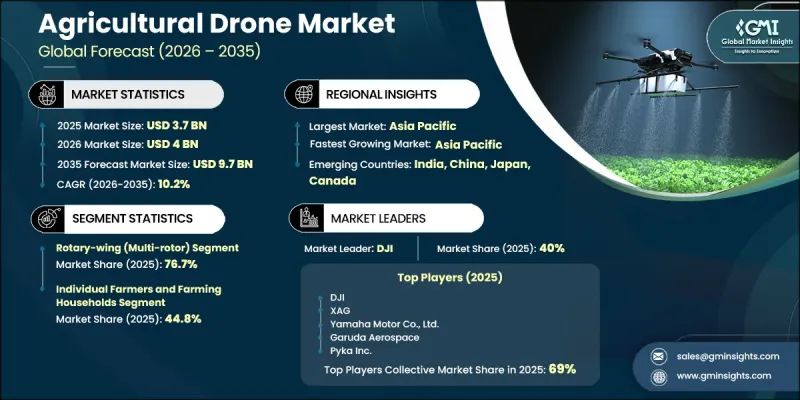
精密農業技術的廣泛應用、無人機硬體價格的持續下降以及人工智慧驅動的農業分析平台的快速發展,共同推動了無人機市場的擴張。隨著人工耕作逐漸被基於無人機的自主系統所取代,農業生產正在發生重大變革,這些系統提高了生產力並減少了對勞動力的依賴。同時,商業農業企業和農業服務供應商越來越願意接受更高的初始技術投資,以換取產量最佳化、投入效率和營運擴充性方面的可衡量收益。法律規範正在多個地區逐步標準化,提高了商用無人機使用的透明度,並促進了整個生態系統的長期投資。無人機應用帶來的單位經濟效益的提升也加速了其普及,因為更低的設備成本和更高的營運效率已將投資回收期縮短至某些高價值作物領域不到三個種植季。另一個結構性變化是基於服務的無人機應用模式的出現,營運商按英畝提供無人機服務。這減輕了農民的資本負擔,加速了中小農業生產者對無人機的採用。
| 市場範圍 | |
|---|---|
| 開始年份 | 2025 |
| 預測期 | 2026-2035 |
| 初始市場規模 | 37億美元 |
| 預測金額 | 97億美元 |
| 複合年成長率 | 10.2% |
到2025年,旋翼無人機市佔率將達到76.7%。這反映出市場對多旋翼無人機系統在噴灑、測繪和監測等領域的強勁需求,這些應用需要穩定的懸停能力、垂直起降能力以及高度靈活的有效載荷配置。這些系統涵蓋了從用於小規模農場作業的緊湊型多旋翼平台到專大規模商業農田噴灑而設計的先進高容量機型,為包括穀物和油籽在內的主要作物生產系統提供支援。
2025年,自農戶和農戶群體將佔據44.8%的市場佔有率,成為最大的終端用戶群。這一主導地位得益於人們對精密農業益處的日益關注,例如更有效地監測作物健康狀況、更有效率地施用農藥以及更準確地預測產量。已開發經濟體和新興農業經濟體的農民正逐步將無人機技術融入日常農場管理實踐中,以提高生產力並減少投入浪費。
預計到2025年,北美農業無人機市佔率將達到27.7%,主要得益於北美主要農業區廣泛的商業農業基礎。該地區的法律規範由一套系統化的運營框架構成,該框架規範了商用無人機的使用;此外,簡化的許可製度也提高了無人機在管制空域內進行農業應用的便利性,從而促進了大規模農業作業中無人機的廣泛應用。
目錄
第1章:調查方法和範圍
第2章執行摘要
第3章 行業洞察
- 產業生態系分析
- 影響產業的因素
- 促進因素
- 精密農業的應用越來越廣泛。
- 政府對無人機的支持和有利的法規
- 人手不足加劇和對農業自動化的需求不斷成長
- 無人機、人工智慧和感測器技術的進步
- 產業潛在風險與挑戰
- 高昂的初始成本和維修成本
- 監理限制和遵守空域法規
- 市場機遇
- 無人機即服務 (DaaS)經營模式的擴展
- 新興農業經濟體的採用率擴大
- 促進因素
- 成長潛力分析
- 監理情勢
- 技術展望
- 最新科技趨勢
- 新興技術
- 價格趨勢分析
- 未來市場趨勢
- 專利分析
- 波特的分析
- PESTLE分析
- 人工智慧和生成式人工智慧對市場的影響
- 價值鏈分析
- 投資與資金籌措分析
- 消費者洞察
第4章 競爭情勢
- 介紹
- 企業市佔率分析:按地區分類
- 北美洲
- 歐洲
- 亞太地區
- 中東和非洲
- 拉丁美洲
- 主要進展
- 重要合作夥伴關係和合作
- 併購主要趨勢
- 產品創新和新產品發布
- 市場擴大策略
- 競爭定位矩陣
第5章 市場規模及預測:依類型分類,2022-2035年
- 旋轉葉片(多旋翼)
- 固定翼飛機
- 混合
第6章 市場規模及預測:依組件分類,2022-2035年
- 硬體
- 軟體和服務
第7章 市場規模及預測:依應用領域分類,2022-2035年
- 噴灑殺蟲劑
- 作物監測和健康評估
- 實地調查和土壤分析
- 灌溉管理
- 牲畜監測
- 種植/播種
- 其他
第8章 市場規模與預測:依最終用戶分類,2022-2035年
- 農業服務供應商
- 個體農戶與農業家庭
- 政府機構
- 研究機構和大學
- 其他
第9章 市場規模及預測:依地區分類,2022-2035年
- 北美洲
- 美國
- 加拿大
- 歐洲
- 德國
- 法國
- 英國
- 荷蘭
- 西班牙
- 義大利
- 亞太地區
- 中國
- 日本
- 韓國
- 印度
- 澳洲
- 中東和非洲
- 沙烏地阿拉伯
- UAE
- 南非
- 拉丁美洲
- 巴西
- 阿根廷
- 墨西哥
第10章:公司簡介
- DJI
- XAG Co., Ltd
- Yamaha Motor Co., Ltd.
- EagleNXT
- Kray Technologies
- EAVISION
- Hylio Inc.
- Rantizo
- Pyka Inc.
- Garuda Aerospace
- Marut Drones
- AgTecher
- SKYX AEROSPACE PVT. LTD
- General Aeronautics Pvt. Ltd.
- OPTRON(Pty)Ltd
The Global Agricultural Drone Market was valued at USD 3.7 billion in 2025 and is estimated to grow at a CAGR of 10.2% to reach USD 9.7 billion by 2035.
Expansion in this market is driven by the widespread adoption of precision agriculture practices, continuous reductions in drone hardware pricing, and rapid advancement of AI-enabled agricultural analytics platforms. A major transformation is underway as manual agricultural operations are increasingly substituted with autonomous drone-based systems that improve productivity and reduce labor dependency. At the same time, commercial farming enterprises and agricultural service providers are increasingly accepting higher initial technology investment in return for measurable gains in yield optimization, input efficiency, and operational scalability. Regulatory frameworks across multiple regions are gradually becoming more standardized, improving clarity for commercial drone usage and encouraging long-term investment across the ecosystem. The improving unit economics of drone adoption are also accelerating penetration, as declining equipment costs and improved operational efficiencies shorten return-on-investment cycles to fewer than three growing seasons in several high-value crop segments. A further structural shift is the rise of service-based deployment models where operators provide drone services on a per-acre basis, reducing capital burden for farmers and enabling faster adoption among small and mid-sized agricultural producers.
| Market Scope | |
|---|---|
| Start Year | 2025 |
| Forecast Year | 2026-2035 |
| Start Value | $3.7 Billion |
| Forecast Value | $9.7 Billion |
| CAGR | 10.2% |
The rotary-wing drone segment held a 76.7% share in 2025, reflecting strong demand for multi-rotor systems in spraying, mapping, and monitoring applications that require stable hovering, vertical takeoff capability, and adaptable payload configurations. These systems range from compact multi-rotor platforms used for small-field operations to advanced high-capacity models designed for large-scale commercial spraying across extensive farmland areas, supporting applications in major crop production systems including grains and oilseeds.
The individual farmers and farming households segment accounted for 44.8% share in 2025, making it the largest end-user category. This dominance is driven by increasing awareness of precision farming benefits, including improved crop health monitoring, efficient pesticide application, and enhanced yield forecasting. Farmers across both developed and emerging agricultural economies are progressively integrating drone technologies into routine farm management practices to improve productivity and reduce input wastage.
North America Agricultural Drone Market captured 27.7% share in 2025 owing to its extensive commercial farming base across key agricultural regions. Regulatory oversight in the region is shaped by structured operational frameworks that govern commercial drone usage, while streamlined authorization systems have improved accessibility for agricultural applications in controlled airspace zones, supporting broader adoption across large-scale farming operations.
Major companies operating in the global agricultural drone industry include DJI, XAG Co., Ltd., Yamaha Motor Co., Ltd., EagleNXT, Kray Technologies, EAVISION, Hylio Inc., Rantizo, Pyka Inc., Garuda Aerospace, Marut Drones, AgTecher, SKYX Aerospace Pvt. Ltd., General Aeronautics Pvt. Ltd., and OPTRON (Pty) Ltd. The key strategies adopted by companies in the agricultural drone market focus on improving autonomous flight capabilities and AI-powered analytics to enhance precision farming outcomes. Firms are investing in expanding drone-as-a-service models that lower entry barriers for farmers by shifting from ownership to subscription-based usage. Strategic partnerships with agritech firms and farming cooperatives are strengthening distribution and on-field adoption. Companies are also developing multi-functional drones capable of spraying, imaging, and mapping within a single platform to improve operational efficiency.
Table of Contents
Chapter 1 Methodology & Scope
- 1.1 Research approach
- 1.2 Quality commitments
- 1.2.1 GMI AI policy & data integrity commitment
- 1.2.1.1 Source consistency protocol
- 1.2.1 GMI AI policy & data integrity commitment
- 1.3 Research trail & confidence scoring
- 1.3.1 Research trail components
- 1.3.2 Scoring components
- 1.4 Data collection
- 1.4.1 Partial list of primary sources
- 1.5 Data mining sources
- 1.5.1 Paid sources
- 1.5.1.1 Sources, by region
- 1.5.1 Paid sources
- 1.6 Base estimates and calculations
- 1.6.1 Base year calculation for any one approach
- 1.7 Market estimates & forecasts parameters
- 1.8 Forecast model
- 1.8.1 Quantified market impact analysis
- 1.8.1.1 Mathematical impact of growth parameters on forecast
- 1.8.1 Quantified market impact analysis
- 1.9 Research transparency addendum
- 1.9.1 Source attribution framework
- 1.9.2 Quality assurance metrics
- 1.9.3 Our commitment to trust
- 1.10 Market definitions
Chapter 2 Executive Summary
- 2.1 Industry synopsis, 2022 - 2035
- 2.1.1 Type trends
- 2.1.2 Component trends
- 2.1.3 End User trends
- 2.1.4 Application trends
- 2.1.5 Regional trends
Chapter 3 Industry Insights
- 3.1 Industry ecosystem analysis
- 3.2 Industry impact forces
- 3.2.1 Growth drivers
- 3.2.1.1 Increasing adoption of precision agriculture practices
- 3.2.1.2 Government support and favorable drone regulations
- 3.2.1.3 Growing labor shortages and demand for farm automation
- 3.2.1.4 Advancements in drone, AI, and sensor technologies
- 3.2.2 Industry pitfalls and challenges
- 3.2.2.1 High acquisition and maintenance costs
- 3.2.2.2 Regulatory restrictions and airspace compliance
- 3.2.3 Market opportunities
- 3.2.3.1 Expansion of Drone-as-a-Service (DaaS) business models
- 3.2.3.2 Growing adoption across emerging agricultural economies
- 3.2.1 Growth drivers
- 3.3 Growth potential analysis
- 3.4 Regulatory landscape (Driven by primary research)
- 3.4.1 North America
- 3.4.2 Europe
- 3.4.3 Asia Pacific
- 3.4.4 Latin America
- 3.4.5 MEA
- 3.5 Technology landscape
- 3.5.1 Current technological trends
- 3.5.2 Emerging technologies
- 3.6 Pricing trend analysis (Driven by primary research)
- 3.7 Future market trends
- 3.8 Patent analysis
- 3.9 Porter's analysis
- 3.10 PESTEL analysis
- 3.11 Impact of AI and Generative AI on the market (Driven by primary research)
- 3.12 Value chain analysis (Driven by primary research)
- 3.13 Investment & funding analysis (Driven by primary research)
- 3.14 Consumer insights (Driven by primary research)
Chapter 4 Competitive Landscape, 2025
- 4.1 Introduction
- 4.2 Company market share analysis, by region, 2025
- 4.2.1 North America
- 4.2.2 Europe
- 4.2.3 Asia Pacific
- 4.2.4 Middle East & Africa
- 4.2.5 Latin America
- 4.3 Key developments
- 4.3.1 Key partnerships & collaborations
- 4.3.2 Major M&A activities
- 4.3.3 Product innovations & launches
- 4.3.4 Market expansion strategies
- 4.4 Competitive positioning matrix
Chapter 5 Market Size and Forecast, By Type, 2022 - 2035 (USD Million)
- 5.1 Key trends
- 5.2 Rotary-Wing (Multi-rotor)
- 5.3 Fixed-Wing
- 5.4 Hybrid
Chapter 6 Market Size and Forecast, By Component , 2022 - 2035 (USD Million)
- 6.1 Key trends
- 6.2 Hardware
- 6.3 Software & Services
Chapter 7 Market Size and Forecast, By Application, 2022 - 2035 (USD Million)
- 7.1 Key trends
- 7.2 Crop Spraying
- 7.3 Crop Monitoring & Health Assessment
- 7.4 Field Mapping & Soil Analysis
- 7.5 Irrigation Management
- 7.6 Livestock Monitoring
- 7.7 Planting & Seeding
- 7.8 Others
Chapter 8 Market Size and Forecast, By End User, 2022 - 2035 (USD Million)
- 8.1 Agricultural Service Providers
- 8.2 Individual Farmers & Farming Households
- 8.3 Government Agencies
- 8.4 Research Institutions & Universities
- 8.5 Others
Chapter 9 Market Size and Forecast, By Region, 2022 - 2035 (USD Million)
- 9.1 Key trends
- 9.2 North America
- 9.2.1 U.S.
- 9.2.2 Canada
- 9.3 Europe
- 9.3.1 Germany
- 9.3.2 France
- 9.3.3 UK
- 9.3.4 Netherlands
- 9.3.5 Spain
- 9.3.6 Italy
- 9.4 Asia Pacific
- 9.4.1 China
- 9.4.2 Japan
- 9.4.3 South Korea
- 9.4.4 India
- 9.4.5 Australia
- 9.5 Middle East & Africa
- 9.5.1 Saudi Arabia
- 9.5.2 UAE
- 9.5.3 South Africa
- 9.6 Latin America
- 9.6.1 Brazil
- 9.6.2 Argentina
- 9.6.3 Mexico
Chapter 10 Company Profiles
- 10.1 DJI
- 10.2 XAG Co., Ltd
- 10.3 Yamaha Motor Co., Ltd.
- 10.4 EagleNXT
- 10.5 Kray Technologies
- 10.6 EAVISION
- 10.7 Hylio Inc.
- 10.8 Rantizo
- 10.9 Pyka Inc.
- 10.10 Garuda Aerospace
- 10.11 Marut Drones
- 10.12 AgTecher
- 10.13 SKYX AEROSPACE PVT. LTD
- 10.14 General Aeronautics Pvt. Ltd.
- 10.15 OPTRON (Pty) Ltd

 全球農業無人機市場規模、佔有率、趨勢和成長分析報告(2026-2034年)
 農業無人機市場規模、佔有率和成長分析:按類型、組件、應用、有效載荷能力、農業環境、最終用戶和地區分類-2026-2033年產業預測
 農業無人機市場:2026-2032年全球市場預測(按組件、平台類型、負載容量、通訊技術、飛行範圍、應用和最終用戶分類)
 農業無人機市場分析與預測(至2035年):類型、產品類型、服務、技術、組件、應用、流程、部署、最終用戶、解決方案
 農業無人機市場:按類型、組件、應用和地區分類
 2026年全球農業無人機市場報告無人機噴灑器市場:按平台、推進方式、技術、應用和最終用戶分類的全球市場預測 – 2026-2032 年農業無人機市場:按組件、無人機類型、技術、農場類型、負載容量、應用和銷售管道,全球預測,2026-2032年農業無人機市場:按類型、組件、無人機等級、應用和最終用戶分類,全球預測,2026-2032年農業無人機市場:按類型、有效載荷能力、應用和最終用戶分類,全球預測,2026-2032年