


 |
市場調查報告書
商品編碼
2101953
無人機電池市場機會、成長要素、產業趨勢分析及2026-2035年預測。Drone Battery Market Opportunity, Growth Drivers, Industry Trend Analysis, and Forecast 2026 - 2035 |
||||||

全球無人機電池市場預計到 2025 年將達到 53 億美元,到 2035 年將以 16.1% 的複合年成長率成長,達到 221 億美元。
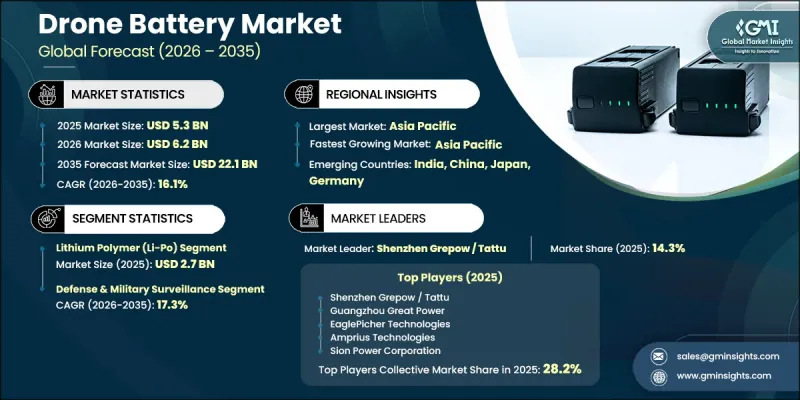
隨著無人機(UAV)在商業和政府運作中日益普及,並以更有效率的空中巡檢技術取代傳統的人工巡檢方式,無人機電池市場正蓬勃發展。對更長飛行時間、更高有效載荷效率和更強運行可靠性的需求不斷成長,是推動市場擴張的主要動力。此外,政府加大對無人機計畫的投入,以及法規結構的完善,也促進了商用無人機的廣泛應用,這些都為市場成長提供了支持。電池化學、能量密度和放電效率的持續改進,使得無人機能夠延長飛行時間,並增強任務能力。同時,顯著的成本節約和安全性的提升,正在加速各行業向基於無人機的營運模式轉型。商用無人機部署數量的不斷成長,也帶來了穩定的更換需求,從而增強了電池生態系統的持續獲利能力。隨著無人機應用在商業、工業和國防等領域的不斷多元化發展,預計在預測期內,對先進高性能儲能解決方案的需求將顯著成長。
| 市場範圍 | |
|---|---|
| 開始年份 | 2025 |
| 預測期 | 2026-2035 |
| 初始市場規模 | 53億美元 |
| 預測金額 | 221億美元 |
| 複合年成長率 | 16.1% |
鋰聚合物(Li-Po)電池市場銷售額達27億美元,佔市場佔有率的51.1%,預計到2035年將以14.6%的複合年成長率成長。該細分市場憑藉其高能量密度、輕量化和靈活的形狀特性(支援緊湊型無人機設計)持續引領市場。完善的生產體系和廣泛的供應進一步鞏固了其在全球無人機電池供應鏈中的領先地位。對於尋求在商用無人機應用中兼顧性能、效率和成本績效的製造商而言,鋰聚合物電池仍然是最佳選擇。
預計到2025年,國防與軍事監視領域市場規模將達到11億美元(市佔率為21.7%),並在2035年之前以17.3%的複合年成長率成長。該領域持續擴張的原因在於,情報收集、監視、偵察和關鍵任務行動對無人駕駛航空器系統( UAV)的依賴日益增強。該領域對電池的要求強調高可靠性、長壽命以及在嚴苛條件下的穩定性能,因此與商業應用相比,對高附加價值產品的需求更高。全球範圍內不斷擴大的國防現代化項目也進一步增加了對先進無人機電池技術的需求。
預計到2025年,北美無人機電池市場規模將達到15億美元,市佔率為28.4%,並將在2035年之前以14.4%的複合年成長率成長。該地區的成長主要得益於商用無人機的日益普及、強大的技術創新能力以及無人系統在工業和國防領域的持續應用。法規結構的不斷完善正在擴大無人機的作業範圍,進一步推動了各應用領域對高性能電池系統的需求。
目錄
第1章:調查方法和範圍
第2章執行摘要
第3章 行業洞察
- 產業生態系分析
- 影響產業的因素
- 促進因素
- 商用無人機正在各行業中得到越來越廣泛的應用。
- 加大對國防和國防安全保障的投資
- 電池技術的進步
- 無人機配送和城市空中運輸(UAM)的擴展
- 產業潛在風險與挑戰
- 由於電池容量限制,飛行時間受到限制。
- 先進電池技術高成本
- 市場機遇
- 對遠端工業和配送無人機的需求日益成長
- 氫能混合和永續能源解決方案的擴展
- 促進因素
- 成長潛力分析
- 監理情勢
- 技術展望
- 最新科技趨勢
- 新興技術
- 價格趨勢分析
- 未來市場趨勢
- 專利分析
- 波特的分析
- PESTLE分析
- 人工智慧和生成式人工智慧對市場的影響
- 價值鏈分析
- 投資與資金籌措分析
- 消費者洞察
第4章 競爭情勢
- 介紹
- 企業市佔率分析:按地區分類
- 北美洲
- 歐洲
- 亞太地區
- 中東和非洲
- 拉丁美洲
- 主要進展
- 重要合作夥伴關係和合作
- 主要併購活動
- 產品創新和新產品發布
- 市場擴大策略
- 競爭定位矩陣
第5章 市場規模及預測:依電池類型分類,2022-2035年
- 鋰聚合物(Li-Po)
- 鋰離子電池(Li-ion)
- 鎳基(NiCad/NiMH)
- 固態電池
- 其他
第6章 市場規模及預測:依產能範圍分類,2022-2035年
- 小於3000毫安培時
- 3,000~5,000 mAh
- 5,001~10,000 mAh
- 10,000毫安時或以上
第7章 市場規模及預測:依無人機類型分類,2022-2035年
- 旋轉葉片(多旋翼)
- 四軸飛行器
- 六旋翼飛行器
- 八旋翼機
- 其他
- 固定翼無人機
- 其他
第8章 市場規模及預測:依應用領域分類,2022-2035年
- 航拍攝影、影像和測繪
- 商業攝影和影像
- 地理資訊系統和地形測量
- 基礎設施和施工監測
- 其他
- 國防/軍事監視
- 情報、監視和偵察(ISR)
- 戰術和作戰支援無人機
- 邊防安全和海上監視
- 其他
- 公共安全和緊急應變
- 搜救行動
- 消防支援/災害救援
- 其他
- 精密農業
- 向農作物噴灑農藥和施肥
- 作物健康監測和頻譜成像
- 其他
- 物流/配送
- 基礎設施檢查
- 其他
第9章 市場規模及預測:依銷售管道分類,2022-2035年
- OEM(目的地設備製造商)
- 售後/替換件
第10章 市場規模及預測:依地區分類,2022-2035年
- 北美洲
- 美國
- 加拿大
- 歐洲
- 德國
- 法國
- 英國
- 荷蘭
- 西班牙
- 義大利
- 亞太地區
- 中國
- 日本
- 韓國
- 印度
- 澳洲
- 中東和非洲
- 沙烏地阿拉伯
- UAE
- 南非
- 拉丁美洲
- 巴西
- 阿根廷
- 墨西哥
第11章:公司簡介
- Shenzhen Grepow/Tattu
- Guangzhou Great Power
- EaglePicher Technologies
- Amprius Technologies
- Sion Power Corporation
- Foxtech Energy
- Denchi Group
- Epsilor Electric Fuel
- Amicell-Amit Industries
- Custom Power
- RRC Power Solutions GmbH
- Huizhou Fullymax
- LiTrue Battery Technology
- UFO-Power
- MaxAmps LLC
The Global Drone Battery Market was valued at USD 5.3 billion in 2025 and is estimated to grow at a CAGR of 16.1% to reach USD 22.1 billion by 2035.
The drone battery market is gaining strong momentum as unmanned aerial systems become increasingly embedded across enterprise and government operations, replacing conventional manual and crewed inspection methods with more efficient aerial alternatives. Expanding adoption is being driven by rising demand for long-endurance flight capabilities, higher payload efficiency, and improved operational reliability. Growth is further supported by increasing government investments in unmanned aerial vehicle programs and evolving regulatory frameworks that enable broader commercial drone usage. Continuous improvements in battery chemistry, energy density, and discharge efficiency are enabling longer flight times and enhanced mission capabilities. At the same time, industries are increasingly shifting toward drone-based operational models due to measurable cost reductions and improved safety outcomes. The growing installed base of commercial drones is also generating consistent replacement demand, reinforcing recurring revenue cycles within the battery ecosystem. As drone applications continue to diversify across commercial, industrial, and defense sectors, the demand for advanced, high-performance energy storage solutions is expected to accelerate significantly over the forecast period.
| Market Scope | |
|---|---|
| Start Year | 2025 |
| Forecast Year | 2026-2035 |
| Start Value | $5.3 Billion |
| Forecast Value | $22.1 Billion |
| CAGR | 16.1% |
The lithium polymer (Li-Po) segment generated USD 2.7 billion, representing 51.1% share, and is projected to grow at a CAGR of 14.6% through 2035. This segment continues to dominate due to its high energy density, lightweight characteristics, and adaptable form factor that supports compact drone designs. Its well-established production ecosystem and widespread availability further reinforce its strong position in the global drone battery supply chain. Li-Po batteries remain a preferred choice for manufacturers seeking a balance between performance, efficiency, and cost-effectiveness in commercial drone applications.
The defense and military surveillance segment accounted for USD 1.1 billion in 2025, representing 21.7% share, and is projected to grow at a CAGR of 17.3% through 2035. This segment continues to expand due to increasing reliance on unmanned aerial systems for intelligence gathering, surveillance, reconnaissance, and mission-critical operations. Battery requirements in this segment emphasize high reliability, extended operational life, and performance stability under extreme conditions, which contributes to higher-value product demand compared to commercial applications. Growing defense modernization programs worldwide are further strengthening the need for advanced drone battery technologies.
North America Drone Battery Market was valued at USD 1.5 billion in 2025, accounting for 28.4% share, and is projected to grow at a CAGR of 14.4% through 2035. Regional growth is supported by expanding commercial drone deployment, strong technological innovation capabilities, and increasing integration of unmanned systems across industrial and defense sectors. Continuous advancements in regulatory frameworks are enabling broader operational use of drones, which is further supporting demand for high-performance battery systems across multiple applications.
Key companies operating in the global drone battery market include EaglePicher Technologies, Amprius Technologies, Shenzhen Grepow Battery Co., Ltd. (Tattu), Guangzhou Great Power Energy & Technology Co., Ltd., Foxtech Energy, Sion Power Corporation, Denchi Group, Epsilor Electric Fuel, Amicell-Amit Industries, Custom Power, RRC Power Solutions GmbH, Huizhou Fullymax Battery Technology Co., Ltd., LiTrue Battery Technology, UFO-Power, and MaxAmps LLC. Companies operating in the drone battery market are strengthening their market position by focusing on improving energy density, extending battery lifecycle, and enhancing safety performance under high-load operating conditions. Manufacturers are investing heavily in advanced lithium-based chemistries and next-generation solid-state technologies to achieve longer flight durations and faster charging capabilities. Strategic partnerships with drone OEMs and aerospace firms are enabling co-development of optimized battery systems tailored to specific mission profiles. Companies are also expanding production capacities and strengthening global supply chain integration to meet rising demand across commercial and defense applications.
Table of Contents
Chapter 1 Methodology & Scope
- 1.1 Research approach
- 1.2 Quality commitments
- 1.2.1 GMI AI policy & data integrity commitment
- 1.2.1.1 Source consistency protocol
- 1.2.1 GMI AI policy & data integrity commitment
- 1.3 Research trail & confidence scoring
- 1.3.1 Research trail components
- 1.3.2 Scoring components
- 1.4 Data collection
- 1.4.1 Partial list of primary sources
- 1.5 Data mining sources
- 1.5.1 Paid sources
- 1.5.1.1 Sources, by region
- 1.5.1 Paid sources
- 1.6 Base estimates and calculations
- 1.6.1 Base year calculation for any one approach
- 1.7 Market estimates & forecasts parameters
- 1.8 Forecast model
- 1.8.1 Quantified market impact analysis
- 1.8.1.1 Mathematical impact of growth parameters on forecast
- 1.8.1 Quantified market impact analysis
- 1.9 Research transparency addendum
- 1.9.1 Source attribution framework
- 1.9.2 Quality assurance metrics
- 1.9.3 Our commitment to trust
- 1.10 Market definitions
Chapter 2 Executive Summary
- 2.1 Industry synopsis, 2022 - 2035
- 2.1.1 Battery Type trends
- 2.1.2 Capacity Range trends
- 2.1.3 Drone Type trends
- 2.1.4 Sales Channel trends
- 2.1.5 Application trends
- 2.1.6 Regional trends
Chapter 3 Industry Insights
- 3.1 Industry ecosystem analysis
- 3.2 Industry impact forces
- 3.2.1 Growth drivers
- 3.2.1.1 Rising Adoption of Commercial Drones Across Industries
- 3.2.1.2 Growing Defense and Homeland Security Investments
- 3.2.1.3 Advancements in Battery Technology
- 3.2.1.4 Expansion of Drone Delivery and Urban Air Mobility (UAM)
- 3.2.2 Industry pitfalls and challenges
- 3.2.2.1 Limited Flight Time Due to Battery Capacity Constraints
- 3.2.2.2 High Cost of Advanced Battery Technologies
- 3.2.3 Market opportunities
- 3.2.3.1 Growing Demand for Long-Endurance Industrial and Delivery Drones
- 3.2.3.2 Expansion of Hydrogen Hybrid and Sustainable Energy Solutions
- 3.2.1 Growth drivers
- 3.3 Growth potential analysis
- 3.4 Regulatory landscape (Driven by primary research)
- 3.4.1 North America
- 3.4.2 Europe
- 3.4.3 Asia Pacific
- 3.4.4 Latin America
- 3.4.5 MEA
- 3.5 Technology landscape
- 3.5.1 Current technological trends
- 3.5.2 Emerging technologies
- 3.6 Pricing trend analysis (Driven by primary research)
- 3.7 Future market trends
- 3.8 Patent analysis
- 3.9 Porter's analysis
- 3.10 PESTEL analysis
- 3.11 Impact of AI and Generative AI on the market (Driven by primary research)
- 3.12 Value chain analysis (Driven by primary research)
- 3.13 Investment & funding analysis (Driven by primary research)
- 3.14 Consumer insights (Driven by primary research)
Chapter 4 Competitive Landscape, 2025
- 4.1 Introduction
- 4.2 Company market share analysis, by region, 2025
- 4.2.1 North America
- 4.2.2 Europe
- 4.2.3 Asia Pacific
- 4.2.4 Middle East & Africa
- 4.2.5 Latin America
- 4.3 Key developments
- 4.3.1 Key partnerships & collaborations
- 4.3.2 Major M&A activities
- 4.3.3 Product innovations & launches
- 4.3.4 Market expansion strategies
- 4.4 Competitive positioning matrix
Chapter 5 Market Size and Forecast, By Battery Type, 2022 - 2035 (USD Million)
- 5.1 Key trends
- 5.2 Lithium Polymer (Li-Po)
- 5.3 Lithium-ion (Li-ion)
- 5.4 Nickel-Based (NiCad / NiMH)
- 5.5 Solid-State
- 5.6 Others
Chapter 6 Market Size and Forecast, By Capacity Range, 2022 - 2035 (USD Million)
- 6.1 Key trends
- 6.2 Below 3,000 mAh
- 6.3 3,000-5,000 mAh
- 6.4 5,001-10,000 mAh
- 6.5 Above 10,000 mAh
Chapter 7 Market Size and Forecast, By Drone Type, 2022 - 2035 (USD Million)
- 7.1 Key trends
- 7.2 Rotary-Wing (Multi-rotor)
- 7.2.1 Quadcopter
- 7.2.2 Hexacopter
- 7.2.3 Octocopter
- 7.2.4 Others
- 7.3 Fixed-Wing
- 7.4 Others
Chapter 8 Market Size and Forecast, By Application, 2022 - 2035 (USD Million)
- 8.1 Aerial Imaging, Cinematography & Mapping
- 8.1.1 Commercial Photography & Videography
- 8.1.2 GIS & Topographic Surveying
- 8.1.3 Infrastructure & Construction Monitoring
- 8.1.4 Others
- 8.2 Defense & Military Surveillance
- 8.2.1 Intelligence, Surveillance & Reconnaissance (ISR)
- 8.2.2 Tactical & Combat Support UAVs
- 8.2.3 Border Patrol & Maritime Monitoring
- 8.2.4 Others
- 8.3 Public Safety & Emergency Response
- 8.3.1 Search & Rescue Operations
- 8.3.2 Firefighting Support & Disaster Relief
- 8.3.3 Others
- 8.4 Precision Agriculture
- 8.4.1 Crop Spraying & Fertilization
- 8.4.2 Crop Health Monitoring & Multispectral Imaging
- 8.4.3 Others
- 8.5 Logistics & Delivery
- 8.6 Infrastructure Inspection
- 8.7 Others
Chapter 9 Market Size and Forecast, By Sales Channel, 2022 - 2035 (USD Million)
- 9.1 OEM (Original Equipment Manufacturer)
- 9.2 Aftermarket / Replacement
Chapter 10 Market Size and Forecast, By Region, 2022 - 2035 (USD Million)
- 10.1 Key trends
- 10.2 North America
- 10.2.1 U.S.
- 10.2.2 Canada
- 10.3 Europe
- 10.3.1 Germany
- 10.3.2 France
- 10.3.3 UK
- 10.3.4 Netherlands
- 10.3.5 Spain
- 10.3.6 Italy
- 10.4 Asia Pacific
- 10.4.1 China
- 10.4.2 Japan
- 10.4.3 South Korea
- 10.4.4 India
- 10.4.5 Australia
- 10.5 Middle East & Africa
- 10.5.1 Saudi Arabia
- 10.5.2 UAE
- 10.5.3 South Africa
- 10.6 Latin America
- 10.6.1 Brazil
- 10.6.2 Argentina
- 10.6.3 Mexico
Chapter 11 Company Profiles
- 11.1 Shenzhen Grepow / Tattu
- 11.2 Guangzhou Great Power
- 11.3 EaglePicher Technologies
- 11.4 Amprius Technologies
- 11.5 Sion Power Corporation
- 11.6 Foxtech Energy
- 11.7 Denchi Group
- 11.8 Epsilor Electric Fuel
- 11.9 Amicell-Amit Industries
- 11.10 Custom Power
- 11.11 RRC Power Solutions GmbH
- 11.12 Huizhou Fullymax
- 11.13 LiTrue Battery Technology
- 11.14 UFO-Power
- 11.15 MaxAmps LLC

 無人機電池市場-2026-2032年全球市場預測
 全球無人機電池市場規模、佔有率、趨勢和成長分析報告(2026-2034年)無人機電池市場:策略分析與預測(2026-2031)
 無人機電池系統市場報告:趨勢、預測和競爭分析(至2035年)
 無人機電池市場:按無人機類型、電池類型和地區分類
 2026年全球無人機鋰離子電池市場報告2026年全球無人機電池市場報告
 2026年無人機電池市場報告:全球收入、市場佔有率及主要企業排名
 無人機電池市場-全球產業規模、佔有率、趨勢、機會、預測:按無人機類型、電池類型、地區和競爭格局分類,2021-2031年
 無人機電池市場規模、佔有率及成長分析(按電池類型、無人機類型和地區分類)-2026-2033年產業預測