


 |
市場調查報告書
商品編碼
2101952
助聽器市場機會、成長要素、產業趨勢分析及2026-2035年預測。Hearing Amplifiers Market Opportunity, Growth Drivers, Industry Trend Analysis, and Forecast 2026 - 2035 |
||||||

全球助聽器市場預計到 2035 年將達到 1.791 億美元,年複合成長率為 5.1%,2025 年市場規模為 1.083 億美元。
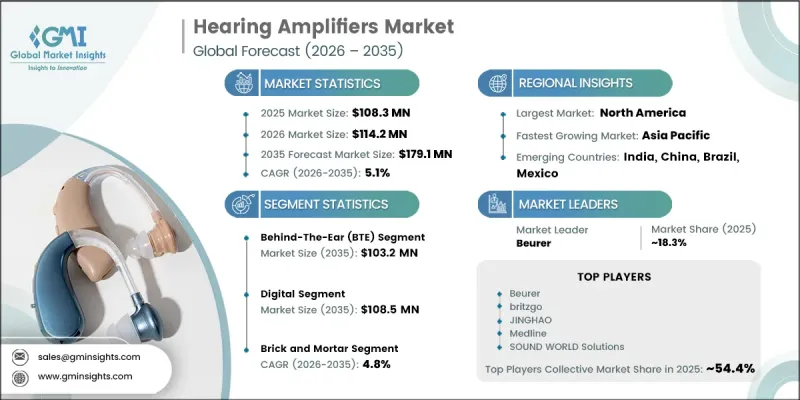
市場成長的驅動力來自聽力障礙人群數量的增加以及人們對經濟實惠的助聽解決方案的日益關注。助聽器是一種非處方箋電子設備,旨在放大環境噪音,幫助人們在日常生活中改善聽力。這些產品並非用於診斷或治療聽力障礙的醫療設備,而是旨在改善聲音感知。其價格實惠、易於獲取和使用便捷的特點持續吸引著尋求無需臨床干預的實用替代方案的消費者。由於長期暴露於高噪音環境,工作年齡層聽力障礙的發生率不斷上升,這也促進了市場成長。此外,聲音處理、數位放大和降噪技術的不斷進步正在提升語音清晰度、佩戴舒適度和整體聆聽效果。這些技術進步,加上消費者意識的提高和產品供應的擴大,預計將在預測期內為全球助聽器市場提供持續成長的機會。
| 市場範圍 | |
|---|---|
| 開始年份 | 2025 |
| 預測期 | 2026-2035 |
| 初始市場規模 | 1.083億美元 |
| 預測金額 | 1.791億美元 |
| 複合年成長率 | 5.1% |
到2025年,耳掛型將佔據58.8%的市場。該細分市場憑藉其卓越的放大性能、耐用的結構以及對各種聽力障礙用戶的適用性,持續引領市場。其符合人體工學的設計、便利的操作和舒適的配戴體驗,使其深受廣大消費者的青睞。易於調節且音質可靠,進一步提升了各年齡層對耳掛型的需求。
預計實體零售通路將以4.8%的複合年成長率成長,到2035年市場規模將達到1.133億美元。實體店仍然是主要的銷售管道,因為消費者傾向於在購買前親自觸摸和查看產品。訓練有素的員工提供的個人化支援、產品展示以及產品的即時供應,持續提升客戶體驗。在購買過程中能夠直接比較產品並獲得專家建議,也是離線零售通路在助聽器市場保持重要性的另一個原因。
預計到2025年,北美助聽器市佔率將達到38.1%。推動該地區市場成長的因素包括聽力障礙盛行率的上升以及消費者對便捷助聽解決方案日益成長的偏好。公眾意識的提高、產品供應的增加以及有利的監管環境也持續推動市場成長。隨著技術的不斷創新和消費者需求的強勁成長,預計北美的主導地位將在未來幾年進一步鞏固。
目錄
第1章:調查方法
第2章執行摘要
第3章 行業洞察
- 產業生態系分析
- 影響產業的因素
- 促進因素
- 與老齡化的聽力損失的盛行率正在增加。
- 有利的監管支持
- 放大和降噪技術的進步
- 勞動年齡人口中噪音性耳聾增加
- 產業潛在風險與挑戰
- 與處方箋助聽器和人工電子耳。
- 報銷和保險範圍有限
- 機會
- 線上銷售和遠距聽力測試平台的成長
- 產品小型化和改良的人體工學設計
- 促進因素
- 成長潛力分析
- 監理情勢
- 價格趨勢分析
- 技術與創新展望
- 最新科技趨勢
- 新興技術
- 未來市場趨勢
- 人工智慧和生成式人工智慧對市場的影響
- 波特的分析
- PESTLE分析
第4章 競爭情勢
- 介紹
- 企業矩陣分析
- 企業市佔率分析
- 世界
- 北美洲
- 歐洲
- 亞太地區
- LAMEA
- 主要市場公司的競爭分析
- 競爭定位矩陣
- 主要進展
- 併購
- 夥伴關係和聯盟
- 新產品發布
- 業務拓展計劃
第5章 市場估價與預測:依產品分類,2022-2035年
- 耳掛型(BTE)
- 耳內式(ITE)
- 其他產品
第6章 市場估計與預測:依技術分類,2022-2035年
- 數位的
- 模擬
第7章 市場估價與預測:依通路分類,2022-2035年
- 實體店面
- 電子商務
第8章 市場估計與預測:依地區分類,2022-2035年
- 北美洲
- 美國
- 加拿大
- 歐洲
- 德國
- 英國
- 法國
- 西班牙
- 義大利
- 荷蘭
- 亞太地區
- 中國
- 日本
- 印度
- 澳洲
- 韓國
- 拉丁美洲
- 巴西
- 墨西哥
- 阿根廷
- 中東和非洲
- 南非
- 沙烏地阿拉伯
- UAE
第9章:公司簡介
- alango
- Beurer
- britzgo
- Conversor
- Diglo
- VOHOM
- Innerscope Hearing Technologies
- JINGHAO
- Kinetik
- MEDca Hearing
- Medline
- Nuheara
- SOUND WORLD Solutions
The Global Hearing Amplifiers Market was valued at USD 108.3 million in 2025 and is estimated to grow at a CAGR of 5.1% to reach USD 179.1 million by 2035.
Market growth is supported by the increasing number of individuals experiencing hearing-related challenges, coupled with greater awareness of affordable sound enhancement solutions. Hearing amplifiers are non-prescription electronic devices developed to increase the volume of surrounding sounds for individuals seeking improved hearing support in everyday environments. These products are designed to enhance sound perception without serving as medical devices intended to diagnose or treat hearing impairment. Their affordability, accessibility, and ease of use continue to attract consumers looking for practical alternatives that do not require clinical intervention. The market is also benefiting from the growing incidence of hearing difficulties associated with prolonged exposure to high noise levels among the working-age population. In addition, continuous advancements in sound processing, digital amplification, and noise reduction technologies are improving speech clarity, user comfort, and overall listening performance. These technological improvements, combined with increasing consumer awareness and expanding product availability, are expected to create sustained growth opportunities for the global hearing amplifiers market throughout the forecast period.
| Market Scope | |
|---|---|
| Start Year | 2025 |
| Forecast Year | 2026-2035 |
| Start Value | $108.3 Million |
| Forecast Value | $179.1 Million |
| CAGR | 5.1% |
The behind-the-ear segment accounted for 58.8% share in 2025. The segment continues to lead the market because of its superior amplification capability, durable construction, and suitability for users with varying levels of hearing difficulty. Its ergonomic design, ease of operation, and comfortable fit make it a preferred choice among a broad consumer base. The ability to deliver reliable sound performance while remaining simple to adjust has further strengthened demand for behind-the-ear devices across multiple age groups.
The brick-and-mortar distribution channel is projected to grow at a CAGR of 4.8%, generating USD 113.3 million by 2035. Physical retail outlets remain the leading sales channel as consumers often prefer evaluating products in person before making a purchase. Personalized assistance from trained staff, product demonstrations, and immediate product availability continue to enhance the customer experience. The opportunity to compare products directly and receive professional guidance during the buying process supports the ongoing importance of offline retail channels within the hearing amplifiers market.
North America Hearing Amplifiers Market accounted for 38.1% share in 2025. The regional market is driven by the increasing prevalence of hearing-related conditions and a growing consumer preference for accessible hearing support solutions. Rising public awareness, expanding product availability, and supportive regulatory developments continue to encourage market expansion. Continuous technological innovation and strong consumer demand are expected to reinforce North America's leading position over the coming years.
Major companies operating in the global hearing amplifiers market include Nuheara, Diglo, JINGHAO, Kinetik, Innerscope Hearing Technologies, VOHOM, Beurer, SOUND WORLD Solutions, Medline, MEDca Hearing, britzgo, alango, and Conversor. Companies operating in the hearing amplifiers market are strengthening their market presence by investing in advanced sound amplification technologies, digital noise reduction, and user-friendly product designs that improve overall listening performance. Manufacturers are expanding their product portfolios with lightweight, ergonomic, and rechargeable devices while incorporating wireless connectivity and enhanced battery efficiency to meet changing consumer expectations. Businesses are also strengthening both online and offline distribution channels to improve product accessibility and customer engagement. Strategic collaborations with retail partners, investments in product innovation, and expansion into emerging markets continue to support long-term growth. In addition, companies are focusing on competitive pricing, brand awareness initiatives, customer education programs, and continuous research and development to enhance product differentiation and strengthen their competitive position across global markets.
Table of Contents
Chapter 1 Research Methodology
- 1.1 Research approach
- 1.2 Quality commitments
- 1.2.1 GMI AI policy & data integrity commitment
- 1.2.1.1 Source consistency protocol
- 1.2.1 GMI AI policy & data integrity commitment
- 1.3 Research trail & confidence scoring
- 1.3.1 Research trail components
- 1.3.2 Scoring components
- 1.4 Data collection
- 1.4.1 Partial list of primary sources
- 1.5 Data mining sources
- 1.5.1 Paid sources
- 1.5.1.1 Sources, by region
- 1.5.1 Paid sources
- 1.6 Base estimates and calculations
- 1.6.1 Base year calculation
- 1.7 Forecast model
- 1.7.1 Quantified market impact analysis
- 1.7.1.1 Mathematical impact of growth parameters on forecast
- 1.7.1 Quantified market impact analysis
- 1.8 Research transparency addendum
- 1.8.1 Source attribution framework
- 1.8.2 Quality assurance metrics
- 1.8.3 Our commitment to trust
Chapter 2 Executive Summary
- 2.1 Industry 360° synopsis
- 2.2 Key market trends
- 2.2.1 Regional trends
- 2.2.2 Product trends
- 2.2.3 Technology trends
- 2.2.4 Distribution channel trends
- 2.3 CXO perspectives: Strategic imperatives
Chapter 3 Industry Insights
- 3.1 Industry ecosystem analysis
- 3.2 Industry impact forces
- 3.2.1 Growth drivers
- 3.2.1.1 Increasing prevalence of age-related hearing loss
- 3.2.1.2 Favorable regulatory support
- 3.2.1.3 Technological improvements in amplification and noise reduction
- 3.2.1.4 Rising noise-induced hearing loss among working-age population
- 3.2.2 Industry pitfalls and challenges
- 3.2.2.1 Competition from prescription hearing aids and cochlear implants
- 3.2.2.2 Limited reimbursement/insurance coverage
- 3.2.3 Opportunities
- 3.2.3.1 Growth of online sales and tele-audiology platforms
- 3.2.3.2 Product miniaturization and improved ergonomics
- 3.2.1 Growth drivers
- 3.3 Growth potential analysis
- 3.4 Regulatory landscape
- 3.5 Pricing trend analysis (Driven by Primary Research)
- 3.6 Technology and innovation landscape (Driven by Primary Research)
- 3.6.1 Current technological trends
- 3.6.2 Emerging technologies
- 3.7 Future market trends (Driven by Primary Research)
- 3.8 Impact of AI & Generative AI on the Market (Driven by Primary Research)
- 3.9 Porter's analysis
- 3.10 PESTEL analysis
Chapter 4 Competitive Landscape, 2025
- 4.1 Introduction
- 4.2 Company matrix analysis
- 4.3 Company market share analysis (Driven by Primary Research)
- 4.3.1 Global
- 4.3.2 North America
- 4.3.3 Europe
- 4.3.4 Asia Pacific
- 4.3.5 LAMEA
- 4.4 Competitive analysis of major market players
- 4.5 Competitive positioning matrix
- 4.6 Key developments
- 4.6.1 Mergers & acquisitions
- 4.6.2 Partnerships & collaborations
- 4.6.3 New product launches
- 4.6.4 Expansion plans
Chapter 5 Market Estimates and Forecast, By Product, 2022 - 2035 ($ Mn)
- 5.1 Key trends
- 5.2 Behind-the-ear (BTE)
- 5.3 In-the-ear (ITE)
- 5.4 Other products
Chapter 6 Market Estimates and Forecast, By Technology, 2022 - 2035 ($ Mn)
- 6.1 Key trends
- 6.2 Digital
- 6.3 Analog
Chapter 7 Market Estimates and Forecast, By Distribution Channel, 2022 - 2035 ($ Mn)
- 7.1 Key trends
- 7.2 Brick and mortar
- 7.3 E-commerce
Chapter 8 Market Estimates and Forecast, By Region, 2022 - 2035 ($ Mn)
- 8.1 Key trends
- 8.2 North America
- 8.2.1 U.S.
- 8.2.2 Canada
- 8.3 Europe
- 8.3.1 Germany
- 8.3.2 UK
- 8.3.3 France
- 8.3.4 Spain
- 8.3.5 Italy
- 8.3.6 Netherlands
- 8.4 Asia Pacific
- 8.4.1 China
- 8.4.2 Japan
- 8.4.3 India
- 8.4.4 Australia
- 8.4.5 South Korea
- 8.5 Latin America
- 8.5.1 Brazil
- 8.5.2 Mexico
- 8.5.3 Argentina
- 8.6 MEA
- 8.6.1 South Africa
- 8.6.2 Saudi Arabia
- 8.6.3 UAE
Chapter 9 Company Profiles
- 9.1 alango
- 9.2 Beurer
- 9.3 britzgo
- 9.4 Conversor
- 9.5 Diglo
- 9.6 VOHOM
- 9.7 Innerscope Hearing Technologies
- 9.8 JINGHAO
- 9.9 Kinetik
- 9.10 MEDca Hearing
- 9.11 Medline
- 9.12 Nuheara
- 9.13 SOUND WORLD Solutions

 全球助聽器市場規模、佔有率、趨勢和成長分析報告(2026-2034)
 助聽器市場-2026-2032年全球市場預測
 2026年全球助聽器市場報告
 助聽器市場規模、佔有率和成長分析(按類型、產品、充電方式、銷售管道和地區分類):產業預測(2026-2033 年)
 全球集音器市場