


 |
市場調查報告書
商品編碼
2101941
導管導引線市場機會、成長要素、產業趨勢分析及2026-2035年預測。Guidewires Market Opportunity, Growth Drivers, Industry Trend Analysis, and Forecast 2026 - 2035 |
||||||

預計到 2025 年,全球導管導引線市場價值將達到 14 億美元,年複合成長率為 5.5%,到 2035 年將達到 24 億美元。
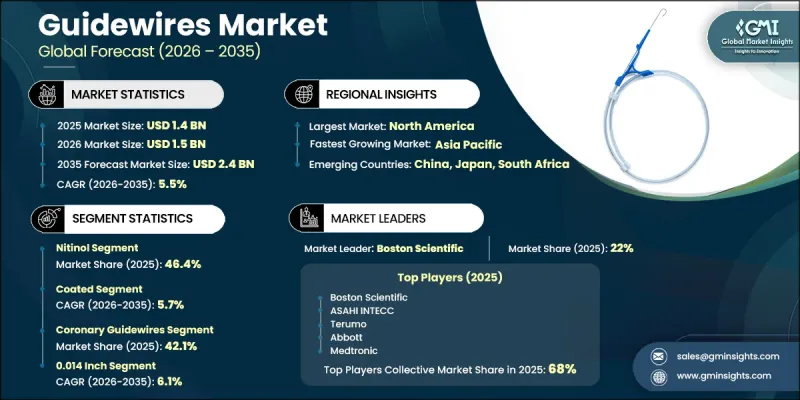
市場擴張主要受三個相互關聯的結構性因素驅動:全球慢性病負擔日益加重,持續增加對導管介入治療的需求;老年人口不斷成長,需要頻繁進行微創手術;以及導管導引線技術的不斷進步,包括超細鎳鈦合金導絲、高親水性和抗血栓塗層以及混合複合結構。這些因素共同作用,既支持現有醫療體系中導絲的持續應用(這些體系的手術頻率較高),也促進了新興經濟體的強勁成長,因為這些地區的醫療基礎設施不斷完善,介入治療的可及性也隨之提高。在心血管、血管和泌尿系統領域,微創手術相對於開放性手術的日益普及,顯著提高了導管導引線的消耗量,這得益於其更短的恢復時間、更低的併發症風險和更高的成本效益。在介入性心臟病學領域,經皮冠狀動脈介入治療(PCI)已成為合格患者的標準治療方法,導管導引線在血管內導航、病變通過和器械植入方面繼續發揮至關重要的作用。
| 市場範圍 | |
|---|---|
| 開始年份 | 2025 |
| 預測期 | 2026-2035 |
| 初始市場規模 | 14億美元 |
| 預計金額 | 24億美元 |
| 複合年成長率 | 5.5% |
預計到2025年,鎳鈦諾導管導引線將佔據46.4%的市場佔有率,並將在2035年之前以5.6%的複合年成長率成長。這一優勢源於該材料獨特的性能,例如超彈性和形狀記憶,這些特性使導絲能夠承受顯著的形變並在不發生永久性損傷的情況下恢復到原始形狀。這些特性使其在複雜的血管解剖結構中,尤其是在血管嚴重彎曲和鈣化的情況下,能夠實現卓越的導航性能。在這些情況下,傳統的鋼製導管導引線往往無法在手術過程中保持結構完整性。
預計到2025年,醫院市場將佔據77.2%的市場佔有率,並在2035年之前以5.4%的複合年成長率成長。這一主導地位主要歸功於醫院導管檢查室和專科手術室進行的大量介入手術,導管導引線在這些手術中被常規用於心血管、周邊血管、神經血管和泌尿器官系統介入治療。集中採購系統、長期供應商合約以及醫療機構的大規模採購框架進一步鞏固了醫院作為製造商主要收入來源的地位。
北美導管導引線市佔率為37.4%,預計到2035年將以4.7%的複合年成長率成長。美國仍然是該地區的主要成長引擎,這得益於其高額的醫療費用支出、廣泛的介入治療機構網路以及微創手術的廣泛保險覆蓋。門診介入服務的擴展和有利的報銷機制持續推動多個臨床專科手術數量的持續成長。
目錄
第1章:調查方法和範圍
第2章執行摘要
第3章 行業洞察
- 產業生態系分析
- 影響產業的因素
- 促進因素
- 微創手術的日益普及。
- 開發中國家文明病的增加
- 已開發國家的各種還款政策
- 世界人口老化問題日益嚴重。
- 產業潛在風險與挑戰
- 導管導引線高成本
- 開發中國家缺乏技術專業人員
- 導管導引線相關風險
- 市場機遇
- 擴大新興國家的醫療保健基礎設施
- 影像引導和機器人輔助療法正變得越來越普及。
- 促進因素
- 成長潛力分析
- 監理情勢
- 技術展望
- 最新科技趨勢
- 新興技術
- 價格趨勢分析
- 未來市場趨勢
- 專利分析
- PESTLE分析
- 人工智慧和生成式人工智慧對市場的影響
- 價值鏈分析
- 投資與資金籌措分析
第4章 競爭情勢
- 介紹
- 企業市佔率分析:按地區分類
- 北美洲
- 歐洲
- 亞太地區
- 主要進展
- 重要合作夥伴關係和合作
- 併購主要趨勢
- 產品創新和新產品發布
- 市場擴大策略
- 競爭定位矩陣
第5章 市場規模及預測:依材料分類,2022-2035年
- 鎳鈦諾
- 不銹鋼
- 混合
- 其他材料
第6章 市場規模及預測:依塗料類別分類,2022-2035年
- 塗層
- 親水塗層
- 抗血栓/肝素塗層
- 防水塗層
- 矽塗層
- 四氟乙烯(TFE)塗層
- 未塗層
第7章 市場規模及預測:依應用領域分類,2022-2035年
- 冠狀動脈導管導引線
- 末梢用導管導引線
- 泌尿系統導管導引線
- 神經血管導管導引線
- 其他用途
第8章 市場規模及預測:依直徑分類,2022-2035年
- 0.014英寸
- 0.018英寸
- 0.025英寸
- 0.032英寸
- 0.035英寸
- 0.038英寸
第9章 市場規模及預測:依長度分類,2022-2035年
- 80~145 cm
- 150~200 cm
- 210~300 cm
- 305公分或以上
第10章 市場規模及預測:依最終用途分類,2022-2035年
- 醫院
- 門診手術中心
- 其他最終用戶
第11章 市場規模及預測:依地區分類,2022-2035年
- 北美洲
- 美國
- 加拿大
- 歐洲
- 德國
- 法國
- 英國
- 荷蘭
- 西班牙
- 義大利
- 亞太地區
- 中國
- 日本
- 韓國
- 印度
- 澳洲
- 中東和非洲
- 沙烏地阿拉伯
- UAE
- 南非
- 拉丁美洲
- 巴西
- 阿根廷
- 墨西哥
第12章:公司簡介
- Abbott Laboratories
- AngioDynamics
- ASAHI INTECC
- B. Braun SE
- Becton, Dickinson and Company
- Boston Scientific
- Cordis
- Cook Medical
- Medtronic
- Merit Medical Systems
- Olympus
- Stryker
- Teleflex
- Terumo
The Global Guidewires Market was valued at USD 1.4 billion in 2025 and is estimated to grow at a CAGR of 5.5% to reach USD 2.4 billion by 2035.
Market expansion is shaped by three interconnected structural drivers, including the rising global burden of chronic diseases that continues to increase demand for catheter-based interventions, a growing elderly population requiring frequent minimally invasive treatments, and continuous advancements in guidewire engineering such as ultra-thin Nitinol-based designs, advanced hydrophilic and antithrombogenic coatings, and hybrid composite constructions. These factors collectively support sustained utilization across established healthcare systems with high procedural intensity, while also enabling strong growth in emerging economies where healthcare infrastructure expansion is widening access to interventional procedures. The increasing preference for minimally invasive techniques over open surgical methods across cardiovascular, vascular, and urological care pathways is significantly boosting guidewire consumption by reducing recovery times, lowering complication risks, and improving cost efficiency. In interventional cardiology, percutaneous coronary intervention has become the standard approach for eligible patients, with guidewires remaining essential for vessel navigation, lesion crossing, and device placement.
| Market Scope | |
|---|---|
| Start Year | 2025 |
| Forecast Year | 2026-2035 |
| Start Value | $1.4 Billion |
| Forecast Value | $2.4 Billion |
| CAGR | 5.5% |
Nitinol-based guidewires accounted for 46.4% share in 2025 and are projected to grow at a CAGR of 5.6% through 2035. This dominance is attributed to the material's unique properties, including superelasticity and shape memory, which allow the wire to endure significant deformation and return to its original form without permanent damage. These characteristics provide superior navigation performance in complex vascular anatomies, particularly in cases involving severe tortuosity or calcified lesions, where conventional stainless steel alternatives often fail to maintain structural integrity during procedures.
The hospitals segment held 77.2% share in 2025 and is growing at a CAGR of 5.4% through 2035. This leadership is driven by the high concentration of interventional procedures performed in hospital catheterization laboratories and specialized surgical units, where guidewires are routinely used across cardiovascular, peripheral vascular, neurovascular, and urological interventions. Centralized procurement systems, long-term supplier agreements, and large-scale institutional purchasing frameworks continue to reinforce hospitals as the primary revenue-generating channel for manufacturers.
North America Guidewires Market held 37.4% share and is expected to grow at a CAGR of 4.7% through 2035. The United States remains the key growth engine in the region, supported by high healthcare spending, an extensive network of interventional facilities, and broad insurance coverage for minimally invasive procedures. Expanding outpatient interventional services and favorable reimbursement structures continue to support sustained procedural volumes across multiple clinical specialties.
Major players operating in the global guidewires industry are Abbott Laboratories, Boston Scientific, Medtronic, Terumo, Stryker, Becton Dickinson, B. Braun, Cook Medical, Teleflex, ASAHI INTECC, AngioDynamics, Cordis, Merit Medical Systems, and Olympus Corporation. Companies in the guidewires market are focusing on continuous product innovation, particularly in ultra-thin diameters, advanced tip shaping, and enhanced torque control technologies to improve procedural precision and safety. They are also investing heavily in surface engineering, including hydrophilic and antithrombogenic coatings, to reduce friction and improve navigation through complex vascular pathways. Strategic expansion into emerging healthcare markets is being prioritized through distributor partnerships and localized manufacturing to improve cost efficiency and market penetration. In addition, firms are strengthening their clinical collaboration programs with hospitals and physicians to support training, product feedback, and faster adoption of next-generation guidewires.
Table of Contents
Chapter 1 Methodology & Scope
- 1.1 Market definitions
- 1.2 Research approach
- 1.3 Quality commitments
- 1.3.1 GMI AI policy & data integrity commitment
- 1.3.1.1 Source consistency protocol
- 1.3.1 GMI AI policy & data integrity commitment
- 1.4 Research trail & confidence scoring
- 1.4.1 Research trail components
- 1.4.2 Scoring components
- 1.5 Data collection
- 1.5.1 Partial list of primary sources
- 1.6 Data mining sources
- 1.6.1 Paid sources
- 1.6.1.1 Sources, by region
- 1.6.1 Paid sources
- 1.7 Base estimates and calculations
- 1.7.1 Base year calculation for any one approach
- 1.8 Forecast model
- 1.8.1 Quantified market impact analysis
- 1.8.1.1 Mathematical impact of growth parameters on forecast
- 1.8.1 Quantified market impact analysis
- 1.9 Research transparency addendum
- 1.9.1 Source attribution framework
- 1.9.2 Quality assurance metrics
- 1.9.3 Our commitment to trust
Chapter 2 Executive Summary
- 2.1 Industry synopsis, 2022 - 2035
- 2.1.1 Business trends
- 2.1.2 Material trends
- 2.1.3 Coating trends
- 2.1.4 Application trends
- 2.1.5 Diameter trends
- 2.1.6 Length trends
- 2.1.7 End use trends
- 2.1.8 Regional trends
Chapter 3 Industry Insights
- 3.1 Industry ecosystem analysis
- 3.2 Industry impact forces
- 3.2.1 Growth drivers
- 3.2.1.1 Rising adoption of minimally invasive surgical procedures
- 3.2.1.2 Increasing number of lifestyle disorders in developing countries
- 3.2.1.3 Various reimbursement policies in developed countries
- 3.2.1.4 Growing geriatric population base across the globe
- 3.2.2 Industry pitfalls and challenges
- 3.2.2.1 High cost of guidewires
- 3.2.2.2 Dearth of skilled professionals in developing economies
- 3.2.2.3 Risks associated with guidewires
- 3.2.3 Market opportunities
- 3.2.3.1 Expansion of healthcare infrastructure in emerging economies
- 3.2.3.2 Growing adoption of image-guided and robotic-assisted interventions
- 3.2.1 Growth drivers
- 3.3 Growth potential analysis
- 3.4 Regulatory landscape (Driven by primary research)
- 3.4.1 North America
- 3.4.2 Europe
- 3.4.3 Asia Pacific
- 3.4.4 Latin America
- 3.4.5 Middle East and Africa
- 3.5 Technology landscape
- 3.5.1 Current technological trends
- 3.5.2 Emerging technologies
- 3.6 Pricing trend analysis (Driven by primary research)
- 3.7 Future market trends
- 3.8 Patent analysis
- 3.9 PESTEL analysis
- 3.10 Impact of AI and Generative AI on the market (Driven by primary research)
- 3.11 Value chain analysis (Driven by primary research)
- 3.12 Investment & funding analysis (Driven by primary research)
Chapter 4 Competitive Landscape, 2025
- 4.1 Introduction
- 4.2 Company market share analysis, by region, 2025
- 4.2.1 North America
- 4.2.2 Europe
- 4.2.3 Asia Pacific
- 4.3 Key developments
- 4.3.1 Key partnerships & collaborations
- 4.3.2 Major M&A activities
- 4.3.3 Product innovations & launches
- 4.3.4 Market expansion strategies
- 4.4 Competitive positioning matrix
Chapter 5 Market Size and Forecast, By Material, 2022 - 2035 (USD Million)
- 5.1 Key trends
- 5.2 Nitinol
- 5.3 Stainless steel
- 5.4 Hybrid
- 5.5 Other materials
Chapter 6 Market Size and Forecast, By Coating, 2022 - 2035 (USD Million)
- 6.1 Key trends
- 6.2 Coated
- 6.2.1 Hydrophilic coating
- 6.2.2 Anti-thrombogenic/Heparin coating
- 6.2.3 Hydrophobic coating
- 6.2.4 Silicone coating
- 6.2.5 Tetrafluoroethylene (TFE) coating
- 6.3 Non-coated
Chapter 7 Market Size and Forecast, By Application, 2022 - 2035 (USD Million)
- 7.1 Key trends
- 7.2 Coronary guidewires
- 7.3 Peripheral guidewires
- 7.4 Urology guidewires
- 7.5 Neurovascular guidewires
- 7.6 Other applications
Chapter 8 Market Size and Forecast, By Diameter, 2022 - 2035 (USD Million)
- 8.1 Key trends
- 8.2 0.014 inch
- 8.3 0.018 inch
- 8.4 0.025 inch
- 8.5 0.032 inch
- 8.6 0.035 inch
- 8.7 0.038 inch
Chapter 9 Market Size and Forecast, By Length, 2022 - 2035 (USD Million)
- 9.1 Key trends
- 9.2 80 - 145 cm
- 9.3 150 - 200 cm
- 9.4 210 - 300 cm
- 9.5 Above 305 cm
Chapter 10 Market Size and Forecast, By End Use, 2022 - 2035 (USD Million)
- 10.1 Key trends
- 10.2 Hospital
- 10.3 Ambulatory surgical centers
- 10.4 Other end users
Chapter 11 Market Size and Forecast, By Region, 2022 - 2035 (USD Million)
- 11.1 Key trends
- 11.2 North America
- 11.2.1 U.S.
- 11.2.2 Canada
- 11.3 Europe
- 11.3.1 Germany
- 11.3.2 France
- 11.3.3 UK
- 11.3.4 Netherlands
- 11.3.5 Spain
- 11.3.6 Italy
- 11.4 Asia Pacific
- 11.4.1 China
- 11.4.2 Japan
- 11.4.3 South Korea
- 11.4.4 India
- 11.4.5 Australia
- 11.5 Middle East & Africa
- 11.5.1 Saudi Arabia
- 11.5.2 UAE
- 11.5.3 South Africa
- 11.6 Latin America
- 11.6.1 Brazil
- 11.6.2 Argentina
- 11.6.3 Mexico
Chapter 12 Company Profiles
- 12.1 Abbott Laboratories
- 12.2 AngioDynamics
- 12.3 ASAHI INTECC
- 12.4 B. Braun SE
- 12.5 Becton, Dickinson and Company
- 12.6 Boston Scientific
- 12.7 Cordis
- 12.8 Cook Medical
- 12.9 Medtronic
- 12.10 Merit Medical Systems
- 12.11 Olympus
- 12.12 Stryker
- 12.13 Teleflex
- 12.14 Terumo

 導管導引線全球市場規模、佔有率、趨勢和成長分析報告(2026-2034年)
 導管導引線市場:按材料、類型、應用和最終用戶分類-2026-2032年全球市場預測血管導管導引線市場:2026-2032年全球市場預測(按產品類型、材質、塗層、直徑範圍、尖端形狀、應用和最終用戶分類)
 神經血管導管導引線市場規模、佔有率和成長分析:按產品類型、尖端形狀、塗層類型、材質、應用、最終用戶和地區分類-2026-2033年產業預測壓力導管導引線市場:按類型、技術、應用、最終用戶和分銷管道分類-2026-2032年全球市場預測
 2026年全球醫用鎢合金屏蔽市場報告導管導引線全球市場報告2026全球微引導管市場規模、佔有率、趨勢和成長分析報告(2026-2034年)
 2026-2030年全球導管導引線市場一次性神經血管導引線市場按產品類型、材料、銷售管道、應用和最終用戶分類-全球預測,2026-2032年