


 |
市場調查報告書
商品編碼
2101939
伴隨診斷市場機會、成長要素、產業趨勢分析及2026-2035年預測Companion Diagnostics Market Opportunity, Growth Drivers, Industry Trend Analysis, and Forecast 2026 - 2035 |
||||||

全球伴隨診斷市場預計到 2025 年價值 79 億美元,並將以 11.2% 的複合年成長率成長,到 2035 年達到 225 億美元。
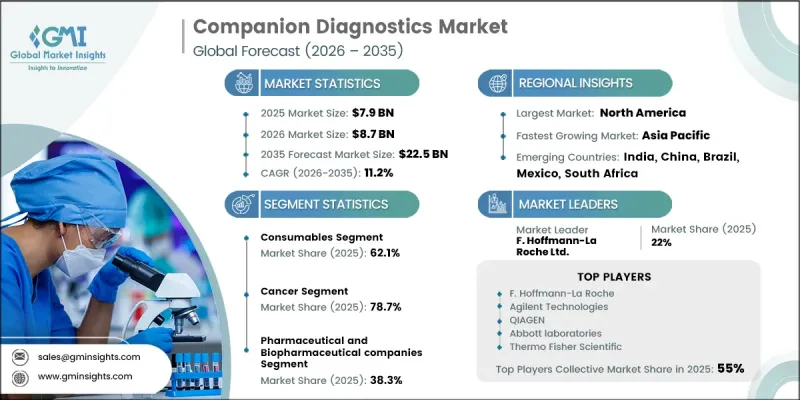
伴隨診斷市場的成長主要受癌症發病率上升、藥物不良反應發生率增加以及精準醫療在整個醫療保健系統中日益普及的驅動。伴隨診斷是一種專門的醫學檢測,旨在識別哪些患者最有可能對標靶治療反應,或哪些患者面臨較高的治療相關不利事件風險。這些診斷解決方案能夠識別生物標記、基因突變和蛋白質表現模式,從而支持個人化治療方案的選擇並改善臨床決策。隨著伴隨診斷在精準醫療中發揮越來越重要的作用,其在現代醫療保健中的重要性顯著提升,尤其是在需要基於生物標記進行患者篩選的療法中。隨著全球癌症病例的持續成長,醫療服務提供者越來越重視精準的分子檢測,以提高治療效果並改善患者預後。從標準化治療方法向個人化醫療策略的轉變進一步加劇了市場需求。這是因為基於生物標記的診斷能夠實現更精準的治療性介入,有助於改善臨床療效,並支持標靶治療的持續發展。
| 市場範圍 | |
|---|---|
| 開始年份 | 2025 |
| 預測期 | 2026-2035 |
| 上市時的市場規模 | 79億美元 |
| 預計金額 | 225億美元 |
| 複合年成長率 | 11.2% |
到2025年,耗材部分將佔據62.1%的市場。此部分包括伴隨診斷程序所需的檢測試劑盒、試劑、抗體、探針、卡盒和其他檢測材料。這些產品是分子和基因檢測工作流程中的關鍵組成部分,能夠識別生物標記、基因突變和其他疾病特異性特徵,從而指導標靶治療決策。隨著基於生物標記的檢測成為精準醫療不可或缺的一部分,它們的重要性日益凸顯,並在廣泛的臨床應用中支持精準的患者篩選和個人化治療策略。
到2025年,製藥和生物製藥公司將佔據38.3%的市場。這些公司正在將伴隨診斷整合到藥物研發過程的多個階段,以識別合適的患者群體並支持標靶治療的開發。在臨床研發計畫中擴大採用基於生物標記的方法,有助於提高治療效果、最佳化臨床試驗結果並加快法規核准進程,從而持續推動對伴隨診斷技術的需求。
到2025年,北美伴隨診斷市佔率將達到33.3%。人們對藥物不良反應日益成長的擔憂正在推動伴隨診斷解決方案在全部區域得到更廣泛的應用。基於生物標記的檢測能夠幫助醫療專業人員識別可能從特定治療中受益的患者,同時最大限度地降低治療相關併發症的風險。隨著個人化醫療和精準治療概念的日益普及,北美市場對伴隨診斷的需求也持續成長。
目錄
第1章:調查方法
第2章執行摘要
第3章 行業洞察
- 產業生態系分析
- 影響產業的因素
- 促進因素
- 癌症發生率上升
- 藥物副作用數量增加
- 精準醫療的發展
- 製藥公司在藥物研發過程中擴大採用伴隨藥物。
- 隨著核准的抗體藥物偶聯物 (ADC) 和免疫腫瘤藥物數量不斷增加,伴隨診斷變得不可或缺。
- 產業潛在風險與挑戰
- 開發成本相對較高。
- 具有有限兌換範圍的模型
- 市場機遇
- 基於液態生物檢體的伴隨診斷正變得越來越普及。
- 擴展伴隨診斷以涵蓋新型生物標記標靶(HER2-超低表達、KRAS G12C、FGFR 突變和 NTRK 基因融合)
- 促進因素
- 成長潛力分析
- 監理情勢
- 技術展望
- 最新科技趨勢
- 新興技術
- 未來市場趨勢
- 人工智慧和生成式人工智慧對市場的影響
- 專利分析
- 價格趨勢分析
- 波特的分析
- PESTLE分析
第4章 競爭情勢
- 介紹
- 企業市佔率分析
- 世界
- 北美洲
- 歐洲
- 亞太地區
- 企業矩陣分析
- 主要市場公司的競爭分析
- 競爭定位矩陣
- 主要進展
- 併購
- 夥伴關係和聯盟
- 新產品發布
- 業務拓展計劃
第5章 市場估價與預測:依產品分類,2022-2035年
- 裝置
- 消耗品
- 軟體服務
第6章 市場估計與預測:依治療領域分類,2022-2035年
- 癌症
- 乳癌
- 肺癌
- 結腸癌
- 皮膚癌
- 其他癌症
- 心血管疾病
- 神經系統疾病
- 其他治療領域
第7章 市場估計與預測:依技術分類,2022-2035年
- 免疫組織化學
- 原位雜合反應
- 聚合酵素鏈鎖反應
- 次世代定序
- 其他技術
第8章 市場估算與預測:依最終用途分類,2022-2035年
- 醫院
- 製藥和生物製藥公司
- 受託研究機構
- 診斷檢查室
第9章 市場估計與預測:依地區分類,2022-2035年
- 北美洲
- 美國
- 加拿大
- 歐洲
- 德國
- 英國
- 法國
- 西班牙
- 義大利
- 荷蘭
- 亞太地區
- 中國
- 日本
- 印度
- 澳洲
- 韓國
- 拉丁美洲
- 巴西
- 墨西哥
- 阿根廷
- 中東和非洲
- 南非
- 沙烏地阿拉伯
- UAE
第10章:公司簡介
- F. Hoffmann-La Roche Ltd
- Foundation Medicine
- QIAGEN
- Agilent Technologies
- Abbott Laboratories
- Illumina
- Thermo Fisher Scientific
- Guardant Health
- Myriad Genetics
- BioMerieux
- Leica Biosystems
- MolecularMD
- ARUP Laboratories
- Bio-Rad Laboratories
- Sysmex Corporation
The Global Companion Diagnostics Market was valued at USD 7.9 billion in 2025 and is estimated to grow at a CAGR of 11.2% to reach USD 22.5 billion by 2035.
Growth in the Companion Diagnostics Market is fueled by the increasing prevalence of cancer, the rising occurrence of adverse drug reactions, and the expanding adoption of precision medicine across healthcare systems. Companion diagnostics are specialized medical tests designed to determine which patients are most likely to respond to a targeted therapy or may face a greater risk of treatment-related adverse effects. These diagnostic solutions identify biomarkers, genetic alterations, and protein expression patterns that support personalized treatment selection and improve clinical decision-making. Their growing role in precision medicine has significantly increased their importance in modern healthcare, particularly for therapies that require biomarker-guided patient selection. As cancer cases continue to increase worldwide, healthcare providers are placing greater emphasis on accurate molecular testing to improve treatment effectiveness and patient outcomes. The ongoing transition from standardized treatment approaches toward personalized healthcare strategies is further strengthening market demand, as biomarker-based diagnostics enable more precise therapeutic interventions and contribute to better clinical results while supporting the continued advancement of targeted medicine.
| Market Scope | |
|---|---|
| Start Year | 2025 |
| Forecast Year | 2026-2035 |
| Start Value | $7.9 Billion |
| Forecast Value | $22.5 Billion |
| CAGR | 11.2% |
The consumables segment accounted for a 62.1% share in 2025. This segment includes assay kits, reagents, antibodies, probes, cartridges, and other testing materials required during companion diagnostic procedures. These products serve as essential components of molecular and genetic testing workflows by enabling the identification of biomarkers, gene mutations, and other disease-specific characteristics used to guide targeted treatment decisions. Their importance continues to increase as biomarker-driven testing becomes an integral part of precision medicine, supporting accurate patient selection and personalized therapeutic strategies across a wide range of clinical applications.
The pharmaceutical and biopharmaceutical companies segment held 38.3% share in 2025. These organizations integrate companion diagnostics throughout multiple stages of the drug development process to identify appropriate patient populations and support the advancement of targeted therapies. The increasing use of biomarker-based approaches within clinical development programs is helping improve treatment effectiveness, optimize clinical trial performance, and support regulatory approval efforts, contributing to continued demand for companion diagnostic technologies.
North America Companion Diagnostics Market held a 33.3% share in 2025. Rising concerns regarding adverse drug reactions are encouraging broader adoption of companion diagnostic solutions throughout the region. Biomarker-based testing enables healthcare providers to identify patients who are more likely to benefit from specific therapies while minimizing the risk of treatment-related complications. The growing emphasis on personalized healthcare and precision treatment approaches continues to strengthen demand for companion diagnostics across the North American market.
Major companies operating in the Global Companion Diagnostics Market include F. Hoffmann-La Roche Ltd, Foundation Medicine, QIAGEN, Agilent Technologies, Abbott Laboratories, Illumina, Thermo Fisher Scientific, Guardant Health, Myriad Genetics, BioMerieux, Leica Biosystems, MolecularMD, ARUP Laboratories, Bio-Rad Laboratories, and Sysmex Corporation. Companies participating in the Companion Diagnostics Market are reinforcing their market position by investing in biomarker discovery, expanding molecular diagnostic capabilities, and strengthening research and development activities. Many organizations are focusing on developing advanced diagnostic assays that support precision medicine and improve targeted therapy selection. Strategic collaborations between diagnostic developers and pharmaceutical companies are accelerating the co-development of companion diagnostics alongside innovative therapies, helping expand commercial opportunities and improve regulatory success.
Table of Contents
Chapter 1 Research Methodology
- 1.1 Research approach
- 1.2 Quality commitments
- 1.2.1 GMI AI policy and data integrity commitment
- 1.2.1.1 Source consistency protocol
- 1.2.1 GMI AI policy and data integrity commitment
- 1.3 Research trail and confidence scoring
- 1.3.1 Research trail components
- 1.3.2 Scoring components
- 1.4 Data collection
- 1.4.1 Partial list of primary sources
- 1.5 Data mining sources
- 1.5.1 Paid sources
- 1.5.1.1 Sources, by region
- 1.5.1 Paid sources
- 1.6 Base estimates and calculations
- 1.6.1 Base year calculation for any one approach
- 1.7 Forecast model
- 1.7.1 Quantified market impact analysis
- 1.7.1.1 Mathematical impact of growth parameters on forecast
- 1.7.1 Quantified market impact analysis
- 1.8 Research transparency addendum
- 1.8.1 Source attribution framework
- 1.8.2 Quality assurance metrics
- 1.8.3 Our commitment to trust
Chapter 2 Executive Summary
- 2.1 Industry 3600 synopsis
- 2.2 Key market trends
- 2.2.1 Product trends
- 2.2.2 Therapy area trends
- 2.2.3 Technology trends
- 2.2.4 End use trends
- 2.2.5 Regional trends
- 2.3 CXO perspectives: Strategic imperatives
Chapter 3 Industry Insights
- 3.1 Industry ecosystem analysis
- 3.2 Industry impact forces
- 3.2.1 Growth drivers
- 3.2.1.1 Rising prevalence of cancer.
- 3.2.1.2 Growing incidence of adverse drug reaction.
- 3.2.1.3 Growth of precision medicine.
- 3.2.1.4 Pharmaceutical firms increasingly embed companion drugs in drug development.
- 3.2.1.5 Rising ADC and immuno-oncology drug approvals requiring companion diagnostics
- 3.2.2 Industry pitfalls and challenges
- 3.2.2.1 High development costs.
- 3.2.2.2 Limited reimbursement models.
- 3.2.3 Market opportunities
- 3.2.3.1 Growing adoption of liquid biopsy-based companion diagnostics
- 3.2.3.2 Expansion of companion diagnostics for emerging biomarker targets (HER2-ultralow, KRAS G12C, FGFR alterations, and NTRK gene fusions)
- 3.2.1 Growth drivers
- 3.3 Growth potential analysis
- 3.4 Regulatory landscape (Driven by primary research)
- 3.4.1 North America
- 3.4.2 Europe
- 3.4.3 Asia Pacific
- 3.4.4 Latin America
- 3.4.5 Middle East and Africa
- 3.5 Technology landscape (Driven by primary research)
- 3.5.1 Current technological trends
- 3.5.2 Emerging technologies
- 3.6 Future market trends (Driven by primary research)
- 3.7 Impact of AI and Generative AI on the market (Driven by primary research)
- 3.8 Patent analysis
- 3.9 Pricing trend analysis (Driven by primary research)
- 3.10 Porter's analysis
- 3.11 PESTEL analysis
Chapter 4 Competitive Landscape, 2025
- 4.1 Introduction
- 4.2 Company market share analysis
- 4.2.1 Global
- 4.2.2 North America
- 4.2.3 Europe
- 4.2.4 Asia Pacific
- 4.3 Company matrix analysis
- 4.4 Competitive analysis of major market players
- 4.5 Competitive positioning matrix
- 4.6 Key developments
- 4.6.1 Mergers and acquisitions
- 4.6.2 Partnerships and collaborations
- 4.6.3 New product launches
- 4.6.4 Expansion plans
Chapter 5 Market Estimates and Forecast, By Product, 2022 - 2035 ($ Mn)
- 5.1 Key trends
- 5.2 Instruments
- 5.3 Consumables
- 5.4 Software and services
Chapter 6 Market Estimates and Forecast, By Therapy Areas, 2022 - 2035 ($ Mn)
- 6.1 Key trends
- 6.2 Cancer
- 6.2.1 Breast cancer
- 6.2.2 Lung cancer
- 6.2.3 Colorectal cancer
- 6.2.4 Skin cancer
- 6.2.5 Other cancers
- 6.3 Cardiovascular disease
- 6.4 Neurological diseases
- 6.5 Other therapy areas
Chapter 7 Market Estimates and Forecast, By Technology, 2022 - 2035 ($ Mn)
- 7.1 Key trends
- 7.2 Immunohistochemistry
- 7.3 In situ hybridization
- 7.4 Polymerase chain reaction
- 7.5 Next-Generation Sequencing
- 7.6 Other technologies
Chapter 8 Market Estimates and Forecast, By End Use, 2022 - 2035 ($ Mn)
- 8.1 Key trends
- 8.2 Hospitals
- 8.3 Pharmaceutical and biopharmaceutical companies
- 8.4 Contract research organizations
- 8.5 Diagnostic laboratories
Chapter 9 Market Estimates and Forecast, By Region, 2022 - 2035 ($ Mn)
- 9.1 Key trends
- 9.2 North America
- 9.2.1 U.S.
- 9.2.2 Canada
- 9.3 Europe
- 9.3.1 Germany
- 9.3.2 UK
- 9.3.3 France
- 9.3.4 Spain
- 9.3.5 Italy
- 9.3.6 Netherlands
- 9.4 Asia Pacific
- 9.4.1 China
- 9.4.2 Japan
- 9.4.3 India
- 9.4.4 Australia
- 9.4.5 South Korea
- 9.5 Latin America
- 9.5.1 Brazil
- 9.5.2 Mexico
- 9.5.3 Argentina
- 9.6 Middle East and Africa
- 9.6.1 South Africa
- 9.6.2 Saudi Arabia
- 9.6.3 UAE
Chapter 10 Company Profiles
- 10.1 F. Hoffmann-La Roche Ltd
- 10.2 Foundation Medicine
- 10.3 QIAGEN
- 10.4 Agilent Technologies
- 10.5 Abbott Laboratories
- 10.6 Illumina
- 10.7 Thermo Fisher Scientific
- 10.8 Guardant Health
- 10.9 Myriad Genetics
- 10.10 BioMerieux
- 10.11 Leica Biosystems
- 10.12 MolecularMD
- 10.13 ARUP Laboratories
- 10.14 Bio-Rad Laboratories
- 10.15 Sysmex Corporation

 伴隨診斷(CDx)市場-監理情勢分析,2026年全球伴隨診斷(CDx)市場-競爭格局分析,2026年EGFR伴隨診斷市場:策略洞察與預測(2026-2035年)伴隨診斷市場:策略洞察與預測(2026-2035 年)
 伴隨診斷市場:2026-2032年全球市場預測(按交付方式、技術、檢體類型、生物標記分類、應用、最終用戶和分銷管道分類)
 全球伴隨診斷市場(至 2031 年):按產品(檢測、試劑盒和試劑、儀器和軟體)、技術(PCR、NGS、ISH、IHC)、適應症(乳癌、肺癌、大腸癌、心血管疾病、感染疾病)和藥物類型(單株抗體、細胞和基因療法)分類
 伴隨診斷市場規模、佔有率和趨勢分析報告:按產品/服務、適應症、技術、檢體類型、最終用途、地區和細分市場預測(2026-2033 年)
 伴隨診斷市場預測至2034年-按產品和服務、技術、適應症、檢體類型、應用、最終用戶和地區分類的全球分析
 伴隨診斷市場報告:按產品/服務、技術、適應症、最終用戶和地區分類(2026-2034 年)
 伴隨診斷服務的合作與授權協議(2010-2026 年)