


 |
市場調查報告書
商品編碼
2101929
液態生物檢體市場:商業機會、成長要素、產業趨勢分析及2026-2035年預測Liquid Biopsy Market Opportunity, Growth Drivers, Industry Trend Analysis, and Forecast 2026 - 2035 |
||||||

全球液態生物檢體市場預計到 2025 年將達到 63 億美元,到 2035 年將以 12.1% 的複合年成長率成長,達到 199 億美元。
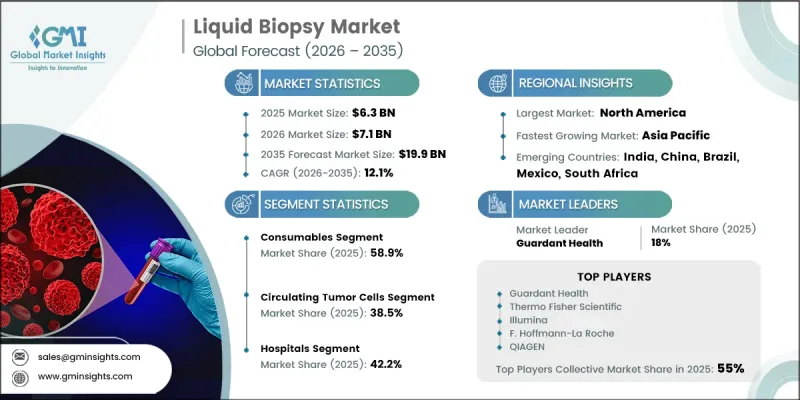
由於癌症診斷技術的進步、微創檢測方法的日益普及以及全球癌症發病率的上升,市場正蓬勃發展。液態生物檢體已成為一種先進的診斷技術,用於識別癌症相關生物標記物,例如循環腫瘤DNA (ctDNA)、循環性腫瘤細胞(CTC) 以及體液中存在的其他分子指標。該技術無需傳統的組織切片檢查即可實現癌症的早期檢測、治療方案的選擇以及疾病的持續監測。對更安全、更人性化的切片檢查方案的需求不斷成長,正在加速液態生物檢體技術的應用。與通常需要侵入性操作的傳統活體組織切片不同,液態生物檢體提供了一種負擔較小的腫瘤相關資訊分析方法,尤其是在組織樣本採集困難的情況下。醫療專業人員正擴大採用這些解決方案來改善精準醫療方法、監測疾病進展並評估治療反應的變化。分子診斷、定序技術和生物標記分析平台的持續創新進一步鞏固了液態生物檢體在現代腫瘤學中的作用。
| 市場範圍 | |
|---|---|
| 開始年份 | 2025 |
| 預測期 | 2026-2035 |
| 上市時的市場規模 | 63億美元 |
| 預計金額 | 199億美元 |
| 複合年成長率 | 12.1% |
預計儀器業務類股2025年銷售額將達到16億美元,並在2026年至2035年間以11.7%的複合年成長率成長。該板塊包括用於檢體處理、定序、聚合酵素鏈鎖反應(PCR)分析以及識別與液態生物檢體應用相關的生物標記的先進平台和系統。這些儀器對於提高癌症生物標記檢測的準確性、可靠性和效率至關重要,可為臨床診斷和研究提供支援。
到2025年,醫院通路將佔據42.2%的市場。醫院通路在該領域的主導地位得益於癌症診斷和治療程序在醫院環境中的日益增多,以及先進診斷基礎設施和腫瘤專科部門的發展。醫院正積極將液態生物檢體解決方案引入臨床實踐,以支持基於精準醫療的治療決策,並提供更個人化的患者照護。
預計到2025年,北美液態切片市場佔有率將達到40.8%。受癌症發病率上升和先進診斷技術日益普及的推動,該地區的液體活體組織切片市場正持續顯著擴張。美國仍然是該地區成長的主要驅動力,這得益於其對微創解決方案的需求不斷成長,這些解決方案有助於癌症的識別、治療方案的選擇以及疾病的持續監測。
目錄
第1章:調查方法
第2章執行摘要
第3章 行業洞察
- 產業生態系分析
- 影響產業的因素
- 促進因素
- 癌症診斷領域的技術不斷進步
- 非侵入性疾病診斷正成為日益成長的趨勢。
- 癌症在全球的發生率正在上升。
- 人們對疾病早期診斷重要性的認知不斷提高
- 產業潛在風險與挑戰
- 嚴格的法規結構
- 熟練專業人員短缺
- 市場機遇
- 擴大多癌種早期檢測(MCED)檢測範圍
- 促進因素
- 成長潛力分析
- 監理情勢
- 技術展望
- 最新科技趨勢
- 新興技術
- 未來市場趨勢
- 人工智慧和生成式人工智慧對市場的影響
- 專利分析
- 價格趨勢分析
- 波特的分析
- PESTLE分析
第4章 競爭情勢
- 介紹
- 企業市佔率分析
- 世界
- 北美洲
- 歐洲
- 亞太地區
- 企業矩陣分析
- 主要市場公司的競爭分析
- 競爭定位矩陣
- 主要進展
- 併購
- 夥伴關係和聯盟
- 新產品發布
- 業務拓展計劃
第5章 市場估價與預測:依產品分類,2022-2035年
- 消耗品
- 試劑盒和試劑
- 檢測和檢測組
- 裝置
- 服務
第6章 市場估計與預測:依生物標記分類,2022-2035年
- 循環性腫瘤細胞(CTCs)
- 循環腫瘤DNA
- 無細胞DNA
- 細胞外囊泡
- 其他生物標記
第7章 市場估計與預測:依疾病適應症分類,2022-2035年
- 癌症
- 肺癌
- 乳癌
- 結腸癌
- 攝護腺癌
- 其他癌症
- 非癌症
- 非侵入性產前檢測
- 器官移植
- 傳染病檢查
第8章 市場估計與預測:依臨床應用分類,2022-2035年
- 治療監測
- 預後和復發監測
- 治療方案
- 診斷和篩檢
第9章 市場估計與預測:依技術分類,2022-2035年
- 下一代擴展(NGS)
- 單基因分析(PCR微陣列)
第10章 市場估價與預測:依最終用途分類,2022-2035年
- 醫院
- 研究所
- 臨床實驗室
- 其他最終用戶
第11章 市場估價與預測:按地區分類,2022-2035年
- 北美洲
- 美國
- 加拿大
- 歐洲
- 德國
- 英國
- 法國
- 西班牙
- 義大利
- 荷蘭
- 亞太地區
- 中國
- 日本
- 印度
- 澳洲
- 韓國
- 拉丁美洲
- 巴西
- 墨西哥
- 阿根廷
- 中東和非洲
- 南非
- 沙烏地阿拉伯
- UAE
第12章:公司簡介
- ANGLE plc
- Biocept, Inc.
- Bio-Rad Laboratories, Inc.
- Epigenomics AG
- F. Hoffmann-La Roche Ltd.
- Freenome Holdings, Inc.
- GRAIL, Inc.
- Guardant Health, Inc.
- Illumina, Inc.
- Lucence Health Inc.
- MDxHealth SA
- Menarini group
- Myriad Genetics, Inc.
- Natera, Inc.
- QIAGEN NV
- Sysmex Corporation
- Thermo Fisher Scientific Inc.
The Global Liquid Biopsy Market was valued at USD 6.3 billion in 2025 and is estimated to grow at a CAGR of 12.1% to reach USD 19.9 billion by 2035.
The market is witnessing momentum owing to advancements in cancer diagnostics, increasing adoption of minimally invasive testing methods, and the growing global incidence of cancer. Liquid biopsy has emerged as an advanced diagnostic approach that identifies cancer-associated biomarkers, including circulating tumor DNA (ctDNA), circulating tumor cells (CTCs), and other molecular indicators present in body fluids. Technology supports early cancer detection, treatment selection, and continuous disease monitoring without requiring conventional tissue biopsy procedures. Growing demand for safer and more patient-friendly diagnostic solutions is accelerating the adoption of liquid biopsy technologies. Unlike traditional biopsy methods that often involve invasive procedures, liquid biopsy provides a less disruptive option for analyzing tumor-related information, especially when obtaining tissue samples is challenging. Healthcare providers are increasingly adopting these solutions to improve precision medicine approaches, monitor disease progression, and evaluate changes in treatment response. Continuous innovation in molecular diagnostics, sequencing technologies, and biomarker analysis platforms is further strengthening the role of liquid biopsy in modern oncology.
| Market Scope | |
|---|---|
| Start Year | 2025 |
| Forecast Year | 2026-2035 |
| Start Value | $6.3 Billion |
| Forecast Value | $19.9 Billion |
| CAGR | 12.1% |
The instruments segment generated USD 1.6 billion in 2025 and is forecast to grow at a CAGR of 11.7% between 2026 and 2035. This segment includes advanced platforms and systems used for processing samples, performing sequencing procedures, conducting polymerase chain reaction (PCR) analysis, and identifying biomarkers associated with liquid biopsy applications. These instruments are essential for improving the accuracy, reliability, and efficiency of cancer biomarker detection, supporting both clinical diagnostics and research activities.
The hospitals segment held 42.2% share in 2025. The segment's leading position is supported by the increasing number of cancer diagnosis and treatment procedures conducted in hospital environments, along with the availability of advanced diagnostic infrastructure and specialized oncology departments. Hospitals are increasingly incorporating liquid biopsy solutions into clinical practices to support precision-based treatment decisions and deliver more personalized patient care.
North America Liquid Biopsy Market accounted for 40.8% share in 2025. The region continues to experience significant market expansion due to the rising prevalence of cancer and increasing adoption of advanced diagnostic technologies. The United States remains the primary contributor to regional growth, supported by increasing demand for minimally invasive solutions that assist in cancer identification, therapy selection, and ongoing disease assessment.
Key players operating in the global liquid biopsy industry include ANGLE plc, Guardant Health, Inc., Bio-Rad Laboratories, Inc., Illumina, Inc., F. Hoffmann-La Roche Ltd., Natera, Inc., Thermo Fisher Scientific Inc., GRAIL, Inc., QIAGEN N.V., Epigenomics AG, Myriad Genetics, Inc., Biocept, Inc., Lucence Health Inc., MDxHealth SA, Menarini Group, and Sysmex Corporation. Companies in the liquid biopsy market are focusing on strengthening their competitive position through continuous research and development, strategic collaborations, technology advancements, and expansion of diagnostic capabilities. Key market participants are investing in improving biomarker detection accuracy, developing advanced testing platforms, and expanding applications across cancer screening, monitoring, and personalized treatment planning. Businesses are also pursuing partnerships with healthcare providers, research institutions, and biotechnology organizations to accelerate innovation and improve clinical adoption. Expansion into emerging markets, regulatory approvals, and the integration of artificial intelligence and advanced data analysis tools are additional strategies being adopted to enhance market presence.
Table of Contents
Chapter 1 Research Methodology
- 1.1 Research approach
- 1.2 Quality commitments
- 1.2.1 GMI AI policy and data integrity commitment
- 1.2.1.1 Source consistency protocol
- 1.2.1 GMI AI policy and data integrity commitment
- 1.3 Research trail and confidence scoring
- 1.3.1 Research trail components
- 1.3.2 Scoring components
- 1.4 Data collection
- 1.4.1 Partial list of primary sources
- 1.5 Data mining sources
- 1.5.1 Paid sources
- 1.5.1.1 Sources, by region
- 1.5.1 Paid sources
- 1.6 Base estimates and calculations
- 1.6.1 Base year calculation for any one approach
- 1.7 Forecast model
- 1.7.1 Quantified market impact analysis
- 1.7.1.1 Mathematical impact of growth parameters on forecast
- 1.7.1 Quantified market impact analysis
- 1.8 Research transparency addendum
- 1.8.1 Source attribution framework
- 1.8.2 Quality assurance metrics
- 1.8.3 Our commitment to trust
Chapter 2 Executive Summary
- 2.1 Industry 360° synopsis
- 2.2 Key market trends
- 2.2.1 Product trends
- 2.2.2 Biomarkers trends
- 2.2.3 Disease indication trends
- 2.2.4 Clinical application trends
- 2.2.5 End use trends
- 2.2.6 Regional trends
- 2.3 CXO perspectives: Strategic imperatives
Chapter 3 Industry Insights
- 3.1 Industry ecosystem analysis
- 3.2 Industry impact forces
- 3.2.1 Growth drivers
- 3.2.1.1 Continuous technological advancements in cancer diagnostics.
- 3.2.1.2 Increasing preference for non-invasive disease diagnosis.
- 3.2.1.3 Growing prevalence of cancer worldwide.
- 3.2.1.4 Rising awareness regarding early disease diagnosis.
- 3.2.2 Industry pitfalls and challenges
- 3.2.2.1 Stringent regulatory framework.
- 3.2.2.2 Lack of skilled professionals.
- 3.2.3 Market opportunities
- 3.2.3.1 Expansion of multi-cancer early detection (MCED) tests.
- 3.2.1 Growth drivers
- 3.3 Growth potential analysis
- 3.4 Regulatory landscape (Driven by primary research)
- 3.4.1 North America
- 3.4.2 Europe
- 3.4.3 Asia Pacific
- 3.4.4 Latin America
- 3.4.5 Middle East and Africa
- 3.5 Technology landscape (Driven by primary research)
- 3.5.1 Current technological trends
- 3.5.2 Emerging technologies
- 3.6 Future market trends (Driven by primary research)
- 3.7 Impact of AI and Generative AI on the market (Driven by primary research)
- 3.8 Patent analysis
- 3.9 Pricing trend analysis (Driven by primary research)
- 3.10 Porter's analysis
- 3.11 PESTEL analysis
Chapter 4 Competitive Landscape, 2025
- 4.1 Introduction
- 4.2 Company market share analysis
- 4.2.1 Global
- 4.2.2 North America
- 4.2.3 Europe
- 4.2.4 Asia Pacific
- 4.3 Company matrix analysis
- 4.4 Competitive analysis of major market players
- 4.5 Competitive positioning matrix
- 4.6 Key developments
- 4.6.1 Mergers and acquisitions
- 4.6.2 Partnerships and collaborations
- 4.6.3 New product launches
- 4.6.4 Expansion plans
Chapter 5 Market Estimates and Forecast, By Product, 2022 - 2035 ($ Mn)
- 5.1 Key trends
- 5.2 Consumables
- 5.2.1 Kits and reagents
- 5.2.2 Assay and panels
- 5.3 Instruments
- 5.4 Services
Chapter 6 Market Estimates and Forecast, By Biomarkers, 2022 - 2035 ($ Mn)
- 6.1 Key trends
- 6.2 Circulating tumor cells (CTC)
- 6.3 Circulating tumor DNA
- 6.4 Cell-free DNA
- 6.5 Extracellular vesicles
- 6.6 Other biomarkers
Chapter 7 Market Estimates and Forecast, By Disease Indication, 2022 - 2035 ($ Mn)
- 7.1 Key trends
- 7.2 Cancer
- 7.2.1 Lung cancer
- 7.2.2 Breast cancer
- 7.2.3 Colorectal cancer
- 7.2.4 Prostate cancer
- 7.2.5 Other cancers
- 7.3 Non-cancer
- 7.3.1 Non-invasive prenatal testing
- 7.3.2 Organ transplantation
- 7.3.3 Infectious disease testing
Chapter 8 Market Estimates and Forecast, By Clinical Application, 2022 - 2035 ($ Mn)
- 8.1 Key trends
- 8.2 Treatment monitoring
- 8.3 Prognosis and recurrence monitoring
- 8.4 Treatment selection
- 8.5 Diagnosis and screening
Chapter 9 Market Estimates and Forecast, By Technology, 2022 - 2035 ($ Mn)
- 9.1 Key trends
- 9.2 Multi-gene parallel analysis (NGS)
- 9.3 Single gene analysis (PCR Microarrays)
Chapter 10 Market Estimates and Forecast, By End Use, 2022 - 2035 ($ Mn)
- 10.1 Key trends
- 10.2 Hospitals
- 10.3 Research Laboratories
- 10.4 Clinical Laboratories
- 10.5 Other end users
Chapter 11 Market Estimates and Forecast, By Region, 2022 - 2035 ($ Mn)
- 11.1 Key trends
- 11.2 North America
- 11.2.1 U.S.
- 11.2.2 Canada
- 11.3 Europe
- 11.3.1 Germany
- 11.3.2 UK
- 11.3.3 France
- 11.3.4 Spain
- 11.3.5 Italy
- 11.3.6 Netherlands
- 11.4 Asia Pacific
- 11.4.1 China
- 11.4.2 Japan
- 11.4.3 India
- 11.4.4 Australia
- 11.4.5 South Korea
- 11.5 Latin America
- 11.5.1 Brazil
- 11.5.2 Mexico
- 11.5.3 Argentina
- 11.6 Middle East and Africa
- 11.6.1 South Africa
- 11.6.2 Saudi Arabia
- 11.6.3 UAE
Chapter 12 Company Profiles
- 12.1 ANGLE plc
- 12.2 Biocept, Inc.
- 12.3 Bio-Rad Laboratories, Inc.
- 12.4 Epigenomics AG
- 12.5 F. Hoffmann-La Roche Ltd.
- 12.6 Freenome Holdings, Inc.
- 12.7 GRAIL, Inc.
- 12.8 Guardant Health, Inc.
- 12.9 Illumina, Inc.
- 12.10 Lucence Health Inc.
- 12.11 MDxHealth SA
- 12.12 Menarini group
- 12.13 Myriad Genetics, Inc.
- 12.14 Natera, Inc.
- 12.15 QIAGEN N.V.
- 12.16 Sysmex Corporation
- 12.17 Thermo Fisher Scientific Inc.

 2026-2030年全球液態生物檢體市場
 液態生物檢體生物標記市場-策略分析與預測(2026-2035)全球液態生物檢體市場規模、佔有率、趨勢和成長分析報告(2026-2034年)
 液態生物檢體市場報告:趨勢、預測和競爭分析(至2035年)
 液態生物檢體市場:2026-2032年全球市場預測(按生物標記、檢體、類型、技術、適應症、最終用戶和應用分類)
 全球液態切片市場(第五版):按技術、檢體、循環生物標記、癌症類型、應用、最終用戶和地區分類的趨勢和預測(2026-2035 年)
 液態生物檢體市場-全球產業規模、佔有率、趨勢、機會和預測:按適應症、類型、地區和競爭格局分類,2021-2031年液態生物檢體市場:按癌症類型、應用、生物標記、地點和產品分類的價格和銷售預測 - 高階主管指南、顧問指南及人工智慧的影響(2026-2030 年) - 第 9 版
 液態生物檢體市場:按生物標記類型、檢體類型、疾病、最終用戶和地區分類
 液態生物檢體市場報告:按產品和服務、循環生物標記、癌症類型、最終用戶、地區分類(2026-2034 年)