


 |
市場調查報告書
商品編碼
2101928
垃圾掩埋沼氣市場機會、成長要素、產業趨勢分析及2026-2035年預測。Landfill Gas Market Opportunity, Growth Drivers, Industry Trend Analysis, and Forecast 2026 - 2035 |
||||||

全球垃圾掩埋沼氣(LFG) 市場預計到 2025 年將達到 39 億美元,年複合成長率為 5.8%,到 2035 年將達到 68 億美元。
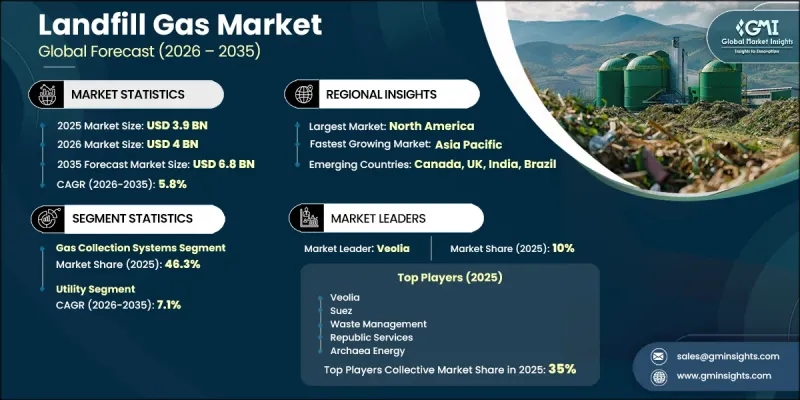
隨著各國政府和掩埋營運商持續投資於先進的氣體收集和處理基礎設施,以提升環境績效並滿足不斷變化的監管要求,垃圾掩埋沼氣(LFG)市場正穩步成長。都市固態廢棄物處理設施中氣體收集和控制系統的日益普及推動了市場擴張,尤其是在那些擁有完善的廢棄物管理系統和健全的可再生能源推廣政策的地區。此外,終端用途的結構性轉變也使市場受益。過去主要依賴傳統發電,現在越來越重視將垃圾掩埋沼氣轉化為可再生天然氣,用於運輸和管道供應。同時,日益嚴格的甲烷排放法規迫使掩埋業者加強氣體回收能力並提高處理效率。模組化處理技術的進步降低了專案成本並加速了其應用,為更廣泛的市場准入創造了機會。此外,企業永續發展舉措和地方政府氣候策略也提高了垃圾掩埋沼氣利用作為減少溫室氣體排放可靠手段的重要性,這進一步推動了全球垃圾掩埋沼氣(LFG)市場的長期成長。
| 市場範圍 | |
|---|---|
| 開始年份 | 2025 |
| 預測期 | 2026-2035 |
| 初始市場規模 | 39億美元 |
| 預測金額 | 68億美元 |
| 複合年成長率 | 5.8% |
預計到2025年,天然氣燃燒系統市佔率將達到18.2%,到2035年將以1.5%的複合年成長率成長,成為產品類型中成長最慢的細分市場。在掩埋,由於回收的天然氣量和品質不足以支持能源回收和可再生天然氣生產,天然氣燃燒仍然是必要的合規措施。雖然燃燒在計畫初期和小規模設施中仍然廣泛使用,但隨著越來越多的掩埋場營運商投資於能夠提高能源回收和垃圾掩埋沼氣附加價值利用的技術,這一領域正日益被視為一種過渡性解決方案。
預計到2025年,公共產業板塊的市佔率將達到38.5%,並在2035年之前以7.1%的複合年成長率成長。作為更廣泛的脫碳策略和可再生能源採購舉措的一部分,公共產業正擴大將垃圾掩埋沼氣產生的可再生天然氣納入其能源供應組合。不斷擴大對可再生天然氣使用的政策支持、提高生物甲烷摻混比例要求以及加強減排力度,都為公共產業持續的需求創造了有利條件,從而鞏固了該板塊在整個預測期內的主導地位。
預計到2025年,北美垃圾掩埋沼氣(LFG)市場將成為最大的區域市場,佔38.5%的市場佔有率。該地區的成長得益於完善的環境法規、成熟的可再生天然氣激勵計劃以及對垃圾掩埋沼氣收集基礎設施的持續投資。有關排放管理的監管要求不斷鼓勵掩埋營運商實施先進的氣體收集和處理系統,從而為垃圾掩埋沼氣技術創造了穩定的需求,並支持北美市場的長期擴張。
目錄
第1章:調查方法和範圍
第2章執行摘要
第3章 行業洞察
- 產業生態系分析
- 原料層
- 氣體發生和收集層
- 處理、修改和進階圖層
- 終端應用中的能量轉換層
- 價值鏈盈利與利潤率分析
- 監理情勢
- 影響產業的因素
- 促進因素
- 嚴格的溫室氣體排放法規
- 企業和地方政府加大力度實現淨零排放。
- 產業潛在風險與挑戰
- 對天然氣收集基礎設施的大量資本投資
- 促進因素
- 成長潛力分析
- 波特的分析
- PESTLE分析
- 人工智慧和生成式人工智慧對市場的影響
- 利用人工智慧改造公共產業
- 生成式人工智慧的應用案例與實施藍圖
- 風險、限制和監管考量
- 基礎架構和部署狀態
- 採用率
- 基礎設施投資的可擴展性限制和趨勢
第4章 競爭情勢
- 介紹
- 企業市佔率分析:按地區分類
- 北美洲
- 歐洲
- 亞太地區
- 中東和非洲
- 拉丁美洲
- 主要市場公司的競爭分析
- 競爭定位矩陣
- 主要進展
- 併購
- 夥伴關係和聯盟
- 新產品發布
- 業務拓展計劃及資金籌措
- 按公司規模進行基準測試
- 排名分類標準與選擇標準
- 按銷售額、地區和創新能力分類的層級定位矩陣。
第5章 市場規模及預測:依類型分類,2022-2035年
- 都市固態廢棄物
- 工業廢棄物
- 生物反應器
- 關閉/遺留問題
第6章 市場規模及預測:依技術分類,2022-2035年
- 氣體回收系統
- 氣體處理和淨化系統
- 瓦斯燃燒系統
第7章 市場規模及預測:依最終用途分類,2022-2035年
- 公用事業
- 工業製造
- 商業設施
- 市政業務
- 運輸
第8章 市場規模及預測:依地區分類,2022-2035年
- 北美洲
- 美國
- 加拿大
- 墨西哥
- 歐洲
- 德國
- 英國
- 法國
- 西班牙
- 義大利
- 亞太地區
- 中國
- 印度
- 日本
- 韓國
- 澳洲
- 中東和非洲
- 沙烏地阿拉伯
- UAE
- 南非
- 拉丁美洲
- 巴西
- 阿根廷
第9章:公司簡介
- Ameresco
- Archaea Energy
- Beijing Enterprises Holdings
- Biffa Group
- Brightmark LLC
- Clean Energy Fuels Corp
- Fortistar LLC
- Gasrec
- Infinis Energy
- LiquidPower Technologies
- Montauk Renewables
- Opal Fuels
- Republic Services
- RNG Energy Solutions
- SCS Engineers
- Shanks Group
- Suez
- Vanguard Renewables
- Veolia
- Waste Management
The Global Landfill Gas (LFG) Market was valued at USD 3.9 billion in 2025 and is estimated to grow at a CAGR of 5.8% to reach USD 6.8 billion by 2035.
The landfill gas (LFG) market is experiencing steady growth as governments and landfill operators continue investing in advanced gas collection and treatment infrastructure to improve environmental performance and meet evolving regulatory requirements. Growing deployment of gas collection and control systems across municipal solid waste facilities is supporting market expansion, particularly in regions with well-established waste management frameworks and renewable energy incentives. The market is also benefiting from a structural transition in end-use applications, with increasing emphasis on converting landfill gas into renewable natural gas for transportation and pipeline distribution instead of relying primarily on conventional electricity generation. At the same time, increasingly stringent methane emission regulations are encouraging landfill operators to strengthen gas capture capabilities and improve processing efficiency. Advances in modular processing technologies are reducing project costs while accelerating deployment, creating opportunities for broader market participation. In addition, corporate sustainability initiatives and municipal climate strategies are increasing the importance of landfill gas utilization as a reliable pathway for reducing greenhouse gas emissions, further supporting long-term growth across the global landfill gas (LFG) market.
| Market Scope | |
|---|---|
| Start Year | 2025 |
| Forecast Year | 2026-2035 |
| Start Value | $3.9 Billion |
| Forecast Value | $6.8 Billion |
| CAGR | 5.8% |
The gas flaring systems segment accounted for 18.2% share in 2025 and is projected to grow at a CAGR of 1.5% through 2035, representing the slowest-growing product category. Gas flaring continues to serve as an essential compliance solution for landfill sites where gas collection volumes or quality remain insufficient to support energy recovery or renewable natural gas production. Although flaring remains widely utilized during early project stages and at smaller facilities, the segment is increasingly viewed as a transitional solution as more landfill operators invest in technologies that enable greater energy recovery and higher-value utilization of captured landfill gas.
The utility segment represented 38.5% share in 2025 and is expected to grow at a CAGR of 7.1% through 2035. Utilities continue to increase the integration of landfill gas-derived renewable natural gas into their energy supply portfolios as part of broader decarbonization strategies and renewable energy procurement initiatives. Growing policy support for renewable gas utilization, expanding biomethane blending requirements, and increasing commitments to lower carbon emissions are creating favorable conditions for sustained demand from utility companies, reinforcing the segment's leadership throughout the forecast period.
North America Landfill Gas (LFG) Market accounted for 38.5% share in 2025, making it the largest regional market. Growth across the region is supported by established environmental regulations, mature renewable natural gas incentive programs, and ongoing investments in landfill gas collection infrastructure. Regulatory requirements governing emissions management continue to encourage landfill operators to install advanced gas collection and treatment systems, creating consistent demand for landfill gas technologies and supporting long-term market expansion across North America.
Major companies operating in the global landfill gas (LFG) market include Ameresco, Republic Services, Waste Management, Veolia, SUEZ, Archaea Energy, Montauk Renewables, Clean Energy Fuels Corp., and Beijing Enterprises Holdings. Companies operating in the landfill gas (LFG) market are strengthening their competitive position by investing in advanced gas collection technologies, renewable natural gas production facilities, and efficient gas upgrading systems. Manufacturers and project developers continue to focus on improving methane recovery rates, increasing operational efficiency, and reducing project development costs through modular processing technologies. Strategic partnerships with municipalities, landfill operators, utility providers, and energy companies are expanding project pipelines and improving long-term revenue opportunities.
Table of Contents
Chapter 1 Methodology & Scope
- 1.1 Research approach
- 1.2 Quality commitments
- 1.2.1 GMI AI policy & data integrity commitment
- 1.2.1.1 Source consistency protocol
- 1.2.1 GMI AI policy & data integrity commitment
- 1.3 Research trail & confidence scoring
- 1.3.1 Research trail components
- 1.3.2 Scoring components
- 1.4 Data collection
- 1.4.1 Partial list of primary sources
- 1.5 Data mining sources
- 1.5.1 Paid sources
- 1.5.1.1 Sources, by region
- 1.5.1 Paid sources
- 1.6 Base estimates and calculations
- 1.6.1 Base year calculation for any one approach
- 1.7 Market estimates & forecasts parameters
- 1.8 Forecast model
- 1.8.1 Quantified market impact analysis
- 1.8.1.1 Mathematical impact of growth parameters on forecast
- 1.8.1 Quantified market impact analysis
- 1.9 Research transparency addendum
- 1.9.1 Source attribution framework
- 1.9.2 Quality assurance metrics
- 1.9.3 Our commitment to trust
- 1.10 Market definitions
Chapter 2 Executive Summary
- 2.1 Industry synopsis, 2022 - 2035
- 2.1.1 Business trends
- 2.1.2 Type trends
- 2.1.3 Technology trends
- 2.1.4 End use trends
- 2.1.5 Regional trends
Chapter 3 Industry Insights
- 3.1 Industry ecosystem analysis
- 3.1.1 Feedstock layer
- 3.1.2 Gas generation & collection layer
- 3.1.3 Treatment, processing & upgrading layer
- 3.1.4 End-use energy conversion layer
- 3.1.5 Value chain profitability & margin analysis
- 3.2 Regulatory landscape
- 3.3 Industry impact forces
- 3.3.1 Growth drivers
- 3.3.1.1 Stringent GHG emission mandates
- 3.3.1.2 Rising corporate & municipal net-zero commitments
- 3.3.2 Industry pitfalls and challenges
- 3.3.2.1 High capital expenditure for gas collection infrastructure
- 3.3.1 Growth drivers
- 3.4 Growth potential analysis
- 3.5 Porter's analysis
- 3.5.1 Bargaining power of suppliers
- 3.5.2 Bargaining power of buyers
- 3.5.3 Threat of new entrants
- 3.5.4 Threat of substitutes
- 3.5.5 Intensity of competitive rivalry
- 3.6 PESTEL analysis
- 3.6.1 Political factors
- 3.6.2 Economic factors
- 3.6.3 Social factors
- 3.6.4 Technological factors
- 3.6.5 Environmental factors
- 3.6.6 Legal factors
- 3.7 Impact of AI and generative AI on the market (Driven by primary research)
- 3.7.1 AI-driven disruption of utility business
- 3.7.2 GenAI use cases & adoption roadmap
- 3.7.3 Risks, limitations & regulatory considerations
- 3.8 Infrastructure & deployment landscape (Driven by Primary Research)
- 3.8.1 Deployment penetration
- 3.8.2 Scalability constraints & infrastructure investment trends
Chapter 4 Competitive Landscape, 2026
- 4.1 Introduction
- 4.2 Company market share analysis, by region, 2025
- 4.2.1 North America
- 4.2.2 Europe
- 4.2.3 Asia Pacific
- 4.2.4 Middle East & Africa
- 4.2.5 Latin America
- 4.3 Competitive analysis of major market players
- 4.4 Competitive positioning matrix
- 4.5 Key developments
- 4.5.1 Mergers & acquisitions
- 4.5.2 Partnerships & collaborations
- 4.5.3 New product launches
- 4.5.4 Expansion plans and funding
- 4.6 Company tier benchmarking
- 4.6.1 Tier classification criteria & qualifying thresholds
- 4.6.2 Tier positioning matrix by revenue, geography & innovation
Chapter 5 Market Size and Forecast, By type, 2022 - 2035 (USD Million)
- 5.1 Key trends
- 5.2 Municipal solid waste
- 5.3 Industrial waste
- 5.4 Bioreactor
- 5.5 Closed/Legacy
Chapter 6 Market Size and Forecast, By technology, 2022 - 2035 (USD Million)
- 6.1 Key trends
- 6.2 Gas collection systems
- 6.3 Gas treatment & processing systems
- 6.4 Gas flaring systems
Chapter 7 Market Size and Forecast, By End use, 2022 - 2035 (USD Million)
- 7.1 Key trends
- 7.2 Utility
- 7.3 Industrial manufacturing
- 7.4 Commercial facilities
- 7.5 Municipal operations
- 7.6 Transportation
Chapter 8 Market Size and Forecast, By Region, 2022 - 2035 (USD Million)
- 8.1 Key trends
- 8.2 North America
- 8.2.1 U.S.
- 8.2.2 Canada
- 8.2.3 Mexico
- 8.3 Europe
- 8.3.1 Germany
- 8.3.2 UK
- 8.3.3 France
- 8.3.4 Spain
- 8.3.5 Italy
- 8.4 Asia Pacific
- 8.4.1 China
- 8.4.2 India
- 8.4.3 Japan
- 8.4.4 South Korea
- 8.4.5 Australia
- 8.5 Middle East & Africa
- 8.5.1 Saudi Arabia
- 8.5.2 UAE
- 8.5.3 South Africa
- 8.6 Latin America
- 8.6.1 Brazil
- 8.6.2 Argentina
Chapter 9 Company Profiles
- 9.1 Ameresco
- 9.2 Archaea Energy
- 9.3 Beijing Enterprises Holdings
- 9.4 Biffa Group
- 9.5 Brightmark LLC
- 9.6 Clean Energy Fuels Corp
- 9.7 Fortistar LLC
- 9.8 Gasrec
- 9.9 Infinis Energy
- 9.10 LiquidPower Technologies
- 9.11 Montauk Renewables
- 9.12 Opal Fuels
- 9.13 Republic Services
- 9.14 RNG Energy Solutions
- 9.15 SCS Engineers
- 9.16 Shanks Group
- 9.17 Suez
- 9.18 Vanguard Renewables
- 9.19 Veolia
- 9.20 Waste Management

 掩埋氣:市場佔有率分析、行業趨勢和統計數據、成長預測(2026-2031 年)
 掩埋氣市場規模、佔有率和趨勢分析報告:按技術、應用、地區和細分市場分類的預測(2026-2033 年)
 掩埋氣市場規模、佔有率、成長及全球產業分析:按類型、應用和地區的洞察,2026-2034年的預測
 掩埋氣監測市場:依監測模式、產品類型、氣體類型、通路、技術、應用和最終用戶產業分類-全球預測,2026-2032年掩埋泵浦市場:按泵浦類型、動力來源、應用和最終用戶分類,全球預測,2026-2032年全球垃圾掩埋沼氣回收利用市場規模、佔有率、趨勢及成長分析報告(2026-2034年)
 2026年全球掩埋氣體收集與利用市場報告
 垃圾掩埋沼氣市場-全球產業規模、佔有率、趨勢、機會及預測(依技術、應用、區域及競爭格局分類,2021-2031年)垃圾掩埋沼氣成分檢測市場(按檢測類型、氣體成分、方法、服務模式、最終用戶和計劃類型分類),全球預測(2026-2032年)全球垃圾掩埋氣發電 (LFGE) 市場 - 產業分析、規模、佔有率、成長、趨勢和預測 (2033) - 按應用程式和地區劃分:北美、歐洲、亞太、拉丁美洲、中東和非洲