

 |
市場調查報告書
商品編碼
2101924
水下攝影機市場機會、成長要素、產業趨勢分析及2026-2035年預測Underwater Camera Market Opportunity, Growth Drivers, Industry Trend Analysis, and Forecast 2026 - 2035 |
||||||

全球水下相機市場預計到 2025 年將達到 40 億美元,年複合成長率為 8.1%,到 2035 年將達到 87 億美元。
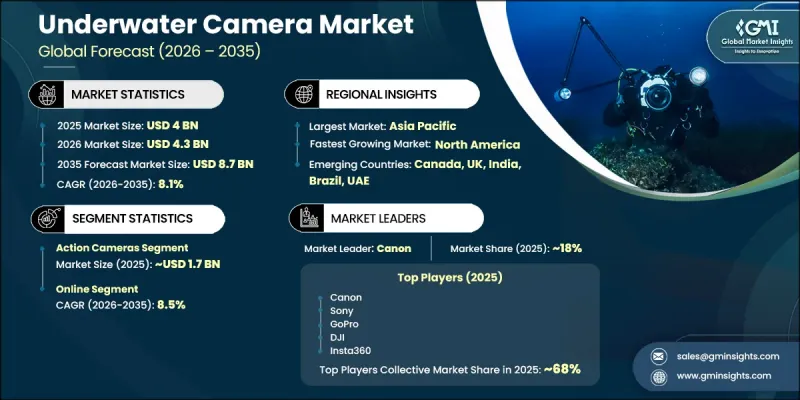
隨著休閒水上活動、海洋探勘和數位內容創作在全球範圍內的持續發展,水下相機市場正蓬勃發展。隨著越來越多的人參與探險旅遊和水上體驗,消費者積極投資能夠在惡劣水下環境中可靠運作的成像設備。人們對透過數位平台記錄和共用旅行體驗的興趣日益濃厚,進一步提升了休閒用戶和內容創作者對水下相機的認知度和使用率。製造商們積極響應市場需求,推出了緊湊耐用、技術先進的設備,這些設備在影像品質、連接性和易用性方面均有所提升。除了消費應用之外,水下相機在需要對海洋環境進行視覺檢測和監控的商業領域也變得越來越重要。來自海上作業、海洋基礎設施和水下維護的需求正在推動市場進一步發展。相機設計、成像性能和防水技術的不斷改進有望創造新的成長機遇,並鞏固水下相機在消費和工業應用中的地位。
| 市場範圍 | |
|---|---|
| 開始年份 | 2025 |
| 預測期 | 2026-2035 |
| 初始市場規模 | 40億美元 |
| 預測金額 | 87億美元 |
| 複合年成長率 | 8.1% |
預計到2025年,運動攝影機市場規模將達到17億美元,並在2026年至2035年間以7.8%的複合年成長率成長。推動該市場成長的主要因素包括:運動相機非常適合水下環境,以及其緊湊的設計、耐用性、便攜性和易用性。這些相機即使在水浸、衝擊和溫度變化等惡劣條件下也能正常運作,因此成為休閒用戶和探險愛好者的首選。與高階專業相機系統相比,其價格優勢進一步提升了運動相機在旅行者、運動愛好者和水下攝影初學者中的受歡迎程度。水上休閒活動的日益普及也持續推動著全球市場對運動攝影機的需求。
預計到2025年,線上分銷管道將佔據55.4%的市場佔有率,並在2026年至2035年間以8.5%的複合年成長率成長。數位銷售平台的重要性日益凸顯,因為它們為客戶提供了便捷的管道,讓他們能夠輕鬆獲取各種產品信息,並在購買前比較產品的功能、規格和價格。線上評論、技術評估和消費者回饋在影響購買決策方面也發揮著至關重要的作用,尤其對於初涉水下攝影領域的新用戶。製造商正不斷加強其線上直銷策略,以提高客戶參與、增強品牌影響力並有效率地推出新產品。
美國水下相機市場預計到2025年將達到9.381億美元,並在2026年至2035年間以8.4%的複合年成長率成長。該國市場成長的主要驅動力是休閒潛水、衝浪和其他水上活動的積極參與。此外,越來越多的數位內容創作者和消費者使用水下攝影設備進行旅行、生活方式和戶外相關內容的創作,也推動了市場需求。美國市場也受益於主要相機製造商的持續技術創新,包括影像處理、影片品質、影像防手震和智慧功能的改進。頻繁的產品創新鼓勵消費者積極升級設備並採用更新的水下攝影解決方案。
目錄
第1章:調查方法和範圍
第2章執行摘要
第3章 行業洞察
- 產業生態系分析
- 供應商情況
- 利潤率
- 每個階段增加的價值
- 影響價值鏈的因素
- 影響產業的因素
- 促進因素
- 在全球範圍內,探險旅遊和水上運動的參與人數不斷增加,推動了消費者的需求成長。
- 社群媒體上日益成長的內容創作文化正在推動休閒水下攝影的發展。
- 擴大對石油、天然氣和海事產業海底基礎設施的檢驗要求。
- 精準水產養殖的引入推動了對即時水下監測的需求。
- 人工智慧影像校正和深度自適應色彩校正的技術進步。
- 產業潛在風險與挑戰
- 由於影像處理和連接技術的快速發展,導致產品快速過時。
- 來自中國低成本OEM廠商的激烈競爭給利潤率帶來了壓力。
- 在極端工作深度下保持防水性能所涉及的技術複雜性。
- 新興市場和發展中市場消費者意識和產品知識不足。
- 機會
- 整個媒體和娛樂產業對 360° 和 VR 水下內容體驗的需求都在不斷成長。
- 加固型攝影機在海軍、港口安全和國防監控領域的應用不斷擴展。
- 增加對海洋保護和氣候變遷研究的投入,將刺激機構投資者的需求。
- 潛水旅遊的擴張和可支配收入的增加正在推動亞太地區尚未開發的成長。
- 促進因素
- 成長潛力分析
- 未來市場趨勢
- 技術與創新展望
- 最新科技趨勢
- 新興技術
- 監理情勢
- 標準和合規要求
- 區域監理框架
- 認證標準
- 貿易數據分析
- 進出口量及進口額趨勢
- 主要貿易路線及關稅的影響
- 價格分析
- 對過去價格趨勢的分析
- 按業務類型(高階/低階/大眾市場)分類的定價策略
- 人工智慧和生成式人工智慧對市場的影響
- 利用人工智慧改造現有經營模式
- 按細分市場分類的生成式人工智慧用例和部署藍圖
- 風險、限制和監管考量
- 波特的分析
- PESTLE分析
- 消費者購買行為分析
- 人口趨勢
- 影響購買決策的因素
- 消費者產品採納
- 首選分銷管道
第4章 競爭情勢
- 介紹
- 企業市佔率分析
- 按地區
- 企業矩陣分析
- 主要市場公司的競爭分析
- 競爭定位矩陣
- 主要進展
- 併購
- 夥伴關係和聯盟
- 新產品發布
- 業務拓展計劃
第5章 市場估算與預測:依產品類型分類,2022-2035年
- 運動攝影機
- 小型防水相機
- 附水下外殼的數位單眼相機
- 附水下外殼的無反光鏡相機
- 360°相機和專用水下相機
第6章 市場估算與預測:依感測器技術分類,2022-2035年
- CMOS(互補型金屬氧化物半導體)
- BSI-CMOS(背照式CMOS)
- CCD(電荷耦合元件)
第7章 市場估計與預測:依決議分類,2022-2035年
- 低於 2K(高清和全高清)
- 2K
- 4K
- 8K 或更高
第8章 市場估算與預測:以連結方式分類,2022-2035年
- 沒有無線連接
- 藍牙相容
- 具備 Wi-Fi 功能
- 多重通訊協定(藍牙+Wi-Fi)
第9章 市場估計與預測:依價格區間分類,2022-2035年
- 低的
- 中等的
- 高的
第10章 市場估價與預測:依應用領域分類,2022-2035年
- 休閒用途
- 冒險運動和內容創作
- 專業攝影和影像
- 科學與環境調查
- 商業檢驗和維護
- 安全監控
- 漁業及水產養殖監測
第11章 市場估價與預測:依通路分類,2022-2035年
- 線上
- 離線
第12章 市場估計與預測:依地區分類,2022-2035年
- 北美洲
- 美國
- 加拿大
- 歐洲
- 德國
- 英國
- 法國
- 義大利
- 西班牙
- 亞太地區
- 中國
- 印度
- 日本
- 韓國
- 澳洲
- 印尼
- 馬來西亞
- 拉丁美洲
- 巴西
- 墨西哥
- 阿根廷
- 中東和非洲
- 沙烏地阿拉伯
- UAE
- 南非
第13章:公司簡介
- 世界頂尖公司
- GoPro Inc.
- Canon Inc.
- Sony Corporation
- Nikon Corporation
- OM Digital Solutions Corporation(Olympus)
- Fujifilm Holdings Corporation
- Panasonic Corporation
- 該地區的領先企業
- Garmin Ltd.
- Ricoh Company Ltd.
- SeaLife Cameras
- Ikelite Underwater Systems
- Imenco AS
- 新興企業
- Insta360
- Drift Innovation Ltd.
- CatchCam Technologies
- OTAQ Plc
- AquaVu
The Global Underwater Camera Market was valued at USD 4 billion in 2025 and is estimated to grow at a CAGR of 8.1% to reach USD 8.7 billion by 2035.
The underwater camera market is gaining momentum as recreational water activities, marine exploration, and digital content creation continue to expand worldwide. Increasing participation in adventure tourism and water-based experiences is encouraging consumers to invest in reliable imaging equipment capable of operating in demanding underwater conditions. Growing interest in capturing and sharing travel experiences through digital platforms is further increasing awareness and adoption of underwater cameras among recreational users and content creators. Manufacturers are responding by introducing compact, durable, and technologically advanced devices featuring improved image quality, enhanced connectivity, and greater ease of operation. Beyond consumer applications, underwater cameras are becoming increasingly important in commercial industries that require visual inspection and monitoring capabilities in marine environments. Demand from sectors such as offshore operations, marine infrastructure, and underwater maintenance is supporting broader market development. Continuous improvements in camera design, imaging performance, and waterproof technology are expected to create new growth opportunities while strengthening the role of underwater cameras across both consumer and industrial applications.
| Market Scope | |
|---|---|
| Start Year | 2025 |
| Forecast Year | 2026-2035 |
| Start Value | $4 Billion |
| Forecast Value | $8.7 Billion |
| CAGR | 8.1% |
The action cameras segment generated USD 1.7 billion in 2025 and is expected to grow at a CAGR of 7.8% from 2026 to 2035. The segment continues to lead due to its strong suitability for underwater environments, offering compact designs, durability, portability, and simple operation. These cameras are built to perform under challenging conditions, including exposure to water, impacts, and temperature changes, making them a preferred option for recreational users and adventure enthusiasts. Their affordable pricing compared with advanced professional camera systems further increases accessibility among travelers, sports participants, and beginner underwater photographers. Rising participation in water-based recreational activities continues to support demand for action cameras across global markets.
The online distribution segment held 55.4% share in 2025 and is forecast to grow at a CAGR of 8.5% from 2026 to 2035. Digital sales platforms continue to gain importance because they provide customers with convenient access to a wide selection of products, allowing comparisons of features, specifications, and pricing before purchase. Online reviews, technical evaluations, and consumer feedback also play a significant role in influencing buying decisions, particularly among new users entering the underwater photography segment. Manufacturers are increasingly strengthening their direct online sales strategies to improve customer engagement, enhance brand presence, and introduce new products more efficiently.
U.S. Underwater Camera Market captured USD 938.1 million in 2025 and is projected to grow at a CAGR of 8.4% from 2026 to 2035. Market growth in the country is supported by strong participation in recreational diving, surfing, and other water-based activities. Demand is further encouraged by the expanding presence of digital creators and consumers who use underwater imaging equipment for travel, lifestyle, and outdoor content. The U.S. market also benefits from continuous technological advancements introduced by leading camera manufacturers, including improvements in image processing, video quality, stabilization, and smart features. Frequent product innovation continues to encourage consumers to upgrade their equipment and adopt newer underwater imaging solutions.
Major companies operating in the global underwater camera market include Fujifilm Holdings Corporation, GoPro Inc., Canon Inc., Sony Corporation, Nikon Corporation, OM Digital Solutions Corporation (Olympus), Panasonic Corporation, Garmin Ltd., Ricoh Company Ltd., SeaLife Cameras, Ikelite Underwater Systems, Imenco AS, Insta360, Drift Innovation Ltd., CatchCam Technologies, OTAQ Plc, and AquaVu. Companies operating in the global underwater camera market are adopting strategies centered on product innovation, technology enhancement, strategic partnerships, and digital market expansion to strengthen their competitive position. Manufacturers are investing in advanced imaging technologies, improved waterproof designs, artificial intelligence-based features, and enhanced connectivity solutions to meet evolving consumer expectations. Companies are also expanding their product portfolios to serve recreational users, professional photographers, and industrial customers with application-specific solutions. Stronger online distribution networks, direct-to-consumer platforms, and targeted marketing campaigns are being used to increase brand visibility and customer engagement.
Table of Contents
Chapter 1 Methodology & Scope
- 1.1 Scope & definitions
- 1.2 Research design
- 1.2.1 Research approach
- 1.2.2 Data collection methods
- 1.3 Base estimates and calculations
- 1.3.1 Base year calculation
- 1.3.2 Market estimates & forecasts parameters
- 1.4 Forecast Model
- 1.4.1 Key trends for market estimates
- 1.4.2 Quantified market impact analysis
- 1.4.2.1 Mathematical impact of growth parameters on forecast
- 1.4.3 Scenario analysis framework
- 1.5 Primary research and validation
- 1.5.1 Some of the primary sources (but not limited to)
- 1.6 Data mining sources
- 1.6.1 Paid Sources
- 1.7 Primary sources
- 1.8 Research Trail & confidence scoring
- 1.8.1 Research trail components
- 1.8.2 Scoring components
- 1.9 Research transparency addendum
- 1.9.1 Source attribution framework
- 1.9.2 Quality assurance metrics
- 1.10 Our commitment to trust
Chapter 2 Executive Summary
- 2.1 Industry 360° synopsis
- 2.2 Key market trends
- 2.2.1 Regional
- 2.2.2 Product Type
- 2.2.3 Sensor Technology
- 2.2.4 Resolution
- 2.2.5 Connectivity
- 2.2.6 Price Range
- 2.2.7 Application
- 2.2.8 Distribution Channel
Chapter 3 Industry Insights
- 3.1 Industry ecosystem analysis
- 3.1.1 Supplier landscape
- 3.1.2 Profit margin
- 3.1.3 Value addition at each stage
- 3.1.4 Factor affecting the value chain
- 3.2 Industry impact forces
- 3.2.1 Growth drivers
- 3.2.1.1 Rising Global Adventure Tourism & Water Sports Participation Driving Consumer Demand
- 3.2.1.2 Growing Social Media Content Creation Culture Fueling Recreational Underwater Photography
- 3.2.1.3 Expanding Subsea Infrastructure Inspection Requirements in Oil & Gas & Marine Industries
- 3.2.1.4 Precision Aquaculture Adoption Driving Demand for Real-Time Underwater Monitoring
- 3.2.1.5 Technological Advancements in AI-Powered Image Enhancement & Depth-Adaptive Color Correction
- 3.2.2 Industry pitfalls & challenges
- 3.2.2.1 Rapid Product Obsolescence Due to Fast-Evolving Imaging & Connectivity Technology Cycles
- 3.2.2.2 Intense Price Competition from Low-Cost Chinese OEM Manufacturers Eroding Margins
- 3.2.2.3 Technical Complexity of Maintaining Waterproof Integrity at Extreme Operational Depths
- 3.2.2.4 Limited Consumer Awareness & Product Education in Emerging & Developing Markets
- 3.2.3 Opportunities
- 3.2.3.1 Growing Demand for 360° & VR Underwater Content Experiences Across Media & Entertainment
- 3.2.3.2 Expanding Naval, Port Security & Defense Surveillance Applications for Ruggedized Cameras
- 3.2.3.3 Rising Investment in Marine Conservation & Climate Change Research Creating Institutional Demand
- 3.2.3.4 Untapped Growth in Asia Pacific Driven by Expanding Dive Tourism & Rising Disposable Income
- 3.2.1 Growth drivers
- 3.3 Growth potential analysis
- 3.4 Future market trends
- 3.5 Technology and innovation landscape
- 3.5.1 Current technological trends
- 3.5.2 Emerging technologies
- 3.6 Regulatory landscape
- 3.6.1 Standards and compliance requirements
- 3.6.2 Regional regulatory frameworks
- 3.6.3 Certification standards
- 3.7 Trade data analysis (HS Code 8525.89)
- 3.7.1 Import/export volume & value trends
- 3.7.2 Key trade corridors & tariff impact
- 3.8 Pricing analysis
- 3.8.1 Historical price trend analysis (driven by primary research)
- 3.8.2 Pricing strategy by player type (premium / value / mass market)
- 3.9 Impact of AI & generative AI on the market
- 3.9.1 AI-driven disruption of existing business models
- 3.9.2 GenAI use cases & adoption roadmap by segment
- 3.9.3 Risks, limitations & regulatory considerations
- 3.10 Porter’s analysis
- 3.11 PESTEL analysis
- 3.12 Consumer buying behavior analysis
- 3.12.1 Demographic trends
- 3.12.2 Factors affecting buying decisions
- 3.12.3 Consumer product adoption
- 3.12.4 Preferred distribution channel
Chapter 4 Competitive Landscape, 2025
- 4.1 Introduction
- 4.2 Company market share analysis
- 4.2.1 By Region
- 4.2.1.1 North America
- 4.2.1.2 Europe
- 4.2.1.3 Asia Pacific
- 4.2.1.4 Latin America
- 4.2.1.5 Middle East & Africa
- 4.2.1 By Region
- 4.3 Company matrix analysis
- 4.4 Competitive analysis of major market players
- 4.5 Competitive positioning matrix
- 4.6 Key developments
- 4.6.1 Mergers & acquisitions
- 4.6.2 Partnerships & collaborations
- 4.6.3 New product launches
- 4.6.4 Expansion plans
Chapter 5 Market Estimates & Forecast, By Product Type, 2022 – 2035, (USD Billion) (Million Units)
- 5.1 Key trends
- 5.2 Action Cameras
- 5.3 Compact Waterproof Cameras
- 5.4 DSLR Cameras with Underwater Housing
- 5.5 Mirrorless Cameras with Underwater Housing
- 5.6 360° & Specialty Underwater Cameras
Chapter 6 Market Estimates & Forecast, By Sensor Technology, 2022 – 2035, (USD Billion) (Million Units)
- 6.1 Key trends
- 6.2 CMOS (Complementary Metal-Oxide Semiconductor)
- 6.3 BSI-CMOS (Back-Side Illuminated CMOS)
- 6.4 CCD (Charge-Coupled Device)
Chapter 7 Market Estimates & Forecast, By Resolution, 2022 – 2035, (USD Billion) (Million Units)
- 7.1 Key trends
- 7.2 Below 2K (HD & Full HD)
- 7.3 2K
- 7.4 4K
- 7.5 8K & Above
Chapter 8 Market Estimates & Forecast, By Connectivity, 2022 – 2035, (USD Billion) (Million Units)
- 8.1 Key trends
- 8.2 No Wireless Connectivity
- 8.3 Bluetooth-Enabled
- 8.4 Wi-Fi Enabled
- 8.5 Multi-Protocol (Bluetooth + Wi-Fi)
Chapter 9 Market Estimates & Forecast, By Price Range, 2022 – 2035, (USD Billion) (Million Units)
- 9.1 Key trends
- 9.2 Low
- 9.3 Medium
- 9.4 High
Chapter 10 Market Estimates & Forecast, By Application, 2022 – 2035, (USD Billion) (Million Units)
- 10.1 Key trends
- 10.2 Recreational Use
- 10.3 Adventure Sports & Content Creation
- 10.4 Professional Photography & Cinematography
- 10.5 Scientific & Environmental Research
- 10.6 Commercial Inspection & Maintenance
- 10.7 Security & Surveillance
- 10.8 Fishing & Aquaculture Monitoring
Chapter 11 Market Estimates & Forecast, By Distribution Channel, 2022 – 2035, (USD Billion) (Million Units)
- 11.1 Key trends
- 11.2 Online
- 11.3 Offline
Chapter 12 Market Estimates & Forecast, By Region, 2022 – 2035, (USD Billion) (Million Units)
- 12.1 Key trends
- 12.2 North America
- 12.2.1 U.S.
- 12.2.2 Canada
- 12.3 Europe
- 12.3.1 Germany
- 12.3.2 UK
- 12.3.3 France
- 12.3.4 Italy
- 12.3.5 Spain
- 12.4 Asia Pacific
- 12.4.1 China
- 12.4.2 India
- 12.4.3 Japan
- 12.4.4 South Korea
- 12.4.5 Australia
- 12.4.6 Indonesia
- 12.4.7 Malaysia
- 12.5 Latin America
- 12.5.1 Brazil
- 12.5.2 Mexico
- 12.5.3 Argentina
- 12.6 MEA
- 12.6.1 Saudi Arabia
- 12.6.2 UAE
- 12.6.3 South Africa
Chapter 13 Company Profiles
- 13.1 Top Global Players
- 13.1.1 GoPro Inc.
- 13.1.2 Canon Inc.
- 13.1.3 Sony Corporation
- 13.1.4 Nikon Corporation
- 13.1.5 OM Digital Solutions Corporation (Olympus)
- 13.1.6 Fujifilm Holdings Corporation
- 13.1.7 Panasonic Corporation
- 13.2 Regional Champions
- 13.2.1 Garmin Ltd.
- 13.2.2 Ricoh Company Ltd.
- 13.2.3 SeaLife Cameras
- 13.2.4 Ikelite Underwater Systems
- 13.2.5 Imenco AS
- 13.3 Emerging Players
- 13.3.1 Insta360
- 13.3.2 Drift Innovation Ltd.
- 13.3.3 CatchCam Technologies
- 13.3.4 OTAQ Plc
- 13.3.5 AquaVu


