


 |
市場調查報告書
商品編碼
2101919
發炎性腸道疾病治療市場機會、成長要素、產業趨勢分析及2026-2035年預測Inflammatory Bowel Disease Treatment Market Opportunity, Growth Drivers, Industry Trend Analysis, and Forecast 2026 - 2035 |
||||||

全球發炎性腸道疾病治療市場預計到 2025 年將達到 281 億美元,到 2035 年將以 6% 的複合年成長率成長至 503 億美元。
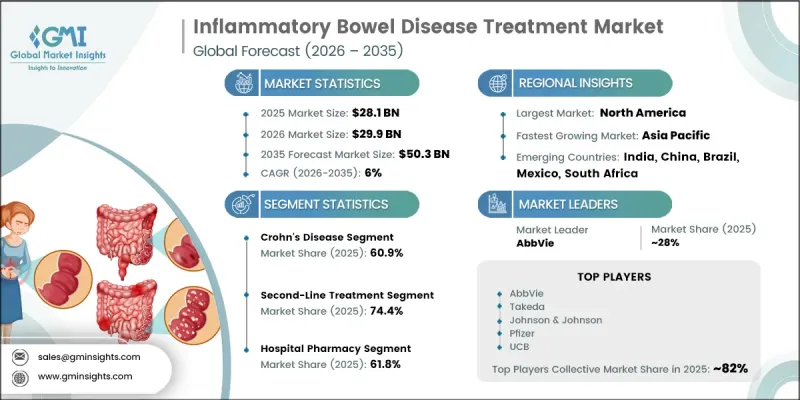
發炎性腸道疾病 (IBD) 治療市場正穩步成長,這主要得益於慢性胃腸道疾病患病率的上升、保險報銷政策的改善以及人們對早期診斷和適當疾病管理重要性的認知不斷提高。 IBD 治療的重點在於控制胃腸道慢性炎症,緩解症狀,阻止疾病進展,並透過藥物、營養管理、生活方式調整以及在臨床必要時進行手術干預等綜合手段實現長期緩解。製藥公司不斷加大研發投入,推出創新治療方案,例如先進的生物製藥、生物相似藥和標靶治療,以改善臨床療效並拓展治療選擇。策略聯盟、收購和產品開發工作正在加速創新,同時也為患者提供更多獲得新一代治療的機會。此外,政府支持、簡化的監管流程和健全的保險報銷機制正在改善整個醫療保健系統內患者的治療可及性。醫療保健專業人員和患者意識的提高進一步促進了早期診斷、更好的疾病監測和更有效的長期管理,為發炎性腸道疾病治療市場的持續成長創造了有利環境。
| 市場範圍 | |
|---|---|
| 開始年份 | 2025 |
| 預測期 | 2026-2035 |
| 上市時的市場規模 | 281億美元 |
| 預測金額 | 503億美元 |
| 複合年成長率 | 6% |
到2025年,克隆氏症細分市場將佔據60.9%的市場佔有率,繼續保持主導主要得益於該疾病患病率的上升、診斷能力的提高以及支持長期疾病管理和改善患者預後的先進療法的廣泛應用。由於克隆氏症是一種慢性疾病,需要持續治療、定期監測和長期疾病管理,因此,能夠改善患者生活品質並延緩疾病進展的創新療法的需求將持續存在。
預計到2025年,醫院藥局市佔率將達到61.8%。這主要歸功於醫院藥局在分發發炎性腸道疾病專用藥物方面發揮的關鍵作用,這些藥物通常需要臨床監督和先進的醫療基礎設施。醫院藥局與多專業醫療團隊緊密合作,以確保治療順利進行,提高病患用藥依從性,並最佳化病患的長期療效。醫院藥房管理複雜治療方案和提供專業藥物警戒的能力,持續鞏固其在市場中的主導地位。
到2025年,北美發炎性腸道疾病(IBD)治療市場將佔據65.5%的市場。該地區持續引領市場,主要得益於IBD的高發病率、完善的醫療基礎設施以及廣泛的先進治療方案。完善的報銷機制和全面的保險覆蓋使患者更容易獲得創新療法,從而促進了先進療法的穩定普及,並推動了該地區市場的持續成長。
目錄
第1章:調查方法
第2章執行摘要
第3章 行業洞察
- 產業生態系分析
- 影響產業的因素
- 促進因素
- 發炎性腸道疾病(IBD)盛行率增加
- 優惠的還款政策
- 技術進步
- 提高對發炎性腸道疾病症狀的認知和早期診斷
- 產業潛在風險與挑戰
- 嚴格的法規環境
- 治療費用高昂
- 市場機遇
- 生物製藥和標靶治療的應用日益廣泛
- 新興市場的擴張
- 促進因素
- 成長潛力分析
- 監理情勢
- 技術展望
- 最新科技趨勢
- 新興技術
- 價格趨勢分析
- 未來市場趨勢
- 贖回方案
- 波特的分析
- PESTLE分析
- 人工智慧和生成式人工智慧對市場的影響
- 價值鏈分析
- 投資與資金籌措分析
- 治療轉換模式和治療順序的趨勢
- 治療基礎設施和臨床實施的現狀
第4章 競爭情勢
- 介紹
- 企業矩陣分析
- 企業市佔率分析
- 世界
- 北美洲
- 歐洲
- 亞太地區
- 競爭定位矩陣
- 主要市場公司的競爭分析
- 主要進展
- 併購
- 夥伴關係和聯盟
- 新產品發布
- 業務拓展計劃
第5章 市場估計與預測:依治療類型分類,2022-2035年
- 克隆氏症
- 潰瘍性大腸炎
第6章 市場估計與預測:依藥物類別分類,2022-2035年
- 一線治療
- 氨基水楊酸類藥物
- 皮質類固醇
- 二級治療
- IL抑制劑
- TNF抑制劑
- JAK抑制劑
- 抗整合素藥物
- S1P受體調變器
- 聯合治療
- TNF抑制劑+硫嘌呤類藥物
- 其他聯合治療
第7章 市場估計與預測:依給藥途徑分類,2022-2035年
- 注射藥物
- 口服
- 直腸
第8章 市場估算與預測:依通路分類,2022-2035年
- 醫院藥房
- 零售藥房
- 網路藥房
第9章 市場估計與預測:依地區分類,2022-2035年
- 北美洲
- 美國
- 加拿大
- 歐洲
- 德國
- 英國
- 法國
- 西班牙
- 義大利
- 荷蘭
- 亞太地區
- 中國
- 日本
- 印度
- 澳洲
- 韓國
- 拉丁美洲
- 巴西
- 墨西哥
- 阿根廷
- 中東和非洲
- 南非
- 沙烏地阿拉伯
- UAE
第10章:公司簡介
- AbbVie
- Alvotech
- Amgen
- Biogen
- Boehringer Ingelheim
- Celltrion
- Dr Falk Pharma
- Eli Lilly
- Ferring
- Johnson & Johnson
- ORGANON
- Pfizer
- Takeda Pharmaceuticals
- UCB
The Global Inflammatory Bowel Disease Treatment Market was valued at USD 28.1 billion in 2025 and is estimated to grow at a CAGR of 6% to reach USD 50.3 billion by 2035.
The inflammatory bowel disease treatment market is experiencing steady expansion, supported by the increasing incidence of chronic gastrointestinal disorders, improving reimbursement policies, and growing awareness that encourages earlier diagnosis and timely disease management. Inflammatory bowel disease treatment focuses on controlling chronic inflammation of the gastrointestinal tract, relieving symptoms, preventing disease progression, and achieving long-term remission through a combination of pharmacological therapies, nutritional management, lifestyle modifications, and surgical intervention when clinically required. Pharmaceutical companies continue to increase research and development investments to introduce innovative treatment options, including advanced biologics, biosimilars, and targeted therapies that improve clinical outcomes and expand therapeutic choices. Strategic partnerships, acquisitions, and product development initiatives are accelerating innovation while broadening patient access to next-generation therapies. In addition, supportive government initiatives, streamlined regulatory processes, and strong reimbursement frameworks are improving treatment accessibility across healthcare systems. Increasing awareness among healthcare professionals and patients is further promoting earlier diagnosis, better disease monitoring, and more effective long-term management, creating favorable conditions for sustained growth in the inflammatory bowel disease treatment market.
| Market Scope | |
|---|---|
| Start Year | 2025 |
| Forecast Year | 2026-2035 |
| Start Value | $28.1 Billion |
| Forecast Value | $50.3 Billion |
| CAGR | 6% |
The Crohn's disease segment accounted for 60.9% share in 2025, maintaining its leading position due to the rising prevalence of the condition, improvements in diagnostic capabilities, and increasing adoption of advanced therapeutic options that support long-term disease control and improved patient outcomes. The chronic nature of the disease requires continuous treatment, ongoing monitoring, and long-term disease management, resulting in sustained demand for innovative therapies that enhance quality of life and reduce disease progression.
The hospital pharmacy segment held 61.8% share in 2025, driven by its essential role in dispensing specialized inflammatory bowel disease therapies that often require clinical oversight and advanced healthcare infrastructure. Hospital pharmacies work closely with multidisciplinary medical teams to ensure coordinated treatment delivery, improve medication adherence, and optimize long-term patient outcomes. Their ability to manage complex treatment protocols and provide specialized pharmaceutical support continues to strengthen the segment's leadership within the market.
North America Inflammatory Bowel Disease Treatment Market accounted for 65.5% share in 2025. The region continues to lead the market due to the high prevalence of inflammatory bowel disease, well-established healthcare infrastructure, and widespread access to advanced therapeutic options. Strong reimbursement systems and comprehensive insurance coverage further improve patient access to innovative treatments, supporting consistent adoption of advanced therapies and contributing to continued regional market growth.
Major companies operating in the global inflammatory bowel disease treatment market include AbbVie, Takeda Pharmaceuticals, Johnson & Johnson, Pfizer, Eli Lilly, UCB, Celltrion, Amgen, Biogen, Alvotech, Boehringer Ingelheim, Ferring, Dr. Falk Pharma, and Organon. Companies participating in the inflammatory bowel disease treatment market are strengthening their competitive position through continuous investment in research and development aimed at expanding biologic, biosimilar, and targeted therapy portfolios. Strategic collaborations, licensing agreements, acquisitions, and partnerships are enabling manufacturers to accelerate product development while expanding global commercial reach. Organizations are also focusing on improving treatment efficacy, enhancing patient convenience, and developing therapies with better long-term safety profiles to address evolving clinical needs. Increased investment in precision medicine, advanced drug delivery technologies, and patient support programs is further improving treatment adherence and outcomes.
Table of Contents
Chapter 1 Research Methodology
- 1.1 Research approach
- 1.2 Quality commitments
- 1.2.1 GMI AI policy & data integrity commitment
- 1.2.1.1 Source consistency protocol
- 1.2.1 GMI AI policy & data integrity commitment
- 1.3 Research trail & confidence scoring
- 1.3.1 Research trail components
- 1.3.2 Scoring components
- 1.4 Data collection
- 1.4.1 Partial list of primary sources
- 1.5 Data mining sources
- 1.5.1 Paid sources
- 1.5.1.1 Sources, by region
- 1.5.1 Paid sources
- 1.6 Base estimates and calculations
- 1.6.1 Base year calculation for any one approach
- 1.7 Forecast model
- 1.7.1 Quantified market impact analysis
- 1.7.1.1 Mathematical impact of growth parameters on forecast
- 1.7.1 Quantified market impact analysis
- 1.8 Research transparency addendum
- 1.8.1 Source attribution framework
- 1.8.2 Quality assurance metrics
- 1.8.3 Our commitment to trust
Chapter 2 Executive Summary
- 2.1 Industry 360° synopsis
- 2.2 Key market trends
- 2.2.1 Regional trends
- 2.2.2 Treatment type trends
- 2.2.3 Drug class trends
- 2.2.4 Route of Administration trends
- 2.2.5 Distribution channel trends
- 2.3 CXO perspectives: Strategic imperatives
Chapter 3 Industry Insights
- 3.1 Industry ecosystem analysis
- 3.2 Industry impact forces
- 3.2.1 Growth drivers
- 3.2.1.1 Increasing prevalence of IBD
- 3.2.1.2 Favorable reimbursement policies
- 3.2.1.3 Technological advancements
- 3.2.1.4 Growing awareness and early diagnosis of IBD symptoms
- 3.2.2 Industry pitfalls and challenges
- 3.2.2.1 Stringent regulatory scenario
- 3.2.2.2 High cost of treatment
- 3.2.3 Market opportunities
- 3.2.3.1 Rising adoption of biologics and targeted therapies
- 3.2.3.2 Expansion in emerging markets
- 3.2.1 Growth drivers
- 3.3 Growth potential analysis
- 3.4 Regulatory landscape (Driven by primary research)
- 3.4.1 North America
- 3.4.2 Europe
- 3.4.3 Asia Pacific
- 3.4.4 Latin America
- 3.4.5 Middle East and Africa
- 3.5 Technology landscape
- 3.5.1 Current technological trends
- 3.5.2 Emerging technologies
- 3.6 Pricing trend analysis (Driven by primary research)
- 3.7 Future market trends
- 3.8 Reimbursement scenario
- 3.9 Porter's analysis
- 3.10 PESTEL analysis
- 3.11 Impact of AI and Generative AI on the market (Driven by primary research)
- 3.12 Value chain analysis (Driven by primary research)
- 3.13 Investment & funding analysis (Driven by primary research)
- 3.14 Treatment switching patterns or sequencing trends
- 3.15 Treatment infrastructure & clinical adoption landscape
Chapter 4 Competitive Landscape, 2025
- 4.1 Introduction
- 4.2 Company matrix analysis
- 4.3 Company market share analysis (Driven by primary research)
- 4.3.1 Global
- 4.3.2 North America
- 4.3.3 Europe
- 4.3.4 Asia Pacific
- 4.4 Competitive positioning matrix
- 4.5 Competitive analysis of major market players
- 4.6 Key developments
- 4.6.1 Mergers & acquisitions
- 4.6.2 Partnerships & collaborations
- 4.6.3 New product launches
- 4.6.4 Expansion plans
Chapter 5 Market Estimates and Forecast, By Treatment Type, 2022 - 2035 ($ Mn)
- 5.1 Key trends
- 5.2 Crohn's disease
- 5.3 Ulcerative colitis
Chapter 6 Market Estimates and Forecast, By Drug Class, 2022 - 2035 ($ Mn)
- 6.1 Key trends
- 6.2 First-line treatment
- 6.2.1 Aminosalicylates
- 6.2.2 Corticosteroids
- 6.3 Second-line treatment
- 6.3.1 IL inhibitors
- 6.3.2 TNF inhibitors
- 6.3.3 JAK inhibitors
- 6.3.4 Anti-integrin
- 6.3.5 S1P receptor modulator
- 6.4 Combination therapy
- 6.4.1 TNF inhibitors + thiopurines
- 6.4.2 Other combination therapies
Chapter 7 Market Estimates and Forecast, By Route of Administration, 2022 - 2035 ($ Mn)
- 7.1 Key trends
- 7.2 Injectable
- 7.3 Oral
- 7.4 Rectal
Chapter 8 Market Estimates and Forecast, By Distribution Channel, 2022 - 2035 ($ Mn)
- 8.1 Key trends
- 8.2 Hospital pharmacy
- 8.3 Retail pharmacy
- 8.4 Online pharmacy
Chapter 9 Market Estimates and Forecast, By Region, 2022 - 2035 ($ Mn)
- 9.1 Key trends
- 9.2 North America
- 9.2.1 U.S.
- 9.2.2 Canada
- 9.3 Europe
- 9.3.1 Germany
- 9.3.2 UK
- 9.3.3 France
- 9.3.4 Spain
- 9.3.5 Italy
- 9.3.6 Netherlands
- 9.4 Asia Pacific
- 9.4.1 China
- 9.4.2 Japan
- 9.4.3 India
- 9.4.4 Australia
- 9.4.5 South Korea
- 9.5 Latin America
- 9.5.1 Brazil
- 9.5.2 Mexico
- 9.5.3 Argentina
- 9.6 Middle East and Africa
- 9.6.1 South Africa
- 9.6.2 Saudi Arabia
- 9.6.3 UAE
Chapter 10 Company Profiles
- 10.1 AbbVie
- 10.2 Alvotech
- 10.3 Amgen
- 10.4 Biogen
- 10.5 Boehringer Ingelheim
- 10.6 Celltrion
- 10.7 Dr Falk Pharma
- 10.8 Eli Lilly
- 10.9 Ferring
- 10.10 Johnson & Johnson
- 10.11 ORGANON
- 10.12 Pfizer
- 10.13 Takeda Pharmaceuticals
- 10.14 UCB

 發炎性腸道疾病治療市場-全球市場預測(2026-2032年)
 發炎性腸道疾病治療市場:按類型、藥物類別、給藥途徑、分銷管道、國家和地區分類-全球產業分析、市場規模、市場佔有率及2026年至2033年預測
 大腸激躁症治療市場規模、佔有率和成長分析:按藥物類別、疾病類型、治療方法、給藥途徑、分銷管道、最終用戶和地區分類-2026-2033年產業預測
 發炎性腸道疾病治療市場規模、佔有率和成長分析:按疾病類型、藥物類別、給藥途徑、分銷管道、最終用戶和地區分類-2026-2033年產業預測
 糞便鈣衛蛋白檢測市場:依檢測方法、適應症、最終用戶和地區分類
 大腸激躁症治療市場規模、佔有率、趨勢和預測:按類型、產品類型、分銷管道和地區分類,2026-2034年苯諾維林市場:2026-2032年全球市場預測(依劑型、適應症、通路、最終用戶、劑量及給藥途徑分類)
 全球大腸激躁症治療市場:規模、佔有率、趨勢和成長分析報告(2026-2034)發炎性腸道疾病治療市場:市場規模、佔有率、成長率、全球產業分析、按類型、應用和地區分類的考察以及未來預測(2026-2034年)
 發炎性腸道疾病治療市場分析及預測(至2035年):依類型、產品類型、服務、技術、應用、最終使用者、組件、模式、階段及解決方案分類