


 |
市場調查報告書
商品編碼
2101916
2026 年至 2035 年多癌種早期檢測市場的商業機會、成長要素、產業趨勢分析與預測。Multi Cancer Early Detection (MCED) Test Market Opportunity, Growth Drivers, Industry Trend Analysis, and Forecast 2026 - 2035 |
||||||

全球多癌症早期檢測 (MCED) 測試市場預計到 2025 年將達到 13 億美元,並以 14.8% 的複合年成長率成長至 2035 年的 53 億美元。
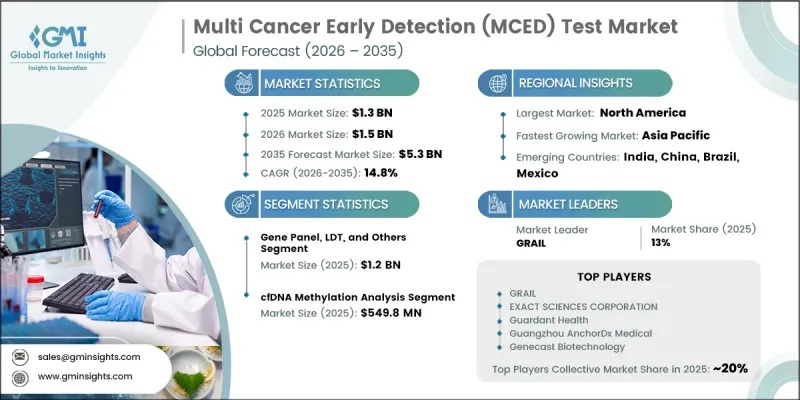
由於全球癌症負擔日益加重、診斷技術不斷進步以及對高效早期檢測解決方案的需求不斷成長,市場正蓬勃發展。人們對早期癌症檢測重要性的認知不斷提高,促使醫療專業人員、患者和機構採用先進的篩檢方法。人口結構、生活方式、環境因素和遺傳風險的變化也促使人們對更有效的癌症檢測方法的需求日益成長。多癌種早期檢測因其微創性而備受關注,只需一次血液檢測即可識別多種癌症類型。對精準醫療、分子診斷、人工智慧和先進分析技術的投資增加,進一步推動了市場發展。醫療系統正日益探索將多癌種早期檢測(MCED)技術作為更廣泛篩檢計畫的潛在工具,旨在改善患者預後並實現及時介入。隨著生物標記識別和診斷準確性的不斷創新,預計未來幾年多癌種早期檢測市場將保持持續成長。
| 市場範圍 | |
|---|---|
| 開始年份 | 2025 |
| 預測期 | 2026-2035 |
| 初始市場規模 | 13億美元 |
| 預測金額 | 53億美元 |
| 複合年成長率 | 14.8% |
人工智慧 (AI) 和數據分析技術的進步在加速多癌種早期檢測 (MCED) 市場成長方面發揮著至關重要的作用。以人工智慧為基礎的技術透過處理龐大的基因組、表觀基因、蛋白質組和臨床資料集,並識別與癌症發展相關的複雜模式,從而提升了篩檢能力。與傳統方法相比,這些先進的分析技術有助於提高診斷準確性、提升檢測效率,並且能夠快速解讀複雜的生物學資訊。
預計2025年,「基因檢測、實驗室自建檢測及其他」細分市場規模將達12億美元,市佔率高達91.9%。該細分市場之所以能保持主導地位,是因為這些檢測方法被廣泛用於識別與各種癌症相關的分子變化。此類別中的許多解決方案利用基因組區域、分子特徵和癌症相關生物標記來輔助檢測。其高度的適應性使得實驗室能夠根據患者需求、臨床應用以及目標族群的特定需求來客製化檢測流程。
到2025年,醫院領域將佔據48.7%的市場。醫院仍然是MCED檢測的主要終端用戶環境,因為它們支援癌症篩檢、診斷、治療計劃制定和長期患者管理。醫療機構正日益評估MCED技術,旨在將其整合到腫瘤學和預防醫學計畫中。此外,醫院內專業醫療團隊的存在有助於準確解讀高階檢測結果,並在需要進一步評估時採取適當的後續措施。
到2025年,北美多癌種早期檢測(MCED)市場將佔據42.3%的市場。該地區持續保持強勁成長勢頭,這主要得益於先進的醫療基礎設施、分子診斷技術的日益普及以及臨床研究投入的增加。醫療專業人員對基於血液的癌症篩檢方法的接受度不斷提高,以及液態生物檢體技術的進步,都為該地區的市場發展提供了支持。此外,領先的生物技術和診斷公司的存在也加速了生物標記研究、人工智慧(AI)驅動的分析平台以及下一代癌症檢測解決方案的創新。
目錄
第1章:調查方法和範圍
第2章執行摘要
第3章 行業洞察
- 產業生態系分析
- 影響產業的因素
- 促進因素
- 癌症發生率上升
- 除了癌症檢出率高之外,對有效的癌症診斷工具的需求也在增加。
- 數據分析和人工智慧(AI)在癌症篩檢的應用進展
- 產業潛在風險與挑戰
- 多種癌症篩檢測試高成本
- 與法規核准相關的挑戰
- 市場機遇
- 開發更經濟實惠的MCED測試
- 發展成為預防醫學和社區健康促進計畫。
- 促進因素
- 成長潛力分析
- 監理情勢
- 技術進步
- 最新科技趨勢
- 新興技術
- 價格趨勢分析
- 未來市場趨勢
- 波特的分析
- PESTLE分析
- 人工智慧和生成式人工智慧對市場的影響
- 價值鏈分析
- 治療基礎設施和臨床實施的現狀
第4章 競爭情勢
- 介紹
- 企業矩陣分析
- 企業市佔率分析
- 世界
- 北美洲
- 歐洲
- 亞太地區
- 競爭定位矩陣
- 主要市場公司的競爭分析
- 主要進展
- 併購
- 夥伴關係和聯盟
- 新產品發布
- 業務拓展計劃
第5章 市場估計與預測:依類型分類,2022-2035年
- 基因檢測板、實驗室自建檢測及其他
- 液態生物檢體
第6章 市場估算與預測:依生物標記類型分類,2022-2035年
- cfDNA甲基化分析
- 體細胞突變/ctDNA
- 基於蛋白質生物標記
- 多分析物/體學
- 片段混合和拷貝數變異
第7章 市場估計與預測:依最終用途分類,2022-2035年
- 醫院
- 診斷檢查室
- 其他最終用戶
第8章 市場估計與預測:依地區分類,2022-2035年
- 北美洲
- 美國
- 加拿大
- 歐洲
- 德國
- 英國
- 法國
- 西班牙
- 義大利
- 荷蘭
- 亞太地區
- 中國
- 印度
- 日本
- 澳洲
- 韓國
- 拉丁美洲
- 巴西
- 墨西哥
- 阿根廷
- 中東和非洲
- 沙烏地阿拉伯
- 南非
- UAE
第9章:公司簡介
- AnPac Bio-Medical Science
- Burning Rock Biotech
- EarlyDiagnostics
- Elypta
- EXACT SCIENCES CORPORATION
- Freenome Holdings
- Genecast Biotechnology
- GRAIL
- Guangzhou AnchorDx Medical
- GUARDANT HEALTH
- Harbinger Health
- Micronoma
- SeekIn
- Singlera Genomics
The Global Multi Cancer Early Detection (MCED) Test Market was valued at USD 1.3 billion in 2025 and is estimated to grow at a CAGR of 14.8% to reach USD 5.3 billion by 2035.
The market is witnessing momentum due to the rising global cancer burden, continuous improvements in diagnostic technologies, and increasing demand for efficient early detection solutions. Growing awareness regarding the importance of identifying cancer at earlier stages is encouraging healthcare providers, patients, and organizations to adopt advanced screening approaches. Changes in population demographics, lifestyle patterns, environmental factors, and genetic risks are contributing to the increasing need for improved cancer detection methods. Multi-cancer early detection tests are gaining attention because they provide a minimally invasive approach by identifying multiple cancer types through a single blood-based test. Expanding investments in precision medicine, molecular diagnostics, artificial intelligence, and advanced analytics are further supporting market development. Healthcare systems are increasingly exploring MCED technologies as potential tools for broader screening programs aimed at improving patient outcomes and enabling timely intervention. As innovation continues in biomarker identification and diagnostic accuracy, the multi-cancer early detection test market is expected to experience sustained growth over the coming years.
| Market Scope | |
|---|---|
| Start Year | 2025 |
| Forecast Year | 2026-2035 |
| Start Value | $1.3 Billion |
| Forecast Value | $5.3 Billion |
| CAGR | 14.8% |
Advancements in artificial intelligence and data analytics are playing an important role in accelerating the growth of the multi cancer early detection (MCED) test market. AI-based technologies are improving screening capabilities by processing extensive genomic, epigenomic, proteomic, and clinical datasets to identify complex patterns associated with cancer development. These advanced analytical methods are helping improve diagnostic accuracy, increase testing efficiency, and support faster interpretation of complex biological information compared with conventional approaches.
The gene panel, LDT, and other segment was valued at USD 1.2 billion in 2025 and accounted for 91.9% share. This segment maintains a leading position as these testing approaches are widely used to identify molecular changes associated with different cancer types. Most solutions within this category rely on genomic regions, molecular signatures, and cancer-related biomarkers to support detection. Their adaptability allows laboratories to customize testing procedures based on patient requirements, clinical applications, and population-specific needs.
The hospitals segment held a share of 48.7% in 2025. Hospitals remain a key end-use environment for MCED tests because they support cancer screening, diagnosis, treatment planning, and long-term patient management. Healthcare institutions are increasingly assessing MCED technologies for integration into oncology and preventive healthcare programs. The availability of specialized medical teams within hospitals also supports accurate interpretation of advanced test outcomes and enables appropriate follow-up procedures when additional evaluation is required.
North America Multi Cancer Early Detection (MCED) Test Market accounted for 42.3% share in 2025. The region continues to demonstrate strong growth due to its advanced healthcare infrastructure, increasing adoption of molecular diagnostic technologies, and expanding investment in clinical research. Growing acceptance of blood-based cancer screening methods among healthcare providers, along with advancements in liquid biopsy technologies, is supporting regional market development. The presence of leading biotechnology and diagnostic companies is also accelerating innovation in biomarker research, artificial intelligence-based analysis platforms, and next-generation cancer detection solutions.
Major companies operating in the global multi cancer early detection (MCED) test industry include GRAIL, EXACT SCIENCES CORPORATION, GUARDANT HEALTH, Freenome Holdings, AnPac Bio-Medical Science, Burning Rock Biotech, Early Diagnostics, Elypta, Genecast Biotechnology, Guangzhou AnchorDx Medical, Harbinger Health, Micronoma, SeekIn, and Singlera Genomics. Companies operating in the multi cancer early detection (MCED) test market are strengthening their competitive position through continuous research and development, strategic collaborations, and technological innovation. Market participants are focusing on improving biomarker discovery, enhancing artificial intelligence capabilities, and developing more accurate and scalable diagnostic platforms. Businesses are also investing in clinical validation studies, regulatory advancements, and partnerships with healthcare organizations to increase adoption of MCED technologies. Expansion of testing capabilities, improvement in affordability, and development of user-friendly solutions are becoming key strategies for increasing market penetration.
Table of Contents
Chapter 1 Methodology and Scope
- 1.1 Market scope and definition
- 1.2 Research design
- 1.2.1 Research approach
- 1.2.2 Data collection methods
- 1.3 Data mining sources
- 1.3.1 Global
- 1.3.2 Regional/Country
- 1.4 Base estimates and calculations
- 1.4.1 Base year calculation
- 1.4.2 Key trends for market estimation
- 1.5 Primary research and validation
- 1.5.1 Primary sources
- 1.6 Forecast model
- 1.7 Research assumptions and limitations
Chapter 2 Executive Summary
- 2.1 Industry 360° synopsis
- 2.2 Key market trends
- 2.2.1 Regional trends
- 2.2.2 Type trends
- 2.2.3 Biomarker class trends
- 2.2.4 End use trends
- 2.3 CXO perspectives: Strategic imperatives
Chapter 3 Industry Insights
- 3.1 Industry ecosystem analysis
- 3.2 Industry impact forces
- 3.2.1 Growth drivers
- 3.2.1.1 Increasing prevalence of cancer
- 3.2.1.2 High cancer detection rate coupled with growing demand for effective cancer tools
- 3.2.1.3 Advancements in data analytics and artificial intelligence (AI) utilized in cancer screening
- 3.2.2 Industry pitfalls and challenges
- 3.2.2.1 High cost of multi-cancer screening tests
- 3.2.2.2 Regulatory approval challenges
- 3.2.3 Market opportunities
- 3.2.3.1 Development of more affordable MCED tests
- 3.2.3.2 Expansion into preventive care and population health programs
- 3.2.1 Growth drivers
- 3.3 Growth potential analysis
- 3.4 Regulatory landscape
- 3.4.1 North America
- 3.4.2 Europe
- 3.4.3 Asia Pacific
- 3.4.4 Latin America
- 3.4.5 Middle East and Africa
- 3.5 Technological advancements
- 3.5.1 Current technological trends
- 3.5.2 Emerging technologies
- 3.6 Pricing trend analysis (Driven by primary research)
- 3.7 Future market trends (Driven by primary research)
- 3.8 Porter's analysis
- 3.9 PESTEL analysis
- 3.10 Impact of AI and Generative AI on the market (Driven by primary research)
- 3.11 Value chain analysis (Driven by primary research)
- 3.12 Treatment infrastructure and clinical adoption landscape (Driven by primary research)
Chapter 4 Competitive Landscape, 2025
- 4.1 Introduction
- 4.2 Company matrix analysis
- 4.3 Company market share analysis (Driven by primary research)
- 4.3.1 Global
- 4.3.2 North America
- 4.3.3 Europe
- 4.3.4 Asia Pacific
- 4.4 Competitive positioning matrix
- 4.5 Competitive analysis of major market players
- 4.6 Key developments
- 4.6.1 Mergers & acquisitions
- 4.6.2 Partnerships & collaborations
- 4.6.3 New product launches
- 4.6.4 Expansion plans
Chapter 5 Market Estimates and Forecast, By Type, 2022 - 2035 ($ Mn)
- 5.1 Key trends
- 5.2 Gene panel, LDT, and others
- 5.3 Liquid biopsy
Chapter 6 Market Estimates and Forecast, By Biomarker Class, 2022 - 2035 ($ Mn)
- 6.1 Key trends
- 6.2 cfDNA methylation analysis
- 6.3 Somatic mutation / ctDNA
- 6.4 Protein biomarker-based
- 6.5 Multi-analyte / multi-omics
- 6.6 Fragmentomics and CNV
Chapter 7 Market Estimates and Forecast, By End Use, 2022 - 2035 ($ Mn)
- 7.1 Key trends
- 7.2 Hospitals
- 7.3 Diagnostic laboratories
- 7.4 Other end users
Chapter 8 Market Estimates and Forecast, By Region, 2022 - 2035 ($ Mn)
- 8.1 Key trends
- 8.2 North America
- 8.2.1 U.S.
- 8.2.2 Canada
- 8.3 Europe
- 8.3.1 Germany
- 8.3.2 UK
- 8.3.3 France
- 8.3.4 Spain
- 8.3.5 Italy
- 8.3.6 Netherlands
- 8.4 Asia Pacific
- 8.4.1 China
- 8.4.2 India
- 8.4.3 Japan
- 8.4.4 Australia
- 8.4.5 South Korea
- 8.5 Latin America
- 8.5.1 Brazil
- 8.5.2 Mexico
- 8.5.3 Argentina
- 8.6 Middle East and Africa
- 8.6.1 Saudi Arabia
- 8.6.2 South Africa
- 8.6.3 UAE
Chapter 9 Company Profiles
- 9.1 AnPac Bio-Medical Science
- 9.2 Burning Rock Biotech
- 9.3 EarlyDiagnostics
- 9.4 Elypta
- 9.5 EXACT SCIENCES CORPORATION
- 9.6 Freenome Holdings
- 9.7 Genecast Biotechnology
- 9.8 GRAIL
- 9.9 Guangzhou AnchorDx Medical
- 9.10 GUARDANT HEALTH
- 9.11 Harbinger Health
- 9.12 Micronoma
- 9.13 SeekIn
- 9.14 Singlera Genomics

 農業基因組學領域NGS市場規模、佔有率和成長分析:按序列類型、應用、工作流程、最終用戶、技術、產品和地區分類-產業預測(2026-2033年)
 固體癌標靶蛋白市場:依適應症、標靶類別、治療方法、作用機制、國家及地區分類-全球產業分析、市場規模、市場佔有率及2026年至2033年預測
 針對原發灶不明的癌症治療,市場規模、佔有率、成長率、全球產業分析、區域趨勢以及 2026-2034 年預測。吸菸相關癌症的流行病學分析與預測:2026-2035年2026-2035年全球癌症疾病負擔及流行病學分析(按地區分類)全球癌症負擔及按年齡層別分類的流行病學分析(2026-2035 年)全球癌症負擔和流行病學分析:按性別分類(2026-2035 年)
 癌症譜分析與通路:技術與全球市場
 腦下垂體癌市場:依癌症類型、荷爾蒙類型、治療方法、年齡層、最終使用者和地區分類。胸腺癌市場:按類型、分期、治療方法、給藥途徑、年齡層、性別、最終用戶、分銷管道和地區分類