

 |
市場調查報告書
商品編碼
2101913
面膜生產設備市場:市場機會、成長要素、產業趨勢分析及2026-2035年預測Facial Mask Maker Market Opportunity, Growth Drivers, Industry Trend Analysis, and Forecast 2026 - 2035 |
||||||

全球面膜製造商市場預計到 2025 年將達到 9.354 億美元,年複合成長率為 6.9%,到 2035 年將達到 18.3 億美元。
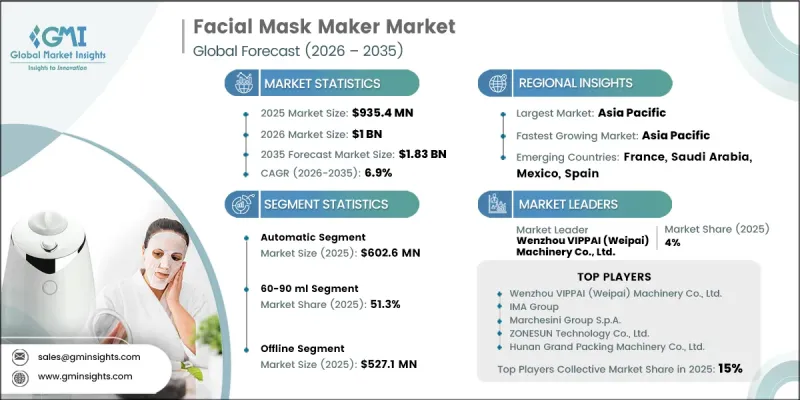
隨著護膚在全球消費者日常個人護理中扮演越來越重要的角色,面膜市場正穩步擴張。消費者護膚意識的提高、對高階美容產品需求的成長以及對客製化化面部護理日益成長的興趣,都推動著製造商加大對先進面膜生產設備的投入。亞太地區仍然是主要的成長中心,這得益於可支配收入的增加、美容行業的蓬勃發展以及國內外市場對面膜需求的不斷成長。製造商正在擴大產能以滿足不斷成長的消費者需求,同時透過自動化和先進的製造技術提高效率。對更高精度、更高產量、更高衛生標準和更穩定產品品質的需求,正在推動面膜生產系統向自動化轉型。此外,自有品牌產品生產的增加和化妝品生產設施的擴張也為設備供應商創造了機會。預計技術的持續進步和對自動化製造解決方案投資的增加將支持面膜生產設備市場的長期發展。
| 市場範圍 | |
|---|---|
| 開始年份 | 2025 |
| 預測期 | 2026-2035 |
| 初始市場規模 | 9.354億美元 |
| 預測金額 | 18.3億美元 |
| 複合年成長率 | 6.9% |
預計到2025年,自動化口罩生產設備市佔率將達到64.4%,並在2025年至2035年間以7.1%的複合年成長率成長。該細分市場保持主導地位的原因在於,市場對自動化設備的需求不斷成長,這些設備能夠確保產品品質的穩定性、營運效率的提升以及衛生加工環境的改善。製造商持續採用自動化系統,以減少人工干預、提高生產速度並維持產品品質的一致性,這支撐了該細分市場在已開發市場和新興市場的強勁表現。
預計到2025年,60-90毫升容量規格的市場規模將達到4.804億美元,並在2026年至2035年間以7.2%的複合年成長率成長。這個容量範圍之所以受歡迎,是因為它既能滿足常用面膜配方的需求,又能高效生產各種類型的產品。對於尋求均衡產能的化妝品生產商而言,此類設備是理想之選,因為它能夠處理各種黏度的配方,同時保持高生產率和營運效率。
美國面膜生產設備市場佔77.2%的市場佔有率,預計2025年市場規模將達到2.048億美元。市場成長的主要驅動力是消費者對成分透明度、產品安全性和高階護膚方案日益成長的需求。家用美容設備和個人化護膚產品需求的不斷成長也進一步推動了全部區域設備的需求。高階個人護理行業的蓬勃發展以及人們對精緻護膚流程的日益接受,預計將在預測期內進一步推動市場成長。
目錄
第1章:調查方法和範圍
第2章執行摘要
第3章 行業洞察
- 產業生態系分析
- 供應商情況
- 利潤率
- 每個階段增加的價值
- 影響價值鏈的因素
- 影響產業的因素
- 促進因素
- 對個人化護膚的需求日益成長
- 居家美容技術的擴展
- 邁向清潔美容和成分透明化的趨勢
- 產業潛在風險與挑戰
- 產品成本高與感知價值之間的差距
- 成分相容性和安全風險
- 機會
- 與智慧護膚生態系統整合
- 永續發展定位
- 促進因素
- 成長潛力分析
- 監理框架
- 美國食品藥物管理局關於個人護理設備的法規
- CE標誌和歐盟化妝品和醫療設備法規(歐洲)
- 中國國家藥品監督管理局(NMPA)關於美容和個人護理器材的規定
- 日本和韓國的監管標準(厚生勞動省的合規標準)
- 印度和海灣合作理事會市場的新監管趨勢
- 價格趨勢
- 按地區
- 依產品類型
- 波特的分析
- PESTLE分析
- 價格分析
- 2022-2025年歷史價格趨勢分析
- 依球員類型分類的定價策略(高級球員、超值球員、成本加成球員)
- 按產品形式和原料類型分類的價格基準。
- 貿易數據分析
- 2022-2025年進出口數量及價值趨勢
- 主要貿易路線及關稅影響(中美、中歐、韓亞東協)
- 人工智慧和生成式人工智慧對市場的影響
- 利用人工智慧革新軸承設計、測試和品管
- 生成式人工智慧在不同自動化領域的應用案例與實施藍圖
- 人工智慧在精密製造領域的風險、限制與監管考量
- 目前分銷基礎設施和通路滲透情況
- 按地區和業務類型(現代貿易與傳統貿易)分類的管道涵蓋範圍
- 最後一公里基礎設施差異和新通路的轉變(電子商務的普及)
第4章 競爭情勢
- 介紹
- 企業市佔率分析
- 按地區
- 企業矩陣分析
- 主要市場公司的競爭分析
- 競爭定位矩陣
- 價格與永續性定位
- 產品線及市場滲透率
- 創新與規模矩陣
- 主要進展
- 併購
- 夥伴關係和聯盟
- 新產品發布
- 業務拓展計劃
第5章 市場估算與預測:依產品類型分類,2022-2035年
- 半自動
- 自動的
第6章 市場估計與預測:依產能分類,2022-2035年
- 少於 60 毫升
- 60~90 ml
- 超過90毫升
第7章 市場估計與預測:依價格分類,2022-2035年
- 價格低廉(30美元以下)
- 中價位(30-80美元)
- 高價位(80美元以上)
第8章 市場估算與預測:依最終用途分類,2022-2035年
- 家用
- 有日常護膚習慣的個人消費者。
- 家庭水療和自我護理/健康愛好者
- 商業用途
- 美容美髮/水療中心
- 美容診所和皮膚科中心
- 飯店、招待和健康設施
- 其他(美容學校、養生度假村、企業禮品)
第9章 市場估價與預測:依通路分類,2022-2035年
- 線上
- 電子商務網站
- 公司網站
- 離線
- 美容及個人護理專賣店
- 超級市場和大賣場
- 藥局/藥局
- 其他
第10章 市場估價與預測:依地區分類,2022-2035年
- 北美洲
- 美國
- 加拿大
- 歐洲
- 德國
- 英國
- 法國
- 義大利
- 西班牙
- 亞太地區
- 中國
- 日本
- 印度
- 澳洲
- 韓國
- 拉丁美洲
- 巴西
- 墨西哥
- 阿根廷
- 中東和非洲
- 南非
- 沙烏地阿拉伯
- UAE
第11章:公司簡介
- 世界公司
- IMA Group
- ZONESUN Technology Co., Ltd.
- Wenzhou VIPPAI(Weipai)Machinery Co., Ltd.
- Marchesini Group SpA
- Hunan Grand Packing Machinery Co., Ltd.
- Guangzhou SINAEKATO Chemical Machinery Co., Ltd.
- Shanghai Imberson Intelligent Technology Co., Ltd.
- 當地公司
- Ton Jain Inc.
- Shanghai POEMY Machinery Co., Ltd.
- Kingdom Machinery Co., Ltd.
- Guangzhou Laymax Machinery Co., Ltd.
- Guangzhou Jutao Machinery Equipment Co., Ltd.
- Mentpack Makina AS
- Wejing Intelligent Equipment Co., Ltd.
- 新興企業
- Beijing XinyiHuida Electromechanical Equipment Co., Ltd.
- Guangzhou Yundu Machinery Technology Co., Ltd.
- Guangzhou Guanyu Machinery Co., Ltd.
- Adroit Machinery
- Miziho Machinery
- Shenzhen Mini Automation Co., Ltd.
- Lintyco
The Global Facial Mask Maker Market was valued at USD 935.4 million in 2025 and is estimated to grow at a CAGR of 6.9% to reach USD 1.83 billion by 2035.
The market is expanding steadily as skincare continues to become an essential part of daily personal care routines across global consumer groups. Growing awareness of skincare, rising demand for premium beauty products, and increasing interest in customized facial treatments are encouraging manufacturers to invest in advanced facial mask production equipment. The Asia Pacific region remains a major growth hub due to rising disposable incomes, expanding beauty industries, and increasing demand for facial masks across both domestic and international markets. Manufacturers are expanding production capacity to satisfy growing consumption while improving efficiency through automation and advanced manufacturing technologies. The transition toward automated production systems is being supported by the need for greater precision, higher output, improved hygiene standards, and consistent product quality. In addition, increasing private-label manufacturing activities and the expansion of cosmetics production facilities are creating favorable opportunities for equipment suppliers. Continuous technological advancements and growing investment in automated manufacturing solutions are expected to support the long-term development of the facial mask maker market.
| Market Scope | |
|---|---|
| Start Year | 2025 |
| Forecast Year | 2026-2035 |
| Start Value | $935.4 Million |
| Forecast Value | $1.83 Billion |
| CAGR | 6.9% |
The automatic facial mask maker segment accounted for 64.4% share in 2025 and is anticipated to grow at a CAGR of 7.1% during the 2025-2035. The segment maintains its leading position due to increasing demand for automated equipment capable of delivering consistent production quality, improved operational efficiency, and enhanced hygienic processing conditions. Manufacturers continue to adopt automatic systems to reduce manual intervention, improve production speed, and maintain uniform product quality, supporting the segment's strong market performance across developed and emerging markets.
The 60-90 ml capacity segment generated USD 480.4 million in 2025 and is projected to grow at a CAGR of 7.2% throughout 2026-2035. The popularity of this capacity range is driven by its compatibility with widely used facial mask formulations while offering efficient production performance across a variety of product types. Equipment within this category supports the processing of different formulation consistencies while maintaining high productivity and operational efficiency, making it a preferred choice for cosmetics manufacturers seeking balanced production capacity.
U.S. Facial Mask Maker Market held 77.2% share, generating USD 204.8 million in 2025. Market growth is supported by increasing consumer interest in ingredient transparency, product safety, and premium skincare solutions. Rising demand for home-based beauty devices and personalized skincare products continues to strengthen equipment demand across the region. The expanding premium personal care industry and growing adoption of advanced skincare routines are expected to further support market growth throughout the forecast period.
Major companies operating in the global facial mask maker market include Marchesini Group S.p.A., IMA Group, Shanghai Imberson Intelligent Technology Co., Ltd., Guangzhou SINAEKATO Chemical Machinery Co., Ltd., Wenzhou VIPPAI (Weipai) Machinery Co., Ltd., Hunan Grand Packing Machinery Co., Ltd., ZONESUN Technology Co., Ltd., Shanghai POEMY Machinery Co., Ltd., Kingdom Machinery Co., Ltd., Guangzhou Laymax Machinery Co., Ltd., Guangzhou Jutao Machinery Equipment Co., Ltd., Mentpack Makina A.S., Wejing Intelligent Equipment Co., Ltd., Ton Jain Inc., Beijing XinyiHuida Electromechanical Equipment Co., Ltd., Guangzhou Yundu Machinery Technology Co., Ltd., Guangzhou Guanyu Machinery Co., Ltd., Adroit Machinery, Miziho Machinery, Shenzhen Mini Automation Co., Ltd., and Lintyco. Companies operating in the facial mask maker market are strengthening their market position by investing in automation technologies, expanding manufacturing capabilities, and developing equipment that improves production efficiency, product consistency, and operational flexibility. Manufacturers are focusing on research and development to introduce advanced machinery with enhanced precision, user-friendly controls, and greater compatibility with a wide range of facial mask formulations. Strategic collaborations with cosmetics manufacturers and private-label producers are helping companies secure long-term business opportunities and broaden their customer base.
Table of Contents
Chapter 1 Methodology and Scope
- 1.1 Market scope and definition
- 1.2 Research design
- 1.2.1 Research approach
- 1.2.2 Data collection methods
- 1.3 Data mining sources
- 1.3.1 Global
- 1.3.2 Regional/Country
- 1.4 Base estimates and calculations
- 1.4.1 Base year calculation
- 1.4.2 Key trends for market estimation
- 1.5 Primary research and validation
- 1.5.1 Primary sources
- 1.6 Forecast model
- 1.7 Research assumptions and limitations
Chapter 2 Executive Summary
- 2.1 Industry 360° synopsis
- 2.2 Key market trends
- 2.2.1 Regional
- 2.2.2 Product type
- 2.2.3 Capacity
- 2.2.4 Price range
- 2.2.5 End use
- 2.2.6 Distribution channel
Chapter 3 Industry Insights
- 3.1 Industry ecosystem analysis
- 3.1.1 Supplier landscape
- 3.1.2 Profit margin
- 3.1.3 Value addition at each stage
- 3.1.4 Factor affecting the value chain
- 3.2 Industry impact forces
- 3.2.1 Growth drivers
- 3.2.1.1 Rising demand for personalized skincare
- 3.2.1.2 Expansion of at-home beauty tech
- 3.2.1.3 Clean beauty & ingredient transparency movement
- 3.2.2 Industry pitfalls & challenges
- 3.2.2.1 High product cost vs. Perceived value
- 3.2.2.2 Ingredient compatibility & safety risks
- 3.2.3 Opportunities
- 3.2.3.1 Integration with smart skincare ecosystems
- 3.2.3.2 Sustainability positioning
- 3.2.1 Growth drivers
- 3.3 Growth potential analysis
- 3.4 Regulatory framework
- 3.4.1 FDA regulations for personal care devices (United States)
- 3.4.2 CE marking & EU cosmetic device regulations (Europe)
- 3.4.3 China NMPA regulations for beauty & personal care devices
- 3.4.4 Japan & south korea regulatory standards (ministry of health compliance)
- 3.4.5 Emerging regulatory developments in India & GCC markets
- 3.5 Price trends
- 3.5.1 By region
- 3.5.2 By product type
- 3.6 Porter's analysis
- 3.7 PESTEL analysis
- 3.8 Pricing analysis (driven by primary research)
- 3.8.1 Historical price trend analysis (2022-2025)
- 3.8.2 Pricing strategy by player type (premium / value / cost-plus)
- 3.8.3 Price benchmarking across product formats & ingredient types
- 3.9 Trade data analysis (driven by paid database)
- 3.9.1 Import/export volume & value trends (2022-2025)
- 3.9.2 Key trade corridors & tariff impact (China-US, China-EU, South Korea-ASEAN)
- 3.10 Impact of AI & generative AI on the market
- 3.10.1 AI-driven disruption of bearing design, testing & quality control
- 3.10.2 GenAI use cases & adoption roadmap by automation segment
- 3.10.3 Risks, limitations & regulatory considerations for AI in precision manufacturing
- 3.11 Distribution infrastructure & channel penetration landscape (driven by primary research)
- 3.11.1 Channel coverage by region & format (modern trade vs. Traditional trade)
- 3.11.2 Last-mile infrastructure gaps & emerging channel shifts (e-commerce penetration)
Chapter 4 Competitive Landscape, 2025
- 4.1 Introduction
- 4.2 Company market share analysis
- 4.2.1 By region
- 4.2.1.1 North America
- 4.2.1.2 Europe
- 4.2.1.3 Asia Pacific
- 4.2.1.4 Latin America
- 4.2.1.5 Middle East and Africa
- 4.2.1 By region
- 4.3 Company matrix analysis
- 4.4 Competitive analysis of major market players
- 4.5 Competitive positioning matrix
- 4.5.1 Price vs. sustainability positioning
- 4.5.2 Product range vs. market penetration
- 4.5.3 Innovation vs. scale matrix
- 4.6 Key developments
- 4.6.1 Mergers & acquisitions
- 4.6.2 Partnerships & collaborations
- 4.6.3 New product launches
- 4.6.4 Expansion plans
Chapter 5 Market Estimates and Forecast, By Product Type, 2022 - 2035 (USD Million) (Thousand Units)
- 5.1 Key trends
- 5.2 Semi-Automatic
- 5.3 Automatic
Chapter 6 Market Estimates and Forecast, By Capacity, 2022 - 2035 (USD Million) (Thousand Units)
- 6.1 Key trends
- 6.2 Below 60 ml
- 6.3 60-90 ml
- 6.4 Above 90 ml
Chapter 7 Market Estimates and Forecast, By Price, 2022 - 2035 (USD Million) (Thousand Units)
- 7.1 Key trends
- 7.2 Low (Below USD 30)
- 7.3 Medium (USD 30-USD 80)
- 7.4 High (Above USD 80)
Chapter 8 Market Estimates and Forecast, By End Use, 2022 - 2035 (USD Million) (Thousand Units)
- 8.1 Key trends
- 8.2 Home use
- 8.2.1 Individual consumers daily skincare routine users
- 8.2.2 At-home spa & self-care wellness enthusiasts
- 8.3 Commercial use
- 8.3.1 Salons & spas
- 8.3.2 Beauty clinics & dermatology centers
- 8.3.3 Hotels & hospitality wellness facilities
- 8.3.4 Others (beauty schools, wellness retreats, corporate gifting)
Chapter 9 Market Estimates and Forecast, By Distribution Channel, 2022 - 2035 (USD Million) (Thousand Units)
- 9.1 Key trends
- 9.2 Online
- 9.2.1 E-commerce websites
- 9.2.2 Company websites
- 9.3 Offline
- 9.3.1 Specialty beauty & personal care stores
- 9.3.2 Supermarkets & hypermarkets
- 9.3.3 Pharmacies & drug stores
- 9.3.4 Others
Chapter 10 Market Estimates and Forecast, By Region, 2022 - 2035 (USD Million) (Thousand Units)
- 10.1 Key trends
- 10.2 North America
- 10.2.1 U.S.
- 10.2.2 Canada
- 10.3 Europe
- 10.3.1 Germany
- 10.3.2 UK
- 10.3.3 France
- 10.3.4 Italy
- 10.3.5 Spain
- 10.4 Asia Pacific
- 10.4.1 China
- 10.4.2 Japan
- 10.4.3 India
- 10.4.4 Australia
- 10.4.5 South Korea
- 10.5 Latin America
- 10.5.1 Brazil
- 10.5.2 Mexico
- 10.5.3 Argentina
- 10.6 Middle East and Africa
- 10.6.1 South Africa
- 10.6.2 Saudi Arabia
- 10.6.3 UAE
Chapter 11 Company Profiles
- 11.1 Global players
- 11.1.1 IMA Group
- 11.1.2 ZONESUN Technology Co., Ltd.
- 11.1.3 Wenzhou VIPPAI (Weipai) Machinery Co., Ltd.
- 11.1.4 Marchesini Group S.p.A.
- 11.1.5 Hunan Grand Packing Machinery Co., Ltd.
- 11.1.6 Guangzhou SINAEKATO Chemical Machinery Co., Ltd.
- 11.1.7 Shanghai Imberson Intelligent Technology Co., Ltd.
- 11.2 Regional players
- 11.2.1 Ton Jain Inc.
- 11.2.2 Shanghai POEMY Machinery Co., Ltd.
- 11.2.3 Kingdom Machinery Co., Ltd.
- 11.2.4 Guangzhou Laymax Machinery Co., Ltd.
- 11.2.5 Guangzhou Jutao Machinery Equipment Co., Ltd.
- 11.2.6 Mentpack Makina A.S.
- 11.2.7 Wejing Intelligent Equipment Co., Ltd.
- 11.3 Emerging players
- 11.3.1 Beijing XinyiHuida Electromechanical Equipment Co., Ltd.
- 11.3.2 Guangzhou Yundu Machinery Technology Co., Ltd.
- 11.3.3 Guangzhou Guanyu Machinery Co., Ltd.
- 11.3.4 Adroit Machinery
- 11.3.5 Miziho Machinery
- 11.3.6 Shenzhen Mini Automation Co., Ltd.
- 11.3.7 Lintyco

 2026-2030年全球清潔美容市場
 清潔美容市場規模、佔有率和成長分析:按產品類型、成分類型、劑型、分銷管道、最終用戶和地區分類-2026-2033年產業預測
 全球面膜製造商市場規模、佔有率、趨勢和成長分析報告(2026-2034)
 清潔美容產品市場預測至2034年—按產品類型、成分類型、分銷管道、認證類型和最終用戶分類的全球分析
 2026-2030年全球豐胸產品市場冰療美容工具市場規模、佔有率、成長、全球產業分析、區域洞察及2026-2034年預測
 清潔美容市場報告:趨勢、預測和競爭分析(至2035年)美容工具市場報告:趨勢、預測和競爭分析(至2035年)人工智慧美妝客製化市場預測至2034年:按工具類型、組件、技術、應用、最終用戶和地區分類的全球分析2026-2034年全球清潔美容市場規模、佔有率、趨勢和成長分析報告