


 |
市場調查報告書
商品編碼
2101912
睡眠技術設備市場:商業機會、成長要素、產業趨勢分析及2026-2035年預測Sleep Tech Devices Market Opportunity, Growth Drivers, Industry Trend Analysis, and Forecast 2026 - 2035 |
||||||

全球睡眠科技設備市場預計到 2025 年將價值 293 億美元,並將以 18.6% 的複合年成長率成長,到 2035 年達到 1,606 億美元。
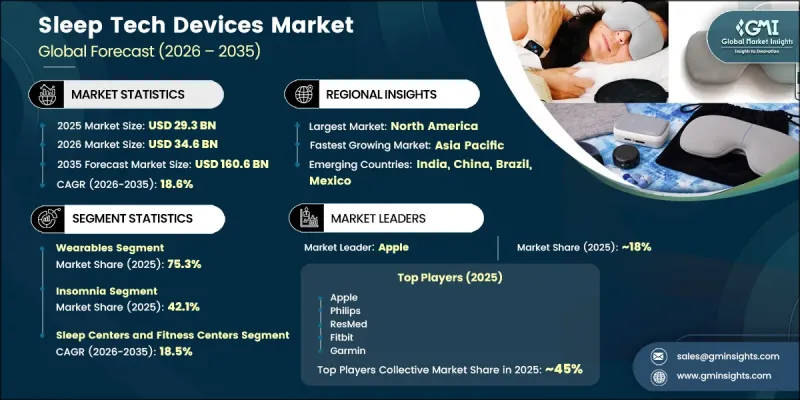
睡眠監測解決方案技術的快速發展、人們對睡眠健康的日益關注以及全球老年人口的成長,正推動著睡眠科技市場蓬勃發展。睡眠科技設備是先進的消費性電子產品,旨在透過測量各種生理和環境因素(包括睡眠週期、心率、呼吸模式、身體活動以及溫度、光照和噪音水平等環境條件)來評估、追蹤和改善睡眠模式。人口老化和睡眠相關健康問題的日益增多,是推動市場擴張的重要因素。隨著全球老年人口的持續成長,人們對便利、技術主導的睡眠監測、分析和個人化改善方案的家用電子電器。
| 市場範圍 | |
|---|---|
| 開始年份 | 2025 |
| 預測期 | 2026-2035 |
| 上市時的市場規模 | 293億美元 |
| 預測金額 | 1606億美元 |
| 複合年成長率 | 18.6% |
睡眠障礙的日益普遍是推動睡眠技術設備普及的另一個主要因素。老年人更容易出現睡眠模式紊亂、失眠和呼吸睡眠障礙等問題,因此對持續監測和有效睡眠管理技術的需求不斷成長。消費者越來越傾向於尋求便利的解決方案,以便透過數位健康工具更深入地了解自己的睡眠行為並改善整體健康狀況。
預計到2025年,穿戴式裝置市佔率將達到75.3%。這主要得益於連線健診設備的日益普及、消費者對睡眠品質日益關注,以及人工智慧(AI)感測器和數位醫療平台的進步。穿戴式睡眠技術之所以備受歡迎,是因為它能夠持續追蹤關鍵的睡眠和健康指標,包括睡眠時間、睡眠階段、心率、血氧飽和度、呼吸頻率、皮膚溫度、壓力水平和心率變異性(HRV)。與傳統的臨床睡眠評估方法相比,使用者可以透過穿戴式裝置連接智慧型手機和數位健康應用程式,在日常生活中輕鬆監測自己的睡眠模式。
預計到2025年,睡眠中心和健身中心細分市場將佔據35.1%的市場佔有率,並在2035年之前以18.5%的複合年成長率成長。此細分市場的成長主要得益於消費者對專業睡眠評估、個人化建議和全面健康解決方案日益成長的需求。投資高階睡眠技術的客戶通常希望在選擇睡眠監測設備、智慧睡眠系統和其他科技產品等先進解決方案之前,能夠獲得專家指導、產品展示和諮詢服務。透過專業中心提供的專家支援能夠增強消費者的信心,並促進睡眠技術產品的更廣泛應用。
預計到2025年,北美睡眠技術設備市佔率將達到42.5%。北美市場強勁成長的促進因素包括睡眠障礙的普遍存在、消費者對預防性醫療保健投入的不斷增加以及對數位健康技術的積極應用。人們日益認知到睡眠不足與長期健康問題之間的聯繫,這促使消費者採用先進的睡眠監測和改善解決方案。對預防性健康管理和個人化健康技術的日益關注,也持續推動全部區域對睡眠技術設備的需求成長。
目錄
第1章:調查方法
第2章執行摘要
第3章 行業洞察
- 產業生態系分析
- 影響產業的因素
- 促進因素
- 睡眠相關設備的技術進步
- 人們對睡眠技術設備的了解日益增多
- 老年人口增加
- 市場對高度便攜、高效、性能卓越的睡眠技術設備的需求激增。
- 主要市場參與企業的產品創新和各種策略的採用
- 產業潛在風險與挑戰
- 睡眠技術設備高成本
- 嚴格的法規結構
- 機會
- 與遠端醫療和遠端患者監護相結合
- 業務拓展至心理健康與保健領域
- 促進因素
- 成長潛力分析
- 監理情勢
- 價格趨勢分析
- 技術與創新展望
- 最新科技趨勢
- 新興技術
- 未來市場趨勢
- 專利分析
- 消費者行為趨勢
- 打入市場策略分析
- 人工智慧和生成式人工智慧對市場的影響
- 波特的分析
- PESTLE分析
第4章 競爭情勢
- 介紹
- 企業矩陣分析
- 企業市佔率分析
- 世界
- 北美洲
- 歐洲
- 主要市場公司的競爭分析
- 競爭定位矩陣
- 主要進展
- 併購
- 夥伴關係和聯盟
- 新產品發布
- 業務拓展計劃
第5章 市場估價與預測:依產品分類,2022-2035年
- 穿戴式裝置
- 智慧型手錶和智慧手環
- 其他穿戴式裝置
- 非穿戴式產品
- 睡眠監測
- 智慧床
第6章 市場估計與預測:依應用領域分類,2022-2035年
- 失眠
- 阻塞型睡眠呼吸中止症
- 嗜睡症
- 其他用途
第7章 市場估價與預測:依通路分類,2022-2035年
- 睡眠中心及健身中心
- 大賣場和超級市場
- 電子商務
- 藥局和零售店
- 其他分銷管道
第8章 市場估計與預測:依地區分類,2022-2035年
- 北美洲
- 美國
- 加拿大
- 歐洲
- 德國
- 英國
- 法國
- 西班牙
- 義大利
- 荷蘭
- 亞太地區
- 中國
- 日本
- 印度
- 澳洲
- 韓國
- 拉丁美洲
- 巴西
- 墨西哥
- 阿根廷
- 中東和非洲
- 南非
- 沙烏地阿拉伯
- UAE
第9章:公司簡介
- Apple
- Balluga
- BedJet
- ChiliSleep
- Eight Sleep
- Emfit
- Fisher & Paykel Healthcare
- Fitbit
- Garmin
- Huawei
- Itamar Medical
- Ōura Health
- Philips
- Pulsetto
- ResMed
- ReST
- SleepScore Labs
- Smart Nora
- Somnofy
- Somnox
- Withings
- Xiaomi
The Global Sleep Tech Devices Market was valued at USD 29.3 billion in 2025 and is estimated to grow at a CAGR of 18.6% to reach USD 160.6 billion by 2035.
The market is witnessing strong growth due to rapid technological progress in sleep monitoring solutions, increasing awareness of sleep health, and the rising number of elderly individuals worldwide. Sleep tech devices are advanced consumer electronics designed to evaluate, track, and improve sleep patterns by measuring various physiological and environmental factors, including sleep cycles, heart activity, breathing behavior, movement patterns, and surrounding conditions such as temperature, lighting, and sound levels. The growing aging population and increasing occurrence of sleep-related health issues are significantly contributing to market expansion. As the number of older adults continues to rise globally, demand is increasing for convenient, technology-driven solutions that support sleep monitoring, analysis, and personalized improvement strategies.
| Market Scope | |
|---|---|
| Start Year | 2025 |
| Forecast Year | 2026-2035 |
| Start Value | $29.3 Billion |
| Forecast Value | $160.6 Billion |
| CAGR | 18.6% |
The increasing prevalence of sleep disorders is another major factor contributing to the adoption of sleep tech devices. Aging individuals are more likely to experience challenges such as disrupted sleep patterns, insomnia, and breathing-related sleep conditions, creating a greater requirement for continuous monitoring and effective sleep management technologies. Consumers are increasingly seeking accessible solutions that allow them to better understand their sleep behavior and improve overall wellness through digital health tools.
The wearables segment accounted for 75.3% share in 2025, supported by growing acceptance of connected health devices, increasing consumer focus on sleep quality, and advancements in artificial intelligence-powered sensors and digital healthcare platforms. Wearable sleep technology remains highly preferred due to its ability to provide continuous tracking of important sleep and health indicators, including sleep duration, sleep phases, heart rate, oxygen saturation levels, breathing rate, skin temperature, stress indicators, and heart rate variability. Compared with traditional clinical sleep evaluation approaches, wearable devices allow users to monitor their sleep patterns in everyday environments while connecting easily with smartphones and digital wellness applications.
The sleep centers and fitness centers segment held 35.1% share in 2025 growing at a CAGR of 18.5% throughout 2035. Growth in this segment is supported by increasing consumer interest in professional sleep evaluations, customized recommendations, and complete wellness-focused solutions. Customers investing in premium sleep technologies often prefer access to expert guidance, product demonstrations, and consultations before selecting advanced solutions such as sleep monitoring devices, smart sleep systems, and other technology-enabled products. The availability of professional support through specialized centers is helping increase consumer confidence and encourage wider adoption of sleep technology products.
North America Sleep Tech Devices Market captured 42.5% share in 2025. Strong market growth in North America is supported by the widespread presence of sleep disorders, increasing consumer investment in preventive healthcare, and strong adoption of digital wellness technologies. Growing awareness about the connection between inadequate sleep and long-term health concerns is encouraging consumers to adopt advanced sleep monitoring and improvement solutions. Rising interest in proactive health management and personalized wellness technologies continues to accelerate demand for sleep tech devices across the region.
Major players operating in the global sleep tech devices industry are Apple, Eight Sleep, Garmin, Philips, Oura Health, Fitbit, BedJet, ResMed, Xiaomi, Withings, Huawei, ChiliSleep, Fisher & Paykel Healthcare, Itamar Medical, Somnox, SleepScore Labs, Emfit, Smart Nora, Balluga, ReST, Pulsetto, and Somnofy. Companies operating in the sleep tech devices market are strengthening their competitive position through product innovation, artificial intelligence integration, strategic partnerships, and expansion of digital health ecosystems. Manufacturers are focusing on developing smarter devices with improved sensor accuracy, advanced analytics, and personalized recommendations to enhance user experiences. Businesses are also investing in software platforms, mobile applications, and cloud-based solutions to provide deeper sleep insights and improve customer engagement. Collaborations with healthcare providers, wellness organizations, and technology companies are helping brands expand their reach and improve credibility.
Table of Contents
Chapter 1 Research Methodology
- 1.1 Research approach
- 1.2 Quality commitments
- 1.2.1 GMI AI policy & data integrity commitment
- 1.2.1.1 Source consistency protocol
- 1.2.1 GMI AI policy & data integrity commitment
- 1.3 Research trail & confidence scoring
- 1.3.1 Research trail components
- 1.3.2 Scoring components
- 1.4 Data collection
- 1.4.1 Partial list of primary sources
- 1.5 Data mining sources
- 1.5.1 Paid sources
- 1.5.1.1 Sources, by region
- 1.5.1 Paid sources
- 1.6 Base estimates and calculations
- 1.6.1 Base year calculation
- 1.7 Forecast model
- 1.7.1 Quantified market impact analysis
- 1.7.1.1 Mathematical impact of growth parameters on forecast
- 1.7.1 Quantified market impact analysis
- 1.8 Research transparency addendum
- 1.8.1 Source attribution framework
- 1.8.2 Quality assurance metrics
- 1.8.3 Our commitment to trust
Chapter 2 Executive Summary
- 2.1 Industry 360° synopsis
- 2.2 Key market trends
- 2.2.1 Regional trends
- 2.2.2 Product trends
- 2.2.3 Application trends
- 2.2.4 Distribution channel trends
- 2.3 CXO perspectives: Strategic imperatives
Chapter 3 Industry Insights
- 3.1 Industry ecosystem analysis
- 3.2 Industry impact forces
- 3.2.1 Growth drivers
- 3.2.1.1 Technological advancements in sleep tech devices
- 3.2.1.2 Increasing awareness regarding the availability of sleep tech devices
- 3.2.1.3 Rising geriatric population
- 3.2.1.4 Surging demand for portable, efficient, and superior sleep tech devices
- 3.2.1.5 Product innovation and adoption of different strategies by key market participants
- 3.2.2 Industry pitfalls and challenges
- 3.2.2.1 High cost of sleep tech devices
- 3.2.2.2 Stringent regulatory framework
- 3.2.3 Opportunities
- 3.2.3.1 Integration with telehealth and remote patient monitoring
- 3.2.3.2 Expansion into mental health and wellness segments
- 3.2.1 Growth drivers
- 3.3 Growth potential analysis
- 3.4 Regulatory landscape
- 3.4.1 North America
- 3.4.2 Europe
- 3.4.3 Asia Pacific
- 3.4.4 Latin America
- 3.4.5 MEA
- 3.5 Pricing trend analysis
- 3.6 Technology and innovation landscape (Driven by Primary Research)
- 3.6.1 Current technological trends
- 3.6.2 Emerging technologies
- 3.7 Future market trends (Driven by Primary Research)
- 3.8 Patent analysis (Driven by Primary Research)
- 3.9 Consumer behaviour trend (Driven by Primary Research)
- 3.10 Go-to-market strategy analysis
- 3.11 Impact of AI & Generative AI on the Market (Driven by Primary Research)
- 3.12 Porter's analysis
- 3.13 PESTEL analysis
Chapter 4 Competitive Landscape, 2025
- 4.1 Introduction
- 4.2 Company matrix analysis
- 4.3 Company market share analysis (Driven by Primary Research)
- 4.3.1 Global
- 4.3.2 North America
- 4.3.3 Europe
- 4.4 Competitive analysis of major market players
- 4.5 Competitive positioning matrix
- 4.6 Key developments
- 4.6.1 Mergers & acquisitions
- 4.6.2 Partnerships & collaborations
- 4.6.3 New product launches
- 4.6.4 Expansion plans
Chapter 5 Market Estimates and Forecast, By Product, 2022 - 2035 ($ Mn)
- 5.1 Key trends
- 5.2 Wearables
- 5.2.1 Smart watches and bands
- 5.2.2 Other wearables
- 5.3 Non-Wearables
- 5.3.1 Sleep monitors
- 5.3.2 Smart beds
Chapter 6 Market Estimates and Forecast, By Application, 2022 - 2035 ($ Mn)
- 6.1 Key trends
- 6.2 Insomnia
- 6.3 Obstructive sleep apnea
- 6.4 Narcolepsy
- 6.5 Other applications
Chapter 7 Market Estimates and Forecast, By Distribution Channel, 2022 - 2035 ($ Mn)
- 7.1 Key trends
- 7.2 Sleep centers and fitness centers
- 7.3 Hypermarkets and supermarkets
- 7.4 E-commerce
- 7.5 Pharmacy and retail stores
- 7.6 Other distribution channels
Chapter 8 Market Estimates and Forecast, By Region, 2022 - 2035 ($ Mn)
- 8.1 Key trends
- 8.2 North America
- 8.2.1 U.S.
- 8.2.2 Canada
- 8.3 Europe
- 8.3.1 Germany
- 8.3.2 UK
- 8.3.3 France
- 8.3.4 Spain
- 8.3.5 Italy
- 8.3.6 Netherlands
- 8.4 Asia Pacific
- 8.4.1 China
- 8.4.2 Japan
- 8.4.3 India
- 8.4.4 Australia
- 8.4.5 South Korea
- 8.5 Latin America
- 8.5.1 Brazil
- 8.5.2 Mexico
- 8.5.3 Argentina
- 8.6 MEA
- 8.6.1 South Africa
- 8.6.2 Saudi Arabia
- 8.6.3 UAE
Chapter 9 Company Profiles
- 9.1 Apple
- 9.2 Balluga
- 9.3 BedJet
- 9.4 ChiliSleep
- 9.5 Eight Sleep
- 9.6 Emfit
- 9.7 Fisher & Paykel Healthcare
- 9.8 Fitbit
- 9.9 Garmin
- 9.10 Huawei
- 9.11 Itamar Medical
- 9.12 Ōura Health
- 9.13 Philips
- 9.14 Pulsetto
- 9.15 ResMed
- 9.16 ReST
- 9.17 SleepScore Labs
- 9.18 Smart Nora
- 9.19 Somnofy
- 9.20 Somnox
- 9.21 Withings
- 9.22 Xiaomi

 2026年全球人工智慧(AI)睡眠科技與預測性健康穿戴裝置市場報告2026年全球人工智慧睡眠科技設備市場報告
 穿戴式睡眠科技市場:按產品類型、性別、使用者、分銷管道和地區分類
 單分子追蹤顯微鏡市場:按儀器類型、組件、應用和最終用戶分類-全球預測,2026-2032年2026年全球家用睡眠篩檢設備市場報告
 睡眠技術設備市場分析及預測(至2035年):依類型、產品類型、服務、技術、組件、應用、最終用戶及功能分類2026年全球睡眠技術設備市場報告
 睡眠監測設備市場-2026-2031年預測
 家用睡眠檢測設備市場規模、佔有率和成長分析(按設備類型、技術、用戶畫像、功能、通路和地區分類)—2026-2033年產業預測
 全球家用睡眠測試設備市場