


 |
市場調查報告書
商品編碼
2101906
預填充式注射器市場機會、成長要素、產業趨勢分析及2026-2035年預測Prefilled Syringes Market Opportunity, Growth Drivers, Industry Trend Analysis, and Forecast 2026 - 2035 |
||||||

全球預填充式注射器(PFS)市場預計到 2025 年將達到 85 億美元,年複合成長率為 9.1%,到 2035 年將達到 203 億美元。
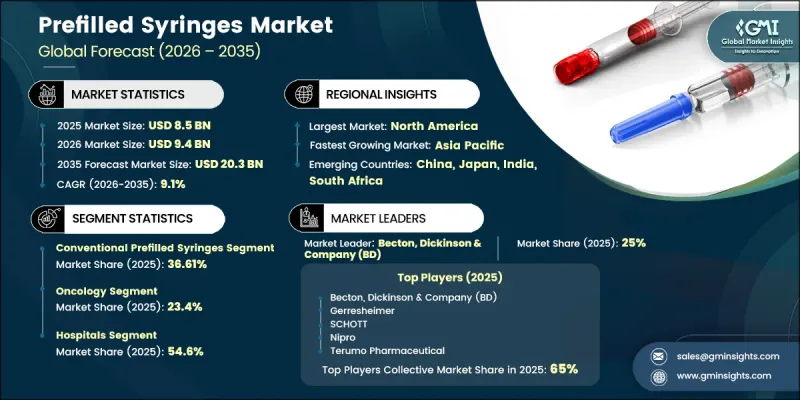
市場擴張的驅動力在於藥物傳遞系統向以患者為中心的模式轉變,特別是從醫院護理轉向居家醫療和自我給藥模式的轉變。這種轉變推動了對即用型注射劑的需求成長,從而提高了給藥的準確性,減少了配藥錯誤,並提升了患者的便利性。同時,注射器工程技術的不斷進步,例如改進的針頭整合系統、精密的推藥器設計以及確保容器完整性的解決方案,正在提升整個行業的性能標準。數位化和智慧給藥功能的整合,例如藥物依從性追蹤和劑量監測,正在進一步改變產品開發策略,並鼓勵製藥公司採用高階預填充製劑。這些創新也有助於提高單位價值,尤其是在準確性和安全性至關重要的特殊藥物應用領域。
| 市場範圍 | |
|---|---|
| 開始年份 | 2025 |
| 預測期 | 2026-2035 |
| 上市時的市場規模 | 85億美元 |
| 預計金額 | 203億美元 |
| 複合年成長率 | 9.1% |
預計到2025年,傳統預填充式注射器將佔據36.61%的市場佔有率,並預計到2035年將以9.3%的複合年成長率成長。在標準注射系統足以滿足需求且無需高級安全機制的多個治療領域,預灌封注射器仍被廣泛使用。其強大的市場地位得益於其成本效益、高度擴充性的生產能力以及與各種藥物填充系統和劑量要求的兼容性。
預計到2025年,醫院通路將佔據54.6%的市場佔有率,並在2035年之前以8.9%的複合年成長率成長。醫院仍然是注射療法的主要給藥場所,尤其是在緊急治療、外科手術和生物製藥的初始治療方面。對病人安全規程和標準化注射流程的日益重視,進一步推動了預填充製劑在醫療機構的應用。
預計到2025年,北美預填充式注射器(PFS)市佔率將達到35.4%,並在2035年之前以8.6%的複合年成長率成長。該地區的市場領先地位得益於對生物製藥的強勁需求、完善的醫療保健基礎設施以及安全注射裝置的廣泛應用。美國憑藉其先進的醫藥生態系統以及向門診和居家護理模式的持續轉變,仍然是主要的成長動力。同時,加拿大透過擴大免疫接種和專科醫療保健項目,也為市場成長做出了穩步貢獻。
目錄
第1章:調查方法和範圍
第2章執行摘要
第3章 行業洞察
- 產業生態系分析
- 影響產業的因素
- 促進因素
- 糖尿病和類風濕性關節炎日益加重的全球負擔
- 注射器設計方面的技術進步
- 自行注射趨勢及向居家醫療的過渡
- 全球疫苗接種計劃的擴大
- 產業潛在風險與挑戰
- 嚴格的監管要求
- 生產成本高且營運複雜
- 市場機遇
- 採用聚合物注射器(COP/COC)進行高靈敏度生物製藥和高價值治療。
- 一種不含矽酮的系統,可增強與先進生物製藥和生物相似藥的兼容性。
- 促進因素
- 成長潛力分析
- 監理情勢
- 技術展望
- 最新科技趨勢
- 新興技術
- 價格趨勢分析
- 未來市場趨勢
- 波特的分析
- PESTLE分析
- 人工智慧和生成式人工智慧對市場的影響
- 價值鏈分析
- 投資與資金籌措分析
第4章 競爭情勢
- 介紹
- 企業市佔率分析:按地區分類
- 北美洲
- 歐洲
- 亞太地區
- 主要進展
- 重要合作夥伴關係和合作
- 主要併購活動
- 產品創新和新產品發布
- 市場擴大策略
- 競爭定位矩陣
第5章 市場規模及預測:依類型分類,2022-2035年
- 傳統預填充式注射器
- 安全型預填充式注射器
第6章 市場規模及預測:依設計分類,2022-2035年
- 單室
- 雙腔體
第7章 市場規模及預測:依材料分類,2022-2035年
- 玻璃
- 塑膠
- 環烯烴聚合物(COP)
- 環烯烴共聚物(COC)
- 其他塑膠材料
第8章 市場規模及預測:依應用領域分類,2022-2035年
- 腫瘤學
- 糖尿病
- 類風濕性關節炎
- 疫苗
- 眼科
- 其他用途
第9章 市場規模及預測:依最終用途分類,2022-2035年
- 醫院
- 門診手術中心
- 家庭醫療保健
- 其他最終用途
第10章 市場規模及預測:依地區分類,2022-2035年
- 北美洲
- 美國
- 加拿大
- 歐洲
- 德國
- 法國
- 英國
- 荷蘭
- 西班牙
- 義大利
- 亞太地區
- 中國
- 日本
- 印度
- 澳洲
- 韓國
- 拉丁美洲
- 巴西
- 墨西哥
- 阿根廷
- 中東和非洲
- 沙烏地阿拉伯
- 南非
- UAE
第11章:公司簡介
- apl
- B Braun
- Baxter
- Becton Dickinson & Company(BD)
- Catalent
- Datwyler Holding
- Fresenius Kabi
- Gerresheimer
- Nipro
- SCHOTT
- Shandong Pharmaceutical Glass
- SiO2
- Terumo Pharmaceutical
- Weigao Group
- West Pharmaceutical
The Global Prefilled Syringe (PFS) Market was valued at USD 8.5 billion in 2025 and is estimated to grow at a CAGR of 9.1% to reach USD 20.3 billion by 2035.
Market expansion is driven by a structural transition toward patient-centric drug delivery systems, particularly the shift from hospital-based care to home healthcare and self-administration models. This transition is increasing demand for ready-to-use injectable formats that improve dosing accuracy, reduce preparation errors, and enhance patient convenience. At the same time, ongoing advancements in syringe engineering, including improved needle integration systems, enhanced plunger designs, and container integrity solutions, are elevating performance standards across the industry. The integration of digital and smart delivery features such as adherence tracking and dose monitoring is further reshaping product development strategies, encouraging pharmaceutical companies to adopt premium prefilled formats. These innovations are also contributing to higher value realization per unit, especially within specialty drug applications where precision and safety are critical.
| Market Scope | |
|---|---|
| Start Year | 2025 |
| Forecast Year | 2026-2035 |
| Start Value | $8.5 Billion |
| Forecast Value | $20.3 Billion |
| CAGR | 9.1% |
The conventional prefilled syringes accounted for 36.61% share in 2025 and is projected to grow at a CAGR of 9.3% through 2035. This segment remains widely used across multiple therapeutic areas where standard injection systems are sufficient and advanced safety mechanisms are not mandatory. Its strong position is supported by cost efficiency, scalable manufacturing capabilities, and compatibility with a wide range of pharmaceutical filling systems and dosage requirements.
The hospital segment held 54.6% share in 2025 and is expected to grow at a CAGR of 8.9% through 2035. Hospitals remain the primary point of administration for injectable therapies, particularly for high-acuity treatments, surgical procedures, and biologic drug initiation. Increasing emphasis on patient safety protocols and standardized injection practices has further strengthened the adoption of prefilled formats across institutional healthcare settings.
North America Prefilled Syringe (PFS) Market held 35.4% share in 2025 and is projected to grow at a CAGR of 8.6% through 2035. The region's dominance is supported by strong demand for biologic drugs, a well-established healthcare infrastructure, and widespread adoption of safety-engineered injectable devices. The United States remains the primary growth engine due to its advanced pharmaceutical ecosystem and increasing shift toward outpatient and home-based treatment models, while Canada contributes steady growth through expanding immunization and specialty care programs.
Major companies operating in the global prefilled syringe industry include Becton Dickinson and Company (BD), Baxter, B Braun, Fresenius Kabi, Gerresheimer, Nipro, SCHOTT, Terumo Pharmaceutical, Catalent, West Pharmaceutical Services, Datwyler Holding AG, Shandong Pharmaceutical Glass Co. Ltd., SiO2, Weigao Group, and APL (Associated Packaging, LLC). Companies operating in the prefilled syringe market are focusing on strengthening their market position through continuous innovation in drug delivery systems that improve safety, accuracy, and ease of administration. Manufacturers are investing in advanced material technologies, including high-quality glass and polymer solutions that enhance container integrity and compatibility with biologics. Expansion of automated and high-precision fill-finish manufacturing capabilities is helping companies increase production efficiency and meet rising global demand. Strategic partnerships with pharmaceutical firms are enabling co-development of drug-device combination products tailored for specific therapies.
Table of Contents
Chapter 1 Methodology & Scope
- 1.1 Market definitions
- 1.2 Research approach
- 1.3 Quality commitments
- 1.3.1 GMI AI policy & data integrity commitment
- 1.3.1.1 Source consistency protocol
- 1.3.1 GMI AI policy & data integrity commitment
- 1.4 Research trail & confidence scoring
- 1.4.1 Research trail components
- 1.4.2 Scoring components
- 1.5 Data collection
- 1.5.1 Partial list of primary sources
- 1.6 Data mining sources
- 1.6.1 Paid sources
- 1.6.1.1 Sources, by region
- 1.6.1 Paid sources
- 1.7 Base estimates and calculations
- 1.7.1 Base year calculation for any one approach
- 1.8 Forecast model
- 1.8.1 Quantified market impact analysis
- 1.8.1.1 Mathematical impact of growth parameters on forecast
- 1.8.1 Quantified market impact analysis
- 1.9 Research transparency addendum
- 1.9.1 Source attribution framework
- 1.9.2 Quality assurance metrics
- 1.9.3 Our commitment to trust
Chapter 2 Executive Summary
- 2.1 Industry 360° synopsis
- 2.1.1 Business trends
- 2.1.2 Type trends
- 2.1.3 Design trends
- 2.1.4 Material trends
- 2.1.5 Application trends
- 2.1.6 End use trends
- 2.1.7 Regional trends
Chapter 3 Industry Insights
- 3.1 Industry ecosystem analysis
- 3.2 Industry impact forces
- 3.2.1 Growth drivers
- 3.2.1.1 Expanding global burden of diabetes and rheumatoid arthritis
- 3.2.1.2 Technological advancements in syringe design
- 3.2.1.3 Self-injection trend and home healthcare shift
- 3.2.1.4 Expansion of global vaccination programs
- 3.2.2 Industry pitfalls and challenges
- 3.2.2.1 Stringent regulatory requirements
- 3.2.2.2 High production costs and operational complexity
- 3.2.3 Market opportunities
- 3.2.3.1 Adoption of polymer-based syringes (COP/COC) for sensitive biologics and high-value therapeutics
- 3.2.3.2 Silicone-free systems enhancing compatibility with advanced biologics and biosimilars
- 3.2.1 Growth drivers
- 3.3 Growth potential analysis
- 3.4 Regulatory landscape (Driven by primary research)
- 3.4.1 North America
- 3.4.2 Europe
- 3.4.3 Asia Pacific
- 3.4.4 Latin America
- 3.4.5 Middle East and Africa
- 3.5 Technology landscape
- 3.5.1 Current technological trends
- 3.5.2 Emerging technologies
- 3.6 Pricing trend analysis (Driven by primary research)
- 3.7 Future market trends
- 3.8 Porter's analysis
- 3.9 PESTEL analysis
- 3.10 Impact of AI and Generative AI on the market (Driven by primary research)
- 3.11 Value chain analysis (Driven by primary research)
- 3.12 Investment & funding analysis (Driven by primary research)
Chapter 4 Competitive Landscape, 2025
- 4.1 Introduction
- 4.2 Company market share analysis, by region, 2025
- 4.2.1 North America
- 4.2.2 Europe
- 4.2.3 Asia Pacific
- 4.3 Key developments
- 4.3.1 Key partnerships & collaborations
- 4.3.2 Major M&A activities
- 4.3.3 Product innovations & launches
- 4.3.4 Market expansion strategies
- 4.4 Competitive positioning matrix
Chapter 5 Market Size and Forecast, By Type, 2022 - 2035 (USD Million)
- 5.1 Key trends
- 5.2 Conventional prefilled syringes
- 5.3 Safety prefilled syringes
Chapter 6 Market Size and Forecast, By Design, 2022 - 2035 (USD Million)
- 6.1 Key trends
- 6.2 Single-chambers
- 6.3 Dual-chamber
Chapter 7 Market Size and Forecast, By Material, 2022 - 2035 (USD Million)
- 7.1 Key trends
- 7.2 Glass
- 7.3 Plastic
- 7.3.1 Cyclo olefin polymer (cop)
- 7.3.2 Cyclo olefin co polymer (coc)
- 7.3.3 Other plastic material
Chapter 8 Market Size and Forecast, By Application, 2022 - 2035 (USD Million)
- 8.1 Key trends
- 8.2 Oncology
- 8.3 Diabetes
- 8.4 Rheumatoid arthritis
- 8.5 Vaccines
- 8.6 Ophthalmology
- 8.7 Other applications
Chapter 9 Market Size and Forecast, By End Use, 2022 - 2035 (USD Million)
- 9.1 Key trends
- 9.2 Hospitals
- 9.3 Ambulatory surgery centers
- 9.4 Home healthcare
- 9.5 Other end use
Chapter 10 Market Size and Forecast, By Region, 2022 - 2035 (USD Million)
- 10.1 Key trends
- 10.2 North America
- 10.2.1 U.S.
- 10.2.2 Canada
- 10.3 Europe
- 10.3.1 Germany
- 10.3.2 France
- 10.3.3 UK
- 10.3.4 Netherlands
- 10.3.5 Spain
- 10.3.6 Italy
- 10.4 Asia Pacific
- 10.4.1 China
- 10.4.2 Japan
- 10.4.3 India
- 10.4.4 Australia
- 10.4.5 South Korea
- 10.5 Latin America
- 10.5.1 Brazil
- 10.5.2 Mexico
- 10.5.3 Argentina
- 10.6 Middle East and Africa
- 10.6.1 Saudi Arabia
- 10.6.2 South Africa
- 10.6.3 UAE
Chapter 11 Company Profiles
- 11.1 apl
- 11.2 B Braun
- 11.3 Baxter
- 11.4 Becton Dickinson & Company (BD)
- 11.5 Catalent
- 11.6 Datwyler Holding
- 11.7 Fresenius Kabi
- 11.8 Gerresheimer
- 11.9 Nipro
- 11.10 SCHOTT
- 11.11 Shandong Pharmaceutical Glass
- 11.12 SiO2
- 11.13 Terumo Pharmaceutical
- 11.14 Weigao Group
- 11.15 West Pharmaceutical

 無矽預填充注射器市場:全球市場預測,2026-2032年聚合物預填充注射器市場:全球市場預測,2026-2032年
 預填充一次性衛生用品市場規模、佔有率和成長分析:按產品類型、材料、應用、最終用戶、分銷管道和地區分類-2026-2033年產業預測
 預填充式注射器市場報告:趨勢、預測與競爭分析(至2035年)雙腔預填充式注射器市場-2026-2032年全球市場預測預填充式注射器市場:2026-2032年全球市場預測(依產品類型、材質、容量、設計、應用、最終用戶及通路分類)
 低分子量預填充式注射器市場:按類型、材料、應用、分銷管道和地區分類
 預填充式注射器市場預測至2034年-按類型、材質、設計、通路、應用和地區分類的全球分析
 全球預填充式注射器市場(至2031年):按類型(傳統型與安全型)、材料(玻璃與塑膠)、設計(單腔與雙腔)、應用(糖尿病、癌症、類風濕性關節炎)及地區分類
 預填充式注射器市場規模、佔有率、趨勢和預測:按設計、材質、密封系統、應用、最終用戶和地區分類,2026-2034年