

 |
市場調查報告書
商品編碼
2101901
地毯和地墊市場機會、成長要素、產業趨勢分析及 2026-2035 年預測。Carpet and Rug Market Opportunity, Growth Drivers, Industry Trend Analysis, and Forecast 2026 - 2035 |
||||||

全球地毯市場預計到 2025 年將達到 455 億美元,年複合成長率為 5.1%,到 2035 年將達到 635 億美元。
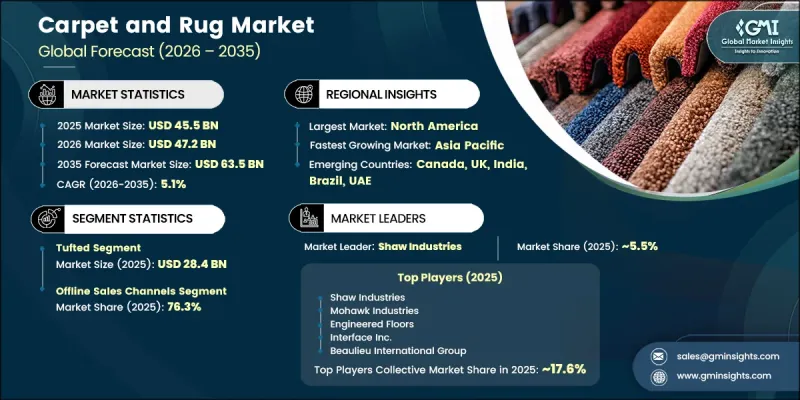
在開發中國家城市發展和家庭數量成長的推動下,住宅、商業和旅館業的穩定需求持續成長,推動了全球地毯市場的擴張。此外,成熟市場的持續維修以及快速都市化地區對地板材料產品的日益普及,也促進了市場成長。隨著消費者對美觀、耐用性和功能性地板材料解決方案的需求不斷成長,製造商正在推出先進材料和創新產品設計,以滿足不斷變化的室內設計偏好。永續的生產方式、紡織技術的進步以及產品客製化能力的提升,進一步增強了市場競爭力,並在高級產品領域創造了新的機會。此外,住宅項目、商業基礎設施和酒店設施建設投資的增加也有助於長期需求的穩定。雖然在成熟經濟體中,更換需求仍然是重要的收入來源,但新興市場不斷擴大的建設活動持續創造商機。預計在整個預測期內,技術進步、產品創新、不斷擴大的分銷網路以及消費者生活方式偏好的改變,將支撐全球地毯市場的穩定成長。
| 市場範圍 | |
|---|---|
| 開始年份 | 2025 |
| 預測期 | 2026-2035 |
| 上市時的市場規模 | 455億美元 |
| 預測金額 | 635億美元 |
| 複合年成長率 | 5.1% |
預計到2025年,線下通路將佔據76.3%的市場佔有率,並預計在2026年至2035年間以3.4%的複合年成長率成長。實體零售仍然是主要的銷售管道,因為許多買家在做出購買決定之前更傾向於親自查看產品的品質、質地、外觀和整體做工。個人化的客戶服務、專業的安裝服務和產品展示進一步提升了線下購物的吸引力。豐富的產品種類和附加價值服務也持續支撐著實體零售通路的長期主導地位。
預計到2025年,簇絨地毯市場銷售額將達到284億美元,並在2035年之前以3.3%的複合年成長率成長。該市場憑藉高效的生產流程、與多種材料的兼容性以及滿足不同價位需求的能力,保持著主導地位。其多功能性使製造商能夠在保持生產成本競爭力的同時,開發適用於住宅和商業用途的產品。紡織技術、襯裡材料和生產效率的持續進步,預計將在未來幾年進一步鞏固該市場的領先地位。
預計到2025年,北美地毯市場規模將達到133億美元,並在2035年之前以3.4%的複合年成長率成長。市場成長的驅動力包括持續的住宅裝修需求、不斷成長的商業建築現代化投資以及成熟的地板材料分銷網路。消費者在住宅維修項目上的支出增加、對高階地板材料產品的強勁需求以及商業設施的持續維修,都全部區域的製造商和經銷商創造了新的機會。
目錄
第1章:調查方法和範圍
第2章執行摘要
第3章 行業洞察
- 產業生態系分析
- 供應商情況
- 利潤率
- 每個階段增加的價值
- 影響價值鏈的因素
- 影響產業的因素
- 促進因素
- 全球住宅翻新維修趨勢。
- 不斷擴大的酒店和商業建築領域
- 新興經濟體的都市化和可支配所得增加
- 電子商務的興起使奢侈品更容易被消費者所接受。
- 產業潛在風險與挑戰
- 廢舊產品回收處置的基礎設施不足
- 貿易中斷和關稅不確定性會對依賴進口的市場造成影響。
- 手工編織和手工藝領域熟練工人短缺。
- 來自亞洲低成本製造商的競爭給利潤率帶來了壓力。
- 機會
- 市場對採用回收材料和生物基纖維製成的永續地毯的需求日益成長。
- 物聯網和智慧地毯在商業和醫療領域的應用
- 拓展至亞太、中東、非洲和拉丁美洲等新興市場。
- 人工智慧驅動、客製化、數位化優先的消費者體驗平台
- 促進因素
- 成長潛力分析
- 未來市場趨勢
- 技術與創新展望
- 最新科技趨勢
- 新興技術
- 監理情勢
- 標準和合規要求
- 區域監理框架
- 認證標準
- 貿易數據分析
- 進出口量及進口額趨勢
- 主要貿易路線及關稅的影響
- 價格分析
- 對過去價格趨勢的分析
- 按業務類型(高階/低階/大眾市場)分類的定價策略
- 人工智慧和生成式人工智慧對市場的影響
- 利用人工智慧改造現有經營模式
- 按細分市場分類的生成式人工智慧用例和部署藍圖
- 風險、限制和監管考量
- 波特的分析
- PESTLE分析
第4章 競爭情勢
- 介紹
- 企業市佔率分析
- 按地區
- 企業矩陣分析
- 主要市場公司的競爭分析
- 競爭定位矩陣
- 主要進展
- 併購
- 夥伴關係和聯盟
- 新產品發布
- 業務拓展計劃
第5章 市場估算與預測:依產品類型分類,2022-2035年
- 簇絨
- 織物
- 結
- 針刺機
- 平紋
- 其他(鉤編、編織、混合編織)
第6章 市場估計與預測:依材料分類,2022-2035年
- 合成纖維
- 尼龍
- 聚酯(PET/PTT)
- 聚丙烯(烯烴)
- 丙烯酸纖維
- 天然纖維
- 羊毛
- 棉布
- 黃麻
- 劍麻/海藻
- 絲綢
- 再生纖維和生物衍生纖維
- 回收PET
- 生物基尼龍和聚酯
- 混紡纖維
第7章 市場規模估算與預測(2022-2035年)
- 小型(4 x 6 英尺或更小)
- 中等尺寸(5 x 8 英尺至 8 x 10 英尺)
- 大型(9 x 12 英尺或更大)
第8章 市場估計與預測:依價格分類,2022-2035年
- 低的
- 中等的
- 高的
第9章 市場估計與預測:依最終用途分類,2022-2035年
- 住宅
- 商業的
第10章 市場估價與預測:依通路分類,2022-2035年
- 線上
- 電子商務網站
- 企業網站
- 離線
- 超級市場和大賣場
- 專賣店
- 其他
第11章 市場估價與預測:按地區分類,2022-2035年
- 北美洲
- 美國
- 加拿大
- 歐洲
- 德國
- 英國
- 法國
- 義大利
- 西班牙
- 亞太地區
- 中國
- 印度
- 日本
- 韓國
- 澳洲
- 印尼
- 馬來西亞
- 拉丁美洲
- 巴西
- 墨西哥
- 阿根廷
- 中東和非洲
- 沙烏地阿拉伯
- UAE
- 南非
第12章:公司簡介
- 世界頂尖公司
- Mohawk Industries, Inc.
- Shaw Industries Group, Inc.
- Interface, Inc.
- Beaulieu International Group
- Tarkett SA
- 該地區的領先企業
- Oriental Weavers Group
- Balta Group
- Victoria PLC
- Tai Ping Carpets International
- Brintons Carpets
- 新興企業
- Milliken & Company
- The Dixie Group
- Ege Carpets
- Bolon AB
- Kleen-Tex Industries
The Global Carpet and Rug Market was valued at USD 45.5 billion in 2025 and is estimated to grow at a CAGR of 5.1% to reach USD 63.5 billion by 2035.
The market continues to expand due to consistent demand from residential, commercial, and hospitality applications, supported by increasing urban development and rising household formation across developing economies. Growth is also being reinforced by ongoing renovation activities in established markets alongside growing adoption of flooring products in rapidly urbanizing regions. Consumer interest in aesthetically appealing, durable, and functional flooring solutions is encouraging manufacturers to introduce advanced materials and innovative product designs that cater to evolving interior preferences. Sustainable manufacturing practices, improved fiber technologies, and product customization capabilities are further enhancing market competitiveness and creating new opportunities across premium product categories. In addition, growing investments in housing projects, commercial infrastructure, and hospitality developments are contributing to stable long-term demand. Replacement purchases remain an important source of revenue in mature economies, while expanding construction activity continues to create opportunities in emerging markets. The combination of technological advancements, product innovation, broader distribution networks, and changing consumer lifestyle preferences is expected to support the steady expansion of the global carpet and rug market throughout the forecast period.
| Market Scope | |
|---|---|
| Start Year | 2025 |
| Forecast Year | 2026-2035 |
| Start Value | $45.5 Billion |
| Forecast Value | $63.5 Billion |
| CAGR | 5.1% |
Offline distribution channels accounted for 76.3% share in 2025 and is projected to grow at a CAGR of 3.4% during 2026-2035. Physical retail continues to represent the leading sales channel because many buyers prefer evaluating product quality, texture, appearance, and overall finish before making a purchase decision. Personalized customer assistance, professional installation services, and direct product demonstrations further strengthen the appeal of offline purchasing. The availability of extensive product selections and value-added services continues to support the long-term dominance of brick-and-mortar retail channels.
The tufted segment generated USD 28.4 billion in 2025 and is expected to register a CAGR of 3.3% through 2035. The segment maintains its leadership position due to its efficient manufacturing process, broad material compatibility, and ability to serve multiple price categories. Its versatility allows manufacturers to develop products for both residential and commercial applications while maintaining competitive production costs. Continuous improvements in fiber technology, backing materials, and manufacturing efficiency are expected to further strengthen the segment's market position over the coming years.
North America Carpet and Rug Market reached USD 13.3 billion in 2025, and is anticipated to grow at a CAGR of 3.4% through 2035. Market growth is supported by sustained residential renovation activity, increasing investments in commercial building modernization, and a well-established flooring distribution network. Rising consumer spending on home improvement projects, strong demand for premium flooring products, and continuous refurbishment across commercial spaces continue to create favorable opportunities for manufacturers and distributors throughout the region.
Major companies operating in the global carpet and rug market include Victoria PLC, Mohawk Industries, Inc., Interface, Inc., Oriental Weavers Group, Milliken & Company, Kleen-Tex Industries, Shaw Industries Group, Inc., Tarkett S.A., Bolon AB, Balta Group, The Dixie Group, Tai Ping Carpets International, Ege Carpets, Brintons Carpets, and Beaulieu International Group. Companies operating in the carpet and rug market are strengthening their competitive position by investing in sustainable materials, innovative manufacturing technologies, and premium product development. Many manufacturers are expanding environmentally responsible product portfolios while improving product durability, stain resistance, and design flexibility to address changing consumer preferences. Businesses are also increasing investments in digital visualization tools, customization capabilities, and omnichannel sales strategies to enhance customer engagement and simplify purchasing decisions. Strategic partnerships with distributors, architects, interior designers, and commercial contractors are helping companies expand market reach and strengthen brand recognition.
Table of Contents
Chapter 1 Methodology & Scope
- 1.1 Market scope and definition
- 1.2 Research design
- 1.2.1 Research approach
- 1.2.2 Data collection methods
- 1.3 Data mining sources
- 1.3.1 Global
- 1.3.2 Regional/Country
- 1.4 Base estimates and calculations
- 1.4.1 Base year calculation
- 1.4.2 Key trends for market estimation
- 1.5 Primary research and validation
- 1.5.1 Primary sources
- 1.6 Forecast model
- 1.7 Research assumptions and limitations
Chapter 2 Executive Summary
- 2.1 Industry 360° synopsis
- 2.2 Key market trends
- 2.2.1 Regional
- 2.2.2 Product type
- 2.2.3 Material
- 2.2.4 Size
- 2.2.5 Price
- 2.2.6 End-use
- 2.2.7 Distribution channel
Chapter 3 Industry Insights
- 3.1 Industry ecosystem analysis
- 3.1.1 Supplier landscape
- 3.1.2 Profit margin
- 3.1.3 Value addition at each stage
- 3.1.4 Factor affecting the value chain
- 3.2 Industry impact forces
- 3.2.1 Growth drivers
- 3.2.1.1 Rising residential renovation & remodeling activity globally
- 3.2.1.2 Expanding hospitality & commercial construction sector
- 3.2.1.3 Growing urbanization & rising disposable incomes in emerging economies
- 3.2.1.4 Proliferation of e-commerce enabling wider consumer access to premium products
- 3.2.2 Industry pitfalls & challenges
- 3.2.2.1 Complex recycling & end-of-life disposal infrastructure gaps
- 3.2.2.2 Trade disruptions & tariff uncertainty affecting import-dependent markets
- 3.2.2.3 Skill shortage in handcrafted & artisan knotting segment
- 3.2.2.4 Price competition from low-cost Asian manufacturers pressuring margins
- 3.2.3 Opportunities
- 3.2.3.1 Growing demand for sustainable, recycled & bio-based fiber carpets
- 3.2.3.2 Smart carpet integration with IoT for commercial & healthcare applications
- 3.2.3.3 Emerging market penetration in Asia Pacific, MEA & Latin America
- 3.2.3.4 AI-powered customization & digital-first consumer experience platforms
- 3.2.1 Growth drivers
- 3.3 Growth potential analysis
- 3.4 Future market trends
- 3.5 Technology and innovation landscape
- 3.5.1 Current technological trends
- 3.5.2 Emerging technologies
- 3.6 Regulatory landscape
- 3.6.1 Standards and compliance requirements
- 3.6.2 Regional regulatory frameworks
- 3.6.3 Certification standards
- 3.7 Trade data analysis (HS Code 5701)
- 3.7.1 Import/export volume & value trends
- 3.7.2 Key trade corridors & tariff impact
- 3.8 Pricing analysis
- 3.8.1 Historical price trend analysis (driven by primary research)
- 3.8.2 Pricing strategy by player type (premium / value / mass market)
- 3.9 Impact of AI & generative AI on the market
- 3.9.1 AI-driven disruption of existing business models
- 3.9.2 GenAI use cases & adoption roadmap by segment
- 3.9.3 Risks, limitations & regulatory considerations
- 3.10 Porter’s analysis
- 3.11 PESTEL analysis
Chapter 4 Competitive Landscape, 2025
- 4.1 Introduction
- 4.2 Company market share analysis
- 4.2.1 By Region
- 4.2.1.1 North America
- 4.2.1.2 Europe
- 4.2.1.3 Asia Pacific
- 4.2.1.4 Latin America
- 4.2.1.5 Middle East & Africa
- 4.2.1 By Region
- 4.3 Company matrix analysis
- 4.4 Competitive analysis of major market players
- 4.5 Competitive positioning matrix
- 4.6 Key developments
- 4.6.1 Mergers & acquisitions
- 4.6.2 Partnerships & collaborations
- 4.6.3 New product launches
- 4.6.4 Expansion plans
Chapter 5 Market Estimates & Forecast, By Product Type, 2022 – 2035, (USD Billion) (Million Units)
- 5.1 Key trends
- 5.2 Tufted
- 5.3 Woven
- 5.4 Knotted
- 5.5 Needle-punched
- 5.6 Flat weave
- 5.7 Others (hooked, braided, hybrid)
Chapter 6 Market Estimates & Forecast, By Material, 2022 – 2035, (USD Billion) (Million Units)
- 6.1 Key trends
- 6.2 Synthetic Fibers
- 6.2.1 Nylon
- 6.2.2 Polyester (PET / PTT)
- 6.2.3 Polypropylene (Olefin)
- 6.2.4 Acrylic
- 6.3 Natural Fibers
- 6.3.1 Wool
- 6.3.2 Cotton
- 6.3.3 Jute
- 6.3.4 Sisal / seagrass
- 6.3.5 Silk
- 6.4 Recycled & bio-based fibers
- 6.4.1 Recycled PET
- 6.4.2 Bio-based nylon & polyester
- 6.5 Blended fibers
Chapter 7 Market Estimates & Forecast, By Size, 2022 – 2035, (USD Billion) (Million Units)
- 7.1 Key trends
- 7.2 Small (Up to 4×6 ft)
- 7.3 Medium (5×8 ft to 8×10 ft)
- 7.4 Large (9×12 ft and Above)
Chapter 8 Market Estimates & Forecast, By Price, 2022 – 2035, (USD Billion) (Million Units)
- 8.1 Key trends
- 8.2 Low
- 8.3 Medium
- 8.4 High
Chapter 9 Market Estimates & Forecast, By End-Use, 2022 – 2035, (USD Billion) (Million Units)
- 9.1 Key trends
- 9.2 Residential
- 9.3 Commercial
Chapter 10 Market Estimates & Forecast, By Distribution Channel, 2022 – 2035, (USD Billion) (Million Units)
- 10.1 Key trends
- 10.2 Online
- 10.2.1 E-commerce websites
- 10.2.2 Company-owned websites
- 10.3 Offline
- 10.3.1 Supermarkets and hypermarkets
- 10.3.2 Specialty stores
- 10.3.3 Others
Chapter 11 Market Estimates & Forecast, By Region, 2022 – 2035, (USD Billion) (Million Units)
- 11.1 Key trends
- 11.2 North America
- 11.2.1 U.S.
- 11.2.2 Canada
- 11.3 Europe
- 11.3.1 Germany
- 11.3.2 UK
- 11.3.3 France
- 11.3.4 Italy
- 11.3.5 Spain
- 11.4 Asia Pacific
- 11.4.1 China
- 11.4.2 India
- 11.4.3 Japan
- 11.4.4 South Korea
- 11.4.5 Australia
- 11.4.6 Indonesia
- 11.4.7 Malaysia
- 11.5 Latin America
- 11.5.1 Brazil
- 11.5.2 Mexico
- 11.5.3 Argentina
- 11.6 MEA
- 11.6.1 Saudi Arabia
- 11.6.2 UAE
- 11.6.3 South Africa
Chapter 12 Company Profiles
- 12.1 Top Global Players
- 12.1.1 Mohawk Industries, Inc.
- 12.1.2 Shaw Industries Group, Inc.
- 12.1.3 Interface, Inc.
- 12.1.4 Beaulieu International Group
- 12.1.5 Tarkett S.A.
- 12.2 Regional Champions
- 12.2.1 Oriental Weavers Group
- 12.2.2 Balta Group
- 12.2.3 Victoria PLC
- 12.2.4 Tai Ping Carpets International
- 12.2.5 Brintons Carpets
- 12.3 Emerging Players
- 12.3.1 Milliken & Company
- 12.3.2 The Dixie Group
- 12.3.3 Ege Carpets
- 12.3.4 Bolon AB
- 12.3.5 Kleen-Tex Industries

 地毯與地墊市場-2026-2032年全球市場預測
 地毯和地墊市場預測至2034年—按產品類型、材料、製造流程、最終用戶和地區分類的全球分析地板材料市場:2026-2032年全球市場預測(依產品類型、應用、結構、材料及通路分類)
 地毯市場規模、佔有率、趨勢和預測:按材質、價格範圍、銷售管道、最終用戶和地區分類,2026-2034年
 手工編織地毯市場規模、佔有率、成長及全球產業分析:按類型和應用分類,區域洞察及2026-2034年預測
 寵物地毯市場:按產品類型、最終用途和地區分類
 環保地毯回收市場分析及預測(至2035年):依類型、產品類型、服務、技術、應用、材料類型、製程、最終用戶、解決方案分類全球地毯和地墊市場規模、佔有率、趨勢和成長分析報告(2026-2034)地毯及地墊市場規模、佔有率、成長率及全球產業分析:按類型和應用分類,區域洞察及2026-2034年預測簇絨地毯市場規模、佔有率、成長及全球產業分析:按類型、應用和地區分類,並提供2026-2034年的洞察和預測