


 |
市場調查報告書
商品編碼
2101899
無線行動電池市場機會、成長要素、產業趨勢分析及2026-2035年預測Wireless Power Bank Market Opportunity, Growth Drivers, Industry Trend Analysis, and Forecast 2026 - 2035 |
||||||

全球無線行動電源市場預計到 2025 年將價值 62 億美元,並將以 4.7% 的複合年成長率成長,到 2035 年達到 98 億美元。
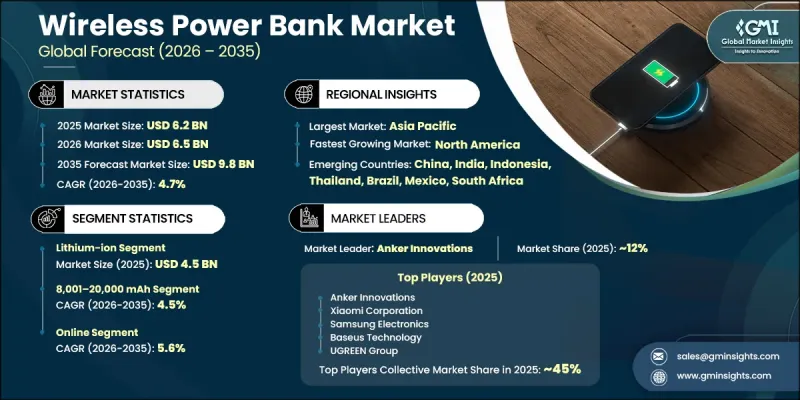
隨著智慧型手機、穿戴式裝置和其他連網電子設備的普及,消費者對攜帶式電源解決方案的依賴度日益增強,無線行動電源市場正穩步擴張。無線充電功能在消費性電子設備中的日益整合也推動了市場普及,因為用戶更青睞無線充電的便利性,這不僅提升了便攜性,也增強了易用性。電池效率、線圈排列技術和緊湊型設備設計的不斷改進也對市場產生了積極影響,提高了產品的性能和易用性。同時,全球電子商務生態系統的擴展提高了已開發國家和新興市場的產品供應量,促進了不同價位消費者的接受度。然而,與有線充電相比,無線充電的效率限制仍然存在,尤其是在充電速度較慢和傳輸中能量損耗較大方面。儘管有這些限制,消費者對便捷充電解決方案日益成長的偏好預計將繼續支撐市場需求。智慧型手機的普及、數位化生活方式的形成以及設備間生態系統相容性的不斷增強,都為無線行動電源市場的長期成長勢頭做出了貢獻。
| 市場範圍 | |
|---|---|
| 開始年份 | 2025 |
| 預測期 | 2026-2035 |
| 初始市場規模 | 62億美元 |
| 預計金額 | 98億美元 |
| 複合年成長率 | 4.7% |
預計2025年,鋰離子電池市佔率將達到72.7%,市場規模將達45億美元。該細分市場憑藉其卓越的性能特性(包括高能量密度、可靠的輸出和成熟的生產規模)持續引領市場。配備鋰離子電池的無線充電寶因其能夠實現緊湊輕便的產品設計,同時提供穩定的充電性能,仍然廣受歡迎。其成本效益高的生產體系和成熟的供應鏈進一步促進了其在全球市場的廣泛應用和價格競爭力。
預計到2025年,8001-20000mAh容量區間將佔據42.8%的市場佔有率,並在2035年之前以4.5%的複合年成長率成長。此區間憑藉均衡的性能表現引領市場,兼顧便攜性和易用性,同時提供充足的充電容量。此容量範圍內的產品通常可為多個裝置充電,滿足日常行動需求。其多功能性,以及通常具備的無線充電功能和額外的輸出選項,使其成為擁有多個設備且尋求可靠可攜式電源解決方案的用戶的理想之選。
亞太地區無線行動電源市場佔據29.6%的市場佔有率,預計到2025年市場規模將達到7.4億美元。該地區的成長主要得益於智慧型手機普及率的提高、數位生態系統的擴展以及強大的消費性電子產品製造能力。可支配收入的增加和數位連接的廣泛應用也推動了對無線充電配件需求的成長。此外,全部區域的線上零售基礎設施擴展提高了產品供應,使得產品在已開發市場和新興市場的不同消費群體中都實現了較高的滲透率。
目錄
第1章:調查方法和範圍
第2章執行摘要
第3章 行業洞察
- 產業生態系分析
- 供應商情況
- 利潤率
- 每個階段增加的價值
- 影響價值鏈的因素
- 影響產業的因素
- 促進因素
- 產業潛在風險與挑戰
- 機會
- 成長潛力分析
- 價格波動和市場不可預測性
- 對品質保證和設備可靠性的擔憂
- 未來市場趨勢
- 技術與創新展望
- 最新科技趨勢
- 新興技術
- 價格分析
- 對過去價格趨勢的分析
- 依球員類型分類的定價策略(高級球員、超值球員、成本加成球員)
- 按產品類型和銷售量分類的平均售價
- 監理情勢
- 標準和合規要求
- 區域監理框架
- 認證標準
- 波特的分析
- PESTLE分析
- 貿易數據分析
- 按地區分類的進出口數量和價值趨勢
- 主要貿易路線(中國-北美、中國-歐洲)及關稅的影響
- 人工智慧和生成式人工智慧對無線行動電源市場的影響
- 利用人工智慧改造現有經營模式(預測性維護、車輛營運最佳化)
- 按細分領域分類的人工智慧生成用例和實施藍圖(自主運行、遠距離診斷)
- 風險、限制和監管考量
- 目前分銷基礎設施和通路滲透情況
- 按地區和業務類型(現代零售、線上零售、專賣店)分類的通路覆蓋率
- 最後一公里基礎設施挑戰和不斷變化的管道(快速商務、D2C)
第4章 競爭情勢
- 介紹
- 企業市佔率分析
- 按地區
- 企業矩陣分析
- 主要市場公司的競爭分析
- 競爭定位矩陣
- 主要進展
- 併購
- 夥伴關係和聯盟
- 新產品發布
- 業務拓展計劃
第5章 市場估價與預測:依電池類型分類,2022-2035年
- 鋰離子
- 鋰聚合物
第6章 市場估計與預測:依產能分類,2022-2035年
- 3000mAh 或更少
- 3,001 mAh~8,000 mAh
- 8,001 mAh~20,000 mAh
- 20,000毫安培小時或以上
第7章 市場估算與預測:依充電技術分類,2022-2035年
- 感應式充電
- 共振充電
- 射頻能源採集
第8章 市場估計與預測:依應用領域分類,2022-2035年
- 智慧型手機
- 藥片
- 筆記型電腦
- 穿戴式裝置
- 其他(耳機、相機)
第9章 市場估計與預測:依最終用途分類,2022-2035年
- 個人/消費者
- 商業
- 產業
第10章 市場估價與預測:依通路分類,2022-2035年
- 線上
- 電子商務平台
- 每家公司的網站
- 離線
- 零售店
- 家用電器商店
第11章 市場估價與預測:按地區分類,2022-2035年
- 北美洲
- 美國
- 加拿大
- 歐洲
- 德國
- 英國
- 法國
- 義大利
- 西班牙
- 亞太地區
- 中國
- 日本
- 印度
- 澳洲
- 韓國
- 拉丁美洲
- 巴西
- 墨西哥
- 阿根廷
- 中東和非洲
- 南非
- 沙烏地阿拉伯
- UAE
第12章:公司簡介
- Top Global Player
- Anker Innovations
- Xiaomi Corporation
- Samsung Electronics
- Baseus Technology
- UGREEN Group
- Zagg Inc.
- Belkin International
- AuGroup
- Regional Player
- Ambrane India
- Syska Group
- Romoss
- Pisen Electronics
- Cellularline
- ADATA Technology
- Intex Technologies
- 新興企業
- Sharge
- Zendure
- Energizer Holdings
- Omnicharge
- RavPower
- Cuktech
The Global Wireless Power Bank Market was valued at USD 6.2 billion in 2025 and is estimated to grow at a CAGR of 4.7% to reach USD 9.8 billion by 2035.
The wireless power bank market is expanding steadily as consumers increasingly rely on portable energy solutions to support growing usage of smartphones, wearable devices, and other connected electronics. Rising integration of wireless charging functionality across consumer devices is strengthening adoption, as users prefer cable-free charging convenience that supports mobility and ease of use. The market is also benefiting from continuous improvements in battery efficiency, coil alignment technologies, and compact device design, which are enhancing product performance and usability. At the same time, expanding global e-commerce ecosystems are improving product accessibility across developed and emerging economies, supporting wider consumer adoption across multiple price segments. However, wireless charging efficiency limitations compared to wired alternatives continue to present challenges, particularly in terms of slower charging speeds and higher energy loss during transfer. Despite these constraints, growing consumer preference for convenience-driven charging solutions is expected to sustain demand. Increasing smartphone penetration, rising digital lifestyles, and expanding ecosystem compatibility across devices are collectively reinforcing long-term growth momentum in the wireless power bank market.
| Market Scope | |
|---|---|
| Start Year | 2025 |
| Forecast Year | 2026-2035 |
| Start Value | $6.2 Billion |
| Forecast Value | $9.8 Billion |
| CAGR | 4.7% |
The lithium-ion segment accounted for 72.7% share in 2025, valued at USD 4.5 billion. This segment continues to lead due to its strong performance characteristics, including high energy density, reliable output, and established manufacturing scalability. Lithium-ion-based wireless power banks remain widely preferred because they deliver consistent charging performance while supporting compact and lightweight product designs. Their cost-efficient production ecosystem and mature supply chain further contribute to widespread availability and competitive pricing across global markets.
The 8,001-20,000 mAh capacity segment held a 42.8% share in 2025 and is expected to grow at a CAGR of 4.5% through 2035. This segment dominates due to its balanced performance profile, offering sufficient charging capacity while maintaining portability and ease of use. Products in this range typically support multiple device charging cycles, making them suitable for everyday mobility needs. Their ability to combine wireless charging functionality with additional output options enhances versatility, making them highly suitable for multi-device users seeking reliable portable power solutions.
Asia Pacific Wireless Power Bank Market held a 29.6% share, generating USD 740 million in 2025. Regional growth is driven by rising smartphone adoption, expanding digital ecosystems, and strong consumer electronics manufacturing capabilities. Increasing demand for wireless charging accessories is supported by growing disposable incomes and widespread digital connectivity. Expanding online retail infrastructure across the region is also improving product accessibility, enabling strong penetration across diverse consumer groups in both developed and emerging markets.
Key companies operating in the global wireless power bank market include Xiaomi Corporation, Samsung Electronics, Anker Innovations, Belkin International, Baseus Technology, Romoss, UGREEN Group, Zendure, ADATA Technology, Ambrane India, boAt, Cuktech, Intex Technologies, ORICO Technologies, Pisen Electronics, Portronics Digital Pvt. Ltd., Sharge, Syska Group, SYSMAX Innovations Co., Ltd., Yoobao, and Aukey (AuGroup). Companies operating in the wireless power bank market are strengthening their market position by investing in advanced battery technologies, compact product engineering, and fast-charging innovation. Manufacturers are focusing on improving wireless charging efficiency, thermal management systems, and multi-device compatibility to enhance user experience. Strategic expansion of product portfolios across budget, mid-range, and premium categories is enabling broader consumer reach. Firms are also increasing investment in research and development to improve coil alignment accuracy, energy conversion efficiency, and product durability. Strengthening e-commerce partnerships and direct-to-consumer distribution channels is further enhancing global market penetration.
Table of Contents
Chapter 1 Methodology and Scope
- 1.1 Research approach
- 1.2 Quality Commitments
- 1.2.1 GMI AI policy & data integrity commitment
- 1.2.1.1 Source consistency protocol
- 1.2.1 GMI AI policy & data integrity commitment
- 1.3 Research Trail & Confidence Scoring
- 1.3.1 Research Trail Components
- 1.3.2 Scoring Components
- 1.4 Data Collection
- 1.4.1 Partial list of primary sources
- 1.5 Data mining sources
- 1.5.1 Paid sources
- 1.5.1.1 Sources, by region
- 1.5.1 Paid sources
- 1.6 Base estimates and calculations
- 1.6.1 Base year calculation for any one approach
- 1.7 Forecast model
- 1.7.1 Quantified market impact analysis
- 1.7.1.1 Mathematical impact of growth parameters on forecast
- 1.7.1 Quantified market impact analysis
- 1.8 Research transparency addendum
- 1.8.1 Source attribution framework
- 1.8.2 Quality assurance metrics
- 1.8.3 Our commitment to trust
Chapter 2 Executive Summary
- 2.1 Industry 360° synopsis
- 2.2 Key market trends
- 2.2.1 Regional
- 2.2.2 Battery Type
- 2.2.3 Capacity
- 2.2.4 Application
- 2.2.5 Charging Technology
- 2.2.6 End User
- 2.2.7 Distribution Channel
Chapter 3 Industry Insights
- 3.1 Industry ecosystem analysis
- 3.1.1 Supplier landscape
- 3.1.2 Profit margin
- 3.1.3 Value addition at each stage
- 3.1.4 Factor affecting the value chain
- 3.2 Industry impact forces
- 3.2.1 Growth drivers
- 3.2.2 Industry pitfalls & challenges
- 3.2.3 Opportunities
- 3.3 Growth potential analysis
- 3.3.1 Price volatility and market unpredictability
- 3.3.2 Quality assurance and equipment reliability concerns
- 3.4 Future market trends
- 3.5 Technology and innovation landscape
- 3.5.1 Current technological trends
- 3.5.2 Emerging technologies
- 3.6 Pricing Analysis (Driven by Primary Research)
- 3.6.1 Historical Price Trend Analysis (Driven by Primary Research)
- 3.6.2 Pricing Strategy by Player Type (Premium/Value/Cost-plus) (Driven by Primary Research)
- 3.6.3 Average Selling Price by Product Type & Capacity
- 3.7 Regulatory landscape
- 3.7.1 Standards and compliance requirements
- 3.7.2 Regional regulatory frameworks
- 3.7.3 Certification standards
- 3.8 Porter's analysis
- 3.9 PESTEL analysis
- 3.10 Trade Data Analysis (Driven by Primary Research)
- 3.10.1 Import/Export Volume & Value Trends by Region (HS Code Level) (Driven by Primary Research)
- 3.10.2 Key Trade Corridors (China-North America, China-Europe) & Tariff Impact (Driven by Primary Research)
- 3.11 Impact of AI & Generative AI on the Wireless Power Bank Market
- 3.11.1 AI-Driven Disruption of Existing Business Models (Predictive Maintenance, Fleet Optimization)
- 3.11.2 GenAI Use Cases & Adoption Roadmap by Segment (Autonomous Operations, Remote Diagnostics)
- 3.11.3 Risks, Limitations & Regulatory Considerations
- 3.12 Distribution Infrastructure & Channel Penetration Landscape (Driven by Primary Research)
- 3.12.1 Channel Coverage by Region & Format (Modern Trade vs. Online vs. Specialty) (Driven by Primary Research)
- 3.12.2 Last-Mile Infrastructure Gaps & Emerging Channel Shifts (Quick Commerce, D2C) (Driven by Primary Research)
Chapter 4 Competitive Landscape, 2025
- 4.1 Introduction
- 4.2 Company market share analysis
- 4.2.1 By region
- 4.2.1.1 North America
- 4.2.1.2 Europe
- 4.2.1.3 Asia Pacific
- 4.2.1.4 Latin America
- 4.2.1.5 Middle East and Africa
- 4.2.1 By region
- 4.3 Company matrix analysis
- 4.4 Competitive analysis of major market players
- 4.5 Competitive positioning matrix
- 4.6 Key developments
- 4.6.1 Mergers & acquisitions
- 4.6.2 Partnerships & collaborations
- 4.6.3 New product launches
- 4.6.4 Expansion plans
Chapter 5 Market Estimates & Forecast, By Battery Type, 2022 - 2035, (USD Billion) (Thousand Units)
- 5.1 Key trends
- 5.2 Lithium-ion
- 5.3 Lithium polymer
Chapter 6 Market Estimates & Forecast, By Capacity, 2022 - 2035, (USD Billion) (Thousand Units)
- 6.1 Key trends
- 6.2 Up to 3,000 mAh
- 6.3 3,001 mAh-8,000 mAh
- 6.4 8,001 mAh-20,000 mAh
- 6.5 Above 20,000 mAh
Chapter 7 Market Estimates & Forecast, By Charging Technology, 2022 - 2035, (USD Billion) (Thousand Units)
- 7.1 Key trends
- 7.2 Inductive charging
- 7.3 Resonant charging
- 7.4 RF energy harvesting
Chapter 8 Market Estimates & Forecast, By Application, 2022 - 2035, (USD Billion) (Thousand Units)
- 8.1 Key trends
- 8.2 Smartphone
- 8.3 Tablet
- 8.4 Laptop
- 8.5 Wearable devices
- 8.6 Others (headsets, camera)
Chapter 9 Market Estimates & Forecast, By End Use, 2022 - 2035, (USD Billion) (Thousand Units)
- 9.1 Key trends
- 9.2 Individual/consumer
- 9.3 Commercial
- 9.4 Industrial
Chapter 10 Market Estimates & Forecast, By Distribution Channel, 2022 - 2035, (USD Billion) (Thousand Units)
- 10.1 Key trends
- 10.2 Online
- 10.2.1 E-commerce platforms
- 10.2.2 Company websites
- 10.3 Offline
- 10.3.1 Retail stores
- 10.3.2 Specialty electronics stores
Chapter 11 Market Estimates and Forecast, By Region, 2022 - 2035 (USD Billion) (Thousand Units)
- 11.1 Key trends
- 11.2 North America
- 11.2.1 U.S.
- 11.2.2 Canada
- 11.3 Europe
- 11.3.1 Germany
- 11.3.2 UK
- 11.3.3 France
- 11.3.4 Italy
- 11.3.5 Spain
- 11.4 Asia Pacific
- 11.4.1 China
- 11.4.2 Japan
- 11.4.3 India
- 11.4.4 Australia
- 11.4.5 South Korea
- 11.5 Latin America
- 11.5.1 Brazil
- 11.5.2 Mexico
- 11.5.3 Argentina
- 11.6 Middle East and Africa
- 11.6.1 South Africa
- 11.6.2 Saudi Arabia
- 11.6.3 UAE
Chapter 12 Company Profiles
- 12.1 Top Global Player
- 12.1.1 Anker Innovations
- 12.1.2 Xiaomi Corporation
- 12.1.3 Samsung Electronics
- 12.1.4 Baseus Technology
- 12.1.5 UGREEN Group
- 12.1.6 Zagg Inc.
- 12.1.7 Belkin International
- 12.1.8 AuGroup
- 12.2 Regional Player
- 12.2.1 Ambrane India
- 12.2.2 Syska Group
- 12.2.3 Romoss
- 12.2.4 Pisen Electronics
- 12.2.5 Cellularline
- 12.2.6 ADATA Technology
- 12.2.7 Intex Technologies
- 12.3 Emerging Players
- 12.3.1 Sharge
- 12.3.2 Zendure
- 12.3.3 Energizer Holdings
- 12.3.4 Omnicharge
- 12.3.5 RavPower
- 12.3.6 Cuktech

 全球無線充電器市場規模、佔有率、趨勢和成長分析報告(2026-2034年)全球無線行動電池市場規模、佔有率、趨勢和成長分析報告(2026-2034年)
 無線充電器市場分析及預測(至2035年):類型、產品、技術、組件、應用、形式、設備、最終用戶、安裝方式、解決方案
 汽車充電器市場規模、佔有率和成長分析:按連接技術類型、可用連接器連接埠類型、電源輸出額定功率、分銷和採購管道以及地區分類-2026-2033年產業預測
 無線充電器屏蔽軛片市場:按材料類型、充電標準、充電器類型、分銷管道和最終用戶分類 - 全球預測(2026-2032 年)
 無線行動電源市場-全球產業規模、佔有率、趨勢、機會和預測(按電池類型、技術、最終用戶、地區和競爭細分,2020-2030 年預測)
 全球無線充電器市場規模、佔有率、趨勢分析報告:按產品、功率範圍、組件、技術、應用、地區、展望和預測,2024年至2031年
 無線充電器市場規模、佔有率、趨勢分析報告:按組件、產品、技術、輸出功率、應用、地區、細分市場預測,2025-2030 年