

 |
市場調查報告書
商品編碼
2101894
無線麥克風市場機會、成長要素、產業趨勢分析及2026-2035年預測。Wireless Microphone Market Opportunity, Growth Drivers, Industry Trend Analysis, and Forecast 2026 - 2035 |
||||||

全球無線麥克風市場預計到 2025 年將達到 29 億美元,年複合成長率為 8.1%,到 2035 年將達到 63 億美元。
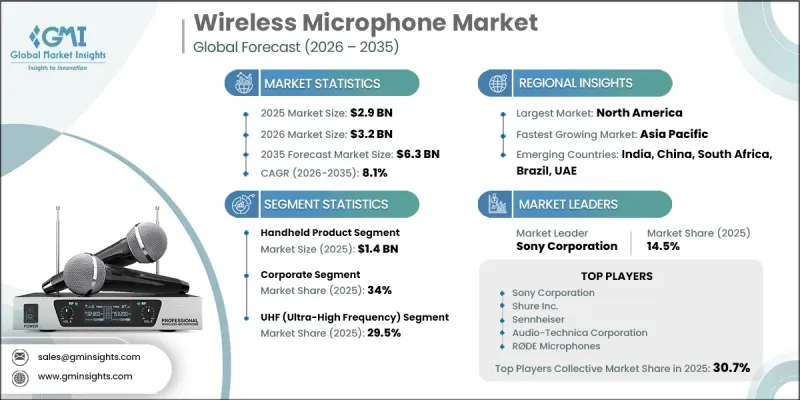
由於市場對行動音訊解決方案的需求不斷成長,使得主講人、表演者和演講者能夠擺脫線纜的束縛,從而實現無線音訊市場的蓬勃發展。在商務溝通環境、培訓中心和混合會議場景中的廣泛應用進一步推動了這項需求。向數位化內容創作和直播平台的轉變也促進了專業和半專業應用領域的使用。無線麥克風因其柔軟性、易於部署以及在動態環境中更佳的音質而日益普及。對攜帶式和緊湊型音訊設備的需求不斷成長,正在改變產品開發趨勢,製造商正致力於輕量化設計和增強連接性。同時,與最新視聽生態系統的整合正在提升大規模活動和企業環境中的效能穩定性。訊號穩定性、電池效率和降噪技術的持續進步,進一步推動了全球終端用戶產業的長期市場擴張。
| 市場範圍 | |
|---|---|
| 開始年份 | 2025 |
| 預測期 | 2026-2035 |
| 初始市場規模 | 29億美元 |
| 預計金額 | 63億美元 |
| 複合年成長率 | 8.1% |
預計到2025年,手持式無線麥克風市場規模將達到14億美元,主要得益於數位無線系統的日益普及和頻率管理技術的進步。該細分市場因其易用性、價格優勢以及與最新無線通訊系統的兼容性而持續受到廣泛支援。在專業音訊環境中,便攜性和可靠性至關重要,手持式麥克風因此持續獲得市場青睞,並且仍然是無線麥克風行業的重要組成部分。
到2025年,企業應用領域將佔據34%的市場。該領域的需求主要源於負責人會議室、培訓、會議和混合會議環境的廣泛應用,在這些環境中,無縫通訊和高品質語音傳輸至關重要。無線麥克風正日益整合到先進的會議系統和數位通訊平台中,從而在小規模大規模的組織環境中實現不間斷的協作和清晰的語音傳輸。
預計到2025年,北美無線麥克風市佔率將達到36.1%。這得歸功於其強大的技術基礎設施和先進音訊系統的廣泛應用。該地區持續受益於娛樂製作、廣播、企業通訊和內容創作等行業的高普及率。對數位媒體生態系統和現場製作能力的積極投資進一步推動了該地區的市場擴張,而持續的技術創新則提升了整體專業應用的音質和運行可靠性。
目錄
第1章:調查方法和範圍
第2章執行摘要
第3章 行業洞察
- 產業生態系分析
- 供應商情況
- 利潤率
- 成本結構
- 每個階段增加的價值
- 影響價值鏈的因素
- 中斷
- 影響產業的因素
- 促進因素
- 娛樂和活動產業的快速成長
- 它在企業和教育領域的應用正在不斷擴大。
- 無線音訊設備的需求正在激增。
- 技術發展進展
- 內容創作與串流生態系統的發展
- 產業潛在風險與挑戰
- 與干擾和頻段可用性相關的複雜問題
- 先進麥克風技術成本高昂。
- 市場機遇
- OTT平台和數位內容創作領域的應用日益廣泛。
- 擴大混合活動和虛擬會議
- 促進因素
- 成長潛力分析
- 監理情勢
- 波特的分析
- PESTLE分析
- 技術與創新展望
- 最新科技趨勢
- 新興技術
- 價格分析
- 對過去價格趨勢的分析
- 依球員類型分類的定價策略(高級球員、超值球員、成本加成球員)
- 貿易數據分析
- 進出口量及進口額趨勢
- 主要貿易路線及關稅的影響
- 人工智慧和生成式人工智慧對市場的影響
- 利用人工智慧改造現有經營模式
- 按細分市場分類的生成式人工智慧用例和部署藍圖
- 風險、限制和監管考量
第4章 競爭情勢
- 介紹
- 企業市佔率分析
- 按地區
- 北美洲
- 歐洲
- 亞太地區
- 拉丁美洲
- 中東和非洲
- 市場集中度分析
- 按地區
- 主要市場公司的競爭分析
- 競爭定位矩陣
- 主要進展
- 併購
- 夥伴關係和聯盟
- 新產品發布
- 業務拓展計劃及資金籌措
- 按公司規模進行基準測試
- 排名分類標準與遴選標準
- 按銷售額、地區和創新能力分類的層級定位矩陣。
第5章 市場估價與預測:依產品分類,2022-2035年
- 手持式
- 夾式
- 其他
第6章 市場估計與預測:依技術分類,2022-2035年
- 超高頻(UHF)
- 類比超高頻
- 數位超高頻
- 甚高頻(VHF)
- 2.4 GHz
- 5 GHz
- DECT
- 其他
第7章 市場估算與預測:依射頻通道分類,2022-2035年
- 單通道
- 雙通道
- 多通道
第8章 市場估算與預測:依最終用途分類,2022-2035年
- 公司
- 教育
- 飯店業
- 體育賽事
- 其他
第9章 市場估計與預測:依地區分類,2022-2035年
- 北美洲
- 美國
- 加拿大
- 歐洲
- 德國
- 英國
- 法國
- 西班牙
- 義大利
- 荷蘭
- 其他歐洲國家
- 亞太地區
- 中國
- 印度
- 日本
- 澳洲
- 韓國
- 其他亞太國家
- 拉丁美洲
- 巴西
- 墨西哥
- 阿根廷
- 其他拉丁美洲國家
- 中東和非洲
- 南非
- 沙烏地阿拉伯
- UAE
- 其他中東和非洲國家
第10章:公司簡介
- 世界公司
- Shure Inc.
- Sony Corporation
- Audio-Technica Corporation
- Sennheiser
- Harman International Industries, Incorporated
- RØDE Microphones
- Yamaha Corporation
- Electro-Voice(EV)
- Tascam
- 該地區的領先企業
- TOA Corporation
- Mipro Electronics Co., Ltd.
- Samson Technologies Corp.
- Azden Corporation
- Phonic Corporation
- Peavey Electronics Corporation
- AKG Acoustics
- Taiden Industrial Co., Ltd.
- 新興企業
- Hollyland Technology
- Saramonic
The Global Wireless Microphone Market was valued at USD 2.9 billion in 2025 and is estimated to grow at a CAGR of 8.1% to reach USD 6.3 billion by 2035.
Growth in this market is driven by the increasing need for mobility-driven audio solutions that allow presenters, performers, and speakers to operate without physical cable constraints. Expanding adoption in business communication environments, training centers, and hybrid meeting setups is further strengthening demand. The shift toward digital content creation and live streaming platforms is also contributing to higher usage across professional and semi-professional applications. Wireless microphones are increasingly preferred due to their flexibility, ease of deployment, and improved sound clarity in dynamic environments. Rising demand for portable and compact audio devices is reshaping product development trends, with manufacturers focusing on lightweight designs and enhanced connectivity features. At the same time, integration with modern audio-visual ecosystems is improving performance consistency in large-scale events and corporate environments. Continuous advancements in signal stability, battery efficiency, and noise reduction technologies are further supporting long-term market expansion across global end-use industries.
| Market Scope | |
|---|---|
| Start Year | 2025 |
| Forecast Year | 2026-2035 |
| Start Value | $2.9 Billion |
| Forecast Value | $6.3 Billion |
| CAGR | 8.1% |
The handheld wireless microphone segment generated USD 1.4 billion in 2025, driven by increasing adoption of digital wireless systems and improvements in frequency management technologies. This segment remains widely preferred due to its ease of handling, affordability, and compatibility with modern wireless communication systems. Handheld designs continue to gain traction across professional audio environments where portability and reliable performance are essential, making them a core component of the wireless microphone industry landscape.
The corporate application segment accounted for 34% share in 2025. Demand in this segment is primarily driven by widespread use in boardrooms, training sessions, conferences, and hybrid meeting environments where seamless communication and high-quality audio transmission are essential. Wireless microphones are increasingly integrated with advanced conferencing systems and digital communication platforms, enabling uninterrupted collaboration and improved speech clarity in both small and large organizational settings.
North America Wireless Microphone Market held a 36.1% share in 2025, supported by strong technological infrastructure and widespread adoption of advanced audio systems. The region continues to benefit from high usage across entertainment production, broadcasting, corporate communication, and content creation industries. Strong investments in digital media ecosystems and live production capabilities are further reinforcing regional market expansion, while continuous technological advancements are improving audio quality and operational reliability across professional applications.
Key companies operating in the global wireless microphone market include Audio-Technica Corporation, RODE Microphones, Harman International Industries, Incorporated, Samson Technologies Corp., Saramonic, Hollyland Technology, Azden Corporation, Electro-Voice (EV), Mipro Electronics Co., Ltd., Peavey Electronics Corporation, Phonic Corporation, and AKG Acoustics. Companies operating in the wireless microphone market are strengthening their competitive position by focusing on product innovation, wireless connectivity improvements, and enhanced audio performance capabilities. Manufacturers are investing in advanced digital transmission technologies to improve signal stability, reduce interference, and expand operating range. Continuous development of lightweight, compact, and energy-efficient microphone systems is helping companies address the growing demand for portable audio solutions. Strategic collaborations with entertainment production houses, broadcasting networks, and corporate communication providers are expanding market reach and strengthening brand presence. Firms are also enhancing product compatibility with modern AV and conferencing platforms to support integrated communication environments.
Table of Contents
Chapter 1 Methodology and Scope
- 1.1 Market scope and definition
- 1.2 Research design
- 1.2.1 Research approach
- 1.2.2 Data collection methods
- 1.3 Data mining sources
- 1.3.1 Global
- 1.3.2 Regional/Country
- 1.4 Base estimates and calculations
- 1.4.1 Base year calculation
- 1.4.2 Key trends for market estimation
- 1.5 Primary research and validation
- 1.5.1 Primary sources
- 1.6 Forecast model
- 1.7 Research assumptions and limitations
Chapter 2 Executive Summary
- 2.1 Industry 360° synopsis, 2022 – 2035
- 2.2 Key market trends
- 2.2.1 Product trends
- 2.2.2 Technology trends
- 2.2.3 Radio frequency channel trends
- 2.2.4 End use trends
- 2.2.5 Regional trends
- 2.3 TAM Analysis, 2026-2035
- 2.4 CXO perspectives: Strategic imperatives
Chapter 3 Industry Insights
- 3.1 Industry ecosystem analysis
- 3.1.1 Supplier Landscape
- 3.1.2 Profit Margin
- 3.1.3 Cost structure
- 3.1.4 Value addition at each stage
- 3.1.5 Factor affecting the value chain
- 3.1.6 Disruptions
- 3.2 Industry impact forces
- 3.2.1 Growth drivers
- 3.2.1.1 Rapid growth of the entertainment and event industry.
- 3.2.1.2 Emerging use in corporate and educational sectors.
- 3.2.1.3 Surge in demand for wireless audio equipment.
- 3.2.1.4 Increasing technological developments.
- 3.2.1.5 Growth of content creation and streaming ecosystem.
- 3.2.2 Industry pitfalls and challenges
- 3.2.2.1 Complexities associated with interference and spectrum availability.
- 3.2.2.2 High cost of advanced microphone technology.
- 3.2.3 Market opportunities
- 3.2.3.1 Rising adoption in OTT platforms and digital content production.
- 3.2.3.2 Expansion of hybrid events and virtual conferencing.
- 3.2.1 Growth drivers
- 3.3 Growth potential analysis
- 3.4 Regulatory landscape
- 3.4.1 North America
- 3.4.2 Europe
- 3.4.3 Asia Pacific
- 3.4.4 Latin America
- 3.4.5 Middle East & Africa
- 3.5 Porter’s analysis
- 3.6 PESTEL analysis
- 3.7 Technology and Innovation landscape
- 3.7.1 Current technological trends
- 3.7.2 Emerging technologies
- 3.8 Pricing Analysis (Driven by Primary Research)
- 3.8.1 Historical Price Trend Analysis
- 3.8.2 Pricing Strategy by Player Type (Premium / Value / Cost-plus)
- 3.9 Trade Data Analysis (Based on Paid Database)
- 3.9.1 Import/Export Volume & Value Trends
- 3.9.2 Key Trade Corridors & Tariff Impact
- 3.10 Impact of AI & Generative AI on the Market (Driven by Primary Research)
- 3.10.1 AI-Driven Disruption of Existing Business Models
- 3.10.2 GenAI Use Cases & Adoption Roadmap by Segment
- 3.10.3 Risks, Limitations & Regulatory Considerations
Chapter 4 Competitive Landscape, 2025
- 4.1 Introduction
- 4.2 Company market share analysis
- 4.2.1 By Region
- 4.2.1.1 North America
- 4.2.1.2 Europe
- 4.2.1.3 Asia-Pacific
- 4.2.1.4 Latin America
- 4.2.1.5 Middle East and Africa
- 4.2.2 Market Concentration Analysis
- 4.2.1 By Region
- 4.3 Competitive analysis of major market players
- 4.4 Competitive positioning matrix
- 4.5 Key developments
- 4.5.1 Mergers & acquisitions
- 4.5.2 Partnerships & collaborations
- 4.5.3 New product launches
- 4.5.4 Expansion plans and funding
- 4.6 Company tier benchmarking
- 4.6.1 Tier classification criteria & qualifying thresholds
- 4.6.2 Tier positioning matrix by revenue, geography & innovation
Chapter 5 Market Estimates and Forecast, By Product, 2022 – 2035 (USD Million)
- 5.1 Key trends
- 5.2 Handheld
- 5.3 Clip-on
- 5.4 Others
Chapter 6 Market Estimates and Forecast, By Technology, 2022 – 2035 (USD Million)
- 6.1 Key trends
- 6.2 UHF (Ultra-High Frequency)
- 6.2.1 Analog UHF
- 6.2.2 Digital UHF
- 6.3 VHF (Very High Frequency)
- 6.4 2.4 GHz
- 6.5 5 GHz
- 6.6 DECT
- 6.7 Others
Chapter 7 Market Estimates and Forecast, By Radio Frequency Channel, 2022 – 2035 (USD Million)
- 7.1 Key trends
- 7.2 Single channel
- 7.3 Dual channel
- 7.4 Multi-channel
Chapter 8 Market Estimates and Forecast, By End Use, 2022 – 2035 (USD Million)
- 8.1 Key trends
- 8.2 Corporate
- 8.3 Education
- 8.4 Hospitality
- 8.5 Sporting events
- 8.6 Others
Chapter 9 Market Estimates and Forecast, By Region, 2022 – 2035 (USD Million)
- 9.1 Key trends
- 9.2 North America
- 9.2.1 U.S.
- 9.2.2 Canada
- 9.3 Europe
- 9.3.1 Germany
- 9.3.2 UK
- 9.3.3 France
- 9.3.4 Spain
- 9.3.5 Italy
- 9.3.6 Netherlands
- 9.3.7 Rest of Europe
- 9.4 Asia Pacific
- 9.4.1 China
- 9.4.2 India
- 9.4.3 Japan
- 9.4.4 Australia
- 9.4.5 South Korea
- 9.4.6 Rest of Asia Pacific
- 9.5 Latin America
- 9.5.1 Brazil
- 9.5.2 Mexico
- 9.5.3 Argentina
- 9.5.4 Rest of Latin America
- 9.6 Middle East and Africa
- 9.6.1 South Africa
- 9.6.2 Saudi Arabia
- 9.6.3 UAE
- 9.6.4 Rest of MEA
Chapter 10 Company Profiles
- 10.1 Global Players
- 10.1.1 Shure Inc.
- 10.1.2 Sony Corporation
- 10.1.3 Audio-Technica Corporation
- 10.1.4 Sennheiser
- 10.1.5 Harman International Industries, Incorporated
- 10.1.6 RØDE Microphones
- 10.1.7 Yamaha Corporation
- 10.1.8 Electro-Voice (EV)
- 10.1.9 Tascam
- 10.2 Regional Champions
- 10.2.1 TOA Corporation
- 10.2.2 Mipro Electronics Co., Ltd.
- 10.2.3 Samson Technologies Corp.
- 10.2.4 Azden Corporation
- 10.2.5 Phonic Corporation
- 10.2.6 Peavey Electronics Corporation
- 10.2.7 AKG Acoustics
- 10.2.8 Taiden Industrial Co., Ltd.
- 10.3 Emerging Players
- 10.3.1 Hollyland Technology
- 10.3.2 Saramonic


