


 |
市場調查報告書
商品編碼
2101892
自動注射器市場機會、成長要素、產業趨勢分析及2026-2035年預測。Autoinjectors Market Opportunity, Growth Drivers, Industry Trend Analysis, and Forecast 2026 - 2035 |
||||||

全球汽車噴油嘴市場預計到 2025 年將達到 1,150 億美元,並以 14.4% 的複合年成長率成長,到 2035 年將達到 4,308 億美元。
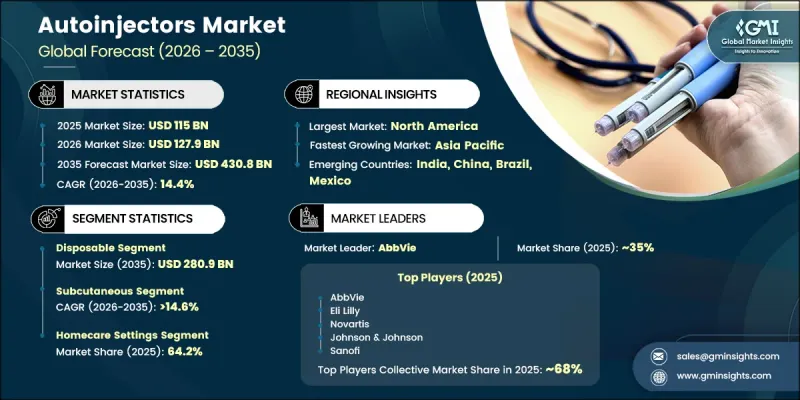
市場成長主要受標靶治療日益普及、非專利自動注射器供應增加以及對便捷式自我給藥設備需求成長的驅動。自動注射器是一種先進的藥物輸送系統,旨在透過針頭自動注射預設劑量的藥物,同時最大限度地減輕使用者負擔。這些設備廣泛用於治療慢性疾病,包括糖尿病、類風濕性關節炎、過敏症和其他長期疾病,方便患者自我給藥。其人性化的設計,通常採用彈簧式注射機制,使其特別適合需要定期注射的患者。嚴重過敏反應發生率的上升進一步加速了對急救藥物輸送設備的需求,這些設備能夠在緊急情況下快速進行自我給藥。此外,價格實惠的非專利自動注射器的普及降低了治療成本,並擴大了全球醫療保健市場患者的用藥範圍。持續的產品創新、患者便利性的提升以及居家照護需求的日益成長,都進一步增強了自動注射器市場的長期成長前景。
| 市場範圍 | |
|---|---|
| 開始年份 | 2025 |
| 預測期 | 2026-2035 |
| 初始市場規模 | 1150億美元 |
| 預測金額 | 4308億美元 |
| 複合年成長率 | 14.4% |
預計到2025年,一次性自動注射器市佔率將達到66.5%。這主要得益於一次性注射器在多種治療應用中展現出的便利性、安全性和易用性。一次性自動注射器預先填充藥物,僅供單次使用,無需更換藥筒,從而最大限度地降低了污染風險和劑量誤差。其高可靠性和易用性使其在需要長期持續精準給藥的慢性疾病治療中廣泛應用。
預計到2025年,居家醫療產業將佔據64.2%的市場佔有率,這主要得益於醫療模式轉向自我管理及以病人為中心的模式。居家照護因其便利性、降低醫療成本以及支持患者自主管理慢性疾病等優勢,持續受到患者的青睞。自動注射器是長期注射治療的理想解決方案,無需醫護人員直接監督,即可安全、準確、便捷地輸送藥物,同時還能提高治療順從性和患者滿意度。
預計到2025年,北美自動注射器市佔率將達到46.9%。該地區市場擴張的促進因素包括:需要定期注射治療的慢性病盛行率不斷上升、人們對自我給藥治療方案的認知度不斷提高,以及先進藥物傳輸技術的普及。對便利、可靠且患者友善的注射裝置的持續需求,加上完善的醫療保健基礎設施,預計將推動全部區域市場持續成長。
目錄
第1章:調查方法
第2章執行摘要
第3章 行業洞察
- 產業生態系分析
- 影響產業的因素
- 促進因素
- 對標靶治療的需求日益成長
- 全球非專利自動注射器的供應情況
- 糖尿病和過敏反應發生率增加
- 患者越來越傾向自行用藥
- 產業潛在風險與挑戰
- 替代療法的可近性
- 汽車噴油嘴價格高昂
- 汽車噴油嘴產能短缺
- 機會
- 智慧連網自動注射器的普及
- 擴大生物相似藥和生物製藥的上市規模
- 促進因素
- 成長潛力分析
- 監理情勢
- 價格趨勢分析
- 技術與創新展望
- 最新科技趨勢
- 新興技術
- 未來市場趨勢
- 人工智慧和生成式人工智慧對市場的影響
- 波特的分析
- PESTLE分析
第4章 競爭情勢
- 介紹
- 企業矩陣分析
- 企業市佔率分析
- 世界
- 北美洲
- 歐洲
- 亞太地區
- LAMEA
- 主要市場公司的競爭分析
- 競爭定位矩陣
- 主要進展
- 併購
- 夥伴關係和聯盟
- 新產品發布
- 業務拓展計劃
第5章 市場估計與預測:依類型分類,2022-2035年
- 拋棄式的
- 可重複使用的
第6章 市場估計與預測:依給藥途徑分類,2022-2035年
- 皮下
- 肌肉內部
第7章 市場估計與預測:依療法分類,2022-2035年
- 類風濕性關節炎
- 多發性硬化症
- 過敏反應
- 糖尿病
- 其他療法
第8章 市場估算與預測:依最終用途分類,2022-2035年
- 醫院和診所
- 居家照護環境
- 其他最終用戶
第9章 市場估計與預測:依地區分類,2022-2035年
- 北美洲
- 美國
- 加拿大
- 歐洲
- 德國
- 英國
- 法國
- 西班牙
- 義大利
- 荷蘭
- 亞太地區
- 中國
- 日本
- 印度
- 澳洲
- 韓國
- 拉丁美洲
- 巴西
- 墨西哥
- 阿根廷
- 中東和非洲
- 南非
- 沙烏地阿拉伯
- UAE
第10章:公司簡介
- AbbVie
- Amgen
- Antares Pharma
- Becton, Dickinson and Company
- Eli Lilly
- Gerresheimer
- GlaxoSmithKline
- Halozyme
- Johnson & Johnson
- Mylan
- Novo Nordisk
- Owen Mumford
- SHL Medical
- Teva Pharmaceuticals
- West Pharmaceutical Services
- Ypsomed
The Global Autoinjectors Market was valued at USD 115 billion in 2025 and is estimated to grow at a CAGR of 14.4% to reach USD 430.8 billion by 2035.
Market growth is being fueled by the rising adoption of targeted therapies, expanding availability of generic autoinjectors, and increasing demand for convenient self-administration devices. Autoinjectors are advanced drug delivery systems designed to automatically administer a predetermined dose of medication through a needle with minimal user effort. These devices are widely used for the self-administration of therapies for chronic conditions, including diabetes, rheumatoid arthritis, allergies, and other long-term diseases. Their user-friendly design, typically supported by a spring-powered injection mechanism, makes them particularly suitable for patients requiring regular injections. The increasing prevalence of severe allergic reactions is further accelerating demand for emergency drug delivery devices that enable rapid self-administration during critical situations. In addition, broader access to cost-effective generic autoinjectors is improving treatment affordability and expanding patient access across global healthcare markets. Continuous product innovation, improved patient convenience, and growing preference for home-based treatment continue to reinforce the long-term growth outlook for the autoinjectors market.
| Market Scope | |
|---|---|
| Start Year | 2025 |
| Forecast Year | 2026-2035 |
| Start Value | $115 Billion |
| Forecast Value | $430.8 Billion |
| CAGR | 14.4% |
The disposable autoinjectors segment held 66.5% share in 2025, supported by the convenience, safety, and ease of use offered by single-use devices across a broad range of therapeutic applications. Disposable autoinjectors are supplied prefilled and intended for one-time administration, eliminating the need for cartridge replacement while minimizing contamination risks and dosing inaccuracies. Their high reliability and simplified operation have encouraged widespread adoption for the treatment of chronic diseases that require consistent and accurate medication delivery over extended periods.
The homecare settings segment captured a 64.2% share in 2025 driven by the increasing shift toward self-administration and patient-centered healthcare models. Patients continue to favor home-based treatment because it offers greater convenience, lowers healthcare expenses, and supports independent management of chronic conditions. Autoinjectors provide safe, precise, and user-friendly drug administration without requiring direct medical supervision, making them an ideal solution for long-term injectable therapies while improving treatment adherence and patient satisfaction.
North America Autoinjectors Market accounted for 46.9% share in 2025. Regional expansion is supported by the growing prevalence of chronic diseases that require routine injectable therapies, increasing awareness of self-administered treatment options, and the widespread adoption of advanced drug delivery technologies. Continued demand for convenient, reliable, and patient-friendly injection devices, along with a well-established healthcare infrastructure, is expected to sustain market growth across the region.
Key players operating in the global autoinjectors market include Novo Nordisk, AbbVie, Gerresheimer, Eli Lilly and Company, Becton, Dickinson and Company, Johnson & Johnson, SHL Medical, Halozyme, Owen Mumford, Teva Pharmaceuticals, GlaxoSmithKline, Mylan, Antares Pharma, West Pharmaceutical Services, Ypsomed, and Amgen. Companies operating in the autoinjectors market are strengthening their competitive position by investing in advanced drug delivery technologies, expanding product portfolios, and enhancing patient-centric device designs. Manufacturers are focusing on developing user-friendly, ergonomic, and highly reliable autoinjectors that improve treatment adherence and overall patient experience. Strategic partnerships with pharmaceutical companies, healthcare providers, and distribution networks are helping expand commercial reach and support combination product development. Businesses are also increasing investments in research and development to improve injection mechanisms, safety features, and device compatibility with biologics and specialty drugs. In addition, companies continue to pursue regulatory approvals, geographic expansion, manufacturing capacity enhancements, and the introduction of cost-effective generic autoinjectors to broaden market access and reinforce long-term market leadership.
Table of Contents
Chapter 1 Research Methodology
- 1.1 Research approach
- 1.2 Quality commitments
- 1.2.1 GMI AI policy & data integrity commitment
- 1.2.1.1 Source consistency protocol
- 1.2.1 GMI AI policy & data integrity commitment
- 1.3 Research trail & confidence scoring
- 1.3.1 Research trail components
- 1.3.2 Scoring components
- 1.4 Data collection
- 1.4.1 Partial list of primary sources
- 1.5 Data mining sources
- 1.5.1 Paid sources
- 1.5.1.1 Sources, by region
- 1.5.1 Paid sources
- 1.6 Base estimates and calculations
- 1.6.1 Base year calculation
- 1.7 Forecast model
- 1.7.1 Quantified market impact analysis
- 1.7.1.1 Mathematical impact of growth parameters on forecast
- 1.7.1 Quantified market impact analysis
- 1.8 Research transparency addendum
- 1.8.1 Source attribution framework
- 1.8.2 Quality assurance metrics
- 1.8.3 Our commitment to trust
Chapter 2 Executive Summary
- 2.1 Industry 360° synopsis
- 2.2 Key market trends
- 2.2.1 Regional trends
- 2.2.2 Type trends
- 2.2.3 Route of administration trends
- 2.2.4 Therapy trends
- 2.2.5 End use trends
- 2.3 CXO perspectives: Strategic imperatives
Chapter 3 Industry Insights
- 3.1 Industry ecosystem analysis
- 3.2 Industry impact forces
- 3.2.1 Growth drivers
- 3.2.1.1 Growing demand for targeted therapies
- 3.2.1.2 Availability of generic autoinjectors globally
- 3.2.1.3 Increasing incidence of diabetes and anaphylaxis
- 3.2.1.4 Rising patient preference towards self-administration of medication
- 3.2.2 Industry pitfalls and challenges
- 3.2.2.1 Availability of alternative treatment options
- 3.2.2.2 High pricing of the autoinjectors
- 3.2.2.3 Limited autoinjector manufacturing capacity
- 3.2.3 Opportunities
- 3.2.3.1 Adoption of smart and connected autoinjectors
- 3.2.3.2 Expansion of biosimilar and biologic drug launches
- 3.2.1 Growth drivers
- 3.3 Growth potential analysis
- 3.4 Regulatory landscape
- 3.4.1 North America
- 3.4.2 Europe
- 3.4.3 Asia Pacific
- 3.4.4 Latin America
- 3.4.5 Middle East and Africa
- 3.5 Pricing trend analysis (Driven by Primary Research)
- 3.6 Technology and innovation landscape (Driven by Primary Research)
- 3.6.1 Current technological trends
- 3.6.2 Emerging technologies
- 3.7 Future market trends (Driven by Primary Research)
- 3.8 Impact of AI & Generative AI on the Market (Driven by Primary Research)
- 3.9 Porter's analysis
- 3.10 PESTEL analysis
Chapter 4 Competitive Landscape, 2025
- 4.1 Introduction
- 4.2 Company matrix analysis
- 4.3 Company market share analysis (Driven by Primary Research)
- 4.3.1 Global
- 4.3.2 North America
- 4.3.3 Europe
- 4.3.4 Asia Pacific
- 4.3.5 LAMEA
- 4.4 Competitive analysis of major market players
- 4.5 Competitive positioning matrix
- 4.6 Key developments
- 4.6.1 Mergers & acquisitions
- 4.6.2 Partnerships & collaborations
- 4.6.3 New product launches
- 4.6.4 Expansion plans
Chapter 5 Market Estimates and Forecast, By Type, 2022 - 2035 ($ Mn)
- 5.1 Key trends
- 5.2 Disposable
- 5.3 Reusable
Chapter 6 Market Estimates and Forecast, By Route of Administration, 2022 - 2035 ($ Mn)
- 6.1 Key trends
- 6.2 Subcutaneous
- 6.3 Intramuscular
Chapter 7 Market Estimates and Forecast, By Therapy, 2022 - 2035 ($ Mn)
- 7.1 Key trends
- 7.2 Rheumatoid arthritis
- 7.3 Multiple sclerosis
- 7.4 Anaphylaxis
- 7.5 Diabetes
- 7.6 Other therapies
Chapter 8 Market Estimates and Forecast, By End Use, 2022 - 2035 ($ Mn)
- 8.1 Key trends
- 8.2 Hospital and clinics
- 8.3 Homecare settings
- 8.4 Other end users
Chapter 9 Market Estimates and Forecast, By Region, 2022 - 2035 ($ Mn)
- 9.1 Key trends
- 9.2 North America
- 9.2.1 U.S.
- 9.2.2 Canada
- 9.3 Europe
- 9.3.1 Germany
- 9.3.2 UK
- 9.3.3 France
- 9.3.4 Spain
- 9.3.5 Italy
- 9.3.6 Netherlands
- 9.4 Asia Pacific
- 9.4.1 China
- 9.4.2 Japan
- 9.4.3 India
- 9.4.4 Australia
- 9.4.5 South Korea
- 9.5 Latin America
- 9.5.1 Brazil
- 9.5.2 Mexico
- 9.5.3 Argentina
- 9.6 MEA
- 9.6.1 South Africa
- 9.6.2 Saudi Arabia
- 9.6.3 UAE
Chapter 10 Company Profiles
- 10.1 AbbVie
- 10.2 Amgen
- 10.3 Antares Pharma
- 10.4 Becton, Dickinson and Company
- 10.5 Eli Lilly
- 10.6 Gerresheimer
- 10.7 GlaxoSmithKline
- 10.8 Halozyme
- 10.9 Johnson & Johnson
- 10.10 Mylan
- 10.11 Novo Nordisk
- 10.12 Owen Mumford
- 10.13 SHL Medical
- 10.14 Teva Pharmaceuticals
- 10.15 West Pharmaceutical Services
- 10.16 Ypsomed

 全球自動噴油嘴市場(2026-2030 年)
 自動注射器市場:2026-2032年全球市場預測(依產品類型、劑量類型、給藥途徑、血管形態、注射量、治療領域、最終用戶、通路及病患類型分類)
 自動注射器市場規模、佔有率和成長分析:按應用、技術、給藥途徑、治療領域、銷售、最終用戶和地區分類 - 產業預測,2026-2033年
 自動注射器市場規模、佔有率、成長率、全球產業分析、區域趨勢及2026-2034年預測
 自動注射器市場-全球產業規模、佔有率、趨勢、機會和預測:按產品、適應症、最終用戶、地區和競爭對手分類,2021-2031年
 自動注射器市場報告:按類型、應用程式、最終用戶和地區分類(2026-2034 年)
 全球自動注射器市場:按類型、用途、操作機制、給藥途徑、治療領域、藥物類型、銷售、最終用戶和地區分類-預測至2031年全球自動注射器市場規模、佔有率、趨勢和成長分析報告(2026-2034)
 2026年全球自動注射器市場報告
 自動注射器市場:按產品類型、疾病、通路和地區分類