


 |
市場調查報告書
商品編碼
2101891
脊椎機器人手術市場機會、成長要素、產業趨勢分析及2026-2035年預測。Spine Robotic Surgery Market Opportunity, Growth Drivers, Industry Trend Analysis, and Forecast 2026 - 2035 |
||||||

全球脊椎機器人手術市場預計到 2025 年將達到 4.874 億美元,並以 12.6% 的複合年成長率成長,到 2035 年將達到 16 億美元。
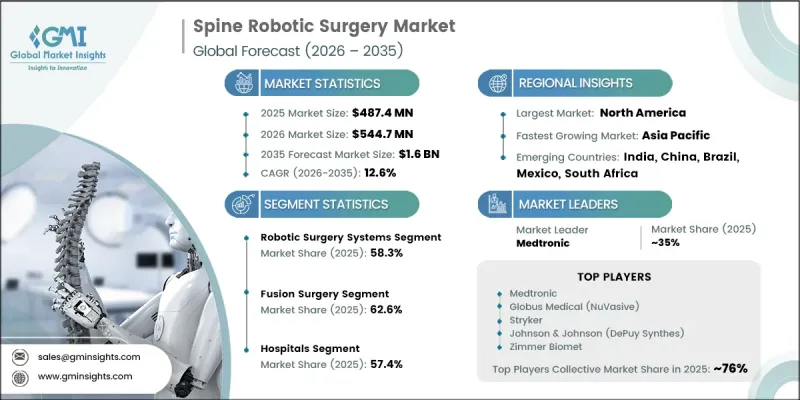
隨著醫療機構擴大採用先進的手術技術來提高手術精度和改善患者預後,脊椎機器人手術市場正穩步成長。對微創手術的需求不斷成長、醫療保健領域的投資增加以及脊椎疾病盛行率的上升,持續為市場擴張創造機會。機器人輔助脊椎手術將智慧機器人平台與先進的導航技術相結合,使外科醫生能夠以更高的精度、一致性和控制力完成複雜的手術。這項技術有助於精準植入植入,提高手術計畫的準確性,最大限度地減少手術差異,並有助於縮短恢復時間和降低併發症率。持續的技術創新,包括人工智慧、即時成像和導航功能的整合,正在進一步加速醫療機構對機器人輔助系統的應用。隨著醫院和專科手術中心不斷投資於先進的手術基礎設施,在臨床接受度不斷提高和持續創新的推動下,預計脊椎機器人手術市場將在預測期內保持持續成長。
| 市場範圍 | |
|---|---|
| 開始年份 | 2025 |
| 預測期 | 2026-2035 |
| 上市時的市場規模 | 4.874億美元 |
| 預計金額 | 16億美元 |
| 複合年成長率 | 12.6% |
脊椎機器人手術市場的競爭格局由美敦力、Globus Medical、史賽克、強生(DePuy Synthes)和捷邁生物等主要企業主導。這些公司透過持續的產品研發、廣泛的國際企業發展以及對技術創新的大量投資,不斷鞏固其市場地位。微創手術的日益普及和機器人輔助手術技術的不斷發展也推動了市場成長。影像、導航系統和人工智慧(AI)技術的持續進步提高了機器人平台的效能、效率和易用性,加速了醫療機構的採用。需要高精度手術的脊椎手術數量不斷增加,進一步推動了對先進機器人解決方案的需求。
預計到2025年,機器人手術系統市佔率將達到58.3%,這主要得益於技術進步、臨床療效的提升以及其支持高度複雜脊椎手術的能力。對精準手術技術日益成長的需求持續推動醫療機構對機器人系統的應用。現代機器人平台融合了先進的成像、人工智慧和即時導航技術,從而提高了植入定位的準確性和手術精度。這些功能增強了手術的一致性,改善了患者的治療效果,降低了手術差異性,並提高了脊椎手術的整體效率。
到2025年,醫院市佔率將達到57.4%。其主導地位得益於先進的醫療基礎設施、專業的醫療團隊以及能夠進行機器人輔助脊椎手術的一體化手術環境。先進影像技術、導航平台和機器人系統的引入進一步鞏固了醫院作為此類手術領先提供者的地位。預計對機器人輔助手術技術的持續投資將推動該領域在預測期內保持持續成長。
到2025年,北美脊椎機器人手術市場將佔據53.9%的市場。該地區持續引領產業發展,主要得益於對先進外科技術的強勁需求、高昂的醫療費用支出以及機器人輔助手術的日益普及。需要脊椎手術的患者數量不斷增加,加上對創新醫療技術和先進醫療基礎設施的持續投資,將繼續推動全部區域市場的成長。
目錄
第1章:調查方法
第2章執行摘要
第3章 行業洞察
- 產業生態系分析
- 影響產業的因素
- 促進因素
- 脊椎疾病盛行率增加
- 技術進步
- 微創手術的激增
- 醫療費用增加
- 產業潛在風險與挑戰
- 機器人設備的複雜性
- 嚴格的監管要求
- 市場機遇
- 新興經濟體的成長潛力
- 持續投資於產品研發
- 促進因素
- 成長潛力分析
- 監理情勢
- 技術展望
- 最新科技趨勢
- 新興技術
- 價格趨勢分析
- 未來市場趨勢
- 專利分析
- 波特的分析
- PESTLE分析
- 人工智慧和生成式人工智慧對市場的影響
- 價值鏈分析
- 消費者洞察
- 治療基礎設施和臨床實施的現狀
- 差距分析
第4章 競爭情勢
- 介紹
- 企業矩陣分析
- 企業市佔率分析
- 世界
- 北美洲
- 歐洲
- 亞太地區
- 競爭定位矩陣
- 主要市場公司的競爭分析
- 主要進展
- 併購
- 夥伴關係和聯盟
- 新產品發布
- 業務拓展計劃
第5章 市場估算與預測:依產品類型分類,2022-2035年
- 機器人手術系統
- 全機器人手術系統
- 機械臂輔助系統
- 手術導航系統
- 電磁導航系統
- 光學導航系統
- 混合導航系統
- 軟體解決方案
- 配件和耗材
第6章 市場估計與預測:依應用領域分類,2022-2035年
- 固定手術
- 非固定手術
第7章 市場估計與預測:依最終用途分類,2022-2035年
- 醫院
- 門診手術中心
- 其他
第8章 市場估計與預測:依地區分類,2022-2035年
- 北美洲
- 美國
- 加拿大
- 歐洲
- 德國
- 英國
- 法國
- 西班牙
- 義大利
- 荷蘭
- 亞太地區
- 中國
- 日本
- 印度
- 澳洲
- 韓國
- 拉丁美洲
- 巴西
- 墨西哥
- 阿根廷
- 中東和非洲
- 南非
- 沙烏地阿拉伯
- UAE
第9章:公司簡介
- B. Braun
- Brainlab
- Curexo
- Globus Medical(NuVasive)
- Intuitive Surgical
- Johnson & Johnson(DePuy Synthes)
- Medtronic plc
- Orthofix Medical
- Siemens Healthineers
- Stryker Corporation
- Surgical Theater
- Surgivisio
- Tinavi Medical Technologies
- Zimmer Biomet
The Global Spine Robotic Surgery Market was valued at USD 487.4 million in 2025 and is estimated to grow at a CAGR of 12.6% to reach USD 1.6 billion by 2035.
The spine robotic surgery market is experiencing steady growth as healthcare providers increasingly adopt advanced surgical technologies to improve procedural accuracy and patient outcomes. Rising demand for minimally invasive surgical techniques, increasing healthcare investments, and the growing incidence of spinal conditions continue to create favorable opportunities for market expansion. Robotic-assisted spine surgery combines intelligent robotic platforms with advanced navigation technologies, enabling surgeons to perform complex procedures with greater precision, consistency, and control. The technology supports improved implant placement, enhances surgical planning, and minimizes procedural variability while contributing to shorter recovery periods and reduced complication rates. Continuous technological advancements, including the integration of artificial intelligence, real-time imaging, and navigation capabilities, are further strengthening the adoption of robotic-assisted systems across healthcare facilities. As hospitals and specialized surgical centers continue to invest in advanced surgical infrastructure, the spine robotic surgery market is expected to witness sustained growth, supported by increasing clinical acceptance and ongoing innovation throughout the forecast period.
| Market Scope | |
|---|---|
| Start Year | 2025 |
| Forecast Year | 2026-2035 |
| Start Value | $487.4 Million |
| Forecast Value | $1.6 Billion |
| CAGR | 12.6% |
The competitive landscape of the spine robotic surgery market is led by companies such as Medtronic, Globus Medical, Stryker, Johnson & Johnson (DePuy Synthes), and Zimmer Biomet. These organizations continue to strengthen their market positions through continuous product development, broad international operations, and significant investments in technological advancement. Market expansion has also been supported by the increasing adoption of minimally invasive surgical procedures and the ongoing evolution of robotic-assisted surgical technologies. Continuous improvements in imaging, navigation systems, and artificial intelligence have enhanced the performance, efficiency, and accessibility of robotic platforms, encouraging wider adoption across healthcare providers. The growing number of spinal procedures requiring high surgical precision continues to reinforce demand for advanced robotic solutions.
The robotic surgery systems segment accounted for 58.3% share in 2025 owing to technological advancements, improved clinical outcomes, and its ability to support highly complex spinal procedures. Increasing demand for precision-focused surgical technologies continues to drive the adoption of robotic systems across healthcare facilities. Modern robotic platforms combine advanced imaging, artificial intelligence, and real-time navigation technologies to improve implant positioning and surgical accuracy. These capabilities enhance procedural consistency, support better patient outcomes, reduce surgical variability, and improve overall efficiency during spinal procedures.
The hospitals segment held 57.4% share in 2025. Their leadership is supported by access to advanced medical infrastructure, specialized surgical teams, and integrated operating environments capable of performing robotic-assisted spinal procedures. The adoption of sophisticated imaging technologies, navigation platforms, and robotic systems has further strengthened the position of hospitals as the primary providers of these procedures. Continued investments in robotic-assisted surgical technologies are expected to support sustained segment growth throughout the forecast period.
North America Spine Robotic Surgery Market held 53.9% share in 2025. The region continues to lead the industry due to strong demand for advanced surgical technologies, substantial healthcare expenditures, and increasing adoption of robotic-assisted procedures. A growing patient population requiring spinal interventions, combined with continued investment in innovative medical technologies and advanced healthcare infrastructure, continues to support market growth across the region.
Prominent companies operating in the global spine robotic surgery market include B. Braun, Brainlab, Curexo, Globus Medical (NuVasive), Intuitive Surgical, Johnson & Johnson (DePuy Synthes), Medtronic plc, Orthofix Medical, Siemens Healthineers, Stryker Corporation, Surgical Theater, Surgivisio, Tinavi Medical Technologies, and Zimmer Biomet. Companies operating in the spine robotic surgery market are reinforcing their market position through continuous innovation, strategic collaborations, and expansion of advanced robotic technology portfolios. Industry participants are investing heavily in research and development to improve robotic precision, navigation capabilities, artificial intelligence integration, and surgical workflow efficiency. Many companies are expanding their global footprint through partnerships, acquisitions, and distribution agreements while strengthening relationships with healthcare providers and academic institutions. Manufacturers are also focusing on product enhancements, software upgrades, surgeon training programs, and clinical evidence generation to encourage broader adoption.
Table of Contents
Chapter 1 Research Methodology
- 1.1 Research approach
- 1.2 Quality commitments
- 1.2.1 GMI AI policy & data integrity commitment
- 1.2.1.1 Source consistency protocol
- 1.2.1 GMI AI policy & data integrity commitment
- 1.3 Research trail & confidence scoring
- 1.3.1 Research trail components
- 1.3.2 Scoring components
- 1.4 Data collection
- 1.4.1 Partial list of primary sources
- 1.5 Data mining sources
- 1.5.1 Paid sources
- 1.5.1.1 Sources, by region
- 1.5.1 Paid sources
- 1.6 Base estimates and calculations
- 1.6.1 Base year calculation for any one approach
- 1.7 Forecast model
- 1.7.1 Quantified market impact analysis
- 1.7.1.1 Mathematical impact of growth parameters on forecast
- 1.7.1 Quantified market impact analysis
- 1.8 Research transparency addendum
- 1.8.1 Source attribution framework
- 1.8.2 Quality assurance metrics
- 1.8.3 Our commitment to trust
Chapter 2 Executive Summary
- 2.1 Industry 360° synopsis
- 2.2 Key market trends
- 2.2.1 Regional trends
- 2.2.2 Product type trends
- 2.2.3 Application trends
- 2.2.4 End use trends
- 2.3 CXO perspectives: Strategic imperatives
Chapter 3 Industry Insights
- 3.1 Industry ecosystem analysis
- 3.2 Industry impact forces
- 3.2.1 Growth drivers
- 3.2.1.1 Increasing prevalence of spinal disorders.
- 3.2.1.2 Technological advancements
- 3.2.1.3 Surge in minimally invasive surgical procedures
- 3.2.1.4 Increased healthcare spending
- 3.2.2 Industry pitfalls and challenges
- 3.2.2.1 Complexity of robotic devices
- 3.2.2.2 Stringent regulatory requirements
- 3.2.3 Market opportunities
- 3.2.3.1 Growth potential in developing economies
- 3.2.3.2 Continued investment in research and development for product development
- 3.2.1 Growth drivers
- 3.3 Growth potential analysis
- 3.4 Regulatory landscape (Driven by primary research)
- 3.4.1 North America
- 3.4.2 Europe
- 3.4.3 Asia Pacific
- 3.4.4 Latin America
- 3.4.5 MEA
- 3.5 Technology landscape (Driven by primary research)
- 3.5.1 Current technological trends
- 3.5.2 Emerging technologies
- 3.6 Pricing trend analysis (Driven by primary research)
- 3.7 Future market trends
- 3.8 Patent analysis (Driven by primary research)
- 3.9 Porter's analysis
- 3.10 PESTEL analysis
- 3.11 Impact of AI and Generative AI on the market (Driven by primary research)
- 3.12 Value chain analysis (Driven by primary research)
- 3.13 Consumer insights (Driven by primary research)
- 3.14 Treatment infrastructure & clinical adoption landscape
- 3.15 Gap analysis
Chapter 4 Competitive Landscape, 2025
- 4.1 Introduction
- 4.2 Company matrix analysis
- 4.3 Company market share analysis (Driven by primary research)
- 4.3.1 Global
- 4.3.2 North America
- 4.3.3 Europe
- 4.3.4 Asia Pacific
- 4.4 Competitive positioning matrix
- 4.5 Competitive analysis of major market players
- 4.6 Key developments
- 4.6.1 Mergers & acquisitions
- 4.6.2 Partnerships & collaborations
- 4.6.3 New product launches
- 4.6.4 Expansion plans
Chapter 5 Market Estimates and Forecast, By Product Type, 2022 - 2035 ($ Mn)
- 5.1 Key trends
- 5.2 Robotic surgery systems
- 5.2.1 Fully robotic systems
- 5.2.2 Robotic arm-assisted systems
- 5.3 Surgical navigation systems
- 5.3.1 Electromagnetic navigation systems
- 5.3.2 Optical navigation systems
- 5.3.3 Hybrid navigation systems
- 5.4 Software solutions
- 5.5 Accessories and consumables
Chapter 6 Market Estimates and Forecast, By Application, 2022 - 2035 ($ Mn)
- 6.1 Key trends
- 6.2 Fusion surgery
- 6.3 Non-fusion surgery
Chapter 7 Market Estimates and Forecast, By End Use, 2022 - 2035 ($ Mn)
- 7.1 Key trends
- 7.2 Hospitals
- 7.3 Ambulatory surgical centers
- 7.4 Other end users
Chapter 8 Market Estimates and Forecast, By Region, 2022 - 2035 ($ Mn)
- 8.1 Key trends
- 8.2 North America
- 8.2.1 U.S.
- 8.2.2 Canada
- 8.3 Europe
- 8.3.1 Germany
- 8.3.2 UK
- 8.3.3 France
- 8.3.4 Spain
- 8.3.5 Italy
- 8.3.6 Netherlands
- 8.4 Asia Pacific
- 8.4.1 China
- 8.4.2 Japan
- 8.4.3 India
- 8.4.4 Australia
- 8.4.5 South Korea
- 8.5 Latin America
- 8.5.1 Brazil
- 8.5.2 Mexico
- 8.5.3 Argentina
- 8.6 Middle East and Africa
- 8.6.1 South Africa
- 8.6.2 Saudi Arabia
- 8.6.3 UAE
Chapter 9 Company Profiles
- 9.1 B. Braun
- 9.2 Brainlab
- 9.3 Curexo
- 9.4 Globus Medical (NuVasive)
- 9.5 Intuitive Surgical
- 9.6 Johnson & Johnson (DePuy Synthes)
- 9.7 Medtronic plc
- 9.8 Orthofix Medical
- 9.9 Siemens Healthineers
- 9.10 Stryker Corporation
- 9.11 Surgical Theater
- 9.12 Surgivisio
- 9.13 Tinavi Medical Technologies
- 9.14 Zimmer Biomet

 全球機器人脊椎手術市場規模、佔有率、趨勢和成長分析報告(2026-2034年)
 脊椎外科產品市場:依產品類型、手術入路、材料、適應症和最終用戶分類-2026-2032年全球市場預測
 人工智慧在脊椎外科領域的市場規模、佔有率和成長分析:按組件、技術類型、應用、最終用戶、分銷管道和地區分類-2026-2033年產業預測
 脊椎外科手術機器人市場規模、佔有率和成長分析:按組件、應用/手術類型、適應症、最終用戶和地區分類-2026-2033年產業預測
 脊椎外科器械市場-全球產業規模、佔有率、趨勢、機會、預測:按器材類型、手術類型、最終用戶、地區和競爭對手分類,2021-2031年
 脊椎外科醫療設備市場:依器械類型、手術類型、應用和地區分類。
 美國脊椎外科人工智慧市場規模、佔有率和趨勢分析報告:按功能、應用、最終用途和細分市場分類(2026-2033 年)
 2026年全球脊椎外科器械及設備市場報告2026年全球脊椎外科手術器械市場報告
 日本脊椎外科器械市場報告(按類型(脊椎減壓、脊椎融合、骨折修復及其他)和地區分類,2026-2034年)