


 |
市場調查報告書
商品編碼
2101886
自動小包裹分揀機市場機會、成長要素、產業趨勢分析及2026-2035年預測Automatic Parcel Singulator Market Opportunity, Growth Drivers, Industry Trend Analysis, and Forecast 2026 - 2035 |
||||||

全球自動小包裹分揀機市場預計到 2025 年將達到 7.3 億美元,年複合成長率為 9%,到 2035 年將達到 17.5 億美元。
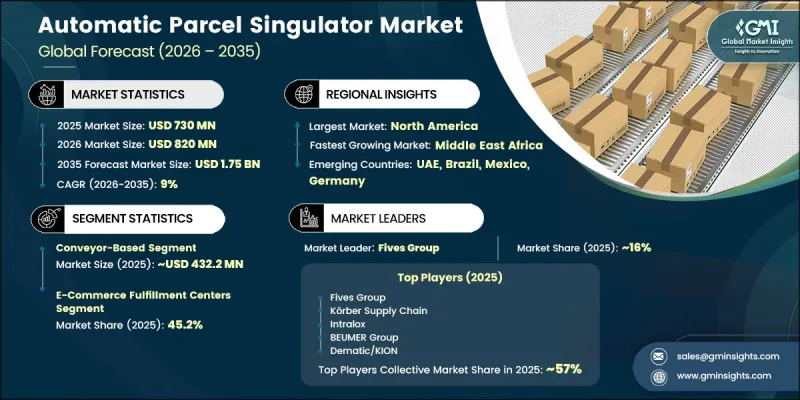
受電子商務持續擴張、小包裹量不斷成長以及履約配送網路現代化等因素的推動,市場正經歷強勁成長,這些因素加速了自動化物料輸送方案的普及。對更快訂單處理速度、更高分揀精度和更有效率的營運需求不斷成長,促使物流供應商加強對先進小包裹處理技術的投資。人手不足加劇和工資壓力上升進一步加速了企業從人工小包裹裝載流程向能夠持續提供高速性能的自動化系統的轉變。此外,機器視覺、人工智慧、機器人和智慧感測技術的不斷進步顯著提升了小包裹識別、分揀和處理能力。企業越來越關注能夠提高生產力和服務品質並降低營運成本的高度擴充性的自動化解決方案。大規模物流樞紐的持續發展、第三方物流(3PL) 業務的擴張以及對智慧倉庫投資的增加,都為自動化小包裹分揀市場創造了持續的機會。隨著供應鏈自動化技術的進步和客戶對更快交付速度的期望不斷提高,預計在整個預測期內,對智慧小包裹分揀系統的需求將保持強勁。
| 市場範圍 | |
|---|---|
| 開始年份 | 2025 |
| 預測期 | 2026-2035 |
| 初始市場規模 | 7.3億美元 |
| 預測金額 | 17.5億美元 |
| 複合年成長率 | 9% |
預計到2025年,機器人單件分類機市佔率將達到15.8%,到2035年將達到30%。這些單臂機器人系統專為每小時處理1000至2500個小包裹的設施而設計。同年,多臂機器人系統佔據了7%的市場佔有率,並因其更高的處理能力和處理大規模自動化分類作業的能力而保持著較高的平均售價。
預計到2025年,郵政和宅配服務市佔率將達到29.1%,市場規模約3.3億美元。隨著小包裹量的成長,以及各機構投資於最新的自動化技術以提高處理效率、擴大產能並應對日益複雜的小包裹流,市場需求正持續向私人物流供應商轉移。
預計到2025年,北美自動小包裹分揀機市場將佔據36.5%的市場佔有率,到2035年市場規模將達到5.435億美元。該地區的成長主要得益於對倉庫自動化持續投資、物流基礎設施的擴張以及配送中心對先進小包裹處理系統的日益普及。智慧自動化技術的積極應用,加上履約營運的不斷現代化以及對智慧物流設施投資的增加,持續推動全部區域市場的擴張。
目錄
第1章:調查方法和範圍
第2章執行摘要
第3章 行業洞察
- 產業生態系分析
- 供應商情況
- 利潤率
- 每個階段增加的價值
- 影響價值鏈的因素
- 影響產業的因素
- 促進因素
- 電子商務小包裹量激增及當日送達服務
- 倉儲產業人手不足和薪資上漲正在加速自動化投資回報(ROI)。
- 擴大高容量履約物流中心的基礎設施。
- 擴大人工智慧、機器視覺和物聯網在智慧倉庫營運的應用。
- 產業潛在風險與挑戰
- 中小企業的大資本投資和較長的投資回收期
- 與傳統倉庫管理系統(WMS)整合的複雜性。
- 現有設施的空間限制與維修挑戰
- 機會
- 新興市場(東南亞、拉丁美洲、中東)尚未開發的需求
- 機器人即服務 (RAA) 和租賃模式的日益普及降低了進入門檻。
- 機場和貨運航廈實施個體隔離
- 軟包裝和塑膠袋的個性化
- 促進因素
- 成長潛力分析
- 供應鏈分析
- 關鍵零件(視覺感測器、伺服馬達、控制系統)的採購
- 供應鏈中斷風險評估
- 零件供應近岸外包和本地化趨勢
- 未來市場趨勢
- 技術與創新展望
- 下一代人工智慧和電腦視覺技術用於個人化小包裹
- 機器人和協作自動化的發展趨勢
- 物聯網整合和即時性能監控
- 邊緣運算和預測性維護技術
- 以永續主導的設計創新(高效驅動裝置、低雜訊系統)
- 監理情勢
- 職業安全與健康及機械指令(歐盟機械法規,OSHA)
- 電磁相容性 (EMC) 和 CE/UL 認證要求
- 關於環境和能源效率的法規(ErP 指令、ISO 14001)
- 人工智慧和自主系統的新法規對物流自動化產生影響
- 貿易數據分析
- 進出口量及進口額趨勢
- 主要貿易走廊及關稅影響(美中貿易、歐亞貿易)
- 人工智慧和生成式人工智慧對市場的影響
- 人工智慧正在改變傳統的輸送機式個人化模式。
- 按細分領域分類的生成式人工智慧用例和實施藍圖(預測性維護、動態流程最佳化、缺陷檢測)
- 人工智慧在小包裹處理中的風險、限制和監管考量
- 價格分析
- 依系統類型分析歷史價格趨勢
- 依球員類型分類的定價策略(高級球員、超值球員、成本加成球員)
- 總擁有成本 (TCO) 框架
- 波特的分析
- PESTLE分析
第4章 競爭情勢
- 介紹
- 企業市佔率分析
- 企業矩陣分析
- 主要市場公司的競爭分析
- 競爭定位矩陣
- 主要進展
- 併購
- 夥伴關係和聯盟
- 新產品發布
- 業務拓展計劃
第5章 市場估計與預測:依技術類型分類,2022-2035年
- 主要趨勢
- 輸送機式單料器
- 皮帶驅動奇點
- 滾筒式奇點
- 線性奇異性
- 旋轉單工器
- 傾斜托盤式奇異性
- 推型奇點
- 機器人單步器
- 單臂機器人奇點
- 多臂機器人單臂
- AI視覺引導單音器
- 基於2D視覺的系統
- 基於3D視覺的系統
- 混合單分子器
第6章 市場估算與預測:依自動化類型分類,2022-2035年
- 主要趨勢
- 全自動
- 半自動
- 人工智慧賦能/智慧
第7章 市場估計與預測:依小包裹類型分類,2022-2035年
- 主要趨勢
- 小小包裹和塑膠袋
- 標準小包裹和瓦楞紙箱
- 大/特大小包裹
- 扁平信封
- 不規則/不規則形狀
第8章 市場估算與預測:依最終用途分類,2022-2035年
- 主要趨勢
- 電子商務履約中心
- 專業電子商務企業
- 全通路零售履約
- 郵政和宅配服務
- 國營郵政服務
- 私人宅配公司
- 第三方物流(3PL)和物流樞紐
- 零售物流中心
- 機場和貨運站
- 其他(製造業、製藥業、工業)
第9章 市場估價與預測:依通路分類,2022-2035年
- 主要趨勢
- 直銷
- 系統整合商和增值轉售商(VAR)
- 銷售代理商和經銷商
- 線上和數位銷售平台
第10章 市場估價與預測:依地區分類,2022-2035年
- 主要趨勢
- 北美洲
- 美國
- 加拿大
- 歐洲
- 德國
- 法國
- 英國
- 義大利
- 西班牙
- 亞太地區
- 中國
- 日本
- 印度
- 澳洲
- 韓國
- 拉丁美洲
- 巴西
- 墨西哥
- 阿根廷
- 中東和非洲
- 沙烏地阿拉伯
- UAE
- 南非
第11章:公司簡介
- Global Leaders
- BEUMER Group
- Fives Group-Smart Automation Solutions
- Korber Supply Chain
- Vanderlande Industries
- Dematic(KION Group)
- Intralox LLC
- Honeywell Intelligrated
- 本地公司
- Wayzim Technology Co., Ltd.
- Kengic Intelligent Equipment
- Falcon Autotech
- Isitec International
- NPI(National Postal Industries)
- Daifuku Co., Ltd
- Interroll Group
- 新興企業
- robominds GmbH
- Photoneo(Zebra Technologies)
- Hangzhou YaoLi Tech Co., Ltd.
- Realkey Machinery(RKSORT)
- Guangdong Siwun Logistics Equipment
- Hangzhou Sunnen Technology
- Bowe Systec GmbH
The Global Automatic Parcel Singulator Market was valued at USD 730 million in 2025 and is estimated to grow at a CAGR of 9% to reach USD 1.75 billion by 2035.
The market is witnessing strong growth as the continuous expansion of e-commerce, increasing parcel volumes, and the modernization of fulfillment and distribution networks accelerate the adoption of automated material handling solutions. Rising demand for faster order processing, higher sorting accuracy, and improved operational efficiency is encouraging logistics providers to invest in advanced parcel handling technologies. Growing labor shortages and increasing wage pressures are further driving companies to replace manual parcel induction processes with automated systems capable of delivering consistent high-speed performance. In addition, continuous advancements in machine vision, artificial intelligence, robotics, and intelligent sensing technologies are significantly improving parcel identification, orientation, and throughput capabilities. Businesses are increasingly focusing on scalable automation solutions that reduce operational costs while improving productivity and service quality. The ongoing development of large distribution hubs, expanding third-party logistics operations, and increasing investment in smart warehouses continue to create favorable opportunities for the automatic parcel singulator market. As supply chains become more automated and customer expectations for rapid deliveries continue to rise, demand for intelligent parcel singulation systems is expected to remain strong throughout the forecast period.
| Market Scope | |
|---|---|
| Start Year | 2025 |
| Forecast Year | 2026-2035 |
| Start Value | $730 Million |
| Forecast Value | $1.75 Billion |
| CAGR | 9% |
The robotic singulators segment held 15.8% share in 2025 and is projected to reach 30% by 2035. Single-arm robotic systems, designed for facilities processing between 1,000 and 2,500 parcels per hour. Multi-arm robotic systems accounted for 7% of the market during the same year and continue to generate higher average selling prices because of their ability to manage greater throughput and support large-scale automated sorting operations.
The postal and courier services segment held 29.1% share in 2025, representing approximately USD 330 million. Demand continues to shift toward private logistics providers as parcel volumes expand and organizations invest in modern automation technologies to improve processing efficiency, increase throughput capacity, and accommodate increasingly complex parcel flows.
North America Automatic Parcel Singulator Market accounted for 36.5% share in 2025 and is projected to reach USD 543.5 million by 2035. Regional growth is supported by continuous investments in warehouse automation, expanding logistics infrastructure, and increasing deployment of advanced parcel handling systems across distribution centers. Strong adoption of intelligent automation technologies, together with ongoing modernization of fulfillment operations and rising investment in smart logistics facilities, continues to strengthen market expansion throughout the region.
Key players in the global automatic parcel singulator market include BEUMER Group, Vanderlande Industries, Dematic (KION Group), Honeywell Intelligrated, Korber Supply Chain, Fives Group - Smart Automation Solutions, Intralox LLC, Wayzim Technology Co., Ltd., Kengic Intelligent Equipment, Falcon Autotech, Isitec International, NPI (National Postal Industries), Daifuku Co., Ltd., Interroll Group, robominds GmbH, Photoneo (Zebra Technologies), Hangzhou YaoLi Tech Co., Ltd., Realkey Machinery (RKSORT), Guangdong Siwun Logistics Equipment, Hangzhou Sunnen Technology, Bowe Systec GmbH. Companies operating in the automatic parcel singulator market are strengthening their competitive position by investing in advanced robotics, artificial intelligence, machine vision, and intelligent automation technologies to improve parcel handling accuracy and operational efficiency. Manufacturers are expanding product portfolios with scalable, modular systems capable of supporting varying throughput requirements across logistics facilities. Strategic partnerships with warehouse automation providers, logistics companies, and system integrators are helping businesses broaden their customer base and accelerate technology adoption.
Table of Contents
Chapter 1 Methodology & Scope
- 1.1 Research approach
- 1.2 Quality Commitments
- 1.2.1 GMI AI policy & data integrity commitment
- 1.2.1.1 Source consistency protocol
- 1.2.1 GMI AI policy & data integrity commitment
- 1.3 Research Trail & Confidence Scoring
- 1.3.1 Research Trail Components
- 1.3.2 Scoring Components
- 1.4 Data Collection
- 1.4.1 Partial list of primary sources
- 1.5 Data mining sources
- 1.5.1 Paid sources
- 1.5.1.1 Sources, by region
- 1.5.1 Paid sources
- 1.6 Base estimates and calculations
- 1.6.1 Base year calculation for any one approach
- 1.7 Forecast model
- 1.7.1 Quantified market impact analysis
- 1.7.1.1 Mathematical impact of growth parameters on forecast
- 1.7.1 Quantified market impact analysis
- 1.8 Research transparency addendum
- 1.8.1 Source attribution framework
- 1.8.2 Quality assurance metrics
- 1.8.3 Our commitment to trust
Chapter 2 Executive Summary
- 2.1 Industry 360° synopsis
- 2.2 Key market trends
- 2.2.1 Region
- 2.2.2 Technology Type
- 2.2.3 Automation
- 2.2.4 Parcel Type
- 2.2.5 End-use
- 2.2.6 Distribution channel
Chapter 3 Industry Insights
- 3.1 Industry ecosystem analysis
- 3.1.1 Supplier landscape
- 3.1.2 Profit margin
- 3.1.3 Value addition at each stage
- 3.1.4 Factor affecting the value chain
- 3.2 Industry impact forces
- 3.2.1 Growth drivers
- 3.2.1.1 Rapid growth of e-commerce parcel volumes & same-day delivery
- 3.2.1.2 Acute warehouse labor shortages & rising wage inflation accelerating automation ROI
- 3.2.1.3 Expansion of high-throughput fulfillment & distribution center infrastructure
- 3.2.1.4 Increasing adoption of ai, machine vision & iot in smart warehouse operations
- 3.2.2 Industry pitfalls & challenges
- 3.2.2.1 High capital expenditure & long payback periods for sme operators
- 3.2.2.2 System integration complexity with legacy warehouse management systems (wms)
- 3.2.2.3 Space constraints & retrofitting challenges in existing facilities
- 3.2.3 Opportunities
- 3.2.3.1 Untapped Demand in Emerging Markets (Southeast Asia, Latin America, Middle East)
- 3.2.3.2 Growing Adoption of Robotics-as-a-Service (raas) & Leasing Models Lowering Entry Barriers
- 3.2.3.3 Airport & Cargo Terminal Singulation
- 3.2.3.4 Soft-Pack & Polybag Singulation
- 3.2.1 Growth drivers
- 3.3 Growth potential analysis
- 3.4 Supply Chain Analysis
- 3.4.1 Critical Component Sourcing (Vision Sensors, Servo Motors, Control Systems)
- 3.4.2 Supply Chain Disruption Risk Assessment
- 3.4.3 Nearshoring & Localization Trends in Component Supply
- 3.5 Future market trends
- 3.6 Technology and innovation landscape
- 3.6.1 Next-Generation AI & Computer Vision in Parcel Singulation
- 3.6.2 Robotics & Collaborative Automation Trends
- 3.6.3 IoT Integration & Real-Time Performance Monitoring
- 3.6.4 Edge Computing & Predictive Maintenance Technologies
- 3.6.5 Sustainability-Driven Design Innovations (Energy-Efficient Drives, Low-Noise Systems)
- 3.7 Regulatory landscape
- 3.7.1 Occupational Safety & Machinery Directives (EU Machinery Regulation, OSHA)
- 3.7.2 Electromagnetic Compatibility (EMC) & CE/UL Certification Requirements
- 3.7.3 Environmental & Energy Efficiency Regulations (ErP Directive, ISO 14001)
- 3.7.4 Emerging AI & Autonomous Systems Regulations Impacting Logistics Automation
- 3.8 Trade data analysis (HS Code)
- 3.8.1 Import/Export Volume & Value Trends
- 3.8.2 Key Trade Corridors & Tariff Impact (US-China, EU-Asia) (Driven by Primary Research)
- 3.9 Impact of AI & generative AI on the market
- 3.9.1 AI-Driven Disruption of Existing Conveyor-Based Singulation Models
- 3.9.2 GenAI Use Cases & Adoption Roadmap by Segment (Predictive Maintenance, Dynamic Flow Optimization, Defect Detection)
- 3.9.3 Risks, Limitations & Regulatory Considerations for AI in Parcel Handling
- 3.10 Pricing Analysis
- 3.10.1 Historical Price Trend Analysis by System Type (Driven by Primary Research)
- 3.10.2 Pricing Strategy by Player Type (Premium / Value / Cost-plus) (Driven by Primary Research)
- 3.10.3 Total Cost of Ownership (TCO) Framework
- 3.11 Porter's analysis
- 3.12 PESTEL analysis
Chapter 4 Competitive Landscape, 2025
- 4.1 Introduction
- 4.2 Company market share analysis
- 4.3 Company matrix analysis
- 4.4 Competitive analysis of major market players
- 4.5 Competitive positioning matrix
- 4.6 Key developments
- 4.6.1 Mergers & acquisitions
- 4.6.2 Partnerships & collaborations
- 4.6.3 New product launches
- 4.6.4 Expansion plans
Chapter 5 Market Estimates & Forecast, By Technology Type, 2022 - 2035, (USD Million) (Thousand Units)
- 5.1 Key Trends
- 5.2 Conveyor-Based Singulators
- 5.2.1 Belt-Driven Singulators
- 5.2.2 Roller-Based Singulators
- 5.2.3 Linear Singulators
- 5.2.4 Rotary Singulators
- 5.2.5 Tilt-Tray Singulators
- 5.2.6 Pusher-Type Singulators
- 5.3 Robotic Singulators
- 5.3.1 Single-Arm Robotic Singulators
- 5.3.2 Multi-Arm Robotic Singulators
- 5.4 AI Vision-Guided Singulators
- 5.4.1 2D Vision-Based Systems
- 5.4.2 3D Vision-Based Systems
- 5.5 Hybrid Singulators
Chapter 6 Market Estimates & Forecast, By Automation, 2022 - 2035, (USD Million) (Thousand Units)
- 6.1 Key Trends
- 6.2 Fully Automated
- 6.3 Semi-Automated
- 6.4 AI-Enabled/Intelligent
Chapter 7 Market Estimates & Forecast, By Parcel Type, 2022 - 2035, (USD Million) (Thousand Units)
- 7.1 Key Trends
- 7.2 Small Parcels & Polybags
- 7.3 Standard Parcels & Cartons
- 7.4 Large & Oversized Parcels
- 7.5 Flats & Envelopes
- 7.6 Irregular & Odd-Shaped Items
Chapter 8 Market Estimates & Forecast, By End-use, 2022 - 2035, (USD Million) (Thousand Units)
- 8.1 Key Trends
- 8.2 E-commerce Fulfillment Centers
- 8.2.1 Pure-Play E-commerce Operators
- 8.2.2 Omnichannel Retail Fulfillment
- 8.3 Postal & Courier Services
- 8.3.1 National Postal Operators
- 8.3.2 Private Express & Courier Companies
- 8.4 Third-Party Logistics (3PL) & Distribution Hubs
- 8.5 Retail Distribution Centers
- 8.6 Airports & Cargo Terminals
- 8.7 Others (Manufacturing, Pharmaceutical, Industrial)
Chapter 9 Market Estimates & Forecast, By Distribution Channel, 2022 - 2035, (USD Million) (Thousand Units)
- 9.1 Key Trends
- 9.2 Direct Sales
- 9.3 System Integrators & Value-Added Resellers (VARs)
- 9.4 Distributors & Resellers
- 9.5 Online & Digital Sales Platforms
Chapter 10 Market Estimates & Forecast, By Region, 2022 - 2035, (USD Million) (Thousand Units)
- 10.1 Key Trends
- 10.2 North America
- 10.2.1 U.S.
- 10.2.2 Canada
- 10.3 Europe
- 10.3.1 Germany
- 10.3.2 France
- 10.3.3 UK
- 10.3.4 Italy
- 10.3.5 Spain
- 10.4 Asia Pacific
- 10.4.1 China
- 10.4.2 Japan
- 10.4.3 India
- 10.4.4 Australia
- 10.4.5 South Korea
- 10.5 Latin America
- 10.5.1 Brazil
- 10.5.2 Mexico
- 10.5.3 Argentina
- 10.6 MEA
- 10.6.1 Saudi Arabia
- 10.6.2 UAE
- 10.6.3 South Africa
Chapter 11 Company Profiles
- 11.1 Global Leaders
- 11.1.1 BEUMER Group
- 11.1.2 Fives Group - Smart Automation Solutions
- 11.1.3 Korber Supply Chain
- 11.1.4 Vanderlande Industries
- 11.1.5 Dematic (KION Group)
- 11.1.6 Intralox LLC
- 11.1.7 Honeywell Intelligrated
- 11.2 Regional Players
- 11.2.1 Wayzim Technology Co., Ltd.
- 11.2.2 Kengic Intelligent Equipment
- 11.2.3 Falcon Autotech
- 11.2.4 Isitec International
- 11.2.5 NPI (National Postal Industries)
- 11.2.6 Daifuku Co., Ltd
- 11.2.7 Interroll Group
- 11.3 Emerging Players
- 11.3.1 robominds GmbH
- 11.3.2 Photoneo (Zebra Technologies)
- 11.3.3 Hangzhou YaoLi Tech Co., Ltd.
- 11.3.4 Realkey Machinery (RKSORT)
- 11.3.5 Guangdong Siwun Logistics Equipment
- 11.3.6 Hangzhou Sunnen Technology
- 11.3.7 Bowe Systec GmbH

 小包裹分類機市場報告:趨勢、預測與競爭分析(至2031年)
 小包裹分類機:全球市場佔有率和排名、總收入和需求預測(2025-2031年)小包裹件分離器 - 全球市場佔有率和排名、總收入和需求預測(2025-2031 年)
 自動小包裹分揀機的全球市場