


 |
市場調查報告書
商品編碼
2101872
2026 年至 2035 年航太和國防推進系統的市場機會、成長要素、產業趨勢和預測。Aerospace and Defense Propulsion System Market Opportunity, Growth Drivers, Industry Trend Analysis, and Forecast 2026 - 2035 |
||||||

全球航太和國防推進系統市場預計到 2025 年將達到 1,929 億美元,年複合成長率為 7.1%,到 2035 年將達到 3,810 億美元。
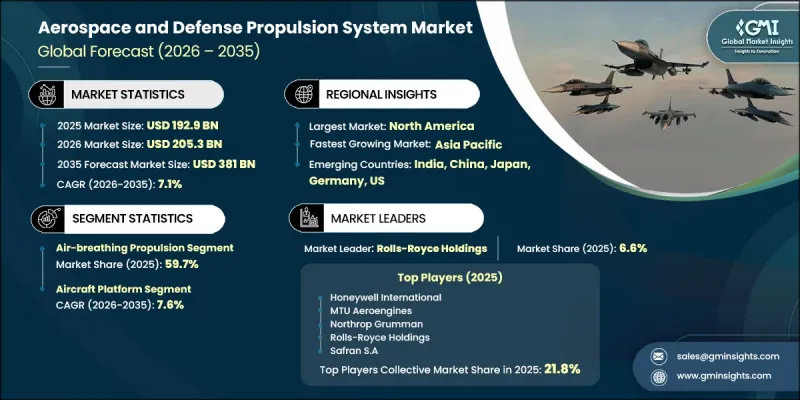
這一成長主要得益於長期的飛機現代化週期、不斷擴大的國防現代化項目以及對下一代推進技術投資的增加。這些因素正在加速整個價值鏈的創新,同時縮短傳統的技術研發週期。向永續航空和高效推進系統的轉型正在進一步重塑整個產業的研發重點。日益加劇的地緣政治緊張局勢和不斷成長的國防費用,尤其是在北約和印太地區,正在推動穩定的採購需求。隨著國防預算的持續成長和民用航空需求在高利用率水準下保持穩定,推進系統正成為性能最佳化和提高燃油效率的關鍵領域。用於電動飛機和無人系統的新型推進技術也備受關注,並促進了航太和國防領域各種應用的成長。
| 市場範圍 | |
|---|---|
| 開始年份 | 2025 |
| 預測期 | 2026-2035 |
| 初始市場規模 | 1929億美元 |
| 預計金額 | 3810億美元 |
| 複合年成長率 | 7.1% |
吸氣式推進系統市佔率高達59.7%,預計2025年市場規模將達到1,151億美元,到2035年將以7.4%的複合年成長率成長。此細分市場包括渦輪扇引擎、渦輪噴射引擎、渦流螺旋槳引擎和渦流引擎,廣泛應用於民用航空、軍用飛機和旋翼飛機平台。其市場主導地位得益於廣泛的應用領域以及在民用和國防航空領域的穩定需求,從而確保了即使個別終端用戶市場出現週期性波動,該細分市場仍能保持長期穩定。
預計到2025年,飛機平台細分市場將佔據38.5%的市場佔有率,市場規模達到742億美元,並預計在2035年之前以7.6%的複合年成長率成長。此細分市場的主要驅動力來自民用和軍用運輸機專案的高需求。持續進行的飛機現代化和替換項目支撐著強勁的生產活動,而全球飛機製造商對燃油效率更高、更先進的飛機推進系統的需求不斷成長,也進一步推動了這一趨勢。
預計到2025年,北美航太和國防推進系統市場規模將達到781億美元,佔全球市場佔有率的40.5%,並有望在2035年之前以7.5%的複合年成長率成長。美國在該地區佔據主導地位,這得益於其雄厚的國防採購預算、大規模的民航機隊以及成熟的航太製造生態系統。該地區持續受益於集中的生產能力以及對民用和國防應用推進系統創新的持續投資。
目錄
第1章:調查方法和範圍
第2章執行摘要
第3章 行業洞察
- 產業生態系分析
- 影響產業的因素
- 促進因素
- 全球國防費用增加和軍用飛機現代化
- 擴大民用航空和飛機更新計劃
- 無人機(UAV)和自主防禦平台的需求日益成長
- 引擎效率和材料方面的持續技術進步
- 產業潛在風險與挑戰
- 高昂的開發、認證和製造成本
- 複雜的供應鏈和關鍵材料的供應情況
- 市場機遇
- 擴大太空發射計畫和可重複使用火箭推進技術
- 增加對下一代軍用飛機和高超音速平台的投資
- 促進因素
- 成長潛力分析
- 監理情勢
- 技術展望
- 最新科技趨勢
- 新興技術
- 價格趨勢分析
- 未來市場趨勢
- 專利分析
- 波特的分析
- PESTLE分析
- 人工智慧和生成式人工智慧對市場的影響
- 價值鏈分析
- 投資與資金籌措分析
- 消費者洞察
第4章 競爭情勢
- 介紹
- 企業市佔率分析:按地區分類
- 北美洲
- 歐洲
- 亞太地區
- 中東和非洲
- 拉丁美洲
- 主要進展
- 重要合作夥伴關係和合作
- 主要併購活動
- 產品創新和新產品發布
- 市場擴大策略
- 競爭定位矩陣
第5章 市場規模及預測:依驅動類型分類,2022-2035年
- 空氣呼吸型
- 渦輪噴射引擎
- 渦流扇
- 渦輪軸
- 渦輪螺旋槳
- 沖壓式噴射引擎和超音速燃燒衝壓引擎
- 非呼吸型
- 固體推進
- 液態推進
- 混合動力推進系統
- 電力推進
第6章 市場規模及預測:依平台分類,2022-2035年
- 飛機
- 窄體飛機
- 寬體飛機
- 支線噴射機
- 公務機
- 飛彈
- 太空船
- 無人駕駛飛行器(UAV)
- 其他
第7章 市場規模及預測:依最終用途分類,2022-2035年
- 商業
- 政府/軍隊
第8章 市場規模及預測:依地區分類,2022-2035年
- 北美洲
- 美國
- 加拿大
- 歐洲
- 德國
- 法國
- 英國
- 荷蘭
- 西班牙
- 義大利
- 亞太地區
- 中國
- 日本
- 韓國
- 印度
- 澳洲
- 中東和非洲
- 沙烏地阿拉伯
- UAE
- 南非
- 拉丁美洲
- 巴西
- 阿根廷
- 墨西哥
第9章:公司簡介
- Aero Engine Corporation of China
- Airbus SE
- Avio SpA
- Bellatrix Aerospace
- CFM International
- Firehawk Aerospace
- General Electric Company
- GKN Aerospace
- Honeywell International
- IHI Corporation
- L3Harris Technologies, Inc.
- Mitsubishi Heavy Industries
- MTU Aeroengines
- Northrop Grumman
- Pratt & Whitney
- Rolls-Royce Holdings
- Safran SA
The Global Aerospace and Defense Propulsion System Market was valued at USD 192.9 billion in 2025 and is estimated to grow at a CAGR of 7.1% to reach USD 381 billion by 2035.
Growth is driven by long-term aircraft replacement cycles, rising defense modernization programs, and increased investment in next-generation propulsion technologies. These factors are accelerating innovation across the value chain while shortening traditional technology development cycles. The shift toward sustainable aviation and high-efficiency propulsion systems is further reshaping R&D priorities across the industry. Expanding geopolitical tensions and rising defense expenditures, particularly across NATO and Indo-Pacific regions, are reinforcing steady procurement demand. As defense budgets continue to increase and commercial aviation demand stabilizes at higher utilization levels, propulsion systems are becoming a critical focus area for performance optimization and fuel efficiency improvements. Emerging propulsion technologies for electric aircraft and unmanned systems are also gaining traction, contributing to diversified growth across multiple aerospace and defense applications.
| Market Scope | |
|---|---|
| Start Year | 2025 |
| Forecast Year | 2026-2035 |
| Start Value | $192.9 Billion |
| Forecast Value | $381 Billion |
| CAGR | 7.1% |
The air-breathing propulsion segment held a 59.7% share, generating USD 115.1 billion in 2025, and is projected to grow at a CAGR of 7.4% through 2035. This segment includes turbofan, turbojet, turboprop, and turboshaft engines, which are widely used across commercial aviation, military aircraft, and rotorcraft platforms. Its dominance is supported by broad application coverage and consistent demand across both civil and defense aviation sectors, ensuring long-term stability despite cyclical fluctuations in individual end-use markets.
The aircraft platform segment held 38.5% share in 2025, generating USD 74.2 billion, and is expected to grow at a CAGR of 7.6% through 2035. This segment is primarily driven by high-volume demand from commercial and military transport aircraft programs. Ongoing fleet modernization and replacement initiatives are sustaining strong production activity, supported by increased demand for fuel-efficient and next-generation aircraft propulsion systems across global aviation manufacturers.
North America Aerospace and Defense Propulsion System Market held 40.5% share, generating USD 78.1 billion in 2025 and is projected to grow at a CAGR of 7.5% through 2035. The United States represents the dominant share within the region, driven by strong defense procurement budgets, a large commercial aviation fleet base, and a well-established aerospace manufacturing ecosystem. The region continues to benefit from concentrated production capabilities and sustained investment in propulsion system innovation across both commercial and defense applications.
Key companies operating in the global aerospace and defense propulsion system market include Safran S.A., Rolls-Royce Holdings, General Electric Company, Pratt & Whitney, Honeywell International, MTU Aero Engines, Mitsubishi Heavy Industries, Airbus SE, Northrop Grumman, L3Harris Technologies Inc., IHI Corporation, GKN Aerospace, Aero Engine Corporation of China, CFM International, Avio S.p.A., and Bellatrix Aerospace. Companies operating in the aerospace and defense propulsion system market are strengthening their market position by investing heavily in next-generation propulsion technologies, including fuel-efficient turbine systems, hybrid-electric propulsion, and advanced thermal management solutions. Manufacturers are focusing on improving engine performance, reducing emissions, and enhancing lifecycle efficiency to meet evolving regulatory and operational requirements. Strategic collaborations between OEMs, defense contractors, and research institutions are accelerating innovation and shortening development timelines for advanced propulsion platforms. Companies are also expanding production capacity and modernizing manufacturing facilities to support rising aircraft and defense procurement demand.
Table of Contents
Chapter 1 Methodology & Scope
- 1.1 Research approach
- 1.2 Quality commitments
- 1.2.1 GMI AI policy & data integrity commitment
- 1.2.1.1 Source consistency protocol
- 1.2.1 GMI AI policy & data integrity commitment
- 1.3 Research trail & confidence scoring
- 1.3.1 Research trail components
- 1.3.2 Scoring components
- 1.4 Data collection
- 1.4.1 Partial list of primary sources
- 1.5 Data mining sources
- 1.5.1 Paid sources
- 1.5.1.1 Sources, by region
- 1.5.1 Paid sources
- 1.6 Base estimates and calculations
- 1.6.1 Base year calculation for any one approach
- 1.7 Market estimates & forecasts parameters
- 1.8 Forecast model
- 1.8.1 Quantified market impact analysis
- 1.8.1.1 Mathematical impact of growth parameters on forecast
- 1.8.1 Quantified market impact analysis
- 1.9 Research transparency addendum
- 1.9.1 Source attribution framework
- 1.9.2 Quality assurance metrics
- 1.9.3 Our commitment to trust
- 1.10 Market definitions
Chapter 2 Executive Summary
- 2.1 Industry synopsis, 2022 - 2035
- 2.1.1 Propulsion Type trends
- 2.1.2 Platform trends
- 2.1.3 End Use trends
- 2.1.4 Regional trends
Chapter 3 Industry Insights
- 3.1 Industry ecosystem analysis
- 3.2 Industry impact forces
- 3.2.1 Growth drivers
- 3.2.1.1 Rising Global Defense Expenditure and Military Aircraft Modernization
- 3.2.1.2 Expansion of Commercial Aviation and Fleet Renewal Programs
- 3.2.1.3 Increasing Demand for Unmanned Aerial Vehicles (UAVs) and Autonomous Defense Platforms
- 3.2.1.4 Continuous Technological Advancements in Engine Efficiency and Materials
- 3.2.2 Industry pitfalls and challenges
- 3.2.2.1 High Development, Certification, and Manufacturing Costs
- 3.2.2.2 Complex Supply Chain and Critical Material Availability
- 3.2.3 Market opportunities
- 3.2.3.1 Expansion of Space Launch Programs and Reusable Rocket Propulsion
- 3.2.3.2 Rising Investments in Next-Generation Military Aviation and Hypersonic Platforms
- 3.2.1 Growth drivers
- 3.3 Growth potential analysis
- 3.4 Regulatory landscape (Driven by primary research)
- 3.4.1 North America
- 3.4.2 Europe
- 3.4.3 Asia Pacific
- 3.4.4 Latin America
- 3.4.5 MEA
- 3.5 Technology landscape
- 3.5.1 Current technological trends
- 3.5.2 Emerging technologies
- 3.6 Pricing trend analysis (Driven by primary research)
- 3.7 Future market trends
- 3.8 Patent analysis
- 3.9 Porter's analysis
- 3.10 PESTEL analysis
- 3.11 Impact of AI and Generative AI on the market (Driven by primary research)
- 3.12 Value chain analysis (Driven by primary research)
- 3.13 Investment & funding analysis (Driven by primary research)
- 3.14 Consumer insights (Driven by primary research)
Chapter 4 Competitive Landscape, 2025
- 4.1 Introduction
- 4.2 Company market share analysis, by region, 2025
- 4.2.1 North America
- 4.2.2 Europe
- 4.2.3 Asia Pacific
- 4.2.4 Middle East & Africa
- 4.2.5 Latin America
- 4.3 Key developments
- 4.3.1 Key partnerships & collaborations
- 4.3.2 Major M&A activities
- 4.3.3 Product innovations & launches
- 4.3.4 Market expansion strategies
- 4.4 Competitive positioning matrix
Chapter 5 Market Size and Forecast, By Propulsion Type, 2022 - 2035 (USD Million)
- 5.1 Key trends
- 5.2 Air-breathing
- 5.2.1 Turbojet
- 5.2.2 Turbofan
- 5.2.3 Turboshaft
- 5.2.4 Turboprop
- 5.2.5 Ramjets & scramjets
- 5.3 Non-air-breathing
- 5.3.1 Solid propulsion
- 5.3.2 Liquid propulsion
- 5.3.3 Hybrid propulsion
- 5.4 Electric propulsion
Chapter 6 Market Size and Forecast, By Platform, 2022 - 2035 (USD Million)
- 6.1 Key trends
- 6.2 Aircraft
- 6.2.1 Narrow-body aircraft
- 6.2.2 Wide-body aircraft
- 6.2.3 Regional jets
- 6.2.4 Business jets
- 6.3 Missiles
- 6.4 Spacecraft
- 6.5 Unmanned Aerial Vehicles (UAVs)
- 6.6 Others
Chapter 7 Market Size and Forecast, By End Use, 2022 - 2035 (USD Million)
- 7.1 Key trends
- 7.2 Commercial
- 7.3 Government & military
Chapter 8 Market Size and Forecast, By Region, 2022 - 2035 (USD Million)
- 8.1 Key trends
- 8.2 North America
- 8.2.1 U.S.
- 8.2.2 Canada
- 8.3 Europe
- 8.3.1 Germany
- 8.3.2 France
- 8.3.3 UK
- 8.3.4 Netherlands
- 8.3.5 Spain
- 8.3.6 Italy
- 8.4 Asia Pacific
- 8.4.1 China
- 8.4.2 Japan
- 8.4.3 South Korea
- 8.4.4 India
- 8.4.5 Australia
- 8.5 Middle East & Africa
- 8.5.1 Saudi Arabia
- 8.5.2 UAE
- 8.5.3 South Africa
- 8.6 Latin America
- 8.6.1 Brazil
- 8.6.2 Argentina
- 8.6.3 Mexico
Chapter 9 Company Profiles
- 9.1 Aero Engine Corporation of China
- 9.2 Airbus SE
- 9.3 Avio S.p.A.
- 9.4 Bellatrix Aerospace
- 9.5 CFM International
- 9.6 Firehawk Aerospace
- 9.7 General Electric Company
- 9.8 GKN Aerospace
- 9.9 Honeywell International
- 9.10 IHI Corporation
- 9.11 L3Harris Technologies, Inc.
- 9.12 Mitsubishi Heavy Industries
- 9.13 MTU Aeroengines
- 9.14 Northrop Grumman
- 9.15 Pratt & Whitney
- 9.16 Rolls-Royce Holdings
- 9.17 Safran S.A.


