


 |
市場調查報告書
商品編碼
2101871
隱形矯正器市場:商業機會、成長要素、產業趨勢分析及2026-2035年預測Clear Aligners Market Opportunity, Growth Drivers, Industry Trend Analysis, and Forecast 2026 - 2035 |
||||||

預計到 2025 年,全球隱形矯正器市場價值將達到 51 億美元,並以 7.3% 的複合年成長率成長,到 2035 年將達到 104 億美元。
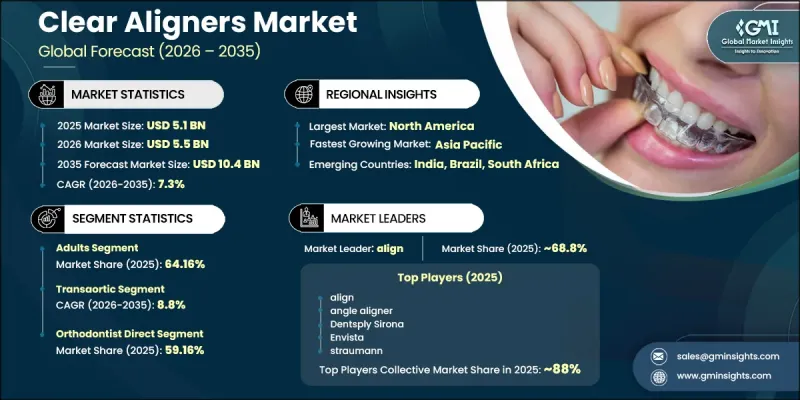
市場擴張的驅動力主要來自成年患者對美觀矯正治療日益成長的需求,以及數位化治療計劃、矯正器製造和遠端監測技術的快速發展。同時,美國FDA的分類標準和歐盟的醫療設備法規(MDR)等法規結構正在塑造市場准入條件,強化了有利於擁有受監管的端到端數位化生態系統的現有製造商的准入壁壘。此外,尋求隱藏式矯正治療的成年患者群體不斷成長,以及數位化工作流程帶來的臨床效率和治療可預測性的提高,也促進了需求的成長。向技術驅動型正畸的轉變正在不斷重塑患者的期望和醫療服務提供者的能力,從而鞏固了全部區域的長期市場前景。
| 市場範圍 | |
|---|---|
| 開始年份 | 2025 |
| 預測期 | 2026-2035 |
| 上市時的市場規模 | 51億美元 |
| 預測金額 | 104億美元 |
| 複合年成長率 | 7.3% |
預計到2025年,成人市場將佔64.16%的市場佔有率,這主要得益於治療普及率的提高、治療時長的延長以及消費者對高品質正畸解決方案日益成長的投資意願。成人患者也是復診需求的重要組成部分。這是因為許多曾經接受過正畸治療的人在日後需要進行牙齒調整,從而形成了一個穩定的複診群體,這將支撐市場的持續成長。
到2025年,正畸醫師直接銷售管道將佔據59.16%的市場佔有率,成為主要通路。此管道的驅動力包括專家主導的治療方案規劃、高價值的臨床病例以及數位化矯正系統在專科診所的深度整合。隨著正畸醫師在複雜的治療流程中繼續發揮核心作用,並受益於支持精準規劃、病例監測和患者互動的先進數位化平台,該管道的主導地位將進一步鞏固。
預計到2025年,北美隱形矯正器市佔率將達到44.77%,並在2035年之前以6.8%的複合年成長率成長。該地區的領先地位得益於其完善的牙科基礎設施、消費者在齒顎矯正服務的高支出以及數位化正畸技術的廣泛應用。美國憑藉其先進的臨床生態系統和數位化矯正治療的高普及率,仍然是該地區需求的主要驅動力。
目錄
第1章:調查方法
第2章執行摘要
第3章 行業洞察
- 產業生態系分析
- 影響產業的因素
- 促進因素
- 咬合不正和牙科疾病的盛行率增加
- 人們對美觀且不顯眼的矯正治療的需求日益成長。
- 技術進步
- 成年人和青少年對此類問題的認知和接受度正在提高。
- 產業潛在風險與挑戰
- 高昂的治療費用阻礙了價格敏感型市場中經濟實惠的治療方案的實現。
- 監管和臨床合規要求
- 與傳統矯正器和其他矯正解決方案的競爭
- 機會
- 電子商務和直接面對消費者的正畸模式的激增。
- 進入新興市場
- SmileDirect退出市場後,價格適中的市場出現了空白。
- 促進因素
- 成長潛力分析
- 監理情勢
- 2025年價格分析
- 技術與創新展望
- 最新科技趨勢
- 新興技術
- 投資情勢
- 未來市場趨勢
- 人工智慧和生成式人工智慧對市場的影響
- 波特的分析
- PESTLE分析
第4章 競爭情勢
- 介紹
- 企業矩陣分析
- 企業市佔率分析
- 世界
- 北美洲
- 歐洲
- 亞太地區
- LAMEA
- 主要市場公司的競爭分析
- DTC、DSO 和獨立零售商:銷售管道的競爭趨勢
- 競爭定位矩陣
- 主要進展
- 併購
- 夥伴關係和聯盟
- 新產品發布
- 業務拓展計劃
第5章 市場估計與預測:依年齡層別分類,2022-2035年
- 成人
- 青少年
第6章 市場估計與預測:依材料分類,2022-2035年
- 聚氨酯
- 塑膠:聚對苯二甲酸乙二醇酯(PETG)
- 其他材料
第7章 市場估價與預測:依通路分類,2022-2035年
- 直接向正畸醫師銷售
- 全科牙醫
- 直接面對消費者
第8章 市場估計與預測:依地區分類,2022-2035年
- 北美洲
- 美國
- 加拿大
- 歐洲
- 德國
- 英國
- 法國
- 西班牙
- 義大利
- 荷蘭
- 亞太地區
- 中國
- 日本
- 印度
- 澳洲
- 韓國
- 拉丁美洲
- 巴西
- 墨西哥
- 阿根廷
- 中東和非洲
- 南非
- 沙烏地阿拉伯
- UAE
第9章:公司簡介
- 3M
- align
- angle aligner
- ASO International, Inc.
- BIOSAFIN
- DenMat
- DentCare
- Dentsply Sirona
- Envista
- GENIOVA
- K LINE
- KRISTELLE Klear Aligners
- makeO
- novoalign
- straumann
The Global Clear Aligners Market was valued at USD 5.1 billion in 2025 and is estimated to grow at a CAGR of 7.3% to reach USD 10.4 billion by 2035.
Market expansion is supported by the growing preference among adult patients for aesthetic orthodontic solutions, combined with rapid advancements in digital treatment planning, aligner manufacturing, and remote monitoring capabilities. At the same time, regulatory frameworks such as the FDA classification standards in the United States and the European Union Medical Device Regulation are shaping market entry conditions and reinforcing barriers that favor established manufacturers with compliant, end-to-end digital ecosystems. Increasing demand is also influenced by a larger adult patient base seeking discreet corrective dental treatments, alongside improvements in clinical efficiency and treatment predictability enabled by digital workflows. The shift toward technology-enabled orthodontics is steadily redefining patient expectations and provider capabilities, strengthening long-term market visibility across developed and emerging regions.
| Market Scope | |
|---|---|
| Start Year | 2025 |
| Forecast Year | 2026-2035 |
| Start Value | $5.1 Billion |
| Forecast Value | $10.4 Billion |
| CAGR | 7.3% |
The adult segment accounted for 64.16% share in 2025, supported by higher treatment adoption rates, longer therapy durations, and greater willingness to invest in premium orthodontic solutions. Adult patients also represent a significant share of retreatment demand, as individuals who previously underwent orthodontic correction often require alignment adjustments later in life, creating a recurring patient base that supports sustained market growth.
The orthodontist direct channel held 59.16% share in 2025, making it the leading distribution pathway. This channel is driven by specialist-led treatment planning, higher-value clinical cases, and strong integration of digital orthodontic systems within professional practices. Orthodontists remain central to complex treatment workflows and benefit from advanced digital platforms that support precision planning, case monitoring, and patient engagement, reinforcing the dominance of this channel.
North America Clear Aligners Market held 44.77% share in 2025, and it is projected to grow at a CAGR of 6.8% through 2035. The region's dominance is supported by strong dental care infrastructure, high consumer spending on orthodontic services, and widespread adoption of digital orthodontic technologies. The United States remains the primary contributor to regional demand due to its advanced clinical ecosystem and high penetration of digitally enabled orthodontic practices.
Major companies operating in the global clear aligners market include Align Technology, Straumann, Dentsply Sirona, Envista, 3M, Angle Aligner, ASO International Inc., BIOSAFEN, DenMat, DentCare, GENIOVA, K LINE, KRISTELLE Klear Aligners, makeO, and novoalign. Companies operating in the clear aligners market are strengthening their competitive position by investing heavily in AI-driven orthodontic planning software and advanced digital scanning technologies that improve treatment precision and efficiency. Market players are expanding fully integrated ecosystems that combine diagnostics, treatment planning, manufacturing, and patient monitoring under unified digital platforms. Strategic partnerships with orthodontists and dental clinics are being prioritized to strengthen clinical adoption and expand referral networks. Companies are also focusing on direct-to-clinic supply models supported by training programs and certification systems that enhance practitioner expertise.
Table of Contents
Chapter 1 Research Methodology
- 1.1 Market definitions and scope
- 1.2 Research approach
- 1.3 Quality commitments
- 1.3.1 GMI AI policy & data integrity commitment
- 1.3.1.1 Source consistency protocol
- 1.3.1 GMI AI policy & data integrity commitment
- 1.4 Research trail & confidence scoring
- 1.4.1 Research trail components
- 1.4.2 Scoring components
- 1.5 Data collection
- 1.5.1 Partial list of primary sources
- 1.6 Data mining sources
- 1.6.1 Paid sources
- 1.6.1.1 Sources, by region
- 1.6.1 Paid sources
- 1.7 Base estimates and calculations
- 1.7.1 Base year calculation
- 1.8 Forecast model
- 1.8.1 Quantified market impact analysis
- 1.8.1.1 Mathematical impact of growth parameters on forecast
- 1.8.1 Quantified market impact analysis
- 1.9 Research transparency addendum
- 1.9.1 Source attribution framework
- 1.9.2 Quality assurance metrics
- 1.9.3 Our commitment to trust
Chapter 2 Executive Summary
- 2.1 Industry 360° synopsis
- 2.2 Key market trends
- 2.2.1 Regional trends
- 2.2.2 Age group trends
- 2.2.3 Material trends
- 2.2.4 Distribution channel trends
- 2.3 CXO perspectives: Strategic imperatives
Chapter 3 Industry Insights
- 3.1 Industry ecosystem analysis
- 3.2 Industry impact forces
- 3.2.1 Growth drivers
- 3.2.1.1 Increasing prevalence of malocclusion and dental disorders.
- 3.2.1.2 Rising demand for aesthetic and discreet orthodontic solutions.
- 3.2.1.3 Advancements in technology
- 3.2.1.4 Expanding awareness and acceptance among adults and teens.
- 3.2.2 Industry pitfalls and challenges
- 3.2.2.1 High treatment costs limiting affordability in price-sensitive markets.
- 3.2.2.2 Regulatory and clinical compliance requirements
- 3.2.2.3 Competition from traditional braces and alternative orthodontic solutions
- 3.2.3 Opportunities
- 3.2.3.1 Surge in e-commerce and direct-to-consumer orthodontic models
- 3.2.3.2 Expansion into emerging markets
- 3.2.3.3 Post-SmileDirect market vacuum in accessible price tiers
- 3.2.1 Growth drivers
- 3.3 Growth potential analysis
- 3.4 Regulatory landscape
- 3.5 Pricing analysis, 2025
- 3.6 Technology and innovation landscape (Driven by Primary Research)
- 3.6.1 Current technological trends
- 3.6.2 Emerging technologies
- 3.7 Investment landscape
- 3.8 Future market trends (Driven by Primary Research)
- 3.9 Impact of AI & Generative AI on the Market (Driven by Primary Research)
- 3.10 Porter's analysis
- 3.11 PESTEL analysis
Chapter 4 Competitive Landscape, 2025
- 4.1 Introduction
- 4.2 Company matrix analysis
- 4.3 Company market share analysis (Driven by Primary Research)
- 4.3.1 Global
- 4.3.2 North America
- 4.3.3 Europe
- 4.3.4 Asia Pacific
- 4.3.5 LAMEA
- 4.4 Competitive analysis of major market players
- 4.5 DTC vs. DSO vs. Private practice - channel competitive dynamics
- 4.6 Competitive positioning matrix
- 4.7 Key developments
- 4.7.1 Mergers & acquisitions
- 4.7.2 Partnerships & collaborations
- 4.7.3 New product launches
- 4.7.4 Expansion plans
Chapter 5 Market Estimates and Forecast, By Age Group, 2022 - 2035 ($ Mn)
- 5.1 Key trends
- 5.2 Adults
- 5.3 Teens
Chapter 6 Market Estimates and Forecast, By Materials, 2022 - 2035 ($ Mn)
- 6.1 Key trends
- 6.2 Polyurethane
- 6.3 Plastic polyethylene terephthalate glycol (PETG)
- 6.4 Other materials
Chapter 7 Market Estimates and Forecast, By Distribution Channel, 2022 - 2035 ($ Mn)
- 7.1 Key trends
- 7.2 Orthodontist direct
- 7.3 General dentist
- 7.4 Direct-to-consumer
Chapter 8 Market Estimates and Forecast, By Region, 2022 - 2035 ($ Mn)
- 8.1 Key trends
- 8.2 North America
- 8.2.1 U.S.
- 8.2.2 Canada
- 8.3 Europe
- 8.3.1 Germany
- 8.3.2 UK
- 8.3.3 France
- 8.3.4 Spain
- 8.3.5 Italy
- 8.3.6 Netherlands
- 8.4 Asia Pacific
- 8.4.1 China
- 8.4.2 Japan
- 8.4.3 India
- 8.4.4 Australia
- 8.4.5 South Korea
- 8.5 Latin America
- 8.5.1 Brazil
- 8.5.2 Mexico
- 8.5.3 Argentina
- 8.6 MEA
- 8.6.1 South Africa
- 8.6.2 Saudi Arabia
- 8.6.3 UAE
Chapter 9 Company Profiles
- 9.1 3M
- 9.2 align
- 9.3 angle aligner
- 9.4 ASO International, Inc.
- 9.5 BIOSAFIN
- 9.6 DenMat
- 9.7 DentCare
- 9.8 Dentsply Sirona
- 9.9 Envista
- 9.10 GENIOVA
- 9.11 K LINE
- 9.12 KRISTELLE Klear Aligners
- 9.13 makeO
- 9.14 novoalign
- 9.15 straumann

 全球隱形矯正器市場(至 2031 年):依材料(聚氨酯、乙二醇改質聚對苯二甲酸乙二醇酯、多層熱塑性塑膠)、年齡層(青少年、成人)及銷售管道(線上、線下)分類
 全球隱形矯正器市場規模、佔有率、趨勢和成長分析報告(2026-2034)
 隱形矯正器市場-2026-2032年全球市場預測
 隱形矯正器市場預測至2034年-按產品類型、材料類型、牙醫類型、年齡、治療時間、最終使用者和地區分類的全球分析
 隱形矯正器市場規模、佔有率和成長分析:按年齡、牙醫類型、類型、材料、分銷管道、產品類型和地區分類-2026-2033年產業預測
 第二階段隱形矯正器市場:依年齡層、咬合不正類型、終端用戶管道、治療複雜程度、分銷方式、材料類型、治療時間和地區分類
 透明矯正器材料 - 2026-2032 年全球市場佔有率和排名、總銷售額和需求預測。
 2026年全球隱形矯正器市場報告2026年全球隱形矯正器遠端監控市場報告全球牙齒矯正器市場規模、佔有率、趨勢和成長分析報告(2026-2034年)